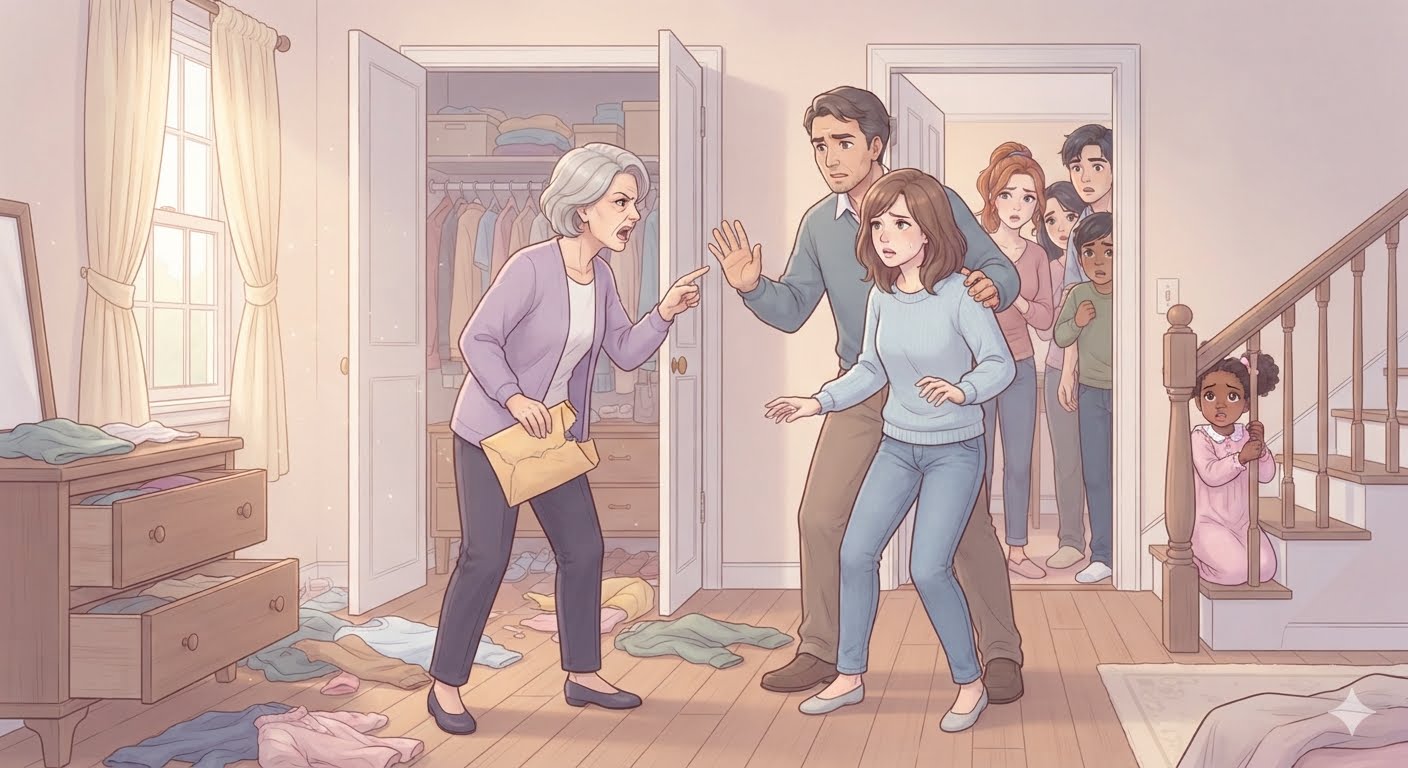
- “If your daughter wakes up the whole house again tonight, you pack up and leave with her, Madison,” my mother-in-law, Shelby, announced in front of the entire family.
- My five-year-old daughter, Natasha, clung to my waist, her eyes swollen and red from crying. We lived in a three-story house in the Maplewood neighborhood of Columbus. My parents-in-law occupied the ground floor; my husband Chandler, Natasha, and I lived on the second; and the third floor was packed with old furniture and storage boxes.
- During the day, Natasha was cheerful, polite, and talkative. But the moment the lights went out, she transformed. She would scream, tremble, and beg us not to leave her alone in the dark.
- “We are doing everything we can, Shelby, but she is terrified of the dark,” I tried to explain, holding my daughter tight.
- “I do not care about your excuses—people need to sleep for work,” Shelby snapped back, her voice echoing down the hall.
- Chandler and I had gone weeks without proper sleep. I had read that we needed to teach her independence, so I tried to hold my ground. Exhausted from his job as an engineer, Chandler usually ended up carrying her down the hallway until he fell asleep sitting upright on the couch. Every night ended in an argument between us.
- “You are spoiling her by picking her up every single time she whimpers,” Chandler grumbled one midnight, rubbing his bloodshot eyes.
- “She is terrified, Chandler, and ignoring her only makes her scream louder,” I whispered back, tears of frustration stinging my eyes.
- The only person who never complained was Walter, my father-in-law. He was sixty-nine years old, with calloused hands and a patience that seemed bottomless. He fixed Natasha’s broken toys and picked her up from kindergarten on his electric bicycle. When she asked why leaves fell from the trees, he would tell her softly that even trees needed to rest.
- Shelby was a contradiction. She could scold Natasha for dropping crumbs, then secretly hide a sweet pastry for her afternoon snack five minutes later. She claimed her knees prevented her from carrying Natasha, yet she left my daughter’s uniform neatly ironed before dawn every day. I noticed those quiet gestures, but her sharp words always carried more weight.
- Walter, on the other hand, noticed what everyone else missed: whenever an argument broke out, Natasha would squeeze an adult’s arm so hard her knuckles turned white.
- “Why are you holding on so tight, little one?” Walter asked her gently one afternoon, handing her a glass of juice.
- “Because if I let go, everybody starts shouting and running away,” Natasha whispered, staring down at her shoes.
- The tension worsened when Kenneth, Chandler’s younger brother, arrived with his wife Naomi and their daughter Paisley. They had closed their small electrical appliance business and sold their apartment to pay off debts. They claimed they would only stay for three months, but they arrived with truckloads of belongings: mattresses, towering boxes, a washing machine, and even a refrigerator.
- Shelby immediately began counting every lit lightbulb and every glass of milk poured. She demanded that Naomi contribute toward groceries, electricity, and water, constantly reminding me that I had been living under her roof for years.
- Yet when her daughter Stephanie showed up crying because her husband Brandon supposedly needed money for a construction contract, my mother-in-law opened her dresser drawer without asking a single question.
- “Here is the money you asked for, sweetheart,” Shelby said softly, handing over a thick stack of bills.
- During dinner one night, Naomi called out the double standard. “How come Stephanie gets cash without a word while you audit every slice of bread we eat?” she asked, setting her fork down with a loud clatter.
- Shelby slammed her hand on the table, making the glasses rattle. “Blood is blood, and a daughter will always be a daughter!” she shouted. “Daughters-in-law, no matter how good they seem, are always outsiders.”
- My face burned with humiliation. Chandler looked down at his plate, remaining completely silent. Kenneth pleaded for calm, while Walter remarked quietly that while money could be divided, dignity could not.
- The next morning, a piercing scream sent us running to Shelby’s room. The wardrobe was wide open, clothes were scattered across the floor, and she was clutching an empty paper envelope.
- “One hundred and eighty thousand dollars is gone!” she shrieked, her hands trembling wildly. She pointed directly at Naomi. “You came in yesterday to get Paisley’s medicine, so empty your bags right now!”
- “I never touched your wardrobe or your money,” Naomi said, turning deathly pale.
- Kenneth stepped protectively in front of his wife, but Shelby had already dumped Naomi’s clothes onto the floor. As Natasha watched wide-eyed from the staircase, my mother-in-law announced that she was calling the police on her own daughter-in-law.
- Part 2: The Cracks Deepen
- Naomi emptied every bag, every drawer, and even her daughter’s backpack onto the carpet. Not a single dollar was found anywhere. Even so, Shelby insisted that no one else knew about her secret hiding place.
- “Just give everybody a moment to breathe,” Walter said, gently asking everyone to leave the room.
- Ten minutes later, he returned carrying a bank passbook and the envelope completely intact. He had found them tucked inside the blood pressure medication box on the bedside table.
- “You put them there yourself when you took your pills last night,” Walter said quietly, setting the envelope on the nightstand.
- My mother-in-law fell silent and looked away, refusing to apologize. Naomi gathered her clothes with trembling hands and announced she would leave the moment Kenneth found a place for them to stay. That humiliation broke something deep within the family. Chandler kept claiming he stayed silent to keep the peace, but I realized his silence always protected the aggressor, never the victim.
- “I stay quiet so the house does not explode,” Chandler insisted while we folded laundry in our room.
- “Your silence just lets your mother crush everyone else without any consequences,” I told him directly.
- A few days later, Stephanie returned with Brandon. He asked for three hundred thousand dollars to release materials for a major construction job. Walter asked for a formal contract, the client’s name, and a clear payment schedule. Offended by the questioning, Brandon walked out, claiming he was being treated like a common criminal.
- That night, Stephanie confessed to me in the kitchen that she had signed blank documents because her husband swore they were standard bank requirements. She had also sent him photos of her parents’ house deeds. I checked their online transactions and found transfers to unknown accounts, late-night withdrawals, and large payments made to a local gambling house.
- Walter was not surprised by the discovery. He had been gathering evidence for weeks: copies of text messages and license plate numbers of suspicious cars lingering near the house. Brandon had no real contract; he owed money to loan sharks and intended to use Stephanie’s signature and her parents’ property as collateral.
- “You are going to lose this house if you keep letting him trick you,” Walter warned Stephanie in front of the entire family.
- When we confronted Brandon the next evening, he knocked over a dining chair, threatened Stephanie, and swore we would all end up on the street. For the first time, Chandler stepped between them to push Brandon back. Walter called an attorney immediately and instructed us to preserve every single piece of evidence.
- As the confrontation ended, I saw Walter place a heavy hand over his chest. I asked if he was alright, but he dismissed it as simple fatigue. Shelby reminded him that he had been dodging a checkup at the Central Health Clinic for months. He quickly changed the subject, insisting we protect Stephanie first. At the time, I brushed it off as stubbornness, having no idea he was putting everyone’s life in order because he suspected his own time was running short.
- An uncanny silence settled over the house. That night, Natasha started crying again in her bed, sobbing that the adults were screaming because she was a bad girl. I held her tight, but my body was completely depleted from weeks of stress.
- Walter appeared at the bedroom door, his face pale in the dim hallway light. “Let her sleep with me just for tonight,” he whispered softly.
- “Are you sure you have the energy for this, Dad?” I asked.
- “I have plenty of time for my favorite granddaughter,” he smiled gently.
- Natasha accepted immediately and curled up beside him in his bed, using his arm as a pillow. Before closing the door, I heard her ask him a quiet question.
- “Grandpa, when you grow up, do you stop needing anyone?” Natasha asked in a small voice.
- “Grown-ups need to be loved, too,” Walter replied gently.
- The next morning, Natasha did not cry or run to find me. She was eerily quiet when I opened the door. My daughter was still holding onto her grandfather’s arm. Walter had a family photo resting on his chest and a small brass key clutched tightly in his right hand.
- “Dad, it is time to wake up,” I whispered, stepping closer to the bed.
- He did not respond or move at all.
- Then Natasha opened her eyes and said something that took my breath away: “Mommy, Grandpa was cold all night, but he asked me not to be scared.”
- Part 3: The Secret Unlocked
- Chandler called an ambulance while I pulled Natasha from the bed. Confused, she resisted, convinced her grandfather was merely sleeping. Shelby rushed in barefoot, pushed the paramedics aside, and began shaking her husband by his shoulders.
- “Walter, get up right now!” Shelby sobbed frantically. “You have a cardiologist appointment on Thursday, so do not do this to me!”
- The doctor confirmed what none of us wanted to hear: Walter had suffered a fatal cardiac event during the night. He had suffered from hidden coronary disease for years and had repeatedly postponed comprehensive testing. He had likely woken up for a few brief minutes, made Natasha comfortable, held the family photo, and was then unable to call for help.
- My daughter had not spoken to him after he passed. The phrase she kept repeating was the last thing he had told her before falling asleep: to not be afraid, and that his arm would always be there. Her young mind had held onto those words throughout the long night.
- During the wake, the house filled with relatives, floral wreaths, and hushed murmurs. Shelby did not shed a single tear in front of anyone. She sat rigid beside the casket, micromanaging the floral arrangements as if controlling tiny details could keep her world from falling apart. But late that night, I found her clutching Walter’s woolen shirt in the dark kitchen.
- “I thought I had time to treat him better,” she wept softly to me. “He was always just there, and you assume people who never complain never get tired.”
- “He loved you despite everything, Shelby,” I said, setting a warm cup of tea beside her.
- After the funeral, Natasha searched for her grandfather in every room. She left a glass of water by his armchair and kept a tiny screw from a toy car he had fixed under her pillow. Whenever someone said he was gone, she would ask when he was coming back. We had to explain death to her in gentle, honest terms without resorting to confusing tales about long trips or distant skies. She cried quietly, then asked if it was her fault for falling asleep. I held her until she understood that her grandfather had chosen to keep her company, and that she had given him a final night free of loneliness.
- Three days later, we remembered the brass key. It opened an old metal filing cabinet in the back tool shed. Chandler set the locked file box on the dining table, and the entire family gathered around: Shelby, Kenneth, Naomi, Stephanie, Natasha, Paisley, and myself.
- Inside were no jewels or gold. Instead, we found a notarized will, bank statements, medical records, copies of the evidence against Brandon, and five labeled envelopes.
- The will stipulated that Walter’s half-share of the house would remain in Shelby’s lifetime usufruct—meaning no one could sell, mortgage, or force her out of the home for as long as she lived. He had also set aside funds for his medications, his funeral expenses, and a small savings account for each grandchild.
- Shelby broke down crying before we even finished reading the document. “I was terrified that once he was gone, you all would throw me out,” she confessed between heavy sobs. “That is why I hid money, and that is why I counted every utility bill. My mother was sick for seven years, and my siblings sold her house to pay for it. They ended up hating each other, so I swore I would never depend on anyone.”
- The first letter was for Chandler:
-
Son: Standing in the middle does not mean you are being fair. When you watch your wife get accused and stay quiet just to keep your mother from getting angry, you are not keeping the peace. You are abandoning the person you promised to protect. A family is not kept together by forcing the most patient person to endure everything.
- Chandler buried his face in his hands. In front of everyone, he begged for my forgiveness, but I did not let him resolve years of silence with a single sentence.
- “I do not need you to cry right now,” I told him firmly. “I need you to act differently when defending me becomes uncomfortable again.”
- “I promise I will change, Madison, whatever it takes,” Chandler replied, wiping his eyes.
- He kept his word. From that day on, he started therapy, took over the nighttime routines with Natasha, and stood up to his mother whenever she crossed boundaries. It was not a miraculous overnight transformation. There were arguments, setbacks, and days I considered leaving. But for the first time, he stopped calling my silent endurance peace.
- The second letter was for Kenneth:
-
Failing in a business does not make you less of a man. Lying to your wife to preserve an image can cost you everything. Pay your mother back the money I lent you, even if it takes years. Let every clean dollar remind you of the man you want to be.
- Kenneth confessed then that Walter had given him eighty thousand dollars to start a small workshop—a detail he had hidden from Naomi out of shame. She was not angry about the loan, but rather about being treated like a stranger while bearing the brunt of the consequences.
- “I do not want a husband who protects me from the truth,” Naomi told Kenneth in front of everyone. “I want one who lets me face it alongside him.”
- Kenneth laid out all his accounts, invoices, and debts. He opened an appliance repair shop near the downtown market. He did not get rich, but every month he deposited a fixed amount to Shelby and handed her the receipt. Naomi handled the books, and for the first time, they discussed real numbers instead of keeping secrets.
- The third letter was for Stephanie:
-
Daughter: Loving your husband does not mean surrendering your signature, your dignity, and your child’s future. Do not teach your son that enduring threats is the only way to keep a home. A house where you live in fear is already broken, even if the walls are still standing.
- Stephanie collapsed into tears. She admitted Brandon had been verbally abusing her for months, taking away her phone, and threatening to take their son. She had begged her mother for money four separate times. In total, Shelby had handed over nearly one hundred and twenty thousand dollars, convinced she was saving her daughter’s marriage.
- Working with Walter’s lawyer, we filed police reports for forgery, extortion, fraud, and domestic violence. The signed blank pages, text messages, bank transfers, and security footage proved Brandon had fabricated the loan story and gambled the money away. Two loan sharks who had been threatening to vandalize the house were also exposed.
- Brandon tried to claim Stephanie had signed the documents voluntarily, but a photo taken before the paperwork was filled out showed the blank spaces clearly. Forensic analysis confirmed the amounts were added later. Months later, he was indicted for fraud and illegal gambling, while the loan sharks were placed under criminal investigation. Stephanie secured protective orders, temporary custody of her son, and initiated divorce proceedings.
- The legal process forced all of us to confront an uncomfortable truth: we had all seen the warning signs and chosen to label them as mere marital issues. Stephanie used makeup to cover bruises; Brandon controlled her finances and mocked her continuously. Shelby urged patience because she feared the public stigma of a divorce. I had my suspicions, but stayed quiet to avoid being intrusive. When Stephanie testified at the prosecutor’s office, none of us could keep pretending.
- We learned that helping someone is not about throwing money at a crisis; sometimes, helping means believing the victim, documenting the abuse, and standing by them even when the truth brings embarrassment to the family.
- The fourth letter was for Naomi and me:
-
Sometimes daughters-in-law enter a family believing they must earn every plate of food. That is not true. No one should have to pass a daily exam just to prove they deserve respect. Be transparent about money, but never use it to measure affection. Do not let other people’s fears turn you into rivals.
- Naomi and I exchanged glances and lowered our heads. We had judged, compared, and hurt each other because we were both terrified of being valued less. We did not become best friends overnight, but we learned a far harder lesson: to ask before assuming, and to stand up for ourselves without destroying each other.
- The final envelope read: For Shelby.
- My mother-in-law tried to read it, but her hands shook uncontrollably. She handed the paper to me to read aloud.
-
My old friend: I know you are afraid of pain, poverty, and ending up alone. I also know your tongue turns sharp when you need love the most. Do not push our children away before they have the chance to care for you. You have the right to get sick, to ask for help, and to cry.
I made mistakes, too, because I believed a man loved his family by carrying everything in silence. By hiding my illness, I robbed you all of the chance to walk beside me. My share of the house is yours so you will never have to beg for a place to live. Buy your medications, see the doctor, and when you miss me, do not scold—cry. If we cannot lean on each other, then what is a home for?
- Shelby clutched the letter to her chest and wept like a child. Natasha walked over, wrapped her arms around her grandmother’s knees, and whispered softly, “Grandma, do not be scared. Grown-ups need to be loved, too.”
- Hearing those words finally broke her defenses. For the first time, she apologized without making excuses—first to Naomi for calling her a thief, then to me for calling me an outsider, and finally to Stephanie for teaching her that suffering abuse was a test of love.
- The letters did not fix everything instantly. Grief made Shelby irritable on certain days. She would still occasionally count eggs in the fridge or complain about an open light switch. But now, she spoke up when her chest hurt, let us take her to the doctor, and sat on the balcony with her husband’s favorite mug to cry openly whenever she missed him.
- Natasha stopped insisting on having someone sleep next to her. We covered her pillow with a clean shirt that belonged to Walter. Every night, she would ask if her grandfather could see her. I would tell her I did not know for sure, but that all the love he gave her remained inside her heart.
- Eight months later, Stephanie was working at a building supplies store near her son’s school. Kenneth was running his repair shop successfully. Naomi and I managed the household budget together in a shared ledger to ensure secrets could never poison the house again. Chandler learned to speak up, even when doing so made his mother uncomfortable.
- One afternoon, Natasha brought her teddy bear out to the quiet balcony.
- “Mommy, where is my warm pillow?” Natasha asked, looking around.
- I looked over at Walter’s empty armchair, his old teapot, and the tools no one had the heart to move.
- “He is not here anymore,” I told her gently, “but the warmth he gave you stays with you forever.”
- I realized then that my father-in-law had not just offered his arm as a pillow on that final night. His entire life had been spent holding up a frightened wife, children lost between pride and silence, and daughters-in-law fighting to be recognized as family.
- The tragedy was not just that Walter died, but that we had to lose him before we were finally ready to listen to everything he had tried to teach us without ever raising his voice. Since then, no one in our house ever says that keeping quiet keeps the peace, or that shared blood gives anyone the right to humiliate another.
- Because family is not proven by inheritance, last names, or who arrived first; it is proven by who dares to tell the truth, ask for forgiveness, and care for one another before all that remains is a photograph on the table.
Part 1: The Gathering Storm