Part 1: Thirteen Years of Yes
The message arrived at 4:47 on a Thursday afternoon, just as my old electric kettle began rattling against the kitchen counter. Rain clouds pressed against the windows, and the room smelled of lemon dish soap, damp towels, and the cabinets Royce had promised to repaint before he died.
My daughter’s name appeared on my phone.
Caroline.
I dried my hands and opened the message.
“You’re choosing yourself over your own grandchildren, and that’s the hill you want to die on. Fine.”
The kettle clicked off behind me, but I did not move. Something inside me became perfectly still, as though my body had finally grown too tired to absorb one more accusation.
I was sixty-eight years old. I had spent forty-one years sorting mail, walking delivery routes through rain, snow, and summer heat, then coming home to raise Caroline on overtime pay, inexpensive meals, and whatever energy remained after a double shift.
All I had done was refuse to babysit for one holiday weekend.
Caroline and her husband, Wade, had planned a three-day vacation with another couple from his office. They expected me to care for four-year-old Hudson and eight-month-old May, who still woke several times each night.
I loved those children more than I could explain. I would have crossed fire for them, but my cataract surgery was scheduled for Tuesday, and my preoperative appointment was early Saturday morning.
The clinic had given me clear instructions: rest before surgery, avoid strain, do not lift anything heavy, and do not spend sleepless nights carrying a baby while chasing a preschooler through the house.
I had explained all of that gently.
“Honey, could you ask Wade’s mother, or move the trip back a week?”
Caroline had not asked whether I was frightened about the surgery. She had not asked who would drive me home or stay with me afterward.
She sent the message instead.
I poured the water into my cup, but it had already cooled. I stood beside the sink drinking weak tea because sitting alone at the kitchen table somehow felt worse.
An hour later, my phone buzzed again. For one foolish moment, I believed Caroline might be apologizing.
The message came from Wade.
There were no words, only a screenshot showing that the eight hundred dollars I had transferred two weeks earlier for Hudson’s preschool fees had been reversed.
The gesture was meant to punish me. They wanted me to see that if I would not give them the help they demanded, they would reject the help I had already offered.
That was when I understood Caroline’s message had not been written during one emotional moment. She and Wade had discussed it, returned the money, and chosen silence together.
They probably called it setting boundaries.
The following morning, I drove to their house anyway. Their SUV and Wade’s pickup were both in the driveway, while Hudson’s blue tricycle lay overturned in the wet grass.
I rang the doorbell.
Inside, a children’s cartoon played loudly. I heard Hudson speaking to himself in the sweet singsong voice he used while building imaginary roads across the living-room carpet.
Then Caroline said something quietly.
Hudson stopped talking.
They knew I was outside.
I rang again, but no one answered. I remained on the porch far longer than my dignity should have allowed, my cardigan growing damp at the cuffs while I stared at the closed door.
Eventually, I returned to my car. I drove to the grocery store, bought milk I did not need and frozen peas I already had, then sat in the parking lot for forty minutes before I could bring myself to start the engine.
When I arrived home, a brown envelope had been placed against my front door. Caroline’s handwriting appeared across the front.
Inside was a typed letter.
That detail hurt more than shouting would have. Caroline had not written a few angry sentences and regretted them later; she and Wade had sat down, arranged their resentment into paragraphs, printed it, and signed it together.
The letter said they had been reflecting on our “family dynamic.” It accused me of creating a “transactional relationship with money” and claimed they needed space to establish “healthier patterns” within their “family unit.”
Caroline did not speak that way.
Caroline usually said, “We’ll manage, Mom.”
Wade had written the letter, or someone had taught him the language, but my daughter’s signature remained beneath his.
Caroline and Wade.
Two names written together like a closed account.
I read the letter in the hallway with the cold door pressing against my shoulder. Then I sat on the wooden bench Royce had built years earlier and began to laugh.
Nothing was funny. My body simply could not find another sound.
When the laughter ended, the refrigerator hummed from the kitchen and one drop of water fell slowly into the sink. The entire house seemed to be counting the seconds of my silence.
I went into the spare room and opened the closet. On the highest shelf sat a green accordion file with two letters written across the front in Royce’s careful handwriting.
C&W.
Caroline and Wade.
Royce had created the file after we cosigned Caroline’s first car loan and discovered months later that she had allowed the payments to fall into collections without telling us.
“We are not keeping this to punish her, Margaret,” he had said. “We are keeping it so we remember the truth when love starts editing our memory.”
I carried the file to the kitchen table and opened it.
Inside were thirteen years of receipts, bank statements, medical bills, transfer confirmations, preschool screenshots, and copies of cashier’s checks. There was money for their house deposit, repairs to Wade’s truck, Caroline’s treatment, an unexpected funeral, overdue utilities, groceries, and emergencies that had always arrived with promises that this would be the last time.
Help with the house.
Help with the children.
Help with the car.
Help when Wade changed jobs.
Help whenever “We’ll manage” quietly became “Mom, we need you.”
I added the amounts on the back of an old grocery receipt.
Seventy-three thousand four hundred and twenty dollars.
That total did not include gasoline, birthday money, school pickups, last-minute babysitting, midnight bottles, or the many bags of groceries I had left on their porch without expecting repayment.
I had been dependable for so long that they no longer recognized my help as a choice. It had become something they believed operated automatically, like electricity or water, available whenever they reached for it.
For one angry minute, I wanted to call Caroline and read every number aloud.
I wanted to ask how she could accuse me of making love transactional when she had accepted every transaction without complaint. I wanted to say, “Your father knew this day might come.”
But I did not call.
I closed the file and placed both hands on top of it.
Then I found the telephone number for Royce’s longtime attorney, Otis Beaman. His office still occupied the second floor above the dry cleaner downtown, and he answered with the same gravelly voice I remembered from the day we prepared our wills.
“Otis,” I said, surprised by how steady I sounded. “It’s Margaret. I need to discuss my will, my power of attorney, and a few other matters.”
He did not ask what had happened. Perhaps men who spend their lives dealing with families learn to recognize the sound of someone who has finally reached the end of an old arrangement.
“Tuesday at two?” he asked.
I looked at the green accordion file and the typed letter beside it.
“I’ll be there.”
That Tuesday, I carried thirteen years of receipts, statements, screenshots, and promises into Otis’s office. My cataract surgery was approaching, my daughter was refusing to speak to me, and I still did not know that someone had already used my name to create a debt large enough to change everything.
Otis looked at my face, pulled a yellow legal pad toward him, and uncapped his pen.
“Start with the money.”
So I did.
Part 2: The Debt Waiting at My Door
Otis listened without interrupting while I described every loan, transfer, emergency payment, and promise Caroline and Wade had made over the past thirteen years. He wrote each amount on his yellow legal pad, occasionally pausing to compare a bank statement with one of the receipts Royce had carefully saved.
I showed him the eight-hundred-dollar transfer Wade had reversed and the typed letter accusing me of creating an unhealthy financial dynamic. Otis read the letter twice before placing it beside the green accordion file.
“Did Caroline write this?” he asked.
“She signed it.”
“That wasn’t my question.”
I looked at the stiff language about boundaries and their “family unit.”
“No,” I said. “It sounds like Wade.”
Otis nodded as though that confirmed something he already suspected. He asked whether Caroline had access to any of my accounts, whether Wade possessed copies of my identification, and whether I had ever signed financial documents for them without reading every page.
Years earlier, Caroline had been listed as an authorized contact on one savings account in case Royce and I experienced an emergency. I had also given Wade copies of my driver’s license, Social Security information, and tax records when Royce and I helped them secure their mortgage.
Otis stopped writing.
“Do they still have those copies?”
“I assumed the bank or mortgage company kept them.”
“That isn’t what I asked.”
A chill moved through me.
“I don’t know.”
Otis advised me to remove Caroline from every account immediately. He prepared documents revoking her financial authority, changed the executor of my will, and replaced the power of attorney that had named her as the person responsible for my affairs if I became incapacitated.
He did not tell me to disinherit my daughter in anger. Instead, he asked what I wanted my money to accomplish after I was gone.
I thought of Hudson and May. I wanted them protected, but I no longer trusted their parents to control whatever I left behind.
Otis suggested creating a trust that Caroline and Wade could not access directly. Funds could be used for the children’s education and medical needs, but every withdrawal would require approval from an independent trustee.
“That sounds severe,” I said.
“It sounds careful.”
I looked at Royce’s handwriting on the green file.
Love starts editing our memory.
“Do it.”
Otis also advised me to contact the credit bureaus and place a security freeze on my identity. I promised I would handle it after surgery, believing a few days would make no difference.
That decision nearly cost me nineteen thousand four hundred dollars.
My cataract surgery took place the following Tuesday. Caroline did not call before the procedure, and she did not ask whether I had anyone to drive me home.
A woman from church named Bernice collected me from the clinic. She prepared soup, helped tape the clear shield over my eye, and stayed until I assured her I could manage alone.
The surgery went well, but the first night was uncomfortable. One eye remained blurry while the other was covered, and every shadow in the house seemed misplaced.
I kept expecting my phone to ring.
It never did.
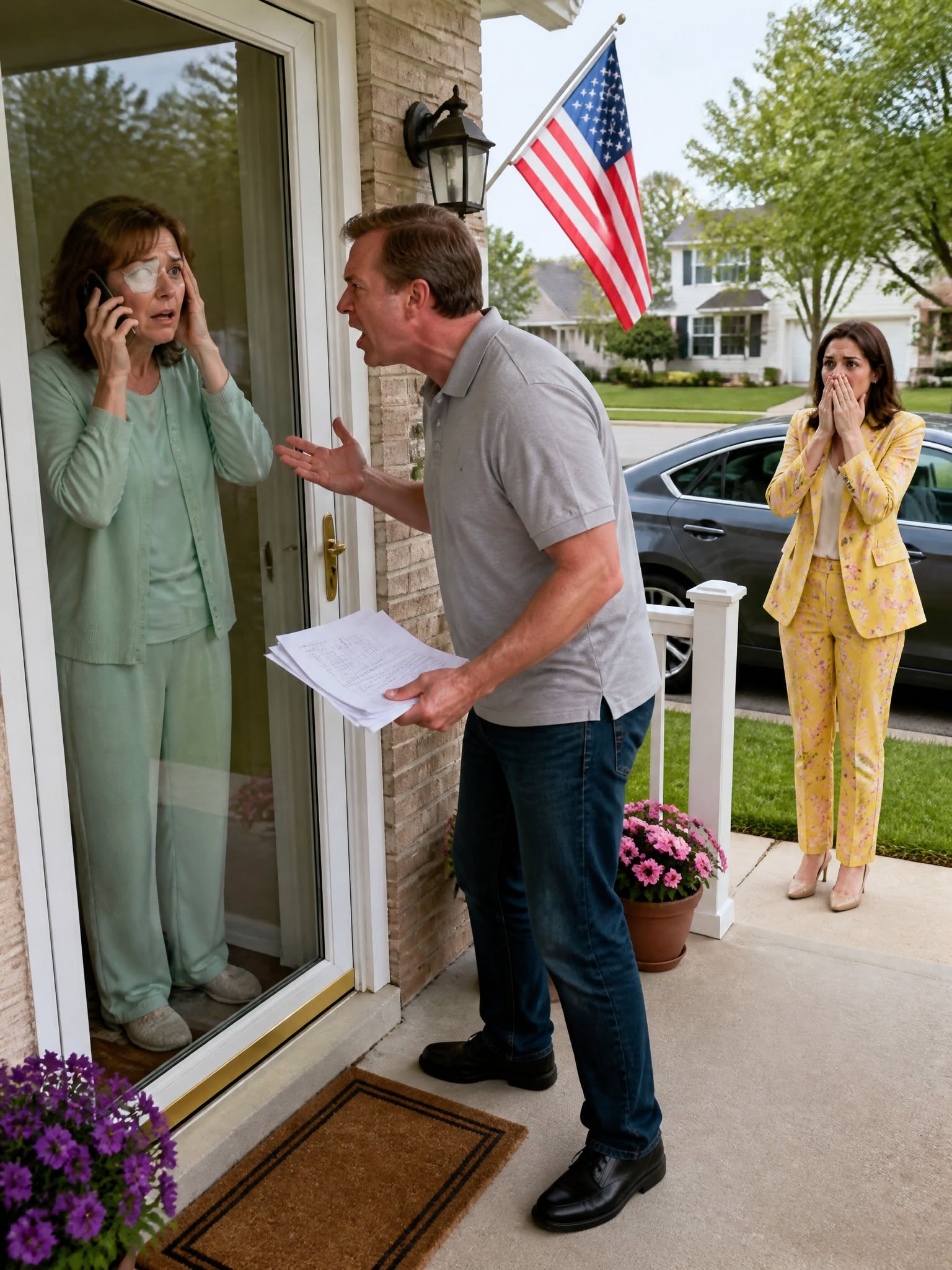
A week later, I was standing in the hallway at seven in the morning when the bank called. The plastic shield was still taped over one eye, and the floorboards tilted slightly whenever I moved too quickly.
The woman on the phone confirmed my name and asked whether I had recently guaranteed a business line of credit.
“No.”
There was a pause.
“Mrs. Holloway, the outstanding balance is nineteen thousand four hundred dollars.”
I tightened my hand around the phone.
“What business?”
She gave me the name of a small investment company registered to Wade. The account listed me as a guarantor and included personal information that only someone close to me should have possessed.
Before I could ask another question, someone struck my front door hard enough to rattle the glass.
Once.
Twice.
Then Wade shouted from the porch.
“Margaret, open the door.”
I looked at the green accordion file resting on the hall table. A week earlier, it had contained thirteen years of rescues I had chosen to provide.
Now the bank was telling me someone had created another rescue without asking.
Wade pounded again.
“Margaret, please. We need to talk.”
I kept the bank employee on the line and walked carefully toward the door. The floor felt cold beneath my feet, and the damp morning air entered through the edges of the old frame.
When I opened it, Wade stood in the rain with water dripping from his hair and collar. He looked as though he had driven there without taking time to dress properly, which was unusual for a man who normally treated appearance like evidence of innocence.
“Wade,” I said. “It’s early.”
“I know, but this is important.” His eyes moved toward the phone in my hand. “Did the bank call?”
“They mentioned a debt of nineteen thousand four hundred dollars. Would you like to explain why it is in my name?”
He rubbed one hand over his wet hair.
“There’s been a misunderstanding.”
“Then explain it.”
“It was for a business opportunity. The numbers looked good, but one of the partners pulled out and everything collapsed.”
“That explains why your business owes money. It does not explain why I owe it.”
Wade looked past me into the hallway as though hoping Caroline might somehow appear and finish the conversation for him.
“We thought the financing had been arranged.”
“Who is we?”
“Caroline and me.”
The answer cut more deeply than I expected.
“Did Caroline know my name was on it?”
“She thought you had agreed to help.”
“I never discussed your business with either of you.”
“We were going to repay it before you noticed.”
I heard the bank employee shift quietly on the line. Wade had either forgotten she was listening or had not realized I had placed the call on speaker.
“You were going to fix a debt I did not know existed before I discovered you had created it?”
His mouth tightened.
“You make it sound criminal.”
“What would you call using someone’s identity without permission?”
He lowered his voice.
“Margaret, please. If the bank freezes the account, we could lose everything.”
“Whose signature is on the guarantee?”
His hesitation lasted only a second, but it was long enough.
“Caroline handled the paperwork.”
The front door felt suddenly too heavy beneath my hand.
“My daughter signed my name?”
“I didn’t say that.”
“You said she handled it.”
“She had copies of your information from the mortgage. We believed you would understand because the business was supposed to help the children.”
Hudson and May. Whenever Wade needed money, responsibility, or forgiveness, he placed those children between himself and the consequences.
“You returned the eight hundred dollars I sent for Hudson’s school,” I said. “Then you borrowed nineteen thousand four hundred dollars under my name?”
“That transfer was Caroline’s decision.”
“And the letter?”
Wade glanced toward the driveway.
“We were upset.”
“The letter said you wanted to separate our financial relationship.”
“We needed space.”
“Yet while asking for space, you were using my credit.”
His face reddened.
“This is not the time to argue over wording. I need you to tell the bank the guarantee was legitimate. Once the business recovers, we’ll repay everything.”
The woman from the bank finally spoke through the phone.
“Mrs. Holloway, do not make any statements affirming the debt until our fraud department reviews the account.”
Wade froze.
His eyes dropped to the phone.
“You put me on speaker?”
“The call was already in progress when you arrived.”
He stepped closer to the threshold.
“Margaret, hang up.”
“No.”
His voice sharpened.
“You don’t understand what you’re doing.”
The sentence sounded painfully familiar. Caroline had written that I was choosing myself over my grandchildren, and now Wade was suggesting that protecting my identity would somehow harm the family.
“I understand that someone used my information without permission.”
“We are your family.”
“Family asks.”
He stared at me, perhaps expecting me to soften. For thirteen years, panic in his voice had been enough to open my checkbook, my spare room, my calendar, or my front door.
That morning, it opened nothing.
Wade’s shoulders dropped.
“I don’t know how to fix this without your help.”
I looked past him toward the car. Hudson’s face appeared briefly through the back window, while May’s faint crying carried through the rain.
“Where is Caroline?”
“At home.”
“You brought the children here?”
“I couldn’t leave them alone.”
“You could have stayed home with them instead of coming here to pressure a woman recovering from surgery.”
He lowered his eyes.
“What do you want us to do?”
“Start by telling the truth.”
“We are telling you the truth.”
“No. You are telling me the smallest part you think will make me rescue you.”
The green accordion file remained visible behind me on the hall table. Wade followed my gaze and seemed to notice it for the first time.
“What is that?”
“Thirteen years of things you said you would fix.”
His face changed.
I told him Otis had already revised my will, revoked Caroline’s financial authority, and begun reviewing every account connected to my name. I also told him the bank would receive copies of the typed letter in which he and Caroline claimed they wanted no further financial involvement with me.
“You went to a lawyer?” he asked.
“Yes.”
“Before talking to Caroline?”
“She stopped talking to me.”
Wade stepped backward into the rain.
“You’re going to destroy this family over money.”
I tightened my robe around my shoulders.
“No, Wade. You used my name, my credit, and my daughter’s silence to create this. The money only gave it a number.”
He looked at me for a long moment, then turned toward the car. Before he reached the steps, I called after him.
“Tell Caroline I expect both of you here this afternoon with every document connected to that loan.”
“And if we don’t come?”
“I let the bank and Otis decide what happens next.”
He stopped but did not look back.
For the first time in thirteen years, I watched Wade leave without giving him money, a solution, or permission to make his emergency mine.
When I closed the door, the woman from the bank was still on the line. She transferred me to the fraud department, where an investigator asked whether I wanted to dispute the debt formally.
I looked at the green file, the typed letter, and the empty porch beyond the glass.
“Yes,” I said. “I do.”
By noon, Otis had copies of the loan application. The guarantee carried my name, my Social Security number, and a signature copied from an old mortgage document.
The application had been submitted three days before Caroline accused me of making our relationship transactional.
That afternoon, both Caroline and Wade returned to my house.
This time, they did not come alone.
Otis was already waiting inside with an investigator from the bank.

Part 3: The Debt They Put in My Name
Caroline entered first, holding May against her chest while Hudson followed close behind. Wade came in after them with his jaw tight, but the confidence he had shown on my porch disappeared when he saw Otis seated at the kitchen table beside a woman from the bank’s fraud department.
My daughter stopped near the doorway.
“Mom, what is this?”
“It is the conversation Wade said we needed to have.”
Otis gestured toward the empty chairs across from him. Caroline glanced at the green accordion file, the loan application, and the typed letter she had left at my door, then slowly sat down.
The investigator introduced herself as Ms. Parker and explained that the business credit line had been opened using my Social Security number, a copy of my driver’s license, and a signature taken from an older mortgage document. The application had been submitted electronically from an address connected to Wade’s company.
Caroline turned toward him.
“You said she was only listed as a family guarantor.”
Wade stared back at her.
“You gave me the documents.”
“You told me Mom had agreed.”
“I said she would agree once the business succeeded.”
The distinction was so ugly that the room went silent.
I looked at Caroline.
“Did you know my information was being used?”
Her eyes filled with tears.
“I knew Wade needed the old mortgage file. He said the lender wanted proof that we had family support.”
“That was not my question.”
She pressed her lips together.
“Yes,” she whispered. “I knew he was using your information, but I thought it was temporary.”
Hudson was playing quietly near the hallway with a toy car he had brought from home. Caroline glanced toward him, as if motherhood might soften what she had just admitted.
“We were going to repay it before you found out.”
“That does not make it permission.”
Wade leaned forward.
“This is getting twisted. We did not steal from you. The business failed unexpectedly.”
Ms. Parker placed the loan guarantee in front of him.
“Did Mrs. Holloway sign this document?”
Wade did not answer.
“Did you witness her signing it?”
“No.”
“Did she authorize you to copy her signature?”
“No.”
The investigator closed the folder.
“Then the success or failure of the business is irrelevant to whether fraud occurred.”
Wade’s face hardened.
“This family has helped each other financially for years. Margaret always steps in.”
Otis opened the green file and removed several bank statements.
“She stepped in by choice. That does not create permanent permission to borrow under her name.”
I placed the typed letter beside the loan application. The dates were only days apart.
“You accused me of creating a transactional relationship with money,” I said. “At the same time, you were using my identity to guarantee a business loan.”
Caroline looked down.
“Wade wrote the letter.”
“But you signed it.”
“I was angry.”
“Were you angry because I refused to babysit, or because you were afraid I would discover the loan?”
Her silence answered me.
Wade shifted in his chair.
“This is not helping. We need to focus on a solution.”
“You mean I should pay it,” I said.
“I mean you could confirm the guarantee, and we could arrange repayment.”
“Using what money?”
“The business may recover.”
“And if it does not?”
He looked toward Caroline.
“We would figure something out.”
For thirteen years, those words had always meant that I would eventually receive another frightened phone call. Their solutions survived only until the next bill became mine.
Otis slid two documents across the table.
The first was a written acknowledgment of the unauthorized loan. It required Caroline and Wade to cooperate with the bank, surrender all related records, and accept responsibility for repayment.
The second confirmed that I had revoked Caroline’s power of attorney, removed her from every financial account, and placed any future inheritance for Hudson and May into an independently managed trust.
Caroline stared at the pages.
“You changed your will?”
“I protected your children.”
“From us?”
“From the choices you are making.”
Wade pushed back from the table.
“This is punishment.”
“No,” I said. “Punishment would be using money to hurt you because I am angry. This is refusing to let you use my money and identity without consent.”
He looked at Caroline.
“Do not sign anything.”
Ms. Parker spoke calmly.
“The bank has already referred the application for criminal review. Cooperation may be considered, but Mrs. Holloway does not control whether charges are filed.”
Wade’s eyes widened.
“You called the police?”
“The bank contacted law enforcement after finding evidence of a forged guarantee.”
He stood so quickly that his chair scraped across the floor.
“This is your mother,” he snapped at Caroline. “Tell her to stop this.”
Caroline remained seated.
“Did you forge the signature?”
“We both knew about the loan.”
“I knew you were using her information. I did not know you copied her signature.”
“You brought me the mortgage papers.”
“You told me she had agreed.”
Wade laughed bitterly.
“Do not pretend you were innocent. You said, ‘Mom always rescues us. She’ll be angry, but she’ll pay.’”
Caroline’s face collapsed.
I felt the words strike somewhere deep, but they did not surprise me. They only gave a voice to the assumption that had shaped our relationship for years.
“Did you say that?” I asked.
She began crying.
“I was scared. We had bills, Wade said the investment would fix everything, and I thought we would replace the money before you noticed.”
“You did not borrow my money. You borrowed my name.”
“I know.”
“No, Caroline. You knew enough to hide it. That is not the same as understanding.”
Wade reached across the table and tried to pull the loan papers toward himself. Otis placed one hand over the folder before he could take it.
“Sit down.”
Wade ignored him and grabbed for the green file instead. The front door opened before his fingers reached it.
Two police officers entered with another bank investigator behind them.
Wade froze.
Ms. Parker had contacted them before the meeting because she feared he might attempt to remove evidence or pressure me into accepting the debt. The officers asked Wade to step away from the table, but he immediately began explaining that the loan had been a family arrangement.
“It was temporary,” he insisted. “She has helped us before.”
One officer looked at the forged signature.
“Helping before is not consent now.”
When they placed Wade under arrest for suspected identity theft, forgery, and credit fraud, he turned toward Caroline.
“Tell them you gave me permission.”
She stood slowly, still holding May.
“I gave you the documents,” she said. “I did not give you permission to forge my mother’s signature.”
His face changed.
For the first time, Caroline had refused to carry his explanation.
“You will lose the house,” he warned. “You will be alone with two children, and it will be her fault.”
Caroline looked at me, then at the clear shield still covering my healing eye.
“No,” she said quietly. “We did this.”
The officers escorted Wade outside. Hudson ran toward the window, but Caroline stopped him and guided him back into the hallway before he could see his father being placed in the patrol car.
When the door closed, she remained standing in the middle of my kitchen.
“Can we stay here?”
The question carried years of habit. Every crisis ended at my table, in my spare bedroom, or inside my bank account.
“No.”
She stared at me.
“Mom, I have two children.”
“And they need you to become the person who protects them instead of using them to avoid consequences.”
“I have nowhere else.”
“Otis has information about temporary housing and legal assistance. Ms. Parker will explain what cooperation the bank requires. But you are not moving into this house.”
Her face tightened with pain.
“You are choosing yourself again.”
The words echoed the text she had sent before my surgery. This time, they no longer made me feel guilty.
“Yes,” I said. “And I should have done it sooner.”
Caroline surrendered her phone, emails, and financial records. Because she cooperated and admitted her role, she was not arrested that day, but she remained part of the investigation and was required to help establish how Wade had opened the account.
The bank removed the debt from my active credit report while the fraud case proceeded. Otis ensured that no collection action could be taken against me and froze every remaining account Caroline had once been allowed to access.
I continued seeing Hudson and May, but the arrangement changed. Caroline could no longer appear at my door and assume I would babysit, provide money, or repair whatever had gone wrong.
Visits were planned in advance. I helped when I freely chose to help, and every no remained a complete sentence.
Caroline moved into a small apartment and began working additional hours. She attended financial counseling, sold several things Wade had purchased for the failed business, and agreed to a repayment plan covering the losses her actions had caused.
Months later, the bank officially confirmed the loan had been fraudulent and removed the entire nineteen-thousand-four-hundred-dollar balance from my name. Wade faced criminal charges, while Caroline avoided prosecution only because of her cooperation and testimony.
One afternoon, she came to my house alone.
She did not bring the children. She did not arrive with laundry, bills, or a story about an emergency.
She handed me an envelope containing two hundred dollars.
“It is the first payment,” she said.
I looked at the money but did not reach for it immediately.
“I know it is not much.”
“It is not about the amount.”
“I know that now.”
She apologized without blaming Wade, her fear, the business, or the pressure of raising children. She admitted that she had mistaken my reliability for obligation and believed I would continue saving her because I always had.
“I thought you would be angry,” she said. “But I never believed you would let me fall.”
“I did not let you fall, Caroline. You stepped off the edge and expected me to stand underneath you.”
She nodded, tears gathering in her eyes.
“Can I come inside?”
I looked past her toward the gray afternoon and remembered myself standing on her porch in the rain while she waited silently behind the door.
Part of me wanted to invite her in immediately. Another part finally understood that forgiveness and restored trust were not the same promise.
“Not today,” I said. “But you can come back next Sunday for tea.”
She accepted the answer without arguing.
After she left, I carried the envelope into the kitchen and placed it inside the green accordion file. Thirteen years of receipts had once reminded me how much I had given; the first repayment reminded me that love no longer required me to erase what others had taken.
For most of Caroline’s life, I believed being a good mother meant keeping her from ever hitting the ground. It took a forged signature, a locked door, and nineteen thousand four hundred dollars to teach me that sometimes love means stepping back and allowing someone to feel the full weight of what they chose.