- We burst through the sliding doors of the county hospital, our clothes soaked from the rain and my heart lodged in my throat. Before the car had even come to a complete stop outside, I had my hand on the door handle. Julian followed right behind me, carrying my bag in one hand and his phone in the other.
- The emergency room hallway was bathed in harsh fluorescent light, buzzing with frantic activity.
- “Get an intubation tray!” “Push epinephrine!” “Family of Evelyn Sterling!”
- That last call tore right through me.
- “That’s me!” I shouted, running forward. “I’m her daughter! I’m a nurse—tell me where she is!”
- The triage clerk typed rapidly without looking up. “Full name and date of birth.”
- “Evelyn Sterling. March 12th. Please!”
- Then I saw the gurney being wheeled down the hall. A small woman, gray hair matted against her forehead, pale skin, an oxygen mask over her face, and wires everywhere. Hands that I knew better than my own.
- “Mom!”
- I sprinted toward her. An orderly stepped into my path, hands raised. “Ma’am, you can’t be in this area.”
- “I’m a nurse!”
- “You’re family!”
- “That is precisely why I—”
- I didn’t listen to him. I brushed past, reached into my bag, and pulled out my stethoscope—the one I carried everywhere as if wearing it made me invincible. I pressed the diaphragm against my mother’s chest.
- A heartbeat. Faint. Irregular. But there.
- “She’s still breathing,” I sobbed, tears spilling over my cheeks. “She’s still here!”
- The double doors of the resuscitation room slammed shut in my face.
- I stood in the hallway, trapped on the side of the door where I usually left grieving families. For six years, I had uttered those exact words with a calm, professional voice: “Please wait out here, we’ll update you as soon as we can.” I had never known how crushing those words felt from the other side.
- Julian stepped up beside me.
- “I don’t know what to do,” I confessed, my voice breaking. “I know how to read monitors. I know how to find impossible veins. I know how to talk to difficult surgeons. But I don’t know where to put my hands when the patient is my own mother.”
- He didn’t offer a hollow “everything is going to be fine.” People who have lost someone know that phrase is just a cold stone painted to look like comfort.
- He simply held out his hands. “Here. Use my hands until you find yours again.”
- I sank into a waiting room chair. He held my shaking hand with one of his while using his other hand to make a call. “My name is Julian Vance. Get the Chief of Medicine on the phone for me. Right now.”
- I looked up at him. “Don’t use your name to pull favors.”
- “I’m not using it to buy special treatment,” he replied quietly. “I’m using it to make sure a woman who is still fighting doesn’t get left behind because of a lack of hospital resources.”
- Ten minutes later, the Chief of Cardiology rushed down the hallway—Dr. Mercer. White hair, sharp eyes, lab coat half-buttoned.
- “Are you Evelyn Sterling’s daughter?”
- “Yes.”
- “We’re reviewing her case with a full team. I understand you’re medical staff?”
- “Trauma nurse.”
- “Then I’ll give it to you straight,” Dr. Mercer said cleanly. “Your mother suffered a massive arrhythmia. We stabilized her, but her heart is exhausted. If she makes it through the night, she needs corrective surgery immediately. She cannot delay this any longer.”
- The word surgery terrified me, even though I had repeated that exact advice to my mother for years.
- While the medical team worked behind the glass doors, I saw my aunt and my cousin Brenda walk into the waiting room, accompanied by Brenda’s husband. They didn’t arrive rushing. Their hair was done; Brenda carried a designer purse and wore the expression of someone attending a pre-planned funeral.
- “Clara,” my aunt said, not bothering to hug me. “Good, you made it. We need to talk.”
- “My mother is fighting for her life in there.”
- “Yes, well, that’s why we’re here. If something happens, we want to avoid any legal unpleasantness. Your mother mentioned years ago that the house—”
- “The house?” I stood up, feeling the blood rush to my face.
- Brenda looked Julian up and down, immediately calculating the value of his suit, his watch, and his presence beside me. “Well, well. You certainly found a wealthy sponsor quickly, didn’t you?”
- Julian’s jaw tightened.
- I stepped right into Brenda’s face. “You blocked my number when I begged you for $280.”
- “We all have financial stress, Clara.”
- “I paid your rent for three months!”
- “That was different!”
- “Right! When you need help, it’s ‘family.’ When I need to see my dying mother, it’s ‘drama.’”
- My aunt clicked her tongue in disgust. “Don’t make a scene in a hospital, Clara. Besides, your mother was always overly emotional with you. She probably isn’t even lucid enough to make legal decisions anymore.”
- Before I could unleash twenty years of buried rage, Mrs. Gable—our sweet, elderly neighbor—walked down the corridor. She was drenched from the rain, holding a paper bag of pastries, her face blazing with fury.
- “She was plenty lucid when she signed the legal deeds!” Mrs. Gable shouted.
- My aunt went pale. “What are you doing here?”
- “What you parasites failed to do,” Mrs. Gable snapped. “Standing by her.”
- She pulled a sealed plastic folder from her coat pocket. “Evelyn asked me to keep this safe in case these vultures came circling before her body was even cold.”
- Brenda turned red. “Mind your own business, old woman!”
- “I’m not minding my business,” Mrs. Gable said proudly. “I’m acting as a witness.”
- She handed me the folder. Inside were official land deeds, a notarized property transfer, and a handwritten letter. The house had been transferred entirely into my name six months ago.
- Attached was a note from my mother:
- “Clara, my sweet girl, if you are reading this, it means I can no longer say these words out loud. I owe nothing to relatives who only visited to measure my furniture. This home is yours, because you have been my home ever since your father passed away.”
- I felt the room spin. My aunt lunged forward to grab the papers out of my hands, but Julian instantly stepped between them, his towering frame blocking her completely. “Don’t even think about it.”
- “And who the hell are you?!” my aunt spat.
- “The person who made sure she got here in time to save her mother.”
- Brenda let out a bitter laugh. “Right, out of the goodness of your heart? Rich men don’t do anything for free.”
- I looked at Julian. He didn’t answer her. He didn’t need to.
- Just then, Dr. Mercer stepped out from behind the double doors. “Family of Evelyn Sterling.”
- The waiting room fell into dead silence.
- “She’s stable,” the doctor announced, a small smile breaking across his face. “She’s still critical, but she cleared the most dangerous window. She made it.”
- My knees buckled, but Julian caught me before I hit the floor.
- “You can see her for one minute,” Dr. Mercer said. “Just her daughter.”
- My aunt immediately protested. “I’m her sister!”
- “And I am the legal power of attorney listed in her file,” I said, reading the notarized copy Mrs. Gable had handed me. “My mother made that abundantly clear.”
- I walked into the room. My mother was barely awake, her eyes tired, but bright and alive beneath her oxygen mask.
- “My sweet girl…” she rasped.
- I rushed to the side of the bed, grabbing her hand. “I’m here, Mom. I made it.”
- “Mrs. Gable told me… you didn’t have money for the flight.”
- “I didn’t.”
- “Then how?”
- I looked toward the glass door. Julian was standing outside in the hallway, holding my small travel bag, keeping a quiet guard. “Someone said to me: We’re going together.”
- My mother smiled weakly, a spark of her old strength returning. “Then don’t let go of him so easily.”
- I cried like a child, pressing my forehead against her hand. “Mom, you have to get the surgery. We can’t keep waiting.”
- She closed her eyes softly. “I was so afraid of dying on an operating table… like your father.”
- “And I’m terrified of losing you because of that fear.”
- A long pause filled the room.
- “Okay,” she whispered. “I’ll do the surgery.”
- The airport, the rain, the cruel texts, the storm, and the shame—all of it finally settled into a place where it could no longer crush me.
- My mother gestured weakly toward the door, calling Julian inside. “You’re the man with the plane,” she murmured.
- “Yes, ma’am,” Julian said respectfully.
- “Thank you for bringing my daughter back to me.”
- “There’s no need to thank me.”
- “Yes, there is,” she said softly. “Because plenty of people share a table when there’s food to spare. Very few share the road when all you have is fear.”
- Julian lowered his eyes, his voice thick with emotion. “My mother died before I could reach her. Tonight, I couldn’t let Clara face that same darkness.”
- My mother squeezed his hand. “Then you made it in time for her, too.”
- I unclasped my stethoscope from around my neck. For the first time in six years, it didn’t feel like a heavy piece of armor—it just felt like a tool. I handed it to Julian. “Hold this for a second.”
- “Why?”
- “Because I want to hug my mother as her daughter, not as a nurse.”
- He took the stethoscope carefully, holding it as if it were sacred.
- I leaned over the hospital bed and wrapped my arms around my mother. She smelled like disinfectant, IV fluids, and fresh fear—but she also smelled like home, like Sunday dinners, like fresh laundry, like a lifetime of unconditional love.
- Outside in the hallway, my aunt and Brenda left without saying another word after Julian quietly informed them that his legal team would be reviewing any attempt to contest my mother’s notarized estate.
- Mrs. Gable stayed. “I brought pastries,” she announced proudly, as if sweet bread could mend any broken soul.
- Two months later, my mother was walking slowly through her living room, recovering remarkably well from her heart surgery. She complained constantly that we were treating her like glass, though she secretly loved every second of it.
- I went back to my shifts at the hospital. But I no longer stayed behind to sleep in the breakroom just to avoid going home to an empty apartment. Sometimes, Julian would be waiting outside the hospital doors at the end of my shift with two hot coffees, greeting me with the phrase that had redefined my life: “We’re going together.”
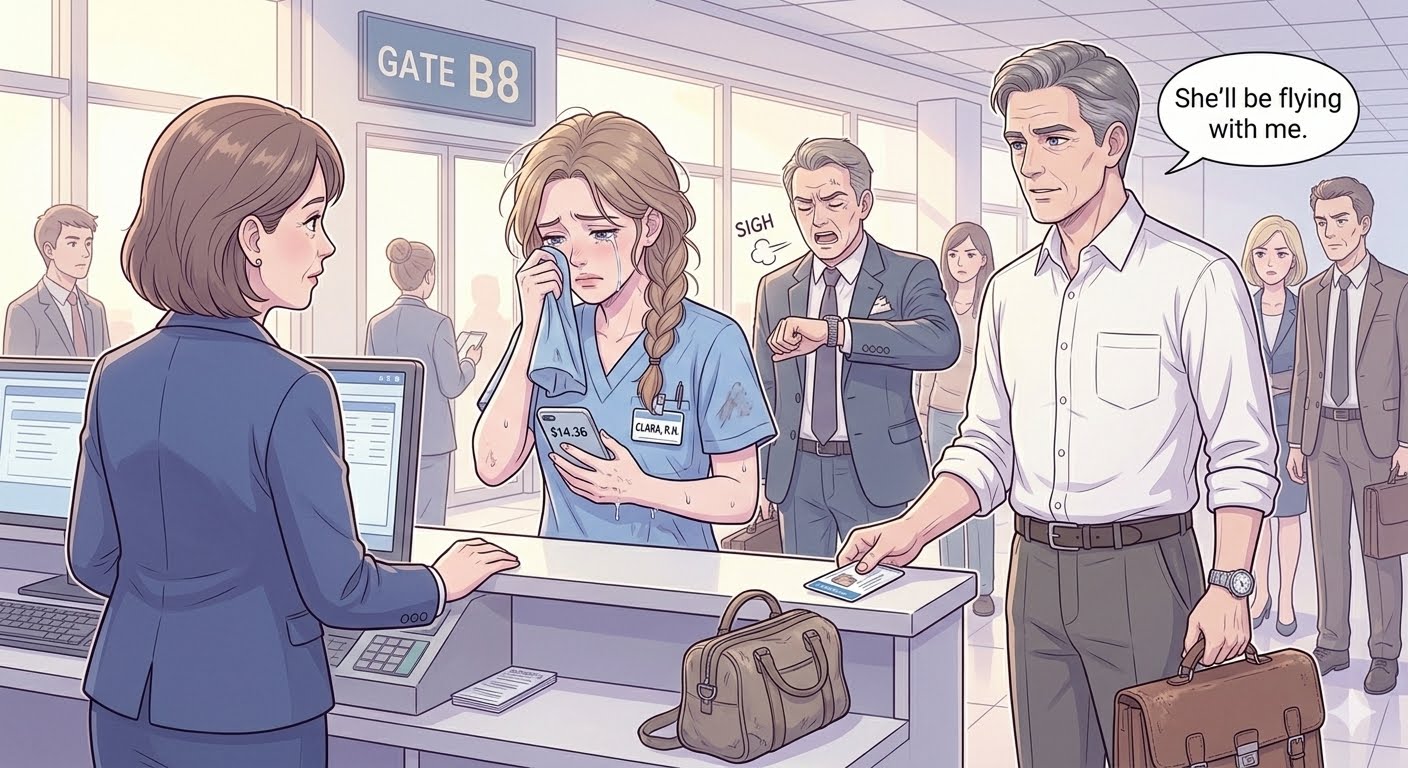
- One Sunday, we were at the airport waiting for a flight. Near Gate B8, a young woman was crying at the counter because she had missed her connection and didn’t have enough money for a new ticket.
- I looked at Julian. He already had his phone out, smiling softly.
- I walked over to the young woman, looked her in the eye, and said the exact words someone had said to me when my entire world was falling apart:
- “We’re going together.”
- She stared at me in disbelief, as if she couldn’t comprehend that people like us existed.
- I smiled. “Someone did it for me first. And some debts aren’t meant to be paid back—they’re meant to be passed on.”
- Because that night, I learned that taking care of people doesn’t always mean saving them with your own two hands. Sometimes, taking care of someone means reaching out and accepting the hand that appears in the middle of the worst airport of your life.
- And true family isn’t the one asking how much it costs to help you—it’s the one that stays right beside you when you have nothing left to offer but tears, fear, and the hope of making it in time.
PART 3