- Ever since Maya was little, she had refused to let anyone cut her hair. She allowed me to trim the split ends every few months, but even then, she sat rigidly in the kitchen chair, watching each snip in the mirror as though I might suddenly remove six inches instead of half an inch.
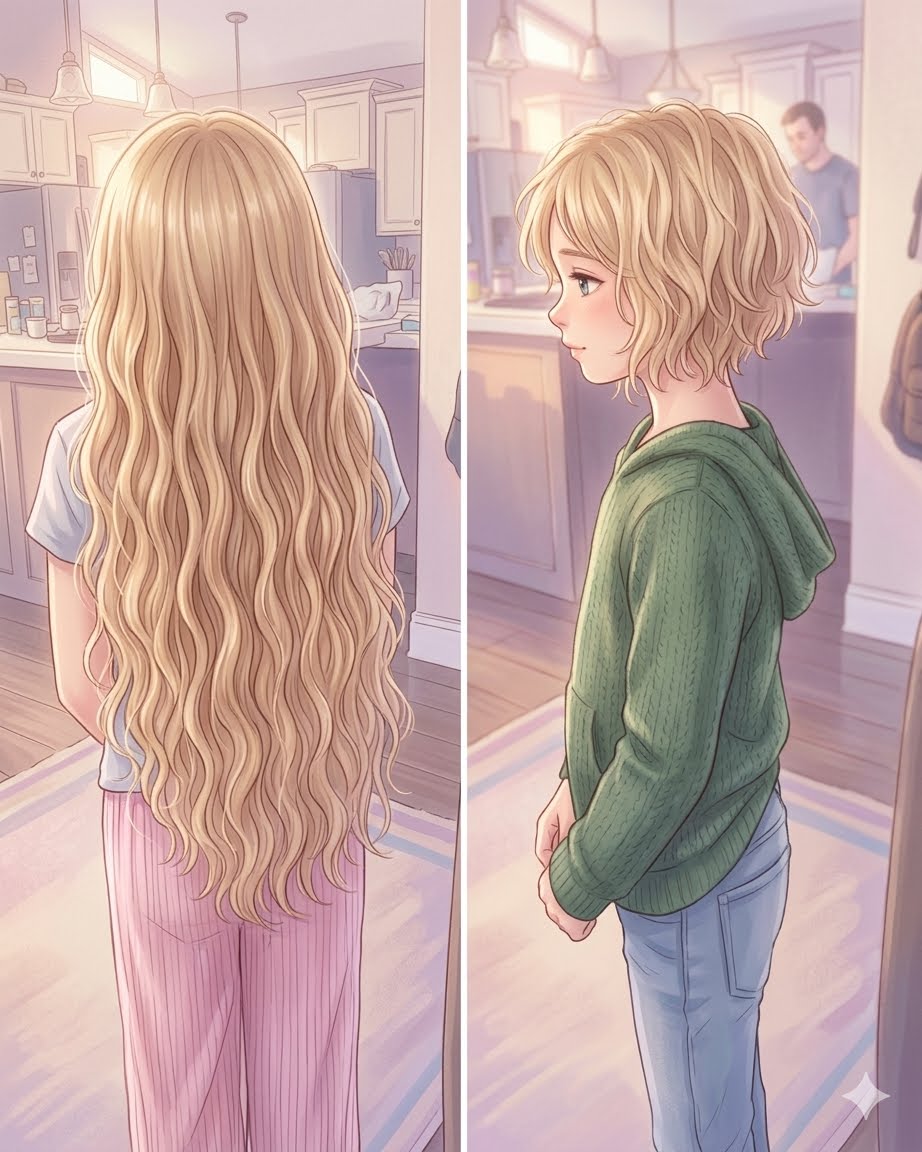
- By the time she turned ten, her hair hung far below her waist. Washing it took ages; drying it took even longer. Every evening, she sat between my knees while I carefully worked through the tangles from the ends upward. At home, Felix and I affectionately called her Rapunzel.
- “Rapunzel, come eat your breakfast.”
- “Rapunzel, please stop leaving wet towels on the floor.”
- She always rolled her eyes, but secretly, she loved the nickname. I knew because one day, when Felix simply called her Maya, she corrected him: “You forgot the Rapunzel part.” Her hair was more than something she had spent years growing—it had become part of her identity.
- School had never treated Maya as gently as we did. She was quiet, reserved, and rarely raised her hand unless she was completely certain of the answer. At recess, she usually sat near the edge of the playground reading. Some children called her hair a curtain; one boy claimed she used it to hide, while another pulled her braid whenever the teacher turned away.
- Felix and I had met with Maya’s teacher twice and spoken to Principal Susan once. We were assured that the children had been warned, the staff would monitor recess more closely, and the behavior would be handled. For a while, it appeared to stop. Maya stopped coming home with her braid half-unraveled, and she no longer begged to stay home on gym days. I should have realized that children do not always tell adults when cruelty merely changes form.
- Yesterday afternoon, I was preparing dinner when the front door opened.
- “Maya?” I called.
- She did not answer. Usually, she entered the house talking—asking what was for dinner or requesting a snack. That day, I heard only the dull thud of her backpack hitting the hallway wall.
- I wiped my hands and walked into the living room. She stood beside the couch with her coat zipped to her chin and her hood pulled low over her head.
- “Sweetheart?” I stepped closer. “Did something happen at school?”
- She shook her head, but the movement was barely noticeable.
- “Maya, look at me.”
- She slowly lifted her eyes. I reached for the edge of her hood. She flinched, but I pulled it back anyway.
- My knees nearly gave way. Her long hair was gone. The thick locks I had brushed that very morning had been chopped into rough, uneven sections just above her shoulders. One side was noticeably shorter, and jagged clumps stuck out awkwardly at the back.
- I dropped to the floor. “Oh, my God.”
- Maya immediately began to cry. I reached toward her head, then hesitated before touching her. “Who did this to you?”
- Felix heard my raised voice and rushed downstairs so quickly he nearly slipped on the final step. “What happened?” Then he saw her. His expression hardened instantly. “Who cut it?”
- When Maya remained silent, Felix grabbed his car keys and pulled out his phone to call the principal.
- “No,” I said, gently gripping Maya’s shoulders. “We need names first.” I looked at her, my blood boiling. “Was it the same children who pulled your braid? Did someone hold you down? I’m calling the police.”
- That made Maya look up, her voice barely a whisper: “No.”
- “Then tell us who did it,” Felix demanded, the anger in his voice frightening her.
- Every incident from the previous year rushed through my mind—the braid pulling, the whispers, the mornings she pleaded to stay home. I pictured my daughter trapped in a bathroom while someone hacked away at her hair.
- Her eyes filled with tears again. Slowly, she reached inside her backpack, opened the small front pocket, and pulled out a crumpled, twice-folded sheet of paper.
- My hands trembled as she handed it to me. I expected a note from a teacher or the name of a bully. But before I could read the first line, Maya whispered four words:
- “He shouldn’t feel alone.”
- PART 2 — LIAM’S LETTER
- Felix lowered his phone as I unfolded the paper. It was written in a child’s neat handwriting:
-
To Maya’s parents,
My name is Liam. I am new in Maya’s class. I wanted to thank you for your daughter. I had cancer, and the medicine made all my hair fall out. Maya is the only person who sits with me every day and tells them to stop. Today I told her my mom and dad are trying to collect enough hair so I can get a real-hair wig. They do not have enough hairpieces yet. Maya said she wanted to give me hers. I told her she did not have to. Please do not be mad at her. She is the kindest person in our class.
— Liam
- I read the note twice, tears blurring the words by the second time. Felix took the paper from my hands, staring at it in disbelief.
- Maya stood between us, crying quietly. I looked at her mangled haircut. “You did this yourself?”
- She nodded.
- “At school? Why didn’t you tell us?”
- “I thought you’d say no.”
- “We might have asked questions,” Felix said softly. “We might have taken you to a salon.”
- “I wanted to do it today.”
- “Why today?” I asked.
- “Because they made him cry again.”
- The rest of the story came out slowly. Liam had joined Maya’s class six weeks earlier after completing chemotherapy. His hair had not yet begun growing back, leaving him completely bald. Some of the same children who had targeted Maya soon turned their cruelty toward him—asking if he polished his head, calling him an egg, or moving away from him during lunch while asking if cancer was contagious.
- Having felt that isolation herself, Maya began sitting beside him. They bonded over a fantasy book series they both loved, and soon they were eating lunch together every day. Whenever someone made a cruel remark, Maya moved closer to Liam instead of walking away.
- That morning, after Liam mentioned his parents’ struggle to gather enough matching hair donations for a custom wig, Maya tucked the large kitchen scissors into her backpack. At lunch, she went into a bathroom stall, tied her hair into two thick ponytails, and began cutting.
- The dull scissors slipped, leaving one ponytail much shorter than the other. Her desperate attempts to fix the back made it worse. Panicked by her reflection, she wrapped the cut ponytails in paper towels, stuffed them into her backpack, pulled up her hood, and returned to class. Liam saw her at dismissal, and upon learning what she had done, he quickly wrote the note for us.
- “I didn’t want him to continue being bullied. I know how it feels,” Maya said.
- Felix pulled her into a tight embrace, sitting on the couch with Maya pressed against his chest while I wrapped my arms around them both. We sat in silence for several minutes. I was overwhelmed with pride, shaken by the safety risk she had taken, and deeply ashamed that my first instinct had been rage rather than listening.
- In her backpack, beneath two folders, we found the two ponytails neatly wrapped in paper towels and secured with elastic bands. Though the cuts were jagged, the vast majority of the length remained intact.
- That evening, we took Maya to a salon. The stylist carefully reshaped the remaining hair into a stylish layered bob that framed her jaw. When it was finished, Maya touched the ends and looked at her reflection.
- “I look different,” she said.
- “You look beautiful,” I replied. “No matter your hair length.”
- PART 3 — BEYOND THE SALON
- The following morning, Felix and I accompanied Maya to school. Principal Susan was stunned when we explained what had happened. Maya walked her through every detail, including the specific comments children had been making about Liam’s appearance.
- Felix spoke up firmly. “We want to know what concrete steps are being taken to address appearance-based bullying at this school. Not just for Maya or Liam, but for any child being targeted.”
- Principal Susan took detailed notes and did not make excuses. “This is unacceptable,” she admitted. “We will implement stricter monitoring, staff training, and enforceable consequences immediately. Cruelty will not be brushed off as teasing in this school.”
- Later that afternoon, we met Liam’s parents, Noella and Duncan, in the school office. Noella pulled Maya into a tearful hug, while Duncan’s voice cracked as he held his son’s letter.
- “We knew you were his friend,” Noella said. “We didn’t realize how much you were protecting him.”
- “I didn’t really protect him,” Maya said quietly. “They still said mean things.”
- “You stayed by my side,” Liam reminded her.
- Maya handed the wrapped ponytails to Noella. The donation organization later confirmed that most of Maya’s hair met their requirements and could be integrated into a custom wig for Liam.
- Inspired by Maya’s gesture, we worked with Principal Susan, local salons, and the wig organization to organize an official hair and fundraising drive at the school three weeks later. Parents, teachers, and students participated—some donating inches of hair, others raising funds to cover wig manufacturing costs. By the end of the event, enough matching hair was collected to finalize Liam’s wig.
- Two months later, Liam wore his new wig to school for the first time—a dark brown style trimmed neatly above his ears. He and Maya met outside the entrance before class.
- “Do I look strange?” Liam asked nervously, touching the fringe.
- Maya examined him thoughtfully, then smiled. “You look like the Liam I spend every day with.”
- They walked through the front doors side by side. Several students looked over, but no one laughed. Principal Susan kept her word: complaints were documented, staff were trained to intervene quickly, and the school culture began to shift.
- That evening, Maya sat in front of me while I brushed her short hair. Without the long tangles, the task took less than a minute.
- Looking at my daughter, I realized I had been wrong when she first walked through the door. Nobody had stolen something precious from her; she had chosen to give it away. Her waist-length hair had been beautiful, but her empathy, courage, and kindness were what truly made her extraordinary.
PART 1 — THE SECRET BENEATH THE HOOD