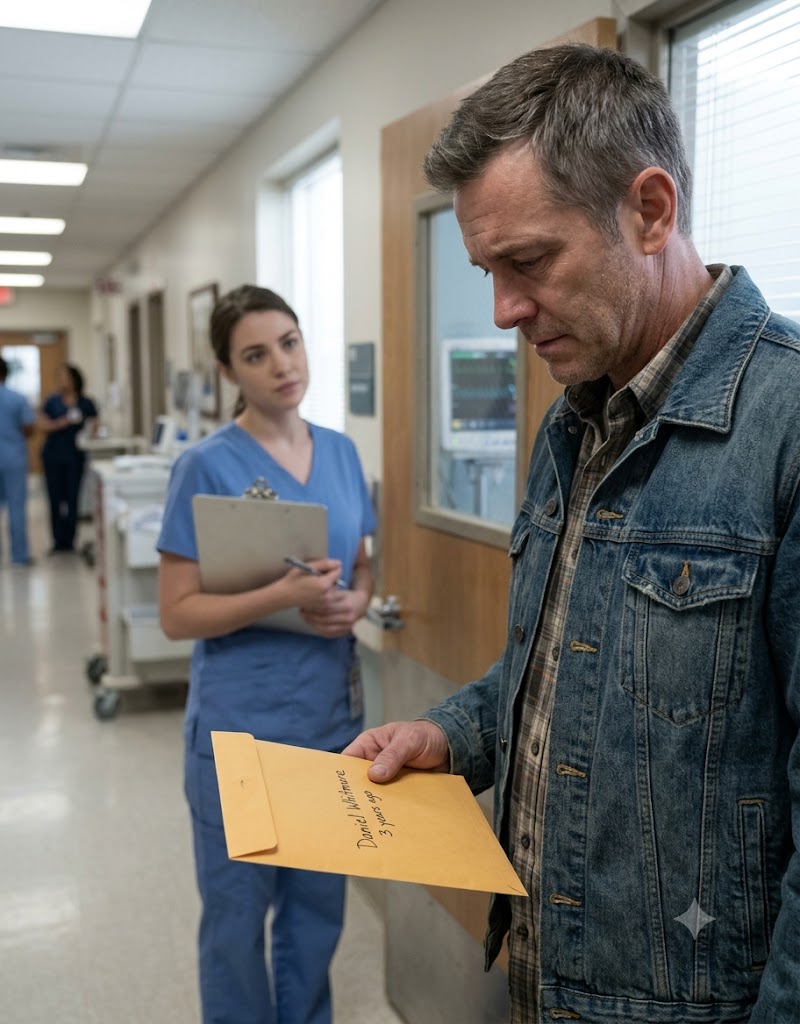
- PART 2 — THE LETTER SHE CARRIED
- “Before you go in, there’s something else you should know.”
The nurse kept her hand on the door handle.
I looked through the narrow window, but all I could see was the corner of a white blanket and the slow green pulse of a monitor.
“What is it?” I asked.
She lowered her voice.
“Rachel collapsed during treatment yesterday. Her blood pressure dropped, and she stopped breathing for almost a minute.”
The hallway tilted beneath my feet.
“Treatment for what?”
The nurse studied my face.
“You truly don’t know?” - I shook my head.
Her expression changed. The careful professionalism disappeared, and for one second, she looked angry—not at me, but for me.
“Cancer,” she said. “Ovarian cancer. It was first diagnosed four years ago.”
Four years.
The number struck me harder the second time.
Four years ago, Rachel had begun going to bed early.
Four years ago, she stopped eating dinner but still sat across from me while I ate.
Four years ago, she started wearing loose sweaters and saying she was cold.
I had blamed age.
I had blamed distance.
I had blamed our marriage. - I had never blamed cancer.
“What stage?” I asked.
The nurse looked toward Rachel’s room.
“It has spread.”
Two words.
That was all it took to reduce twenty-five years of memories into a hallway, a sealed envelope, and the sound of a machine keeping time behind a closed door. - I looked down at the letter.
My name was written across the front in Rachel’s familiar handwriting.
Danny.
Not Daniel.
Not Mr. Whitmore.
Danny. - The name only she used when she wanted me to stop pretending I was stronger than I was.
My thumb slid beneath the flap.
The paper inside had been folded so many times that the edges had begun to soften.
I opened it. - My dearest Danny,
- By the time you read this, you will probably hate me.
- Maybe you should.
- The doctor called three days ago. The growth they removed was cancerous. They believe it may already have spread, but they need more tests before they can tell me how much time I have.
- You were sitting on the porch when I came home. You had fallen asleep with your work boots on and a cup of coffee balanced on your stomach. I stood in the doorway and watched you breathe.
- All I could think was that I refused to let my death become the final chapter of your life.
- I stopped reading.
- The words blurred.
- I wiped my eyes with the back of my hand and forced myself to continue.
- You love with your whole life, Danny. You don’t know how to love halfway. If I stayed, you would close the shop. You would stop sleeping. You would spend every dollar we saved trying to purchase one more morning with me.
- And when the treatments failed, you would sit beside my grave and call that loyalty.
- I couldn’t let you do it.
- So I made you believe our marriage had simply gone quiet.
- I made you think I had stopped loving you because anger heals faster than grief.
- A sound escaped my throat.
- Not a sob.
- Something smaller and more broken.
- The nurse touched my arm, but I stepped away.
- I needed to finish it alone.
- I know what this will do to you if you discover the truth. That is why I am asking Elaine to keep you away from the hospital. She disagrees with what I am doing, but she promised to respect my decision.
- Elaine.
- Rachel’s older sister.
- The woman whose house Rachel had moved into after our divorce.
- The woman who had answered the door the only time I drove to Tulsa and told me Rachel had gone away for the weekend.
- I continued reading.
- There is another reason I have to leave.
- The doctors found something during my first surgery. Something that reopened a part of our past I thought had been buried forever.
- I cannot explain it in this letter. Not yet.
- But if the truth reaches you before I am ready, promise me you will remember one thing: I never betrayed you. Not once.
- Everything I did, I did because I loved you more than I loved being forgiven.
- Please build another life. Fill the house with noise again. Let someone complain about the way you leave coffee grounds in the sink. Let someone sit beside you on the porch.
- Do not spend the rest of your life waiting for a woman who may already be gone.
- Always yours,
- Rachel
- Beneath her name, she had written one final sentence.
- P.S. If I ever give you my wedding ring, it does not mean goodbye. It means I am too frightened to ask you to stay.
- My knees nearly gave out.
- The ring had not been a period at the end of us.
- It had been a question.
- And I had answered it by letting her disappear.
- “I need to see her.”
- The nurse nodded and opened the door.
- The room smelled like antiseptic and warmed plastic.
- Rachel lay beneath a thin blanket, her face nearly as pale as the pillow. A clear tube ran beneath her nose. Bruises covered the back of her hand where the intravenous needle entered her skin.
- She looked smaller than she had at the wedding.
- Smaller than she had ever looked in our bed.
- I moved toward her slowly.
- “Rachel?”
- Her eyelids fluttered.
- For one terrible second, nothing happened.
- Then she opened her eyes.
- She stared at me without speaking.
- I watched disbelief move across her face, followed by fear.
- “Danny?”
- Her voice was barely there.
- I sat beside the bed.
- She tried to push herself upright.
- “No,” she whispered. “You’re not supposed to be here.”
- “That seems to be a popular opinion.”
- Her eyes dropped to the letter in my hand.
- The fear in her face deepened.
- “They gave it to you.”
- “They followed your instructions.”
- “I didn’t think you would ever come.”
- “I almost didn’t.”
- Her mouth trembled.
- I took the ring from my pocket.
- I had carried it every day since the wedding.
- When I placed it in her palm, she closed her fingers around it as though it were the only warm thing left in the room.
- “Why?” I asked.
- Tears filled her eyes.
- “You read the letter.”
- “I read excuses.”
- “Danny—”
- “You held my hand while you destroyed me.”
- “I was trying to save you.”
- “You don’t get to decide which pain I can survive.”
- Her face crumpled.
- “I was dying.”
- “So you killed our marriage first?”
- The words came out harsher than I intended.
- Rachel turned her face toward the window.
- “I watched my mother disappear one piece at a time,” she said. “My father stopped being her husband. He became her nurse. Then he became a man who sat in a dark house talking to someone who wasn’t there.”
- “I’m not your father.”
- “I know.”
- “Then why didn’t you trust me?”
- “Because I knew you.”
- She looked back at me.
- “You would have stayed.”
- “Yes.”
- “You would have given up everything.”
- “Yes.”
- “You would have held my hand until the last second.”
- “Yes.”
- Her tears spilled onto the pillow.
- “That’s why I left.”
- For three years, I had imagined this conversation.
- In some versions, I shouted.
- In others, I walked away before she could explain.
- But sitting beside her now, seeing how thin her wrist looked beneath the hospital band, I could not find enough anger to protect myself.
- I reached for her hand.
- She hesitated before letting me take it.
- “You should have told me,” I said.
- “I know.”
- “You should have let me choose.”
- “I know.”
- “You wasted three years.”
- “I know.”
- Her fingers tightened around mine.
- “I thought I was giving them back to you.”
- I lowered my head.
- The silence between us was no longer empty.
- It was crowded with every breakfast we had missed, every night I had slept alone, every appointment she had attended without me.
- “What happened after the wedding?” I asked. “Why did you leave before I woke up?”
- Rachel’s gaze fell to the ring.
- “My doctor called during the night. The latest scan showed new tumors. He wanted me admitted immediately.”
- “You could have woken me.”
- “I almost did.”
- “But you left the ring.”
- “I wanted you to follow me.”
- The confession was so quiet I nearly missed it.
- “I sat in the car outside the house for twenty minutes,” she continued. “I kept watching the front door, hoping you would come running out.”
- “I was asleep.”
- “I know.”
- “You could have called.”
- “I did.”
- I stared at her.
- “No, you didn’t.”
- Her eyebrows drew together.
- “Yes, I did. The next morning. And again that afternoon. Your phone went straight to voicemail.”
- “I called you at least twenty times.”
- Rachel shook her head.
- “I never received a call from you.”
- A coldness spread through me that had nothing to do with the hospital room.
- “You sent me a message three days later.”
- “What message?”
- I pulled out my phone.
- I had never deleted it.
- I opened the conversation and held the screen where she could see it.
- “Please don’t make this harder, Danny,” she read aloud. “Be happy. That’s the only thing I ever asked of the both of us.”
- The color drained from her face.
- “I never wrote that.”
- I looked at the message.
- Then at her.
- “It came from your number.”
- “I don’t care. I didn’t send it.”
- “Who had your phone?”
- Rachel’s breathing changed.
- The monitor began beeping faster.
- “Rachel?”
- She looked toward the door.
- “Elaine took it while I was in surgery.”
- “Your sister sent the message?”
- “I don’t know.”
- “But she could have.”
- Rachel pulled her hand away from mine.
- She pressed it against her chest as though trying to hold something inside.
- “She promised me she wouldn’t interfere.”
- “She kept me from you.”
- “I asked her to.”
- “Before the wedding?”
- “No.”
- That one word changed the room.
- I leaned closer.
- “What do you mean?”
- Rachel looked at the nurse, who was checking the monitor.
- “After the wedding, I changed my mind,” she said. “I told Elaine I wanted to call you. I told her I couldn’t do it alone anymore.”
- “But she didn’t tell me.”
- “No.”
- “She blocked my number?”
- “I don’t know.”
- “Why would she do that?”
- Rachel closed her eyes.
- The nurse adjusted the intravenous line.
- “Her pulse is climbing,” she warned me. “You need to give her a minute.”
- But Rachel grabbed my wrist before I could stand.
- “There are things you don’t know about Elaine,” she whispered.
- “What things?”
- “She blamed you.”
- “For what?”
- Rachel glanced at the nurse again.
- “For what happened to the baby.”
- The room seemed to shrink.
- I could hear the machine.
- I could hear the air moving through the vent.
- I could hear Rachel breathing.
- But I could not hear my own voice when I spoke.
- “What baby?”
- Her eyes opened wider.
- For a moment, she looked as though she wished she could take the words back.
- Then my phone rang.
- The sound made all three of us jump.
- I looked at the screen.
- The caller’s name stopped my heart.
- RACHEL WHITMORE
- Rachel was lying in front of me.
- Her phone was supposed to be at Elaine’s house.
- Yet her name was glowing in my hand.
- “Don’t answer it,” Rachel whispered.
- I pressed the button.
- “Hello?”
- No one spoke.
- I heard faint breathing.
- Then a woman’s voice said, “Danny, you should have stayed away from the hospital.”
- “Elaine?”
- Rachel covered her mouth.
- The woman continued before I could ask another question.
- “If Rachel tells you what happened, she’ll lie. She has been lying to you for twenty-six years.”
- “What are you talking about?”
- “Ask her why there was never a funeral.”
- My entire body went cold.
- “What funeral?”
- The line went silent for several seconds.
- Then Elaine whispered the words that split my life into two separate halves.
- “The funeral for your daughter.”
- The call ended.
- I stared at Rachel.
- Her face was wet with tears.
- “Danny,” she whispered, “please let me explain.”
- I slowly lowered the phone.
- “We never had a daughter.”
- Rachel closed her eyes.
- Behind us, the monitor began screaming.
- And before the nurses rushed me out of the room, I heard my ex-wife say the one sentence I would spend the rest of the night trying to understand.
- “Yes, we did.”……………….
- PART 3 — THE DAUGHTER WITHOUT A GRAVE
- “Yes, we did.”
Those three words followed me into the hallway.
The nurses pushed past me. One called Rachel’s name while another silenced the screaming monitor. The door closed, leaving me alone beneath the fluorescent lights with my phone still pressed against my palm.
Twenty-six years.
A daughter.
No funeral.
I tried to arrange the facts into something that made sense, but every version ended with the same question.
How could a man lose a child he never knew existed? - The young nurse who had first brought me to Rachel appeared at the end of the hall. Her dark hair was pulled into a loose knot, and she carried two paper cups.
She handed one to me.
“Water,” she said. “You look like you might pass out.”
“I’m fine.”
“You’re gripping your phone hard enough to break it.”
I looked down.
She was right.
I released it and took the cup.
“What happened to Rachel?”
“Her heart rhythm became unstable. The doctor is with her.”
“Is she dying?”
The nurse’s eyes shifted toward the closed door. - “Not right now.”
- It was not the answer I wanted, but it was honest.
- I sat in a plastic chair against the wall. The nurse remained standing beside me.
- “What’s your name?” I asked.
- She touched the identification badge clipped to her uniform.
- GRACE BENNETT, RN.
- “Grace.”
- “Yes.”
- “You made the call this morning?”
- She hesitated.
- “I was the nurse who reached you.”
- “Why?”
- “You were listed as her emergency contact.”
- “That doesn’t answer my question.”
- Grace sat two chairs away.
- “Rachel’s sister had instructed the hospital not to contact you.”
- “Elaine.”
- “Yes.”
- “But you called me anyway.”
- Grace folded her hands.
- “Rachel woke up during the night. She was confused, but she kept asking for Danny. I checked her records and found your number.”
- “Did Rachel tell you about the daughter?”
- Grace’s entire body became still.
- It was a small reaction, but I noticed it.
- “You know something,” I said.
- “I think Rachel should explain it.”
- “She just told me we had a child I never knew about, and then her heart nearly stopped. I’m finished waiting for other people to decide what I deserve to know.”
- Grace looked toward Rachel’s room.
- “Give her a chance to tell you.”
- “You sound like you know her well.”
- Her eyes returned to mine.
- “I do.”
- Before I could question her further, the door opened.
- A doctor stepped into the hallway, removing his gloves.
- “Mr. Whitmore?”
- I stood.
- “Rachel is stable. The episode appears to have been triggered by stress combined with complications from her treatment.”
- “Can I see her?”
- “For a few minutes. She needs rest.”
- “I need answers.”
- “She needs her heart to continue beating.”
- The doctor held my gaze.
- “Keep your voice down. No arguments. If her monitor changes, you leave immediately.”
- I nodded.
- When I looked back, Grace had moved away from the chairs.
- She stood at the nurses’ station with her back to me.
- But I could see her reflection in the glass cabinet.
- She was crying.
- Rachel looked even smaller than before.
- The oxygen tube had been replaced by a mask, and fresh wires ran beneath the collar of her gown. Her eyes followed me as I entered.
- I sat beside her.
- For several seconds, neither of us spoke.
- Then I placed my phone on the table between us.
- “Elaine said we had a daughter.”
- Rachel closed her eyes.
- “She said there was no funeral because there was no body.”
- “I heard her.”
- “And you said it was true.”
- Rachel nodded.
- “Start at the beginning.”
- “Danny—”
- “The beginning.”
- Her fingers trembled beneath the blanket.
- “It happened the year before we got married.”
- I stared at her.
- “We were already engaged,” she continued. “You accepted that temporary position in Oklahoma City because we needed money for the house.”
- Memories surfaced slowly.
- A six-month contract repairing industrial engines. Twelve-hour shifts. A rented room above an old man’s garage.
- This was before cell phones were common. Before video calls. Before you could see someone’s face from hundreds of miles away.
- I remembered calling Rachel from a pay phone every Sunday evening.
- I remembered her sounding tired.
- “You were gone for five months,” she said. “A week after you left, I discovered I was pregnant.”
- I struggled to breathe.
- “You were pregnant while I was calling you?”
- “Yes.”
- “Why didn’t you tell me?”
- “I wanted to surprise you in person. You had been so worried about money. Every phone call was about overtime and the wedding and how you were afraid you couldn’t give me the life I deserved.”
- “I would have come home.”
- “I know.”
- “Then why—”
- “Because your father had just lost the farm.”
- I stopped.
- My father’s debts had nearly destroyed my parents. I had sent home most of what I earned during that contract.
- Rachel had known.
- “I convinced myself that waiting a few weeks wouldn’t matter,” she said. “Then a few weeks became months. I began making plans. I bought a crib from a woman at church and hid it at my mother’s house.”
- “What happened?”
- Rachel turned her face toward the window.
- “I went into labor ten weeks early.”
- The room disappeared around me.
- All I could see was Rachel twenty-six years younger, frightened and alone.
- “Elaine drove me to a private maternity clinic outside Tulsa,” she continued. “It was the closest place. By the time we arrived, I was bleeding badly.”
- “Was she born alive?”
- Rachel’s mouth trembled.
- “Yes.”
- I pressed my fist against my lips.
- “I heard her cry,” she whispered. “It was the most beautiful sound I had ever heard.”
- A tear rolled down her cheek.
- “They placed her on my chest for only a few seconds. She had dark hair. So much dark hair. She opened her eyes once.”
- “Did you name her?”
- “Hope.”
- The name broke something inside me.
- “Hope,” I repeated.
- “I told the nurse her name before they took her away.”
- “What happened next?”
- “I started hemorrhaging. They gave me medication, and everything became blurry. I remember Elaine holding my hand. I remember asking where my baby was.”
- Rachel swallowed.
- “When I woke up the next morning, Elaine told me Hope had stopped breathing.”
- I stared at her.
- “She said the doctors tried to save her, but her lungs were underdeveloped.”
- “Did you see her body?”
- “No.”
- “Why not?”
- “They told me it would be better to remember her alive.”
- “Who told you?”
- “Elaine.”
- My hands curled against my knees.
- “What did the doctor say?”
- “I never saw him again. Elaine said he had been called to another hospital.”
- “And you accepted that?”
- “I was weak, drugged, and twenty-four years old. My mother was crying. Elaine kept telling me I had almost died.”
- “What about a death certificate?”
- “There wasn’t one.”
- “A burial record?”
- “No.”
- “A funeral home?”
- “No.”
- I stood so quickly that the chair struck the wall.
- The monitor accelerated.
- Rachel reached toward me.
- “Danny, please.”
- I forced myself to sit.
- “You believed our child had died without asking to see her?”
- “I asked,” Rachel said, her voice breaking. “I begged.”
- “Then why was there no funeral?”
- “Elaine said the clinic had arranged a cremation because the baby had lived for less than an hour. She said there would be no ashes because Hope was considered a medical loss.”
- “That isn’t how it works.”
- “I know that now.”
- “But you didn’t tell me.”
- Rachel covered her face.
- “When you returned, I tried.”
- “You tried?”
- “I took you to the lake. Do you remember?”
- I did.
- It had been a cold afternoon. Rachel had sat beside me on the dock and cried without explaining why. I had assumed she was overwhelmed by the wedding.
- “You kept asking me if I still wanted children,” I said.
- “Yes.”
- “And I told you we had plenty of time.”
- Rachel nodded.
- “I opened my mouth to tell you. Then I imagined your face when you learned that your daughter had been born and buried while you were working to provide for us.”
- “There was no grave.”
- “I believed there was.”
- “You should have told me!”
- The monitor began beeping faster.
- I lowered my voice.
- “You let me marry you without knowing we had lost a child.”
- “I was ashamed.”
- “You had nothing to be ashamed of.”
- “My mother told me you would blame yourself. Elaine said you might blame me.”
- “I would never have blamed you.”
- “I know that now.”
- I leaned back and stared at the ceiling.
- Every Sunday call from that year returned to me.
- Rachel asking when I would come home.
- Rachel saying she had been sick.
- Rachel crying when I told her I had accepted another two weeks of overtime.
- I had believed we were postponing our wedding.
- She had been preparing to give birth alone.
- “How did you discover she was alive?” I asked.
- Rachel’s eyes moved toward the door.
- “Four years ago, after my first surgery, the oncologist recommended genetic testing. They found a hereditary mutation that increased my risk of ovarian cancer.”
- “What does that have to do with Hope?”
- “The counselor suggested contacting biological relatives. We never had other children, so I uploaded my information to a genetic registry.”
- She paused.
- “Three weeks later, I received a notification.”
- I already knew what she was going to say.
- “A parent-and-child match,” Rachel whispered.
- The words settled between us.
- “Her name was Grace Bennett.”
- My heart stopped.
- I turned toward the door.
- The young nurse was no longer visible through the window.
- “No,” I whispered.
- Rachel began to cry.
- “She was twenty-two when we matched. She had been adopted by a couple in Tulsa. Her adoptive mother had died, and Grace was searching for medical information because she wanted to know why cancer appeared so often in her biological family.”
- “The nurse.”
- “Yes.”
- “Grace is our daughter?”
- Rachel nodded.
- I stood again.
- This time, the monitor did not matter.
- I walked to the door and pulled it open.
- Grace was standing against the opposite wall.
- She had heard everything.
- For several seconds, we stared at each other.
- I studied her face properly for the first time.
- Rachel’s eyes.
- Rachel’s cheekbones.
- But the small dent in her chin belonged to my father.
- I had seen it every morning of my childhood.
- Grace wiped her tears with the back of her hand.
- “I didn’t know how to tell you,” she said.
- I stepped into the hallway.
- “You called me.”
- “Yes.”
- “You brought me to her room.”
- “Yes.”
- “You handed me the letter.”
- “Yes.”
- “Why didn’t you say who you were?”
- “Because you had just discovered Rachel was sick. I couldn’t walk up to you and say, ‘Hello, I’m the daughter you never knew existed.’”
- My voice failed.
- Grace looked terrified.
- Not of me.
- Of what I might say.
- “How old are you?” I managed.
- “Twenty-six.”
- “When is your birthday?”
- “October seventeenth.”
- I closed my eyes.
- October seventeenth.
- I knew exactly where I had been.
- Standing beneath a broken transmission in Oklahoma City, covered in grease, thinking about how much money I would make if I stayed for the weekend.
- My daughter had taken her first breath while I was tightening bolts beneath someone else’s truck.
- “Did you know about me?” I asked.
- “Not until four years ago.”
- “What were you told?”
- “That my birth mother was unmarried and unable to care for me. My parents were told my biological father had disappeared.”
- “I didn’t disappear.”
- “I know.”
- “Did Rachel tell you that?”
- “She showed me photographs. Letters you sent while you were away. Your wedding album.”
- Grace pressed her lips together.
- “She talked about you constantly.”
- “Then why did she divorce me?”
- Grace looked toward Rachel.
- “That wasn’t my decision.”
- Rachel spoke from the bed.
- “Grace asked for time.”
- I returned to the doorway.
- “Time for what?”
- “To understand what happened,” Grace said. “I had parents. Good parents. My father was still alive when I found Rachel. He was afraid I would stop seeing him as my father.”
- “I wouldn’t have asked you to do that.”
- “I didn’t know you.”
- “You could have met me.”
- “Rachel wanted to tell you,” Grace said. “I was the one who asked her not to.”
- The confession struck deeply, but I could see the guilt on her face.
- She had been twenty-two.
- Her mother had recently died.
- A stranger had appeared claiming to be the woman who gave birth to her.
- And another stranger—me—waited behind that truth.
- “I thought we had time,” Grace said. “Then Rachel told me about the cancer.”
- “So she divorced me instead.”
- Rachel’s voice was weak.
- “I couldn’t tell you I was dying and that we had a living daughter in the same conversation.”
- “You could have started with the daughter.”
- “I was afraid you would hate me.”
- “I do hate what you did.”
- Rachel flinched.
- “But I don’t hate you.”
- She looked at me.
- “I don’t know what I feel,” I admitted. “I may not know for a long time.”
- Grace stepped closer.
- “I’m sorry.”
- I turned toward her.
- “You didn’t do this.”
- “I kept the truth from you too.”
- “For four years.”
- “Yes.”
- “Why did you finally call me today?”
- Grace looked down the hallway.
- “Because someone tried to move Rachel.”
- “What?”
- “Yesterday afternoon, Elaine arrived with documents transferring Rachel to a private facility.”
- Rachel pushed herself higher against the pillows.
- “She what?”
- “She claimed you had abandoned Rachel and that she was the only family member authorized to make decisions.”
- “Did Rachel sign anything?”
- “No,” Grace said. “But Elaine had medical power-of-attorney documents.”
- “I never gave her that authority,” Rachel said.
- “The signature looked like yours.”
- Rachel’s eyes widened.
- “She forged it.”
- Grace nodded.
- “I challenged the paperwork. Elaine became angry. She said I had no right to interfere.”
- “She knows who you are?” I asked.
- “She has always known.”
- The anger I had tried to control spread through me.
- “She stole our child, kept us apart, blocked my calls, and now she’s trying to control Rachel’s treatment?”
- “We don’t know exactly what she did twenty-six years ago,” Grace warned.
- “I know enough.”
- “No,” Rachel said. “You don’t.”
- I turned toward her.
- “What else is there?”
- Rachel looked at Grace.
- “Show him.”
- Grace hesitated.
- “Are you sure?”
- “He deserves to see it.”
- Grace reached into her uniform pocket and removed a folded sheet of paper protected inside a clear plastic sleeve.
- She handed it to me.
- The document was yellowed and uneven, as though it had been copied from an old fax.
- At the top were the words:
- VOLUNTARY RELINQUISHMENT OF PARENTAL RIGHTS
- Below them was Rachel’s maiden name.
- Rachel Anne Shaw.
- Her signature appeared at the bottom.
- “I never signed that,” Rachel said.
- A witness signature sat beside hers.
- Elaine Shaw.
- “You were unconscious,” Grace explained. “The document claims you signed it six hours after giving birth.”
- “That’s when I was in surgery,” Rachel said.
- I continued reading.
- The next section identified the child’s biological father.
- Daniel Thomas Whitmore.
- My name.
- My birth date.
- My old address.
- And beneath it, a signature that looked almost exactly like mine.
- For several seconds, I could not understand what I was seeing.
- “They forged my signature too.”
- “Yes,” Grace said.
- I examined the letters.
- The slant was correct. The shape of the D. The way I crossed the final T.
- Whoever had written it had practiced.
- “There should have been a witness,” I said.
- “There was.”
- Grace pointed to the bottom of the page.
- I followed her finger.
- My stomach tightened.
- The witness had signed a full name in careful blue ink.
- A name I had not seen in eight years.
- A name carved into the headstone beside my father’s grave.
- Margaret Whitmore.
- My mother.
- “No.”
- I stared at Grace.
- “My mother wasn’t at the clinic.”
- Rachel began crying again.
- “I never saw her there.”
- “She wouldn’t have done this.”
- Grace removed another item from her pocket.
- An old photograph.
- The colors had faded, but the image was clear enough.
- A newborn baby lay inside a hospital bassinet.
- A card beside her tiny head read:
- BABY GIRL SHAW
- Standing beside the bassinet was Elaine.
- Next to Elaine was my mother.
- Margaret Whitmore was holding an envelope in one hand.
- Her other hand rested on the shoulder of a well-dressed woman I had never seen before.
- On the back of the photograph, someone had written a date.
- October seventeenth.
- The day Grace was born.
- I looked from the photograph to Rachel.
- “My mother told me she was visiting my aunt in Kansas that week.”
- Rachel shook her head.
- “She told me the same thing.”
- Grace took a slow breath.
- “There was something else inside my adoptive mother’s safe.”
- “What?”
- “A receipt.”
- “For what?”
- Grace’s voice became almost inaudible.
- “Fifty thousand dollars.”
- The hallway seemed to move beneath me.
- “Who received it?”
- “The receipt was issued to Margaret Whitmore.”
- I looked down at the photograph again.
- My mother had known.
- She had stood beside my daughter’s bassinet.
- She had watched someone carry Grace away.
- And for the rest of her life, she had sat across from me at birthdays, Christmas dinners, and Sunday lunches without saying a word.
- “Elaine didn’t arrange my adoption,” Grace said.
- My fingers tightened around the photograph.
- “Then who did?”
- Grace looked directly into my eyes.
- “Your mother sold me.”
- Before I could respond, a security alarm sounded near the hospital entrance.
- A voice came over the intercom.
- “Security assistance requested on the oncology floor.”
- Footsteps pounded toward us.
- A hospital guard appeared at the end of the hallway.
- “Mr. Whitmore?”
- “Yes?”
- “We need you to come with us.”
- “Why?”
- The guard looked toward Rachel’s room, then lowered his voice.
- “Elaine Shaw was just caught trying to leave the building.”
- “That sounds like her problem.”
- “She wasn’t alone.”
- My chest tightened.
- “Who was with her?”
- The guard held up a small plastic evidence bag.
- Inside was a syringe.
- “Before security stopped her,” he said, “Ms. Shaw entered Rachel’s room through the staff stairwell.”
- Grace turned pale.
- Rachel stared at the intravenous tube running into her hand.
- The guard continued.
- “And according to the surveillance footage, she injected something into your ex-wife’s medication line.”
- The monitor beside Rachel’s bed began to slow.
- One beep.
- Then another.
- Then silence…………….
- PART 4 — THE SIGNATURE MY MOTHER LEFT BEHIND
- The monitor went silent.
For one impossible second, nobody moved.
Then Grace screamed.
“Mom!”
The room exploded around us.
A nurse shoved me into the hallway while two others surrounded Rachel’s bed. Someone tore the intravenous line from her arm. Another nurse lowered the bed and began pressing hard against Rachel’s chest.
“Code blue, oncology!” a voice shouted over the intercom.
Grace tried to follow them inside.
I caught her around the waist.
“Let me go!” she cried. “She needs me!”
“They’re helping her.”
“She’s my mother!”
The words struck both of us. - Grace stopped struggling.
She stared through the narrow window as the medical team worked over the woman who had given birth to her, lost her, found her, and nearly died before she could bring us together.
A doctor rushed into the room carrying a case.
The door swung shut behind him.
I could no longer see Rachel’s face.
Only hands.
Wires.
The rise and fall of shoulders as people fought to keep her alive.
Grace buried her face against my chest.
I held my daughter for the first time.
There was no joy in it.
No photographs.
No family gathered around us.
Just the smell of antiseptic and the sound of a doctor ordering everyone to stand clear. - Rachel’s body lifted from the bed when the shock hit her.
- Grace screamed again.
- I closed my eyes.
- “Come back,” I whispered. “Please, Rachel. Come back.”
- The monitor answered with one weak beep.
- Then another.
- Then another.
- Grace raised her head.
- A nurse looked through the window and nodded.
- Rachel had a heartbeat.
- I pressed my hand against the glass because it was the closest I could get to touching her.
- “She’s alive,” Grace whispered.
- “For now.”
- The words came from behind us.
- The security guard stood with a police officer near the nurses’ station. The officer was a woman in her late forties with gray beginning to show at her temples.
- “Daniel Whitmore?” she asked.
- “Yes.”
- “I’m Detective Lena Ortiz. We need to speak about what happened.”
- “Where is Elaine?”
- “In custody.”
- “I want to see her.”
- “That isn’t a good idea.”
- “She tried to kill my wife.”
- “Ex-wife,” the detective corrected gently.
- I stared at her.
- “Rachel listed me as her husband.”
- Ortiz glanced toward the room.
- “Then we’ll call her your wife.”
- Grace stepped away from me.
- “What was in the syringe?”
- “The hospital is testing it.”
- “You found her injecting something into the line,” I said. “You must know what it was.”
- “We found a vial in her purse. The label had been removed.”
- “Why would she do this?”
- “That’s what we’re trying to establish.”
- The doctor emerged from Rachel’s room before I could ask anything else.
- His mask hung beneath his chin.
- “Her heart rhythm has stabilized,” he said. “She is breathing with assistance.”
- “Will she wake up?” Grace asked.
- “We don’t know yet.”
- “What did Elaine give her?” I demanded.
- “We believe it was a powerful sedative combined with another medication that lowered her blood pressure.”
- “So she was trying to kill her.”
- The doctor’s expression tightened.
- “The amount in Rachel’s system could have been fatal, especially in her condition.”
- Grace covered her mouth.
- The doctor looked at both of us.
- “We stopped the infusion quickly. That gave her a chance.”
- “A chance,” I repeated.
- “That is all I can promise.”
- He returned to the room.
- Detective Ortiz waited until the door closed.
- “Ms. Shaw claims she wasn’t trying to kill Rachel.”
- I laughed, but there was nothing humorous in the sound.
- “What does she call injecting an unconscious cancer patient with an unknown drug?”
- “She says she was trying to keep Rachel sedated long enough to transfer her.”
- “Transfer her where?”
- “A private care facility outside the city.”
- “Why?”
- “She says Rachel was confused and revealing family matters she had promised to keep secret.”
- Grace looked at me.
- “The adoption.”
- “Not just the adoption,” Ortiz said.
- She held up a clear evidence bag.
- Inside was a thick envelope.
- The paper had yellowed with age.
- My name was written across the front.
- Daniel.
- I knew the handwriting immediately.
- My mother’s.
- “Where did you find that?”
- “In Elaine Shaw’s purse.”
- I reached for it.
- Ortiz pulled it back.
- “It’s evidence.”
- “My mother has been dead for eight years.”
- “I understand.”
- “No, you don’t.”
- I pointed at the envelope.
- “My mother signed documents giving away my daughter. Elaine has spent twenty-six years hiding what happened. Whatever is inside that envelope belongs to me.”
- The detective studied me for a long moment.
- Then she glanced at the security guard.
- “We’ve photographed it,” she said. “You can read it here. Do not leave with it.”
- She opened the evidence bag and handed me the envelope.
- The paper felt fragile beneath my fingers.
- The seal had already been broken.
- Elaine had read it.
- Maybe many times.
- I unfolded the letter inside.
- The first line was dated nine years earlier.
- One year before my mother died.
- Dear Daniel,
- There is no way to write this without losing whatever love you may still have for me.
- I have spent most of my life praying that the truth would remain buried. Now I understand that prayer was cowardice disguised as faith.
- I stopped.
- Grace stood beside me, reading over my arm.
- I continued.
- Rachel gave birth on October seventeenth, twenty-six years ago. You were working in Oklahoma City. Your father and I knew about the pregnancy, although Rachel believed only Elaine and her mother knew.
- My hand began to shake.
- “My parents knew she was pregnant.”
- Grace touched my arm.
- “Keep reading.”
- Your father learned about the child after seeing Rachel leave a doctor’s office. He followed her and confronted her. She begged us not to tell you because you would abandon your work contract and return home.
- We agreed to keep her secret.
- That was the first lie.
- The second began when Rachel went into labor.
- I could hear my mother’s voice in every sentence.
- Calm.
- Measured.
- The voice she used when reading Bible passages at the dinner table.
- Your father’s debts were worse than you knew. The farm was already lost. A man named Dr. Harlan Vale had loaned your father money through private arrangements. When your father could not repay it, Dr. Vale offered another solution.
- Grace inhaled sharply.
- “Vale,” she whispered.
- “What?”
- “My adoptive records list the attending physician as Harlan Vale.”
- I returned to the letter.
- Dr. Vale operated the clinic where Elaine took Rachel. He arranged private adoptions for couples who could not adopt through legal agencies. He called it mercy. It was not mercy.
- It was a business.
- He knew Rachel was unmarried. He knew you were away. He knew the baby could be placed without questions if the documents were signed quickly.
- He offered fifty thousand dollars and forgiveness of your father’s debt.
- My vision blurred.
- The farm.
- The debts.
- The money I had sent home every month.
- I had believed I was helping my parents survive.
- They had been preparing to sell my child.
- I told myself the baby would have a better life.
- I told myself you were too young.
- I told myself Rachel would recover and the two of you would have other children.
- A person can commit almost any evil after repeating enough gentle lies.
- Grace began crying silently.
- I could not look at her.
- Rachel was unconscious after the delivery. Elaine brought the papers. I signed as a witness. Then I signed your name.
- I had hundreds of your letters and forms. I knew the shape of your handwriting.
- I forged Rachel’s signature as well.
- By the time she woke, the adoption had been completed. Elaine told her the baby had died.
- I stopped again.
- The hallway felt too narrow.
- The ceiling too low.
- I wanted to tear the letter in half, but Grace’s fingers closed over mine.
- “Please,” she whispered. “I need to know too.”
- I swallowed and continued.
- For years, I believed one child had been born that night.
- I was wrong.
- The words seemed to darken on the page.
- Rachel delivered twin girls.
- Grace’s hand slipped from my arm.
- “No.”
- Detective Ortiz stepped closer.
- I read the line again.
- Twin girls.
- Not one daughter.
- Two.
- The first child was very small and required assistance breathing. She was transferred to the nursery immediately. The second child was born twelve minutes later. She was stronger.
- Dr. Vale had arranged only one adoption.
- Elaine told me the second baby died before sunrise.
- I believed her.
- Grace shook her head.
- “I don’t have a twin.”
- I could barely speak.
- “You may.”
- She stepped away from me.
- “No. My parents would have known.”
- “Maybe they only adopted you.”
- “My mother kept everything. Every paper. Every photograph.”
- “She kept the receipt.”
- “She would have told me.”
- “Rachel believed you were dead for twenty-two years.”
- Grace stared at me as the truth settled over her.
- People told themselves impossible things when the lie came from someone they trusted.
- I looked down at the letter.
- There was more.
- Seven years ago, I received a photograph with no return address.
- It showed two young women leaving a school graduation ceremony.
- One was Grace Bennett. I recognized Rachel in her face immediately.
- Grace closed her eyes.
- “The other woman?” she whispered.
- I continued reading.
- The second woman looked exactly like her.
- On the back of the photograph, someone had written:
- YOU SOLD ONE. ELAINE KEPT THE OTHER.
- Grace gripped the edge of the nurses’ station.
- I read the sentence twice.
- Then a third time.
- “Elaine kept her?”
- Detective Ortiz held out her hand.
- “May I see that section?”
- I gave her the letter.
- She read quickly.
- “Does Elaine Shaw have children?”
- “Not that I know of,” I said.
- Grace shook her head.
- “She never mentioned a daughter.”
- “She could have raised the child under another name,” Ortiz said. “Or arranged for someone close to her to do it.”
- “Why would she hide the second baby?” I asked.
- The detective did not answer.
- The letter did.
- I took it back and continued.
- I confronted Elaine after receiving the photograph. She denied everything. Then she told me that if I confessed, she would tell you that your father had planned the adoption with me.
- That was true.
- Your father accepted the arrangement because Dr. Vale threatened to expose his debts and have him arrested for forging loan documents.
- He believed losing his granddaughter was the price of protecting his family.
- He was wrong.
- I was wrong.
- There is no protection in a lie. There is only delayed destruction.
- My father had died believing I respected him.
- I had stood beside his hospital bed and thanked him for teaching me to be an honest man.
- He had squeezed my hand and cried.
- At the time, I thought he was afraid to die.
- Now I wondered if he had been trying to confess.
- I wrote this letter because I no longer trust Elaine.
- She watches Rachel. She watches Grace. She has spent years making certain they never reach you.
- I believe she is protecting the second child—or protecting herself from what that child knows.
- The photograph is hidden in my family Bible, beneath Psalm Twenty-Seven.
- There is also a name.
- Leah.
- My breath caught.
- I do not know whether Leah is the child’s real name. I only know Elaine whispered it during our final argument.
- Find her.
- Tell Rachel I am sorry.
- Tell both girls that their grandmother was a coward.
- And tell them that none of this happened because they were unwanted.
- It happened because the people who wanted them were weaker than the people willing to take them.
- The letter ended with my mother’s signature.
- Margaret Whitmore
- Beneath it, she had written one final sentence.
- Elaine has the key to the clinic records.
- I lowered the paper.
- For several seconds, none of us spoke.
- Then Detective Ortiz asked, “Where is the Bible?”
- “My mother’s house was sold after she died.”
- “Who cleared the property?”
- “Elaine helped.”
- The detective’s eyes hardened.
- “Why would your ex-wife’s sister clear your mother’s house?”
- “I was overwhelmed. Rachel and I were still married then. Elaine offered to sort the donations.”
- “She was looking for this letter,” Grace said.
- “And the photograph,” I replied.
- Ortiz took the letter and returned it to the evidence bag.
- “We need to question Elaine about Leah and Dr. Vale.”
- “I’m coming.”
- “No.”
- “She stole twenty-six years from me.”
- “And she may have just attempted to murder your wife. You will stay here.”
- Before I could argue, a man in a dark suit appeared at the end of the hallway.
- He walked beside another police officer.
- “Detective,” the officer called. “Shaw’s attorney is here.”
- The man stopped several feet away.
- He was tall, silver-haired, and carried a leather briefcase that probably cost more than my first car.
- He looked directly at Grace.
- His expression changed.
- Not surprise.
- Recognition.
- “You,” Grace whispered.
- The man removed his glasses.
- “Grace.”
- “You know him?” I asked.
- She nodded slowly.
- “This is Martin Kessler. He handled my adoptive father’s estate.”
- Kessler glanced at the envelope in Detective Ortiz’s hand.
- “I assume you found Margaret’s confession.”
- “You knew about it?” I demanded.
- “I knew Margaret wrote something before her death.”
- “You represented Elaine?”
- “I represent the Vale Medical Trust.”
- The name struck me.
- “Dr. Harlan Vale?”
- “He died twelve years ago.”
- “Then why does his trust need a lawyer?”
- Kessler’s eyes moved toward Rachel’s room.
- “Because Dr. Vale left behind records that could expose dozens of illegal adoptions.”
- Detective Ortiz stepped between us.
- “You should speak carefully, Mr. Kessler.”
- “I intend to.”
- “Your client has been arrested for interfering with a patient’s medical care.”
- “Elaine Shaw is not my client.”
- “Then why are you here?”
- “Because she requested access to something owned by the Vale Trust.”
- “What?”
- “A locked archive.”
- Grace leaned forward.
- “The clinic records.”
- Kessler nodded.
- “They were sealed after Dr. Vale’s death.”
- “Where are they?” I asked.
- “That information is confidential.”
- “My children’s names are in those records.”
- “Possibly.”
- “Possibly?”
- Kessler put his glasses back on.
- “Dr. Vale did not use names consistently. Some infants were identified by numbers. Others were issued amended birth certificates before leaving the clinic.”
- “How many babies did he sell?”
- Kessler did not answer.
- Detective Ortiz motioned toward the officer.
- “Take Mr. Kessler somewhere private and get a formal statement.”
- Kessler did not move.
- “There is something you need to understand first.”
- He looked at Grace.
- “Your adoptive mother discovered the truth before she died.”
- Grace went pale.
- “What truth?”
- “That you had a sister.”
- “Why didn’t she tell me?”
- “She was afraid.”
- “Of Elaine?”
- “Of Leah.”
- The name seemed to echo through the hallway.
- “Who is she?” I asked.
- Kessler closed his briefcase.
- “We don’t know who she is now.”
- “But you knew her before?”
- “She contacted the trust three years ago. She demanded her original birth records and threatened to expose Dr. Vale’s operation.”
- “What happened?”
- “Before we could arrange a meeting, one of our storage buildings burned.”
- Detective Ortiz’s posture changed.
- “Was it investigated?”
- “Yes.”
- “And?”
- “Arson.”
- Grace stared at him.
- “You think my sister burned it?”
- “I think someone wanted the records destroyed.”
- “Were they?”
- “Most of them.”
- “Most?”
- Kessler hesitated.
- “One ledger survived.”
- “Where is it?”
- “That is what Elaine Shaw has been trying to obtain.”
- The detective’s phone rang.
- She stepped aside to answer.
- I looked through the window into Rachel’s room.
- She had not moved.
- A breathing machine lifted her chest in slow, mechanical rhythms.
- Our family had been torn apart before Grace and her sister were old enough to remember each other.
- Now Rachel was fighting for her life, Elaine was in custody, and a dead doctor’s lawyer was standing in front of me speaking about my daughters as if they were entries in an account book.
- “Take me to Elaine,” I told Kessler.
- “I can’t do that.”
- “Then tell me why she tried to sedate Rachel.”
- “She may have wanted time.”
- “Time for what?”
- “To reach the ledger before Rachel told you where the key was hidden.”
- I turned toward Rachel.
- “My mother’s letter says Elaine had the key.”
- “She did,” Kessler replied. “Until four years ago.”
- Grace looked from him to Rachel.
- “When Mom found me.”
- Kessler nodded.
- “Rachel took it.”
- “Where is it?” I asked.
- “I believe only Rachel knows.”
- The detective returned.
- Her face had changed.
- “What happened?” I asked.
- Ortiz looked toward Rachel’s room.
- “The laboratory identified the substance in the syringe.”
- “Was it poison?”
- “It was a sedative.”
- Kessler exhaled.
- “But it had been mixed with something else,” Ortiz continued.
- “What?”
- “A drug commonly used to interfere with memory formation.”
- Grace stared at her.
- “Elaine wasn’t only trying to move Rachel.”
- “No,” the detective said. “It appears she wanted Rachel awake enough to answer questions but unable to remember the interrogation afterward.”
- A chill ran through me.
- “She was going to ask about the key.”
- “That would be my assumption.”
- The door to Rachel’s room opened.
- The doctor stepped out.
- “She’s waking up.”
- Grace and I moved at the same time.
- The doctor raised his hands.
- “One person.”
- Grace looked at me.
- I stepped aside.
- “Go.”
- Her eyes filled with tears.
- “Are you sure?”
- “She has waited twenty-six years for you.”
- Grace entered the room.
- I watched her take Rachel’s hand.
- Rachel’s eyes opened slightly.
- Even through the glass, I saw her recognize Grace.
- Her lips moved.
- Grace leaned closer.
- Then she turned sharply toward the door.
- “Dad!”
- The word stopped me.
- Dad.
- Not Daniel.
- Not Mr. Whitmore.
- Dad.
- I entered before the doctor could object.
- Rachel’s eyes found mine.
- She struggled against the breathing mask.
- “Don’t speak,” I said. “You’re safe.”
- She shook her head.
- “Key,” she whispered.
- “What about it?”
- Her hand moved weakly toward the ring I had placed on the table earlier.
- Grace picked it up.
- Rachel pointed at the inside of the band.
- “There’s nothing there,” Grace said.
- “Look closer,” Rachel whispered.
- I took the ring and held it beneath the light.
- Inside the gold band were tiny scratches I had never noticed.
- Not scratches.
- Numbers.
- A sequence had been engraved so faintly that it disappeared unless the ring was tilted.
- 10-17-2-12
- “Is this a code?” I asked.
- Rachel nodded.
- “For the ledger?”
- Another nod.
- “Where is it?”
- Before she could answer, Grace’s phone vibrated.
- She ignored it.
- Then it vibrated again.
- And again.
- Finally, she pulled it from her pocket.
- Her face went blank.
- “What is it?” I asked.
- She turned the screen toward me.
- The genetic registry had sent her a new notification.
- A close family match has been found.
- Beneath it were two words.
- Identical twin.
- Grace’s hands began to tremble.
- The profile had no photograph.
- Only a first name.
- Leah.
- A message appeared beneath it.
- I know you found Daniel. Do not trust Rachel. She knows why we were separated.
- Grace looked at her mother.
- Rachel stared at the phone in terror.
- Another message arrived.
- Elaine did not try to kill her. She tried to stop her from lying again.
- Then Grace’s phone began ringing.
- The caller identification displayed only one word.
- LEAH
- Grace answered and activated the speaker.
- “Hello?”
- For several seconds, we heard nothing but breathing.
- Then a woman spoke.
- Her voice sounded so much like Grace’s that I looked at my daughter to make sure she had not said the words herself.
- “Which one of you is Daniel Whitmore?”
- I stepped closer to the phone.
- “I am.”
- The woman began to cry.
- “My name is Leah.”
- My throat tightened.
- “Are you Grace’s sister?”
- “Her twin.”
- I gripped the side of Rachel’s bed.
- “Where are you?”
- “I’m outside the hospital.”
- Grace rushed to the window.
- A black car had stopped near the entrance.
- A young woman climbed out.
- Even from several floors above, the resemblance was unmistakable.
- She had Grace’s height.
- Grace’s dark hair.
- Grace’s face.
- My two daughters were standing on opposite sides of the glass.
- “Come upstairs,” I said.
- “I can’t.”
- “Why?”
- “Because Elaine isn’t the person you should be afraid of.”
- Rachel ripped the breathing mask from her face.
- “Leah, don’t!”
- The woman on the phone heard her.
- “Rachel is awake?”
- “Yes.”
- “Then ask her what happened twelve minutes after I was born.”
- Rachel shook her head frantically.
- “Please,” she whispered.
- “What happened?” I asked.
- Leah’s voice became cold.
- “Grace was given to the Bennetts.”
- “And you?”
- A long silence followed.
- Then my second daughter said the words that made Rachel close her eyes.
- “Rachel chose who took me.”
- The call ended.
- Down in the parking lot, the black car pulled away.
- Grace turned from the window.
- Her face was identical to the daughter who had just accused Rachel of giving her away.
- I looked at my wife.
- “You told me you were unconscious.”
- Rachel began sobbing.
- “I was.”
- “Then how could you choose?”
- “I didn’t choose a family.”
- “What did you choose?”
- Rachel stared at Grace.
- Then at me.
- “A baby.”
- The room became completely silent.
- Grace stepped backward.
- “What does that mean?”
- Rachel’s voice broke.
- “They told me only one of you could survive.”………………
- PART 5 — THE TWELVE MINUTES BETWEEN THEM
- “They told me only one of you could survive.”
Grace stared at Rachel as though the woman in the hospital bed had become a stranger.
“What do you mean, one of us?”
Rachel’s lips trembled.
The poison, the cancer, and the effort of speaking had drained nearly all the color from her face. Still, she pushed the breathing mask aside.
“The clinic lost power during the storm,” she whispered. “The backup generator failed in the nursery. Dr. Vale said there was only one machine capable of helping a premature baby breathe.”
Grace’s hand moved unconsciously to her chest. - “And you chose me?”
Rachel began to cry.
“You were the first baby. You were so small that your skin looked transparent. You weren’t breathing on your own.”
She looked toward the phone in Grace’s hand, as though Leah could still hear her from the parking lot.
“Your sister was stronger. She was crying. She was moving. Dr. Vale said Leah had a chance without the machine, but you did not.”
Grace’s face crumpled.
“So you told them to save me.”
“I told them to put you on the ventilator.”
“And Leah?”
“Elaine promised to take her to another hospital.”I felt the air leave my lungs. - “You trusted Elaine with our child?”
“She was my sister.”
Rachel’s voice broke on the final word.
“I was bleeding. The room was spinning. Dr. Vale kept telling me I had seconds to decide. Elaine wrapped Leah in a blanket and said she would drive her to Saint Matthew’s.”
“Did she?”
Rachel shook her head.
“I don’t know.”
“You just said she promised.”
“I never saw Leah again.” - Grace stepped away from the bed.
- “But Elaine told Leah that you gave her away.”
- “I didn’t.”
- “You chose me.”
- “I chose the baby who couldn’t breathe.”
- “And you let Elaine take the other one.”
- “I thought I was saving both of you!”
- Rachel’s cry set off the monitor.
- A nurse entered, but Rachel raised one trembling hand.
- “Please. I have waited twenty-six years to say this.”
- The nurse checked the screen and adjusted the oxygen.
- “One minute,” she warned. “Then she has to rest.”
- Grace turned toward the window.
- Far below us, the black car had stopped near the hospital exit.
- Two police vehicles blocked its path.
- Detective Ortiz stood beside the driver’s door.
- The young woman who looked exactly like Grace was no longer inside.
- She was standing beneath the hospital lights with her hands visible at her sides.
- Leah.
- My second daughter.
- Alive.
- Only a few floors away.
- “I’m going downstairs,” I said.
- Rachel reached for me.
- “Danny.”
- I looked back.
- Her eyes were full of fear.
- “Don’t let her leave again.”
- “I won’t.”
- Grace followed me into the hallway.
- Neither of us spoke inside the elevator.
- She watched the floor numbers fall.
- Five.
- Four.
- Three.
- “I don’t know what to say to her,” she whispered.
- “You don’t have to say anything.”
- “She thinks Mom chose me over her.”
- “Rachel chose the child who was dying.”
- “That doesn’t change how Leah must have felt.”
- “No.”
- The elevator continued downward.
- “But it may change what was true.”
- The doors opened.
- Detective Ortiz had brought Leah into a private waiting room near the hospital entrance.
- When Grace and I entered, Leah was standing beside the window.
- Seeing the twins in the same room stopped everyone.
- They were not completely identical.
- Grace wore her hair tied back. Leah’s fell past her shoulders.
- Grace’s face carried grief openly. Leah’s expression had been trained not to reveal anything.
- But they had the same eyes.
- Rachel’s eyes.
- My daughters stared at one another across twenty-six stolen years.
- Grace spoke first.
- “Hi.”
- Leah gave a short, bitter laugh.
- “That’s what you say?”
- “I don’t know what else to say.”
- “You got the mother. You got the father. You got the machine.”
- Grace flinched.
- “I didn’t choose any of that.”
- “No. She chose for you.”
- “Rachel thought she was saving both of us.”
- “Rachel has had twenty-six years to create a better version of the story.”
- I stepped between them.
- “Leah.”
- Her eyes moved to me.
- “Don’t call me that like you know me.”
- “You’re right. I don’t.”
- The words surprised her.
- “But I would like to.”
- “Twenty-six years too late.”
- “I learned you existed less than an hour ago.”
- “And now you expect me to cry and call you Dad?”
- “No.”
- My voice shook, but I forced myself to continue.
- “I expect nothing from you. Not forgiveness. Not affection. Not even another conversation after today.”
- Leah studied my face.
- “But I need you to understand one thing. I did not leave you.”
- Her expression hardened.
- “That’s what everyone says.”
- “I didn’t know Rachel was pregnant.”
- “She said she was afraid to tell you.”
- “She was wrong.”
- “Convenient.”
- “I was in Oklahoma City working sixteen-hour shifts because my father told me the family was about to lose everything.”
- Leah looked toward Detective Ortiz.
- “My parents used that money and my absence to take you and Grace from us.”
- “Your mother sold Grace.”
- “Yes.”
- “And Rachel handed me to Elaine.”
- “She handed you to the person she trusted to take you to a hospital.”
- Leah’s jaw tightened.
- “Elaine saved my life.”
- “Then let her explain how.”
- Detective Ortiz stepped forward.
- “We have Elaine in an interview room upstairs.”
- Leah’s eyes narrowed.
- “You arrested her.”
- “She injected an unauthorized substance into a patient’s medication line.”
- “She wasn’t trying to kill Rachel.”
- “She could have.”
- “Rachel was about to tell you where the ledger was.”
- “That does not justify drugging her.”
- “You don’t know what’s inside that ledger.”
- “Then tell us,” I said.
- Leah turned away.
- Grace took one cautious step toward her.
- “You contacted the Vale Trust three years ago.”
- Leah looked back sharply.
- “How do you know that?”
- “The lawyer told us.”
- “Kessler?”
- “Yes.”
- “He’s lying.”
- “About what?”
- “Almost everything.”
- Leah reached inside her coat.
- The officer near the door immediately moved his hand toward his weapon.
- Leah froze.
- “It’s a cassette tape.”
- Ortiz nodded for her to continue.
- Leah removed a small plastic case and placed it on the table.
- A faded label had been attached to the front.
- OCTOBER 17 — DELIVERY ROOM 2
- Grace stared at it.
- “Where did you get that?”
- “Elaine gave it to me on my eighteenth birthday.”
- “What’s on it?”
- “The truth.”
- Leah looked at me.
- “Dr. Vale recorded every delivery. He claimed it was for medical documentation, but Elaine said he used the tapes to protect himself. He recorded parents agreeing to things they would later deny.”
- “Have you listened to it?” I asked.
- “Hundreds of times.”
- Detective Ortiz took the cassette.
- “We need a player.”
- “I have one,” Leah said.
- She removed a small recorder from her bag.
- The machine looked nearly as old as the tape.
- Ortiz inserted the cassette and pressed play.
- Static filled the waiting room.
- Then a woman screamed.
- Rachel.
- Her voice was younger, but I recognized it immediately.
- “Where is my baby?”
- A man answered.
- “Your first daughter is not breathing independently. We have one functioning ventilator.”
- “Then help her!”
- “There is another infant.”
- A newborn cried in the background.
- A strong, furious cry.
- Rachel gasped.
- “Another?”
- “You delivered twins.”
- “No one told me.”
- “The second child appears stronger, but we cannot guarantee her survival.”
- “Save them both.”
- “We lack the equipment.”
- “Call another hospital!”
- “The roads are flooded.”
- “Then send someone!”
- A second woman spoke.
- Elaine.
- “I’ll take her.”
- Rachel began crying.
- “Take who?”
- “The stronger baby,” Elaine said. “I’ll drive her to Saint Matthew’s.”
- “You said the roads were flooded.”
- “I know another way.”
- The doctor interrupted.
- “We need authorization to prioritize treatment. Which infant receives the ventilator?”
- Rachel screamed at him.
- “They’re not numbers! They’re my daughters!”
- “The first infant’s heart rate is falling.”
- Another alarm sounded on the recording.
- Rachel’s voice became frantic.
- “Help her! Help the first one!”
- “And the second?”
- “Elaine, take her! Don’t let anything happen to her!”
- “I promise.”
- The tape crackled.
- Then Rachel said something so quietly that Detective Ortiz had to increase the volume.
- “Tell Danny I tried to save them both.”
- The recording continued.
- Footsteps.
- A door closing.
- Then Dr. Vale spoke again.
- “The first infant is stabilized.”
- Rachel sobbed with relief.
- “Where is my other baby?”
- No one answered.
- “Where is Elaine?”
- Dr. Vale’s voice grew softer.
- “The second infant did not survive transport.”
- “No.”
- “I’m sorry.”
- “No, I heard her crying.”
- “You are hemorrhaging. We need to operate.”
- “I want to see both of them.”
- A needle package tore open.
- Rachel began screaming Elaine’s name.
- The screams became slower.
- Then silence.
- The cassette continued recording for another few seconds.
- Dr. Vale spoke to someone near the machine.
- “Prepare the first infant for the Bennetts.”
- A woman asked, “And the second?”
- Dr. Vale answered with six words.
- “Elaine says she has another buyer.”
- The tape clicked off.
- No one moved.
- Leah’s face had lost all expression.
- Grace covered her mouth.
- I felt something inside me collapse.
- Rachel had not given away either child.
- She had been told Grace needed the machine and Leah needed transport.
- While she bled on an operating table, one daughter had been sold to the Bennetts.
- The other had been carried into the storm to be sold somewhere else.
- “Elaine told you she saved you?” I asked.
- Leah nodded slowly.
- “She said she heard Dr. Vale arranging my adoption, so she ran.”
- “Where did she take you?”
- “To a woman named Rebecca Cole.”
- “Who is that?”
- “Elaine’s college roommate. Rebecca raised me in Arkansas.”
- “Was Elaine part of your life?”
- “She visited every few months. I called her Aunt Elaine.”
- Grace lowered her hands.
- “Did Rebecca know where you came from?”
- “She said my mother had abandoned me.”
- “Rachel didn’t.”
- “I know what the tape says.”
- “But you still blamed her.”
- Leah looked at her twin.
- “Because Elaine told me there was another tape.”
- “What other tape?”
- “One made after Rachel woke up.”
- The room went quiet again.
- “Did you hear it?” I asked.
- “No. Elaine said Rachel admitted she had chosen Grace because she only wanted one baby.”
- “That makes no sense.”
- “I was sixteen when she told me. I had spent my entire life wondering why my mother kept one twin and sent the other away.”
- “She kept neither of you,” I said.
- Leah’s eyes filled with tears, but she refused to let them fall.
- “That’s what I know now.”
- “Why didn’t Elaine return you when the danger passed?”
- “She said Dr. Vale threatened to have her arrested for kidnapping.”
- Detective Ortiz folded her arms.
- “That may have been true at first.”
- Leah looked at her.
- “What does that mean?”
- “It means hiding a newborn for twenty-six years requires more than fear.”
- Leah’s face tightened.
- “She loved me.”
- “Perhaps she did,” Ortiz said. “But love does not make every decision innocent.”
- Grace moved closer until only a few feet separated the twins.
- “Did you burn the archive building?”
- “No.”
- “Kessler believes you did.”
- “Kessler burned it.”
- Detective Ortiz leaned forward.
- “Can you prove that?”
- Leah opened her bag again and removed a stack of photographs.
- The first showed Kessler entering the storage building late at night.
- The second showed him carrying two boxes to his car.
- The final photograph showed flames behind the building.
- “I followed him,” Leah said. “I had demanded my records. Two days later, the warehouse burned.”
- “Why didn’t you go to the police?”
- “Because Elaine said the police had protected Dr. Vale for years.”
- “Did she give you proof?”
- “She gave me the tape.”
- “That proves Dr. Vale committed crimes. It does not prove every officer was involved.”
- Leah looked toward the door.
- “Trusting people has never worked well for me.”
- I understood why.
- Everyone who was supposed to protect her had given her a different version of her own life.
- Detective Ortiz gathered the photographs.
- “Why are you here today?”
- Leah glanced at Grace.
- “The genetic registry sent the match four years ago. I saw Rachel’s name attached to Grace’s account.”
- “You knew where they were?”
- “Yes.”
- “But you waited.”
- “I wanted the ledger first.”
- “Why?”
- “Because it contains the real names of the children Dr. Vale sold.”
- “How do you know?”
- “Elaine saw it.”
- “Then why didn’t she expose him?”
- “Her name is in it.”
- The final piece clicked into place.
- Elaine had not only taken Leah.
- She had helped Dr. Vale before the twins were born.
- “How many adoptions did she arrange?” I asked.
- Leah’s eyes lowered.
- “Seven.”
- Grace stepped back.
- “She sold seven babies?”
- “She told herself she was helping families.”
- The same gentle lie my mother had used.
- The same lie Dr. Vale had built an entire business upon.
- “And when it was her own sister’s children?” I asked.
- “She tried to stop.”
- “By taking you to another woman.”
- “She said it was the only way to keep me out of Vale’s hands.”
- “And then she told Rachel you were dead.”
- Leah looked at me.
- “She was afraid Rachel would go to the police.”
- “So she stole your life to protect her crimes.”
- “She raised me.”
- “Rebecca raised you.”
- “Elaine paid for everything.”
- “With money from the other adoptions?”
- Leah did not answer.
- She did not need to.
- Grace finally reached her.
- She stood close enough that the sisters could have touched.
- “I’m not asking you to forgive Rachel,” Grace said. “I’m still angry with her for hiding the truth from Dad.”
- Leah looked at me when Grace called me that.
- “But the tape proves she didn’t choose between us,” Grace continued. “She chose to save me and trusted Elaine to save you.”
- “She trusted the wrong person.”
- “Yes.”
- “So did I.”
- Grace slowly held out her hand.
- “We have both lost enough time.”
- Leah stared at it.
- “I don’t know how to be your sister.”
- “Neither do I.”
- “What if we hate each other?”
- “Then we’ll have something normal to argue about.”
- For the first time, Leah’s expression softened.
- She gave a broken laugh.
- Then she took Grace’s hand.
- Neither of them embraced.
- Not yet.
- But they did not let go.
- Kessler attempted to leave the hospital twenty minutes later.
- Detective Ortiz stopped him in the lobby.
- When she showed him the photographs from the night of the fire, his confidence disappeared.
- He asked for an attorney.
- Ortiz reminded him that he was an attorney.
- By sunset, police had obtained a warrant for the Vale Medical Trust’s remaining archive.
- The code inside Rachel’s wedding ring led them to a private vault beneath the abandoned clinic.
- 10-17-2-12.
- October seventeenth.
- Two infants.
- Locker twelve.
- Inside was a metal cashbox containing the surviving ledger, original birth records, photographs, payment receipts, and audio recordings.
- Dozens of children had been taken.
- Some parents had been told their babies died.
- Others had been pressured into signing papers while drugged or frightened.
- The ledger listed every payment.
- My father’s forgiven debt.
- The fifty thousand dollars given to my mother.
- The money paid to Elaine for the seven adoptions she had helped arrange.
- Beside Grace’s entry was the name Bennett.
- Beside Leah’s was a blank space.
- Underneath it, Dr. Vale had written:
- Removed by E. Shaw before placement. Unresolved.
- Elaine had prevented Leah from being sold.
- That part was true.
- Then she had turned one act of rescue into twenty-six years of possession.
- She confessed after hearing that the ledger had been recovered.
- She admitted forging hospital documents, lying to Rachel, sending the message from Rachel’s phone, blocking my calls, and attempting to drug Rachel to learn the vault code.
- “I wanted to destroy the ledger,” she told Detective Ortiz. “Not because of the other adoptions. Because Leah would see how much money I took before she was born.”
- Elaine said she had loved Leah like a daughter.
- Perhaps she had.
- But love without truth had already destroyed enough of our family.
- The courts would decide the rest.
- Rachel remained in intensive care for three days.
- Grace never left the hospital.
- Leah disappeared for six hours on the first night, and I thought she had run again.
- She returned carrying a small blue blanket.
- The edges were worn thin.
- “Rebecca said I arrived wrapped in this,” she explained.
- She placed it beside Rachel’s hand.
- Rachel woke the following morning.
- Grace stood on one side of the bed.
- Leah stood on the other.
- When Rachel opened her eyes and saw both daughters, she began to cry before either of them spoke.
- Leah did not call her Mom.
- She did not forgive her.
- She simply pressed the button on the old cassette player and let Rachel hear the recording.
- Rachel listened to her younger self begging Elaine to save both babies.
- When the tape ended, Leah asked one question.
- “Why didn’t you tell Daniel about us after you found Grace?”
- Rachel looked at me.
- “Because I had already lost twenty-two years. Then the cancer came back, and I believed telling him would force him to spend whatever life he had left repairing something that could never be repaired.”
- “You made that decision for him,” Leah said.
- “Yes.”
- “You made it for Grace too.”
- “Yes.”
- “And for me.”
- Rachel closed her eyes.
- “Yes.”
- Leah waited.
- Rachel did not offer an excuse.
- She did not call her silence protection.
- She did not ask to be understood.
- “I was wrong,” she whispered. “I was frightened, and I was wrong.”
- Leah’s face changed.
- Perhaps it was the first time an adult had admitted hurting her without placing the blame somewhere else.
- “What do you want from me?” Leah asked.
- “Nothing.”
- “You expect me to believe that?”
- “I want everything,” Rachel said. “I want to know your favorite food. I want to know whether you sing in the car and what you were like on your first day of school. I want every year I lost.”
- She swallowed.
- “But wanting something does not mean I deserve it.”
- Leah looked down at the blue blanket.
- “I like strawberry ice cream.”
- Rachel’s eyes filled with tears.
- “So does Grace.”
- “I hate coffee.”
- A weak smile touched Rachel’s mouth.
- “That comes from me.”
- “I sing badly.”
- “That comes from your father.”
- I almost objected.
- Then Grace laughed.
- Leah did too.
- It was the first sound the sisters shared.
- Rachel reached toward them.
- Grace took her hand immediately.
- Leah hesitated.
- Then she placed her fingers over Rachel’s.
- The four of us remained that way until the nurse asked us to leave.
- Rachel’s doctors told us the cancer could no longer be cured.
- They offered more treatment, but the poisoning had weakened her heart.
- She chose to come home.
- Our home.
- The first morning after her return, I woke before sunrise and walked into the kitchen.
- For twenty-five years, I had made coffee for two.
- For three years, I had continued doing it by habit, pouring the second cup before remembering there was no one there to drink it.
- That morning, I filled four mugs.
- One for me.
- One for Rachel.
- One for Grace.
- And a cup of tea for Leah, who still insisted coffee tasted like burned regret.
- We carried everything to the porch.
- Rachel sat on the old swing beneath a blanket.
- Grace leaned against the railing.
- Leah sat on the steps, close enough to be part of us but far enough to leave whenever she needed.
- No one forced her closer.
- Day by day, she moved on her own.
- The police investigation expanded.
- Families came forward.
- Adults learned that the graves they had visited for decades were empty.
- Mothers discovered that children they had mourned were alive.
- Some reunions were joyful.
- Others were complicated.
- Truth did not repair every wound.
- But it gave each wound its real name.
- Kessler was charged with destroying evidence and helping conceal the records.
- The Vale Medical Trust was dissolved.
- The clinic was eventually torn down.
- A memorial was built on the property—not for children who had died, but for families separated by lies.
- My parents’ names appeared in the court records.
- The town learned what they had done.
- For weeks, I struggled with the memories I still loved.
- My father teaching me to repair an engine.
- My mother baking a cake for my tenth birthday.
- The same hands that comforted me had signed away my child.
- Grace told me I did not have to choose between loving who they had been to me and condemning what they had done to her.
- That wisdom should never have been required of a daughter.
- Leah visited Elaine once in jail.
- She went alone.
- When she returned, she sat on the porch until darkness covered the yard.
- “What did she say?” I asked.
- “That she loved me.”
- “What did you say?”
- “I told her love was the reason she should have returned me.”
- Leah watched the fireflies moving through the grass.
- “Then I thanked her for carrying me out of the clinic.”
- “You thanked her?”
- “She saved my life that night.”
- Leah’s eyes remained on the yard.
- “She stole the rest of it. Both things can be true.”
- Rachel lived another four months.
- Long enough to watch Grace and Leah celebrate their twenty-seventh birthday together.
- We placed two cakes on the table.
- Strawberry for Grace.
- Chocolate for Leah.
- There were twenty-seven candles on each.
- Rachel insisted on lighting every one herself.
- Before the twins blew them out, Leah stopped us.
- “I have something to say.”
- The room became quiet.
- She turned to Rachel.
- “I’m not ready to call you Mom.”
- Rachel nodded.
- “I understand.”
- “But I don’t want you to die believing I wish I had never found you.”
- Rachel covered her mouth.
- Leah stepped forward and wrapped her arms around her.
- Grace joined them.
- I stood beside the table, watching the three women I had nearly lived my entire life without.
- Then Leah looked over Rachel’s shoulder.
- “Are you coming, Dad?”
- The word struck me with the force of every year we had lost.
- I joined them.
- Four people holding one another above two birthday cakes while fifty-four candles burned down toward the frosting.
- For the first time, no one made a wish.
- We already had what should have been impossible.
- Rachel died on a Sunday morning.
- She was on the porch swing with her head against my shoulder.
- The girls had fallen asleep inside after spending the night telling stories.
- The sky was beginning to brighten.
- Rachel touched the wedding ring on her finger.
- I had placed it there again three weeks earlier.
- No ceremony.
- No witnesses.
- Just the same promise we had made when we were twenty-five, spoken by two people who finally understood how expensive silence could become.
- “Danny?”
- “I’m here.”
- “Did I ruin your life?”
- I took her hand.
- “You broke my heart.”
- She closed her eyes.
- “I’m sorry.”
- “And then you gave me two daughters.”
- A tear moved down her cheek.
- “I should have trusted you.”
- “Yes.”
- “You should be angrier.”
- “I was.”
- “What happened?”
- “I ran out of time to waste.”
- She smiled.
- The porch swing moved gently beneath us.
- “Did you ever build a full life?” she asked.
- I looked through the window.
- Grace was asleep on the sofa.
- Leah had fallen asleep on the floor beside her, one hand still holding the edge of her sister’s blanket.
- “Yes,” I said. “It just took longer than we planned.”
- Rachel released a quiet breath.
- “Make sure Leah knows I never chose against her.”
- “She knows.”
- “Tell Grace none of this was her fault.”
- “She knows that too.”
- “And you?”
- “What about me?”
- “Be happy.”
- Those were the same words from the false message Elaine had sent.
- For years, they had sounded like abandonment.
- Now, spoken in Rachel’s real voice, I finally understood them.
- “I am,” I said.
- Rachel smiled.
- Then the porch swing became still.
- We buried Rachel beneath an oak tree overlooking the lake where she had once tried to tell me about our daughters.
- There was a body.
- There was a funeral.
- There was a grave.
- No one was hidden.
- No one was renamed.
- No one was told to mourn a person who was still alive.
- Grace stood on one side of me.
- Leah stood on the other.
- After everyone left, Leah placed the blue baby blanket over the headstone.
- Grace placed Rachel’s wedding ring on top of it.
- I picked the ring up.
- “She wanted one of you to have this.”
- Grace shook her head.
- “It belongs to both of us.”
- Leah studied the tiny code engraved inside.
- “No more locked boxes,” she said.
- She handed it back to me.
- So I wore Rachel’s ring on a chain around my neck.
- Not as a period at the end of us.
- As proof that some questions receive an answer, even when it arrives decades late.
- One year later, Grace and Leah moved into houses on the same street.
- They argued constantly.
- About music.
- About holidays.
- About which one of them had inherited Rachel’s stubbornness.
- They called each other every day.
- Sometimes they called me only to make me settle an argument I had no hope of understanding.
- Every October seventeenth, we returned to the lake.
- We brought two cakes and four cups.
- Coffee for me.
- Coffee for Grace.
- Tea for Leah.
- And one untouched cup for Rachel.
- For twenty-six years, powerful people had told themselves that one daughter could be traded, another hidden, and a mother’s grief erased with forged signatures.
- They had believed families were made by paperwork.
- They were wrong.
- Families are made in the moment someone tells the truth and chooses to remain after hearing it.
- I lost twenty-six years with my daughters.
- I lost three years with the woman I loved.
- I cannot recover those mornings.
- I cannot hold the babies I never knew.
- But every sunrise, Grace and Leah walk onto the porch arguing over who makes the worst coffee.
- And every sunrise, I make enough for all of us.
- Because Rachel was right about one thing.
- I deserved a full life.
- She simply never understood that my full life had always included her—and the two daughters waiting to be found.
- THE END!!!
I slept with my ex-wife after our divorce. Two weeks later, a nurse changed everything.