PART 1

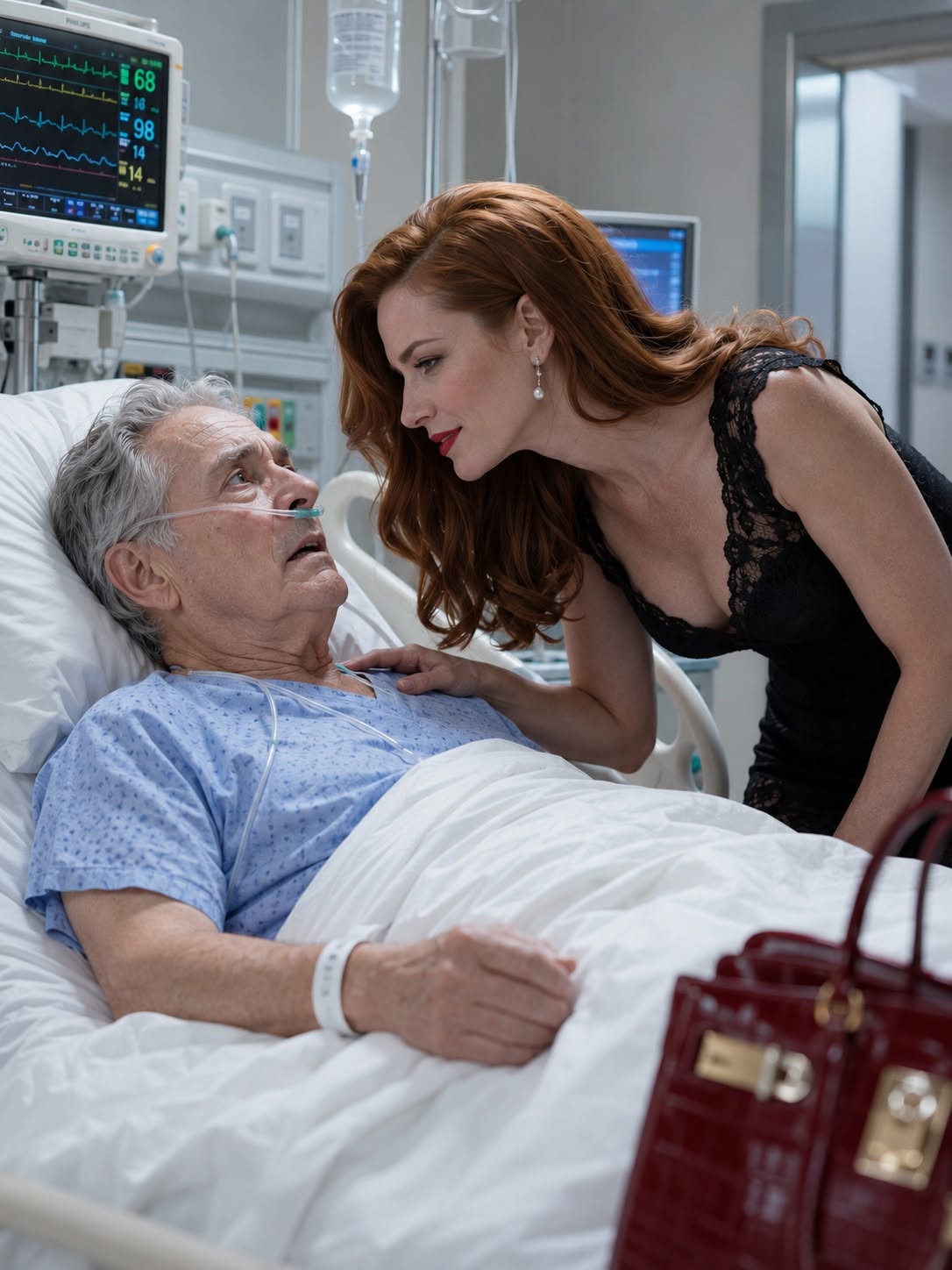
“You are finally going to die, Roderick. I am so sick of pretending to love you.”
Roderick Benedict opened his eyes just enough to make out his wife’s face leaning over his hospital bed. Outside, heavy rain lashed the high-rise windows of St. Jude Memorial Hospital in downtown Baltimore. Inside the room, the heart monitor tapped out a faint, erratic rhythm.
Earlier that morning, the cardiologist had spoken to the nurse just outside the door, believing Roderick was fast asleep.
“He has five days, maybe less,” the doctor had whispered. “The damage to his heart tissue is simply too extensive.”
Roderick was fifty-six years old. He owned a commercial furniture manufacturing plant in Detroit, a sprawling estate in Bethesda, two luxury downtown condos, and liquid accounts totaling over $82 million. He also had a wife sixteen years his junior named Demi who was elegant, attentive, and seemingly devoted.
Or so he had believed for four years.
Demi checked to ensure the door was firmly shut, then turned back to him with a slow, cold smile. It was not the sweet, worried expression she wore in front of the medical staff. It was icy, triumphant, and completely devoid of warmth.
“Your factory, your properties, your stock portfolio… all of it will be mine,” she murmured, her voice dripping with venom. “Gareth and I have already picked out a home in San Diego. You worked your entire life like a dog, and we are going to enjoy every last cent of it.”
Roderick attempted to speak, but only a dry, rasping gasp escaped his throat.
“Don’t strain yourself, my dear,” Demi said softly, leaning down even closer. “The digoxin did its job smoothly. In tiny doses, it helps a weak heart. In the wrong doses, it slowly destroys it. Do you remember those daily heart supplements I brought you every single night? You never questioned a thing because you trusted me far too much.”
The heart monitor’s steady tone accelerated slightly. Demi rested a manicured hand on his chest, pretending to soothe him while enjoying his panic.
“Calm down, sweetheart,” Demi whispered with a soft chuckle. “Don’t go dying on me before I finish saying goodbye.”
She pulled out a compact, touched up her lipstick, kissed him lightly on the forehead, and added her final words.
“The funeral service will be brief and private,” she remarked coldly. “It would be absurd to waste good money on a dead man when I have a new Porsche to buy.”
When she finally walked out, Roderick stared at the ceiling as tears welled in his eyes. He was not crying out of fear of death. He was crying because every tender touch, every soft embrace, and every affectionate phrase over the past four years had been a cold, calculated performance.
Minutes later, Brandon Robbins entered the room quietly. Brandon was a twenty-five-year-old orderly who often went out of his way to help Roderick without ever being asked. Dark circles dragged beneath the young man’s tired eyes.
“Evening, Mr. Benedict,” Brandon said quietly as he adjusted the heavy blanket. “Can I get you some fresh water?”
Roderick remembered hearing the nurses talk about Brandon in the hallway. The young man worked double shifts at the hospital and took night shifts loading delivery trucks because his fourteen-year-old sister, Sierra, suffered from a severe congenital heart defect. She desperately needed specialized reconstructive surgery, which was an operation costing $2.4 million that was an impossible sum for their family.
“Come closer, Brandon,” Roderick rasped, gathering all his remaining strength. “I want to make you a proposal.”
Brandon frowned slightly and looked genuinely concerned. “Mr. Benedict, if this is about extra care, I am happy to help you for free.”
“I do not do anything illegal, sir,” Brandon added quickly, wanting to be clear.
“That is precisely why I chose you,” Roderick said, his voice strengthening through sheer force of will. “Call my attorney immediately because tomorrow morning, I am changing my will.”
Brandon thought the dying man was delirious, until Roderick unlocked his smartphone with a trembling thumb and showed him his bank portals, corporate deeds, and asset portfolios.
“I am leaving everything to you,” Roderick stated firmly. “In exchange, you save your sister’s life, and you use what remains to do something good in this world. My wife is murdering me, and if my fortune falls into her hands, evil wins.”
Brandon backed up a step, completely stunned. “Mr. Benedict, I do not even know you.”
“I know enough about you,” Roderick replied earnestly. “You work sixteen-hour days hauling linen and trash to pay for your sister’s medication, while my wife poisoned me to buy a mansion on the coast. Tell me which of you deserves to decide what happens to my life’s work.”
Brandon stood frozen for several seconds while processing the gravity of the choice. Finally, he pulled out his phone to make the call.
At ten o’clock the following morning, a man in a lab coat entered the room, pretending to be a consulting specialist. Inside his leather briefcase was a notarized estate protocol, a digital video recorder, and the legal document that would incinerate Demi’s plans.
Roderick took the pen with a shaking hand.
While his wife was sipping mimosas at a hotel downtown celebrating his imminent demise, Roderick signed a document that neither she nor her lover could have ever anticipated.
PART 2
Roderick’s longtime attorney, Jace Carlton, had managed his corporate and personal legal affairs for twelve years. To prevent any suspicion from hospital administration or Demi, Jace arrived alongside a board-certified physician who officially verified that Roderick was fully conscious, mentally coherent, and acting entirely of his own free will. Joining them as witnesses were Teresa Pearson, the chief financial officer of Roderick’s manufacturing firm, and Seth Rosales, Roderick’s trusted former business partner.
Jace read the schedule of assets aloud to everyone in the room.
“The manufacturing plant in Detroit, the Bethesda estate, the two downtown condos, vehicles, investment portfolios, and cash accounts total an estimated value of $82.3 million,” Jace announced clearly.
“Everything is to be placed into a trust managed by and designated to Brandon Robbins,” Roderick affirmed clearly. “Demi is to receive nothing, and if it is proven that she contributed to my death, turn this recording directly over to the State’s Attorney and the FBI.”
Brandon looked at Roderick, completely overwhelmed by the sudden turn of events.
Roderick gestured toward his smartwatch resting on the bedside table. He had activated the audio recorder the moment Demi had leaned over his bed days prior. Her confession, the explicit mention of digoxin, her lover Gareth, and the house in San Diego were all captured in high-definition digital audio.
Jace secured a copy on an encrypted flash drive, sealed the revised will, and promised to notify the authorities the second Roderick passed away. Brandon tried to object once more out of humility, but Roderick squeezed the young man’s wrist with surprising force.
“You are not inheriting a fortune for luxury, Brandon,” Roderick whispered earnestly. “You are inheriting a solemn duty.”
Three days later, at dawn, Roderick Benedict passed away.
Demi received the call from the hospital at 6:20 AM while Gareth was sleeping beside her in the master bedroom of Roderick’s Bethesda home. She listened to the nurse’s solemn condolences, hung up the phone, and let out a triumphant laugh.
“It is finally done,” she said gleefully, pouring two full glasses of expensive champagne. “He is gone for good.”
She organized a quick, cheap memorial service to save money. In front of Roderick’s factory managers and acquaintances, she put on a grand performance of grief, though beneath her black lace veil, she did not shed a single genuine tear. Looking across the funeral chapel, she noticed Brandon standing quietly near the back doors and felt a sudden, inexplicable flicker of unease.
“Why is that orderly attending my husband’s service?” Demi muttered to Gareth.
“He is probably just looking for a handout or paying basic respects,” Gareth whispered back smoothly. “Ignore him.”
One week later, the formal reading of the estate was summoned at Jace Carlton’s downtown law office.
Demi arrived wearing a designer black dress, accompanied by Gareth and a high-priced probate lawyer. Brandon was already seated inside the glass-walled conference room next to Teresa and Seth.
Jace opened the thick red leather binder and cleared his throat.
“By express directive of the late Roderick Benedict, executed six days prior to his passing, the entirety of his estate, assets, and corporate holdings pass exclusively to Mr. Brandon Robbins,” Jace declared firmly.
Demi stared at the attorney, her mind completely failing to process the words.
“To an orderly?!” she shrieked hysterically, slamming her hands on the mahogany table. “I am his lawful wife! This is an absolute outrage! He was completely out of his mind!”
“The revised trust was executed with a full psychiatric evaluation, a board-certified physician’s signature, and continuous video documentation,” Jace replied coldly. “Furthermore, there is evidence that necessitates a formal criminal investigation into Mr. Benedict’s cause of death.”
Jace pressed a small button on his desk console.
Demi’s voice filled the room through the ceiling speakers: “I am so sick of pretending to love you… The digoxin did its job… Gareth and I are going to enjoy every last cent of it.”
Gareth’s face went dead white instantly. Demi lunged across the desk toward the recorder, but Seth stepped forward and blocked her path.
“That audio recording is a complete fake!” Demi screamed wildly, her voice cracking. “It was generated by artificial intelligence!”
“The State Police and the Medical Examiner’s office will make that legal determination,” Jace said calmly. “The hospital has already handed over forensic toxicology samples, and search warrants for your pharmacy records, bank accounts, and digital communications are being processed right now.”
Demi stormed out of the office, her high heels clicking furiously against the polished marble floor. In the parking garage below, she grabbed Gareth by his lapels and shoved him hard against his sports car.
“You said he could not possibly suspect anything!” she hissed angrily.
“We can contest the trust in court!” Gareth stammered nervously, sweating through his expensive shirt. “We hire litigators and drag this out for years!”
“And what happens if the toxicology report comes back positive?” Demi demanded sharply.
Gareth looked up through the windshield, spotting Brandon walking toward the elevator doors in the garage.
“Then we make the orderly sign a full waiver and walk away,” Gareth whispered darkly. “Or he does not survive long enough to inherit a single dime.”
That night, Brandon sat by his sister’s hospital bed at the city pediatric unit and told her she was going to get her life-saving surgery. Sierra cried tears of joy, pressing her face gently into his shoulder. For the first time in years, their mother spoke about the future without crying.
However, six days later, as Brandon was walking home from his graveyard shift at the hospital, a black SUV pulled up along the curb. Two men wearing ski masks leaped out, dragged him into a dark alley, and beat him relentlessly, fracturing three of his ribs and leaving him bleeding on the cold pavement.
Before sprinting back to the vehicle, one of the men knelt over Brandon, pressing a heavy boot against his bruised chest.
“Sign the estate renunciation papers tomorrow,” the man growled maliciously. “Or next time, we pay a personal visit to your little sister’s hospital room.”
Brandon dragged himself toward the street and managed to dial 911. As the police sirens echoed in the distance, his bloody hand brushed against a cell phone on the asphalt that had been dropped by one of his attackers during the violent struggle.
The screen was still illuminated.
A text message had just flashed onto the lock screen from an unsaved number: “Make sure he gets the point tonight. If he still refuses to sign the waiver, you know what to do with the kid at the hospital.”
PART 3
Brandon woke up in the trauma unit with his torso tightly bandaged. Detective Elaine Patton from the Baltimore Police Department was seated beside his bed, holding the dropped cell phone inside a clear evidence bag.
“The phone belonged to a low-level enforcer named Carl Henderson, who was hired for quick muscle,” Detective Patton said softly. “The device gave us location logs, Venmo transfers, and encrypted text threads that lead straight back to Gareth.”
Brandon winced in pain as he tried to sit up. “Detective, they explicitly threatened my sister.”
“We already have two plainclothes officers stationed outside Sierra’s room,” Detective Patton assured him firmly. “No one is getting anywhere near her, so tell me everything from the beginning.”
Brandon recounted Roderick’s confession, the secret audio recording, and the altered will. Detective Patton confirmed that the county coroner’s toxicology report had just come back, revealing that Roderick’s heart tissue contained lethal, accumulated concentrations of digoxin. It was not a sudden medical error, but a systematic, multi-month poisoning.
By noon, search warrants were executed at Demi’s Bethesda mansion, Gareth’s luxury apartment, and the private gym Gareth owned. In Demi’s master bathroom, crime scene techs recovered six empty prescription bottles for digoxin, forged prescription pads, and a handwritten journal detailing dates, dosages, and Roderick’s daily pulse rates. On her laptop, forensic investigators recovered search histories regarding heart toxicity, untraceable poisons, and probate law.
On Gareth’s phone, investigators uncovered text threads where the pair planned to sell Roderick’s manufacturing plant, liquidate his stock portfolio, and relocate permanently to California. There were also texts sent after the reading of the will.
“That damn orderly stole our life,” Demi had written in a fury.
“It is being handled as we speak,” Gareth had replied coldly.
Detective Patton showed Brandon a photo recovered from Gareth’s cloud account, which was a long-lens photograph of Sierra leaving her cardiology clinic two days prior.
“They were actively stalking your family,” Detective Patton said grimly. “Which means we are arresting them immediately.”
Demi was arrested that afternoon while receiving an expensive facial at an upscale spa downtown.
“This is an outrageous mistake!” she shrieked hysterically as officers pulled her arms behind her back. “My attorneys will have every single one of you fired for this!”
“You are under arrest for first-degree murder, conspiracy to commit murder, and solicitation of aggravated assault,” Detective Patton stated coldly while snapping the handcuffs shut.
Gareth was captured at his gym shortly after. He tried to sprint out the back emergency exit, but two armed state troopers were waiting in the alley. Inside his office locker, officers recovered $18,000 in cash and a folder containing personal details regarding Brandon, his mother, and Sierra’s medical schedule.
Faced with federal extortion and conspiracy charges, the two hired attackers quickly flipped on Gareth, agreeing to testify against him in exchange for a plea deal. They confirmed that Gareth had paid them $10,000 to assault Brandon and had explicitly instructed them to kidnap Sierra if Brandon refused to surrender the trust.
The legal proceedings spanned five grueling months.
Demi’s high-priced defense team attempted to suppress the audio recording, claiming Roderick was delirious from medication and that Brandon had taken advantage of a dying, confused man. However, audio forensics verified the recording was completely authentic, unedited, and clear. The physician who witnessed the signing testified under oath that Roderick was entirely lucid, articulate, and resolute. The notary’s video recording showed Roderick clearly listing his assets, explaining his motives, and executing the documents without an ounce of coercion.
Teresa Pearson, the company CFO, presented financial records showing that Demi had already fraudulently transferred $400,000 from a shared account into a shell company registered to Gareth prior to Roderick’s death.
During the trial, the gallery was packed with hospital employees, reporters, and families of children with congenital heart conditions who had followed the story on the news.
Demi arrived at court in a tailored suit, her hair meticulously styled, refusing to look in Brandon’s direction. Gareth sat beside her, looking frail and terrified compared to his gym photos.
The prosecutor played the audio recording for the jury: “You are finally going to die, Roderick.”
Demi’s cold, mocking voice echoed through the silent courtroom.
Next came the evidence photos showing the empty pill bottles, the journal detailing exact dosages, and the text messages orchestrating the hit on Brandon. An expert toxicologist testified that Roderick had not suffered a natural cardiac arrest, but an agonizing, protracted chemical execution.
When Brandon took the stand, Demi’s defense attorney tried aggressively to corner him.
“Mr. Robbins, did Mr. Benedict offer you an enormous sum of money to accuse his wife?” the attorney asked slyly.
“No, sir, he did not,” Brandon replied calmly.
“He left you over $82 million, so you directly benefited from his death, did you not?” the attorney pressed.
Brandon took a steady breath and looked the attorney dead in the eye.
“I would have benefited far more if Roderick Benedict had lived,” Brandon answered firmly. “If he were alive today, he could have testified in court, taken back his company, and seen my sister walk out of the hospital after her surgery. Money does not replace a human life.”
The attorney tried to cut him off quickly, but the judge overruled the objection.
“Mr. Benedict did not ask me to lie,” Brandon continued, his voice ringing clearly across the courtroom. “He asked me not to let his murder reward the people who killed him, and I would have gladly gone back to scrubbing hospital floors for the rest of my life if it meant Roderick did not have to die listening to his wife mock him while he lay helpless.”
Demi lost her composure completely and leaped from her chair. “You opportunistic little thief! That money was mine!”
The judge slammed her gavel down hard, ordering Demi to be restrained by bailiffs.
That dramatic outburst sealed her fate. She did not say she loved her husband, nor did she claim to be innocent, because her only true concern was the stolen fortune.
Realizing he was facing life in prison for his involvement in the murder plot and the attempted kidnapping of a minor, Gareth agreed to cooperate with the prosecution. He admitted on the stand that Demi had initiated the poisoning, sourced the forged prescriptions, hired the attackers, and selected the mansion in San Diego.
Demi glared at him fiercely, calling him a pathetic coward from the defense table.
“You were in on it from day one!” she spat angrily. “You picked out the house with me!”
“Because you promised me we would never get caught!” Gareth yelled back in desperation.
The prosecution submitted its final piece of damning evidence, which was a text message sent by Demi the night before Roderick died: “He might pass tonight. If he drags it out past tomorrow, I am doubling the dose.”
The jury deliberated for less than two hours.
Demi Benedict was found guilty of first-degree murder for financial gain, criminal conspiracy, and solicitation of felony assault. She was sentenced to life in prison without the possibility of parole. Gareth was convicted of murder conspiracy, attempted kidnapping, and extortion, receiving thirty-two years in state prison.
As she was led away in heavy chains, Demi turned to Brandon, her face twisted in rage. “You took everything from me!”
Brandon looked at her with quiet pity. “No, Demi. You lost everything the moment you decided a man’s life was worth less than a house on the beach.”
The revised trust was declared completely valid by the court, and Demi was legally barred from receiving any portion of the estate under the slayer rule. Six months later, Brandon officially assumed stewardship of Roderick’s vast assets.
He did not celebrate the wealth.
The very first check he authorized was to St. Jude Memorial Hospital for Sierra’s complex heart reconstruction surgery.
The operation was scheduled for six hours, but unexpected complications stretched it to nearly nine. Brandon walked the hospital corridors so many times he memorized every single tile on the floor while his mother sat in the waiting room praying softly.
When the chief pediatric surgeon finally stepped out, he pulled off his surgical cap and smiled warmly.
“It was complicated, but she pulled through,” the doctor announced happily. “We repaired the defect, and her heart is beating strong on its own.”
Brandon covered his face with his hands and wept. For years, he had worked sixteen-hour days, sold his car, taken out predatory loans, and held neighborhood raffles without ever coming close to the money needed to save his sister. Now, Sierra was going to live because a dying man, in his final hours, had turned an ultimate betrayal into a lasting legacy of hope.
During her first night of recovery, Sierra opened her eyes and reached for her brother’s hand. She could not speak through her oxygen mask, but she tapped out a slow, steady rhythm on his wrist to show him she was okay.
Her recovery was long and difficult, involving months of intensive physical therapy and medication. However, three months later, she walked out of the hospital under her own power. Six months later, she returned to school, and one year later, she ran in a local 5k fun run.
Brandon met her at the finish line, tears streaming down his face as he wrapped her in a warm hug.
“I did not win first place,” she panted, laughing happily.
“You finished the race,” Brandon said gently. “That is the only win that matters.”
The remaining fortune was vast, but Brandon remembered Roderick’s exact words: “Use what remains to do something good.”
He sold the Bethesda estate and one of the downtown condos, using the proceeds to buy a modest, comfortable home for his mother near the hospital. He retained the manufacturing plant in Detroit, but established a generous profit-sharing program and guaranteed full health benefits for every single worker. Teresa Pearson remained on as chief financial officer, guiding the company’s operations smoothly.
With the investment portfolio, Brandon established the Roderick Benedict Pediatric Heart Foundation, an endowment dedicated to fully funding life-saving cardiac surgeries for children whose families could not afford care.
At first, financial executives and board members looked at the former orderly with skepticism. Brandon still wore simple clothes and took public transit to board meetings. Some attempted to charge inflated management fees, but Teresa quickly put an end to it.
“Having a good heart does not mean he is naive,” she reminded them sternly.
In its first year, the foundation funded twelve pediatric surgeries. Brandon visited every single family in the hospital, listening to mothers who had sold their furniture and fathers working three jobs just to keep their children alive. In every story, he saw the exhaustion his own family had endured.
In its second year, the foundation funded forty-five surgeries. By its fifth year, more than three hundred children had received life-saving procedures. Donations began pouring in from regional business leaders, physicians, and citizens who had read about Roderick’s story in the news. The factory workers in Detroit organized an annual fundraising drive and installed a brass plaque at the plant entrance: “In memory of Roderick Benedict, who in his final hours decided that his legacy would save hundreds of lives.”
Brandon also located Roderick’s estranged son, Bradley, who lived in Minneapolis and had not spoken to his father in over fifteen years due to a long-standing falling out. Brandon wrote to him, detailing everything that had transpired, and offered to hand over Roderick’s personal journals, family photos, and sentimental belongings.
Bradley flew to Baltimore a month later.
He was a quiet, reserved man of thirty-six, bearing his father’s sharp jawline and serious eyes. Standing in the foundation’s headquarters, Bradley looked at a portrait of his father hanging on the wall.
“I spent fifteen years being angry at him,” Bradley admitted softly. “I thought he cared more about building his business empire than being a father.”
“Maybe he did for a long time,” Brandon replied gently. “But at the very end, he tried to fix it.”
Bradley refused to challenge the trust. Instead, he asked only for his father’s pocket watch and a wooden box of unsent letters Roderick had written to him over the years. After reading them, Bradley joined the foundation’s advisory board, contributing annually to fund pediatric heart care in his father’s honor.
Five years after Roderick’s passing, the Roderick Benedict Pediatric Heart Foundation had saved over five hundred children. In the main hallway of the foundation’s office, a wall was covered in framed photographs of kids riding bicycles, teenagers holding high school diplomas, and infants sleeping peacefully in their mothers’ arms.
Sierra, now nineteen and thriving, walked into Brandon’s office one afternoon holding an official letter.
“I got accepted into pre-med,” she announced, her eyes shining with joy. “I am going to be a pediatric cardiologist.”
Brandon stood up and pulled his sister into a tight embrace.
“Mr. Benedict would be incredibly proud of you,” Brandon whispered emotionally.
“He would be proud of you, too,” Sierra replied softly.
That evening, Brandon sat alone in his office as rain tapped gently against the windowpane, much like the night he had sat beside Roderick’s hospital bed. Resting on his desk was a small framed photograph of the late businessman.
“We did it, Roderick,” Brandon said quietly into the still room. “Your life’s work did not buy a house on the beach, but it bought time, surgeries, birthdays, and bright futures.”
He thought briefly of Demi and Gareth, sitting in cold prison cells for turning love into a weapon and illness into a business transaction. True justice was not just seeing them punished; it was hearing the laughter of healthy children running through the hospital halls.
Roderick Benedict had lost his family while chasing wealth. But in his final act on earth, he chose a different path by placing his trust in a stranger who knew the true value of a human life.
Roderick’s fortune could not save his own heart.
In the end, however, it saved hundreds of others.
And that was the only inheritance that truly mattered.
THE END.