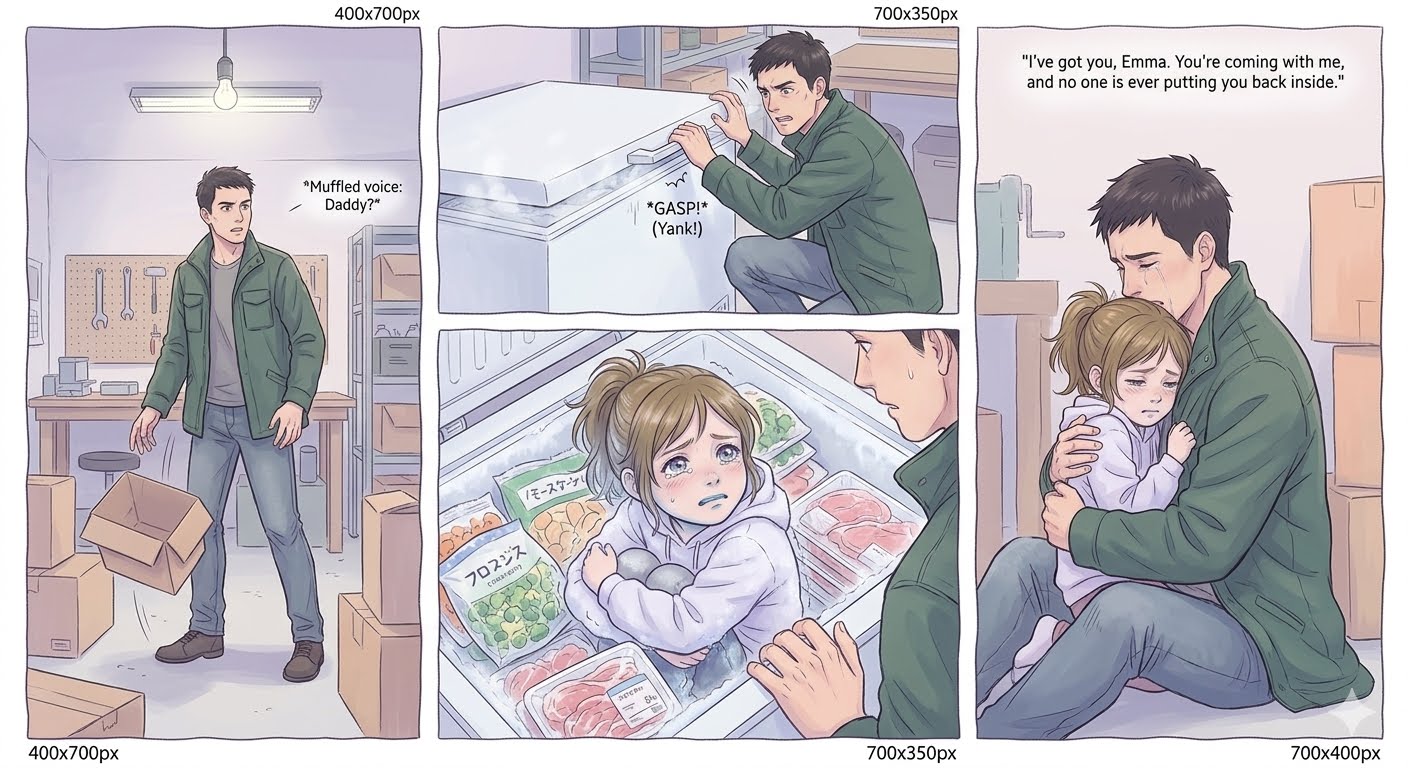
- Lorraine stepped forward, her voice rising in frantic agitation. “This is completely ridiculous! She is simply repeating some absurd story she saw on television!”
- The paramedic nearest her immediately moved into her path, his posture firm. “Ma’am, please step back and remain where you are until the sheriff’s deputies arrive.”
- From inside the cab, Emma pressed her small body closer to me and whispered, “She… she does it whenever Mommy goes away.”
- I had braced myself for a single act of cruelty—horrifying, but isolated. But my daughter’s frail whisper unlocked something infinitely darker.
- “What do you mean, sweetheart? What else does she do?”
- Emma stared down at the floorboards of the truck, her tiny hands twisting her sleeves. “Sometimes she locks me in the pantry when I talk too much. Sometimes she makes me stand alone in the dark basement when I cry. The freezer is for when I am very bad.”
- A cold sickness rushed through my stomach.
- In an instant, a dozen unsettling memories from the past six months snapped into terrifying clarity: Emma suddenly refusing an ice pop at my apartment, claiming she was terrified of the freezer door; her hysterical panic when I accidentally shut a towel closet door; her nervous habit of chewing her sleeves; and the night terrors where she woke up sobbing that she couldn’t find the handle.
- Every single time, Rebecca had brushed it off as a normal, behavioral reaction to the stress of our divorce. And I had swallowed those explanations because I was terrified that pushing back would trigger another explosive custody battle.
- Now, my five-year-old daughter sat shivering in my winter coat, receiving medical treatment for severe cold exposure caused by a system of torture she described as normal.
- Two sheriff’s deputies pulled into the cul-de-sac minutes later. They immediately separated Lorraine from us and began taking independent statements. Lorraine clung frantically to her story, insisting Emma must have slipped past her and climbed into the freezer while playing.
- A deputy walked into the garage to examine the scene. The chest freezer stood nearly four feet tall, and several heavy plastic storage bins were stacked directly in front of it. A five-year-old child could not have physically entered it without moving those bins.
- More damningly, a heavy-duty sliding metal latch had been bolted near the top handle.
- It was a lock that could only be secured from the outside.
- The Hospital Examination
- Emma was transported by ambulance to a specialized children’s hospital in Colorado Springs. I rode in the back beside her, holding her hand while she clung tightly to two of my fingers.
- Her core body temperature was dangerously low, but she remained conscious and responsive. The ER physician pulled me aside to explain that if I hadn’t opened that garage door when I did, the cold exposure would have proven fatal within hours.
- Rebecca arrived nearly an hour later. She swept into the trauma room wearing a expensive evening coat over a black dinner dress, with her brother Jason trailing several paces behind her.
- “What on earth did you do to her?!” she demanded, her voice sharp with anger.
- The sheer audacity of the question left me speechless. “I didn’t do anything, Rebecca. I found Emma locked inside your garage freezer.”
- Rebecca turned her glare toward our daughter. “My mother told me Emma had a meltdown and climbed inside during a tantrum!”
- Emma immediately pulled her hospital blanket up and turned her face toward the wall.
- I stepped into Rebecca’s line of sight, keeping my voice low and dangerously steady. “Your mother installed an external slide bolt on the freezer door. Emma told the paramedics this isn’t the first time she’s been locked inside it.”
- Rebecca crossed her arms, her jaw set. “Young children misunderstand discipline all the time, especially when adults feed them leading questions!”
- The attending physician stepped firmly between us. “Ma’am, no one here conducted a leading interview. Your daughter spontaneously disclosed this information to first responders while being treated for severe hypothermia.”
- Rebecca’s face flushed red. “My mother would never hurt her!”
- On the bed, Emma began pulling the sheets over her head, shrinking into a ball. I moved to her side immediately. “Emma, you don’t have to listen to this, and you don’t have to say another word while you’re scared.”
- Rebecca sneered at me. “You’ve been waiting for a reason to turn her against my family!”
- Before the argument could escalate further, a hospital social worker entered accompanied by a uniformed officer. She politely but firmly requested that Rebecca and Jason wait in the lobby while the medical team completed Emma’s child protection evaluation.
- The physician carefully documented the evidence: mild hypothermia, deep red pressure marks around Emma’s left wrist, and older bruises in various stages of healing that were completely inconsistent with normal childhood play. Together, the findings triggered a mandatory state abuse report.
- A child protection investigator arrived before midnight. Rather than forcing Emma to recount the trauma again, she scheduled a formal, recorded forensic interview for the following morning.
- Emma was admitted overnight for monitoring. By morning, an emergency protective order was granted, placing her officially in my care upon discharge until a family court judge could review the criminal findings.
- Rebecca was waiting in the hallway when the investigator delivered the order.
- “You cannot take my child from me because of one tragic misunderstanding!” Rebecca cried out.
- “This is not a misunderstanding, Mrs. Carter,” the investigator replied calmly. “The physical evidence, the medical evaluation, and the child’s disclosures require immediate protective custody.”
- Rebecca whirled on me, her eyes burning with hatred. “You planned this! You showed up outside the schedule just to manufacture an emergency and re-open our custody agreement!”
- For months, I had carefully censored every word I spoke to Rebecca, terrified of being labeled a high-conflict father. That fear vanished entirely.
- “I showed up to collect cardboard boxes, Rebecca. I stayed because my daughter was screaming for help from inside a sealed freezer. Whatever happens to you and your mother next is the consequence of what investigators find—not a story either of us invented.”
- The Camera Nobody Remembered
- The next morning, detectives executed a search warrant at the house. They took high-resolution photos of the freezer, the external sliding latch, the stacked storage containers, the dark pantry, the basement stairs, and a set of handwritten “discipline charts” Lorraine kept tucked inside a kitchen drawer.
- The chart listed ordinary childhood behaviors next to horrific consequences:
-
Talking back = Pantry time.
-
Crying after bedtime = Basement reflection.
-
Failing to obey immediately = Cold time.
- Rebecca claimed under oath that she had never seen the chart. Lorraine insisted the written rules were merely “theoretical parenting concepts” she had jotted down, not actual punishments.
- Then, a forensic detective discovered an old smart-doorbell and security system I had installed three years prior.
- During the divorce, Rebecca had changed the master account password and claimed she had dismantled the cameras. She hadn’t. The garage camera was still actively uploading motion-triggered clips to a cloud server tied to an old shared family email address.
- Detectives subpoenaed the cloud servers. While the camera angle didn’t capture the interior of the freezer directly, the footage established a damning, systematic pattern.
- On multiple recorded afternoons over the past four months, Lorraine could be seen pulling a crying Emma into the garage by her wrist. Minutes later, Lorraine would re-enter the house alone and close the door. Emma would not reappear on camera for ten, fifteen, sometimes twenty minutes.
- The footage from Thursday night was the most damning of all.
- At 8:41 PM, the camera captured Lorraine dragging Emma into the garage. The five-year-old fought back desperately, clinging to the doorframe with both hands. Lorraine cold-bloodedly pried her tiny fingers off the frame one by one, carried her toward the back wall, and disappeared off-angle.
- At 8:44 PM, Lorraine walked back into the house alone.
- She did not step foot in the garage again until I opened the main door at 9:37 PM.
- Emma had been locked inside an operating freezer for fifty-three minutes. Lorraine’s claim of a “ten-minute accident while folding laundry” fell apart instantly.
- Furthermore, the indoor security hub picked up crisp ambient audio from the kitchen doorway. Lorraine’s ice-cold voice could be heard clearly through the door: “You will stay in there until you learn that throwing tantrums doesn’t control adults.”
- When Rebecca’s criminal defense attorney showed her the video footage inside the investigator’s office, Rebecca reportedly became physically sick.
- I took no satisfaction in her breakdown. I felt only a profound, burning rage that it took hard video evidence before my daughter’s terror was finally believed.
- The Things Rebecca Had Chosen Not to See
- The forensic interview took place in a child-friendly facility equipped with specialized interviewers. I watched from behind a one-way mirror alongside the lead detective, fighting back tears as my daughter spoke.
- Emma quietly described a reign of fear that had begun months before the divorce was finalized.
- Lorraine locked her in the pantry whenever she asked when I was coming home. She forced Emma to hold heavy books above her head for interrupting adults. She had used the freezer punishment several times before, though those instances had been shorter.
- Most devastatingly, Emma revealed that her mother had witnessed at least one of the pantry punishments.
- According to Emma, Rebecca had opened the pantry door, engaged in a hushed, heated argument with Lorraine, but then turned to Emma and told her that “Grandma’s rules are strict because you need to learn discipline.”
- That disclosure didn’t prove Rebecca was a monster who wanted her child abused; it proved something almost as terrible. It proved she had seen the smoke, smelled the fire, and deliberately closed her eyes because relying on her mother was easier than facing the truth.
- At the emergency custody hearing, Rebecca’s attorney argued that his client worked exhausting hours and relied on Lorraine for childcare during a messy divorce.
- My attorney didn’t paint Rebecca as a monster. She simply presented the cold facts: Rebecca had repeatedly ignored clear warning signs, dismissed her child’s terror, and handed her daughter over to a predator.
- The judge granted me immediate, sole legal and physical custody. Rebecca was restricted to short, supervised visitation sessions pending a full psychological evaluation and her cooperation with law enforcement.
- Lorraine was arrested and formally indicted on felony charges of aggravated child abuse, unlawful confinement, and reckless endangerment. A permanent protective order was issued, barring her from ever coming within 1,000 feet of Emma.
- Outside the courthouse, Rebecca approached me while our attorneys stood nearby.
- “I swear to you… I truly didn’t know about the freezer,” she sobbed.
- I believed her about the freezer. “But you knew she was terrified of your mother, Rebecca.”
- Rebecca looked down at her shoes. “Mom told me Emma was just exaggerating to get out of being punished…”
- “Emma was five years old,” I said, my voice heavy with grief. “Your mother was the adult. You were supposed to be her shield.”
- Tears streamed down her face. “If I fought with my mother, she threatened to stop helping me! I couldn’t handle everything on my own after the split!”
- The confession was raw, pathetic, and devastatingly honest.
- “You protected your childcare arrangement,” I said softly, “because keeping your mother happy made your life easier.”
- “I never wanted her hurt!”
- “Wanting to protect your child and actually doing it are not the same thing.”
- Rebecca covered her face with her hands and sobbed as I walked away.
- Learning That Warmth Could Be Safe
- Emma moved into my two-bedroom apartment with a suitcase, a couple of stuffed animals, and an overwhelming terror of closed doors.
- For the first few months, every interior door in my apartment had to remain propped open. I unplugged the main kitchen freezer in front of her, storing our ice cream in a small countertop mini-fridge that opened with a light tug.
- Through intensive child trauma therapy, Emma began learning how to process her fear. Her therapist explained to me that children who suffer severe, arbitrary abuse often become hyper-vigilant, believing that total, silent obedience is their only shield against harm.
- Emma apologized constantly—for spilling a few drops of water, for dropping a crayon, for laughing too loudly, or for crying when a nightmare woke her.
- Every single time, I knelt beside her and repeated the same steady truth:
- “Accidents just mean we clean up together, sweetheart. Not punishment.”
- “Questions just mean we talk. Not darkness.”
- “Crying just means you need a hug. It never means you are bad.”
- Progress was measured in tiny, agonizingly slow steps.
- One evening, while we were making dinner, I opened the refrigerator to get out some milk. Emma, standing near the counter, froze—but she didn’t run out of the kitchen.
- A week later, she walked over and touched the handle herself.
- The day she finally summoned the courage to pull the door shut, she immediately pulled it back open to prove to herself that she could.
- “The handle opens from the inside,” she whispered, testing it.
- “That’s right,” I said softly. “And no one is ever allowed to put you anywhere you can’t leave.”
- She looked up at me, her big eyes searching mine. “Even if I’m really bad?”
- I knelt down and pulled her into a warm hug. “You might make mistakes sometimes, Emma, but you are never a bad child. Ever.”
- A subtle shift occurred in her face—as if an invisible weight she had carried for years had finally been lifted from her shoulders.
- The Trial and the Truth
- Lorraine’s criminal trial unfolded over the following year. The prosecution’s case was airtight, anchored by the garage video footage, the handwritten punishment charts, medical records, and shocking testimony from two former babysitters who recalled Emma screaming whenever Lorraine arrived at the house.
- One babysitter testified that she had raised concerns with Rebecca after hearing Lorraine explicitly threaten to “lock Emma in the dark basement until she learned her place.” Rebecca had dismissed the babysitter’s warning as an absurd exaggeration.
- That testimony shattered Rebecca’s standing in family court. It proved a long, undeniable pattern of ignored warnings.
- Throughout the trial, Lorraine maintained a cold, self-righteous defense, insisting she was merely using “traditional, firm discipline” and never intended physical harm.
- During cross-examination, the prosecutor looked Lorraine dead in the eye and asked, “Does an adult require medical training to understand that locking a five-year-old child inside a sub-zero commercial freezer for an hour could kill her?”
- Lorraine had no answer.
- The jury returned a unanimous verdict in less than two hours: guilty on all counts. The judge sentenced her to significant state prison time, mandatory psychiatric treatment, and a lifelong, non-expiring protective order prohibiting any contact with Emma.
- Rebecca avoided criminal charges, but the family court mandated years of supervised visitation, parenting classes, and therapy before she could ever be considered for unmonitored access.
- For a long time, Rebecca focused bitterly on the anger of losing custody. But slowly, through therapy, her posture softened. She stopped claiming I had “stolen” Emma from her and finally acknowledged the horrific reality of what had happened under her roof.
- During one supervised visit, Rebecca sat across from our daughter and said through tears, “Emma… I should have listened to you when you told me you were scared. It was my job to keep you safe, and I failed you. I am so, so sorry.”
- Emma didn’t run to hug her. She simply listened, letting the silence sit between them.
- Then, she asked quietly, “Will Grandma ever come back?”
- “No,” Rebecca promised, her voice breaking. “I will never let her near you again as long as I live.”
- It was the first promise Rebecca had made in years that Emma seemed to truly believe.
- The Boxes I Had Gone to Collect
- Nearly eighteen months after that terrible night, the marital home was put up for sale. Rebecca could no longer afford the mortgage, and neither of us wanted Emma to ever set foot near that property again.
- Before the closing, attorneys arranged one final, supervised hour for me to collect the remaining personal boxes I had driven over to fetch nearly two years prior.
- Most of the cartons contained items I no longer cared about. Old college textbooks went to the library; winter coats went to a homeless shelter. The framed family photographs took longer to sort through, because admitting a marriage ended disastrously doesn’t instantly erase every good memory.
- At the very bottom of the last box, I found a crayon drawing Emma had made when she was four. It depicted three little figures holding hands under a bright yellow sun next to the maple tree in the front yard.
- Across the top, in clumsy primary-school lettering, she had written: My Safe Family.
- I almost threw it into the trash bin. Instead, I tucked it into my coat and brought it home.
- That evening, I showed the picture to Emma. She studied the drawing for a long time, her small finger tracing the yellow sun.
- “That was from before the freezer,” she said softly.
- “Yes, sweetheart.”
- “Daddy… was our family never really safe?”
- The question cut deeper than any blade. It required complete honesty, not just comforting platitudes.
- “The love I have for you was always real, Emma,” I told her, holding her close. “But some of the adults in your life failed to make our home as safe as you deserved. And I am so sorry I didn’t see it sooner.”
- She looked at the drawing, then up at me. “Can I fix it?”
- I handed her a fresh box of markers.
- Emma set to work. She carefully drew a new, cozy apartment building next to the old house, complete with a big, bright front door drawn wide open. Then, she drew a little figure of herself standing right beside a figure of me inside the new building.
- A few inches away, she drew Rebecca, connecting her to the apartment with a light, dotted line.
- “Mommy is still learning how to be safe,” Emma explained simply, looking up from her art.
- I kissed the top of her head. “She is, sweetheart. She really is.”
- The Door She Chose to Close
- Two years after I pulled her from the dark, Emma started first grade at a neighborhood school. She still saw her child therapist once a month, though the night terrors had finally ceased.
- Rebecca had progressed to short, unsupervised daytime visits after completing her court programs and cutting all ties with Lorraine. But trust remained something earned in inches, verified by professionals rather than promised over the phone.
- One Saturday morning, Emma was helping me organize the storage closet in our townhouse. Tucked away in the back corner was a small, unpowered chest freezer that the previous tenants had left behind.
- Emma froze the moment she saw it, her body going tense.
- “I’ll haul it out to the curb right now,” I said immediately, reaching for the handle.
- Emma held up her hand. “Can we look inside first?”
- Together, we lifted the lid. It was completely empty, clean, and unplugged.
- Emma leaned in, inspecting the interior walls, the rubber gasket, and the latch mechanism.
- “There’s no lock on the outside,” she observed quietly.
- “No,” I replied. “Never again.”
- She stood there for a long moment, breathing steadily, before taking hold of the lid and pushing it closed herself.
- The dull thud of the seal closing made us both flinch slightly, but Emma kept her hand on the handle. Without hesitation, she pulled it straight back open.
- “I’m not scared of this one,” she declared softly.
- “You don’t have to prove anything to anyone, Emma.”
- “I know,” she said, looking up at me with clear, brave eyes. “I wanted to choose.”
- That sentence echoed in my mind for days.
- For years, the adults in Emma’s life had treated her voice as an inconvenience. Lorraine punished her for expressing fear or needing comfort. Rebecca dismissed her cries because acknowledging them threatened her own convenience. And I had stayed quiet for too long during a divorce out of fear of causing conflict.
- Every adult had allowed their own comfort, pride, or fear to take priority over listening to a child.
- The night I found Emma changed everything—not just because I saved her physical life, but because it was the night she realized that calling out for help would bring someone running to protect her.
- I used to think that being a protector meant simply loving my daughter. But real protection demands far more than love. It requires relentless vigilance, uncomfortable questions, and the courage to break down any door—literal or figurative—the second a child whispers that something is wrong.
- Emma closed the freezer lid one last time and took a step back, a small smile appearing on her face.
- “We can use it to store ice cream,” she decided.
- I laughed, feeling a warmth fill my chest. “Only if you get to pick the first flavor.”
- She weighed the decision with absolute gravity before picking chocolate chip.
- Later that evening, she sat at the kitchen table enjoying a bowl of ice cream while the warm orange light of sunset poured across the floorboards. The front door was unlocked, the apartment was warm, and no hidden dark room held any power over her.
- Before bedtime, as I was tucking her in, Emma looked up at me from her pillows.
- “Daddy? Do you remember when I called for you from inside the garage?”
- “I remember every single second of it, sweetheart.”
- “I was so scared nobody would hear me.”
- I leaned down, pulling the blanket up around her shoulders, and kissed her forehead.
- “I heard you, Emma,” I whispered. “And I will never stop listening.”
- She rested her head against my chest, letting out a long, peaceful sigh.
- Our new home was much smaller than the house on Aspen Ridge Lane, and my life looked nothing like the future I had once envisioned. But every door inside it opened from the inside.
- And that made it a real home.
- THE END