- PART 1
- “Why are the staff walking toward you?”
- My mother’s voice was low, but the panic inside it was unmistakable.
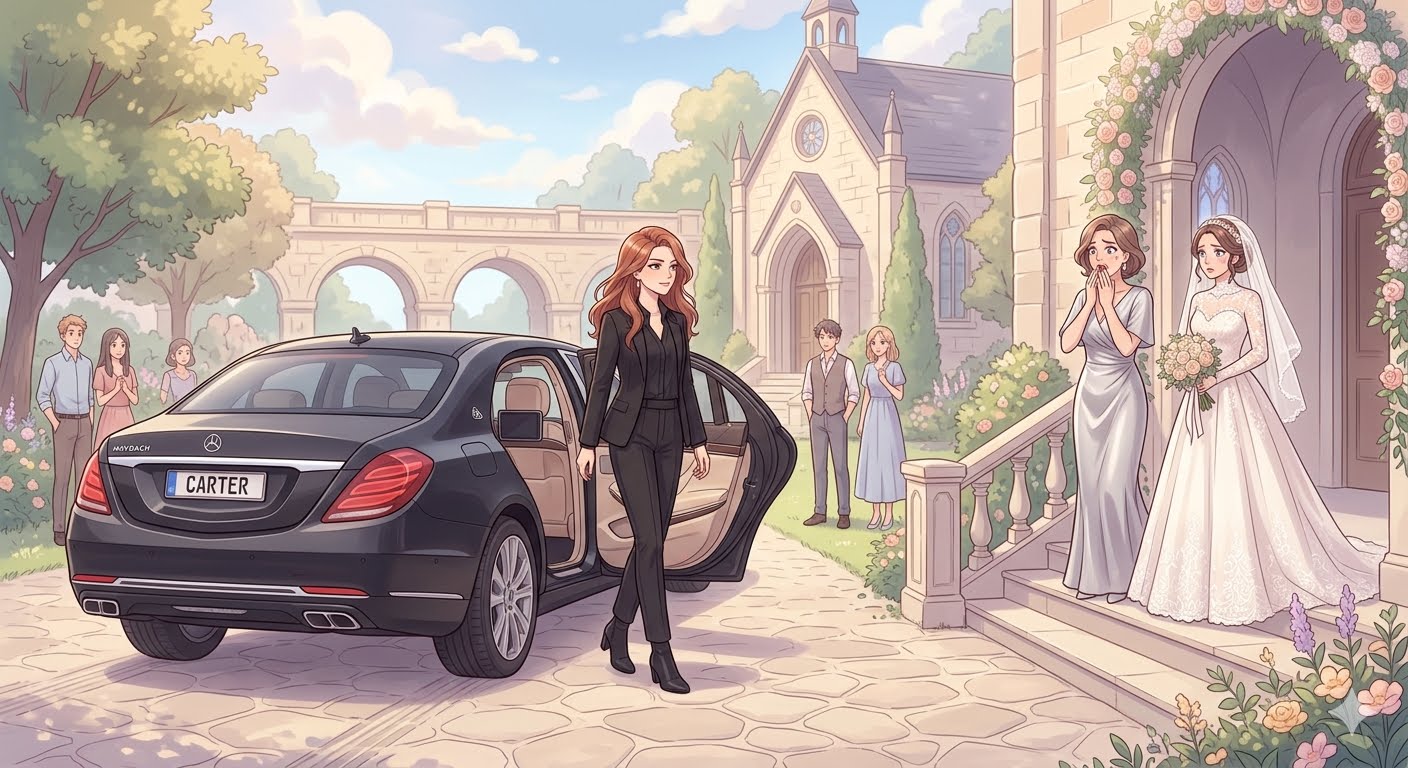
- I stepped from a black Maybach onto Hawthorne Estate’s stone drive. Guests paused beneath the chapel steps. Cameras lowered. Conversations thinned into silence.
- Fifteen years had passed since Diane Carter last watched me step out of a car.
- That time, I was eighteen, still wearing my graduation gown.
- That time, she left me at a bus station with fifty dollars and an old backpack.
- Now she stood wrapped in silver silk, staring as if the daughter she had discarded had returned wearing someone else’s life.
- “Sophie,” my sister Meline said from the doorway.
- Her wedding dress filled the frame. She looked beautiful, though clearly unsure what to do with me.
- My mother rushed forward with both arms open, staging a warm reunion before anyone could ask whether I wanted one. I stepped aside and offered my hand instead.
- Her smile tightened instantly.
- “Still independent,” she announced to the crowd. “She has always been that way.”
- The lie was already beginning.
- At eighteen, I had thought we were driving home from my ceremony to celebrate graduation. Instead, my mother pulled into the Raleigh bus station, opened my door, and dropped a backpack at my feet.
- Inside were two shirts, jeans, and a toothbrush.
- “It is time you learned how to survive on your own,” she said.
- My father stared straight through the windshield with both hands locked tightly around the wheel. Meline sat in the backseat and looked away.
- I asked where I was supposed to sleep.
- My mother closed the door.
- The car disappeared into traffic before the ink on my diploma was even dry.
- I bought the cheapest ticket to Charlotte. After the fare and a bottle of water, I had twenty-seven dollars left. No relatives. No job. No room.
- A station cleaner noticed my graduation gown and wrote a shelter address on the back of a receipt. Three days later, I was stripping beds at a roadside motel before sunrise.
- I washed my uniform in a sink, survived on leftover food, and spent my breaks writing down every hotel job I saw: Front desk agent. Housekeeping supervisor. Revenue manager. General manager.
- The titles sounded like locked doors, so I learned how to open them.
- At the public library, I taught myself spreadsheets, accounting, customer service, and hotel operations. There I met Tessa, a front-desk clerk with no patience for pity.
- “My roommate is leaving,” she told me. “The apartment is terrible, but the locks work.”
- Then one Friday, the motel’s booking system sold twelve rooms twice. The manager hid in his office while angry travelers surrounded the front desk.
- I stepped in. I called nearby hotels, negotiated rates, arranged rides, found two rooms wrongly marked for maintenance, and made sure everyone had somewhere to sleep.
- The manager warned me never to interfere again.
- A woman in a black suit had watched the entire scene unfold. Her name was Marisol Vega.
- She asked where I had studied hospitality management.
- “The public library,” I replied.
- She did not laugh. She handed me a business card. “Call me when you are ready to stop working for people who punish initiative.”
- Marisol owned a failing eighteen-room inn. She offered me an operations job, a room behind the office, and something my family had never given me: a written agreement. Clear hours. Clear pay. Clear responsibilities.
- We rebuilt that inn one ignored detail at a time. Better lighting. Local food. Honest listings. Staff who were listened to instead of blamed.
- When I made an expensive pricing mistake, Marisol placed the report between us.
- “Explain what happened.”
- I did.
- “Now fix it.”
- That was the first time an adult separated my failure from my worth.
- Years passed. One property became two. Two became three. I invested my savings, took night classes, negotiated with lenders, and learned that confidence was acting while doubt was still talking.
- Eventually, I founded Juniper Row Hospitality. We restored neglected properties, paid interns, created emergency housing funds, and trained managers never to use humiliation as motivation.
- By thirty-three, we employed more than two hundred people.
- My family knew none of this. For fifteen years, they never called to ask whether I had found a bed, eaten dinner, or survived.
- Then a regional business magazine published my photograph. Two days later, my mother sent a friend request.
- “Sophie, I always knew you would do something special. We are so proud of you.”
- No apology.
- My father called the bus station an “old misunderstanding.”
- Then Meline invited me to her wedding, mostly because guests might ask awkward questions if I was missing. The invitation displayed Hawthorne Estate. I stared at the photograph longer than she would ever know.
- My mother soon messaged to ask whether I could arrange a free room upgrade or reduce the invoice balance. “Family should support family,” she wrote.
- I replied that the contract would be honored exactly as signed.
- Her answer came within minutes: “We made you independent, and clearly it worked.”
- That single sentence brought me to the wedding.
- Inside Hawthorne’s chapel, relatives whispered. One aunt mentioned that my mother had spent years telling everyone I left home because I wanted freedom.
- So that was the story. I had abandoned them.
- Before the ceremony, a man in a navy suit approached me. My mother stood close enough to hear.
- “Welcome back, Miss Carter,” he said politely. “Would you like tomorrow’s report sent to your office?”
- My mother’s smile vanished. “Your office?”
- “Later,” I said calmly.
- During the reception, she followed me into the service hallway.
- “Since you have connections here, remove the remaining charges.”
- “No.”
- Her eyes hardened. “You can afford it.”
- “Having money does not obligate me to give it to people who only remembered me after a magazine article.”
- “You came here to humiliate me!”
- “No one else can hear us, Mom.”
- She flinched.
- Then the speeches began. My mother took the microphone and looked directly across the room at me.
- “People judge parents for difficult decisions,” she declared to the room. “But a mother knows when her child needs to be pushed into the world.”
- She called abandoning me the hardest, most loving choice of her life. Then she gestured around the grand ballroom.
- “My daughter’s success proves that tough love works.”
- Scattered applause rose through the room. I watched her rewrite her cruelty as a sacrifice.
- Meline looked over at me from the head table, her face filled with quiet regret.
- I opened my handbag. My fingers closed around the old graduation card—the one carrying my eighteen-year-old handwriting and the exact twenty-seven dollars I had left after the bus fare.
- Then I stood up and reached for the microphone.
- PART 2
- I held up the faded graduation card instead of speaking immediately. The ballroom grew quiet as everyone watched.
- “This,” I said, “is the only graduation gift I received from my parents.”
- I turned the card so the closest tables could see the small note I had written to myself fifteen years earlier: Charlotte. Bus ticket. Water. Twenty-seven dollars left.
- “I kept it because I never wanted to forget where I started,” I continued. “Not because I wanted revenge, but because I promised myself that if I ever built a better life, I would never convince another person that abandonment was the same as love.”
- No one interrupted. The silence in the room felt heavier than any argument. My mother lowered her eyes for the first time that evening, while my father remained motionless, staring at the floor.
- I looked toward Meline before continuing.
- “Today isn’t about reopening old wounds. It’s your wedding day, and you deserve joy, not conflict.”
- Then I faced the guests again.
- “Many people believe success erases pain. It doesn’t. It simply gives you the chance to decide what kind of person you’ll become because of it.”
- I explained that every opportunity I had received came from people who believed in guidance instead of humiliation, patience instead of fear, and accountability instead of blame. I spoke about the motel manager who doubted me, the mentor who trusted me, and the coworkers who became family when I had none. None of them had rescued me with money. They had simply opened doors that someone else had closed. That, I said, was the difference between being pushed away and being given a chance.
- When I returned the microphone, the room remained quiet for a long moment before applause slowly began. It wasn’t loud or dramatic; it sounded more like people recognizing honesty when they heard it.
- My mother reached for my arm as I walked past, but I gently stepped aside.
- “I don’t hate you,” I said quietly. “But I won’t rewrite my life to make your choices sound kinder than they were.”
- She opened her mouth as if searching for the perfect explanation, yet none came. Across the room, Meline wiped away a tear before giving me a small, grateful smile. She understood that I had protected her wedding instead of turning it into a public argument, and that mattered more than proving any point.
- Later that evening, I congratulated the newlyweds, left a wedding gift at the reception desk, and walked outside beneath the soft glow of the estate lights. My driver opened the Maybach’s door, but before getting in, I looked back at the celebration one last time.
- Fifteen years earlier, I had stood at a bus station wondering whether I would even have a place to sleep. Tonight, I left with something far more valuable than success. I left knowing that the past no longer controlled the direction of my future.
- Real strength had never been about arriving in an expensive car. It had been about arriving without bitterness, speaking the truth with dignity, and driving away with nothing left to prove.
The Hawthorne Contract