PART 1

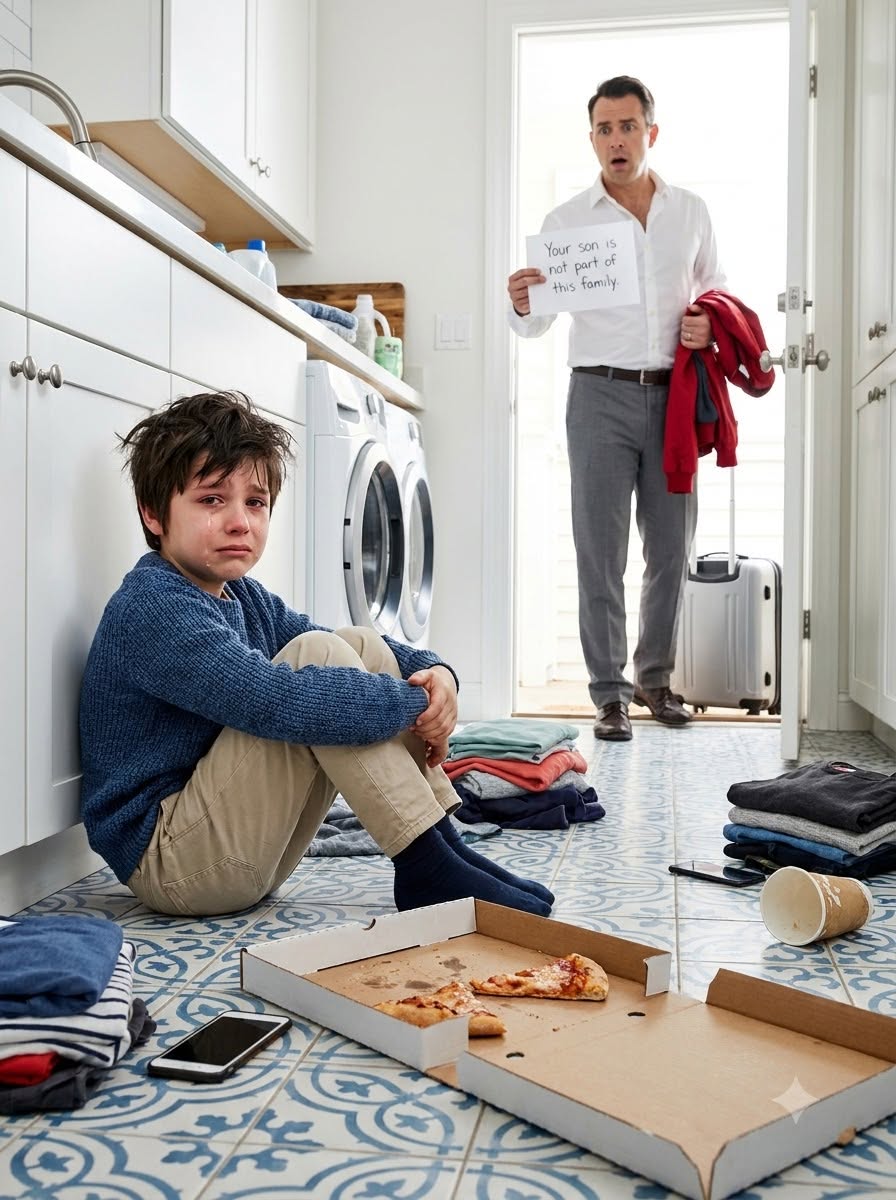
“Your son didn’t come because he’s not part of this family. That’s your mistake, not ours.”
Tobias Albright read those words twice on the note stuck with a magnet to the refrigerator in his own house. It was 12:07 at night, and he had just driven almost nine hours from Milwaukee. Instead of finding his wife waiting for him, he found the house completely dark and Joshua, his twelve-year-old son, folding clothes alone in the laundry room.
“Dad, please don’t be mad at them,” the boy whispered without looking up from the table. “I was going to put everything away in the closet before they came back tomorrow.”
Tobias felt something break inside his heart as he looked at his child.
Samantha, his wife, had traveled with her mother Bernice, her siblings, her cousins, and even two nephews on a five-day luxury cruise. They had departed from Tampa. The note, written in Bernice’s proud handwriting, said that the family had earned a vacation, that they had left money for pizzas, and that Joshua simply was not invited.
Tobias was an expert appraiser of art, valuable antiques, and historic heritage. Banks, courts, and prominent families in Baltimore sought him out whenever they needed to know if a painting was authentic, if a signature had been forged, or if an old dresser concealed a fortune. His first wife, Arianna, used to joke that Tobias could detect a lie before he had even finished pouring his morning coffee.
Arianna had died when Joshua was ten years old. Before she passed away, she left her son an antique cameo medallion that had belonged to his great-grandmother from Richmond. Six months after the funeral, the medallion disappeared. Tobias checked every drawer, every box, and every storage room in the house, but he never found it.
Two years later, he met Samantha Wilkins at a local estate auction. She was attentive, elegant, and knew exactly when to smile at him. Her mother, Bernice Wilkins, ran a well-known estate liquidation company called Wilkins Heritage Services. She organized house sales after deaths, helped wealthy widows, and presented herself as a generous benefactor of local churches and community hospitals.
After the wedding, Bernice moved into the spacious back apartment of Tobias’s house. She arrived with a huge cedar wardrobe that no one was allowed to touch under any circumstances. She wore the small brass key around her neck on a silver chain.
That night, after reading the cold note on the fridge, Tobias asked Joshua how long he had been left alone.
“I’ve been here by myself since Tuesday morning,” Joshua replied quietly. “Grandma said I’m too old to go on family trips now.”
Tobias carefully put the paper note into a clear plastic sleeve. He did not shout at his son, nor did he call Samantha on the phone. He just took a deep breath and pulled his young son into a tight hug.
Then Joshua said something that instantly changed the entire night.
“Dad, I found a secret door inside Grandma’s large wardrobe,” Joshua said, looking into his eyes. “The bottom lock doesn’t work right, so I saw some strange things inside, and I think one of them belonged to Mom.”
Joshua walked into the back apartment and gently pressed a small flower carved into the dark wood. A hidden lower compartment popped open with a faint click.
Inside were nine legal folders with names of elderly people, labeled gold rings, wills, powers of attorney, and official signatures that seemed correct at first glance.
They did not look correct to Tobias.
“These signatures are fake,” Tobias murmured, examining the paper quality under the bright lamp light. “They were written by the exact same hand.”
And in a small cigar box, with a white label that read Lot 44-C, rested Arianna’s missing cameo medallion.
Tobias looked at his son in total silence. Then he smiled, but it was not a smile of relief or joy.
It was the cold smile of a father who had just discovered that his entire marriage was a giant scam.
And he still had five whole days left before everyone returned from their vacation.
They couldn’t possibly imagine what was about to happen next.
PART 2
Tobias did not touch any of the stolen items inside the compartment.
He photographed the large cedar wardrobe from every angle, recorded the hidden wooden mechanism on video, and documented each file as if he were examining evidence for a trial. He knew that taking the legal documents right now could turn perfect evidence into a serious legal problem.
Then he prepared fried eggs and beans for Joshua at one o’clock in the morning and sat down to let the boy talk.
“Samantha changes her clothes immediately as soon as you go on business trips,” Joshua explained, his voice trembling slightly. “She throws my clean clothes onto the dusty garage floor if I use the washing machine during the daytime.”
“What else did your grandmother say to you, son?” Tobias asked softly, holding his hand.
“Bernice told me that my things shouldn’t be mixed with the real family’s items,” Joshua replied. “They forgot to pick me up at school twice last month, and on my last birthday, everyone went out to a fancy dinner without me because Bernice told them I was just faking a stomachache.”
Tobias listened carefully without interrupting his son once.
The next morning he called Nina Patton, a veteran prosecutor specializing in property crimes and elder abuse cases. They had worked together on several high-profile art forgery investigations. They agreed to meet at a quiet coffee shop near the outskirts of Annapolis.
When Nina saw the clear photographs of the documents, she stopped stirring her coffee spoon.
“One of these names is Mrs. Teresa Miller,” Nina said, her eyes widening in realization. “She was a wealthy widow from Easton who passed away two years ago.”
“What happened to her estate?” Tobias asked, leaning closer to the table.
“Her entire will was altered just weeks before her death, leaving her historic house to an unknown caretaker who vanished after selling it through Wilkins Heritage Services,” Nina explained. “Teresa’s daughter filed a police complaint, but she was never able to prove any criminal wrongdoing.”
There were two other almost identical cases in nearby towns across the state.
“We were never able to connect these victims before today,” Nina stated firmly. “If these original folders contain real documents, your mother-in-law doesn’t run a normal liquidation business, because she actually operates a massive fraud network.”
In less than twenty-four hours, a local judge authorized an emergency search warrant for the house.
The heavy wardrobe was completely emptied by police forensic experts that afternoon. They found nine detailed files, stolen heirloom jewelry, hidden authentic wills, and forged copies that had already been presented to official notaries. In a secret double drawer, they found a small leather notebook where Bernice categorized elderly residents like merchandise, writing phrases such as widow, children moved away, sick, no visitors, very promising target.
Then Nina placed a newly discovered page bearing his own surname right in front of Tobias.
“Albright. Widower. House fully paid off. Valid appraiser license. Son complicates things. Samantha will make initial contact,” Nina read aloud from the page.
The date recorded on that note was fourteen months earlier than the day Tobias had met Samantha at the auction.
“My whole marriage was planned before I even met her,” Tobias said, rubbing his tired face.
Behind the back wall of the wardrobe, officers found printed text messages between Samantha and Isaiah Robbins, a dishonest probate attorney who appeared in all nine legal cases. Their romantic relationship had lasted for four full years, long before the wedding ever took place.
Isaiah Robbins was lured to a fake business meeting that evening with the promise of representing a multi-million dollar estate. The entire conversation was secretly recorded by undercover police officers. In less than an hour, the corrupt attorney explained illegal commissions, altered legal wills, and hidden bank payments.
When the police officers identified themselves, the attorney’s very first question was, “What did Bernice keep in her safe?”
That same afternoon, Isaiah Robbins agreed to fully collaborate with the state prosecutors to save himself.
“Tobias’s marriage was completely orchestrated to leverage his professional prestige and expert signature to secure the official property inventories,” Isaiah confessed into the police microphone. “We already drafted a final will where Samantha receives the entire house, all insurance policies, and the young boy’s inheritance.”
“What was going to happen to my son?” Tobias asked the detective standing beside him.
“After signing the documents, the child was going to be sent away to a strict boarding school in another state,” the detective answered gravely.
Tobias felt sick to his stomach as he listened to the confession.
They had not only despised his young son from the very start.
They had calculated every single detail to remove him completely so they could keep all the property for themselves.