- She never even glanced at the frightened three-year-old clinging to my neck.
- Lily’s tiny hands gripped the collar of my blouse so tightly her knuckles turned white. Tears still streaked her cheeks, and every few moments she lifted her head just to make sure I hadn’t disappeared.
- We stood inside Brookfield Mall’s security office beneath harsh fluorescent lights. A wall of surveillance screens showed silent footage of shoppers drifting through the food court.
- Near the doorway stood my mother, Brenda, balancing six glossy shopping bags packed with matching coats, shoes, and toys for my sister Kendra’s twin sons. There wasn’t a single item for Lily.
- The security supervisor, Mr. Ellis, held an incident report in one hand. He remained polite, but the strain around his expression suggested he’d already heard every excuse imaginable.
- “Mrs. Walsh,” he said to my mother, “your granddaughter was unattended for a considerable amount of time. Multiple announcements were made throughout the mall.”
- Brenda shifted one shopping bag higher on her arm. “She wandered off while I was paying. Kids do that.”
- “She was eventually found near the exterior exit.”
- “I heard you.”
- Mr. Ellis turned toward me. “We’ve documented the timeline, preserved the camera records, and attempted every emergency contact number available.”
- Lily had spent almost two hours inside that office. Two hours while my mother continued shopping. Two hours while strangers comforted my little girl with crackers and apple juice—two hours before Brenda either realized, or cared enough to realize, that Lily had vanished.
- I hugged my daughter closer. “Mom… where were you?”
- Only then did Brenda meet my eyes. “I already told you. I was buying coats for the boys.”
- “For two hours?”
- “The stores were packed.”
- “You never heard the announcements?”
- “I was trying things on and checking out.”
- “You never noticed Lily was missing?”
- Her expression immediately hardened. “Amelia, she was beside us one minute and gone the next. I can’t keep children attached to me.”
- “You were supposed to be watching her.”
- “I was watching three children.”
- “No,” I replied. “Kendra’s boys are nine years old. Lily is three.”
- Her eyes narrowed with that familiar look—the same one I’d seen growing up whenever I questioned a decision she’d already determined wasn’t worth discussing.
- Before either of us spoke again, her phone rang with Kendra’s name on the screen. Because both hands were full, Brenda answered on speaker.
- “Mom, did you find the matching boots?” Kendra asked immediately.
- “Yes, but we’ve had a little situation.”
- “What happened?”
- “Lily wandered off.”
- Kendra sighed. “Is she okay?”
- “She’s fine. Amelia is acting like it’s some huge emergency.”
- Lily flinched the moment she heard her name. I kissed the top of her head.
- “What color boots?” Kendra continued. “Black or navy?”
- “Black.”
- “Perfect. Navy wouldn’t match their coats.”
- Beside me, Mr. Ellis slowly looked away, clearly striving to remain professional.
- I waited for Kendra to ask how long Lily had been missing. She never did. I waited for my mother to admit this wasn’t some minor inconvenience. She didn’t.
- Instead, she nodded toward me. “Your sister thinks I’m in trouble because I spent more on the boys.”
- Everything inside me suddenly became very still. Not rage—something colder. If I became angry, they’d dismiss me as emotional, jealous, or dramatic, just as they always had. Calm gave me something much more useful.
- “This has nothing to do with shopping,” I said.
- Kendra’s voice sharpened through the phone. “Then why are you making such a scene?”
- My eyes drifted toward one of Brenda’s shopping bags where a receipt stuck out from the top. The total was more than six hundred dollars. She had happily spent hundreds on Kendra’s sons while my little girl sat terrified inside a security office.
- I ignored my sister and turned to Mr. Ellis. “I’d like copies of everything—the incident report, the announcement log, and the security timeline.”
- Brenda let out a short laugh. “Oh, honestly.”
- I acted as though she hadn’t spoken.
- Mr. Ellis printed several additional pages and attached them to the report. “The video must remain in our archive, but this reference number allows authorized investigators to request its preservation.”
- “Thank you.”
- His voice lowered. “Your daughter was extremely frightened. She finally calmed down after we located your photo through an emergency contact record.”
- My throat tightened. “You had my picture?”
- “She remembered your name. We located it through an earlier report connected to your phone number.”
- Lily leaned close enough to whisper, “I told them Mommy comes.”
- I rested my cheek against her hair. “Yes, sweetheart. I came.”
- Behind us, my mother shifted the shopping bags again. “Can we go now?”
- She didn’t look embarrassed; she looked impatient.
- I signed the remaining paperwork, carried Lily into the parking garage, and buckled her carefully into her car seat. As I tightened the straps, she wrapped both hands around my thumb.
- “Don’t go,” she whispered.
- “I’m right here.”
- “Grandma went away.”
- The words settled deep inside me. Not Grandma lost me—Grandma went away. To Lily, she hadn’t wandered away from an adult; the adult had abandoned her.
- I stayed beside the open car door until her breathing slowed. Then my mother walked over with the shopping bags.
- “You’re encouraging this,” she said.
- I stood up. “Encouraging what?”
- “Her fear. Children copy adults.”
- “She was alone for two hours.”
- “She needs to learn not to wander.”
- “She is three years old.”
- “You’re always making excuses.”
- “For Lily?”
- “You treat her like she’s delicate.”
- “She is a toddler.”
- “Kendra’s boys never behaved like this.”
- Of course they hadn’t. In my mother’s memory, Kendra’s children were perfect. They were the golden grandchildren belonging to the daughter she had always placed above everyone else.
- I opened my driver’s door. “Don’t contact me tonight.”
- She blinked. “What?”
- “Don’t call me. Don’t come to my house.”
- “You’re being ridiculous.”
- “No,” I answered. “I’m setting a boundary.”
- “You’re seriously keeping my granddaughter away because of one mistake?”
- “I decide who is trusted to care for my child.”
- Her lips pressed into a thin line. “Kendra was right. This is really about the shopping.”
- I got into the driver’s seat and closed the door without another word.
- During the drive home, Lily remained unusually quiet, clutching her stuffed ladybug and staring out the window. At a red light, I glanced into the rearview mirror. She was already looking at me.
- “Mommy?”
- “Yes?”
- “You’re still here?”
- “I’m still here.”
- Before we reached home, she asked me the same question four more times.
- Inside my family, I had been expected to be the responsible one since I was seven years old. Kendra was two years younger, yet she remained the golden child in every room. Whenever Kendra was unhappy, the whole family changed its plans; whenever I was hurt, my mother reminded me that I was mature enough to understand.
- I learned early that “maturity” was just the label adults used when they wanted the dependable child to accept less.
- My father noticed the imbalance, but he rarely challenged it directly before he passed away unexpectedly when I was twenty-six. Afterward, my Uncle Richard became the trustee of the family’s shared business interests and commercial property accounts.
- When Richard offered me a monthly distribution from the trust back then, I refused it, preferring to earn my own way in project administration, buy my own townhouse, and build an independent life. Meanwhile, my mother accepted her monthly allowance, and Kendra relied on the business credit line to fund her “independently successful” consulting firm.
- When Lily was born, I opened an education account for her using my own salary. My mother called it unnecessary, claiming Richard would provide for all the grandchildren. But I wanted Lily to know her mother planned for her—and I refused to let her grow up feeling like an afterthought, watching Grandma shower the twins with gifts while offering Lily only a distracted pat on the head.
- That history was the only reason I had reluctantly agreed to the mall trip in the first place. My mother had pleaded for time with her granddaughter, and a foolish part of me hoped things might change.
- Now, sitting in my quiet kitchen while Lily slept upstairs, that hope was entirely gone.
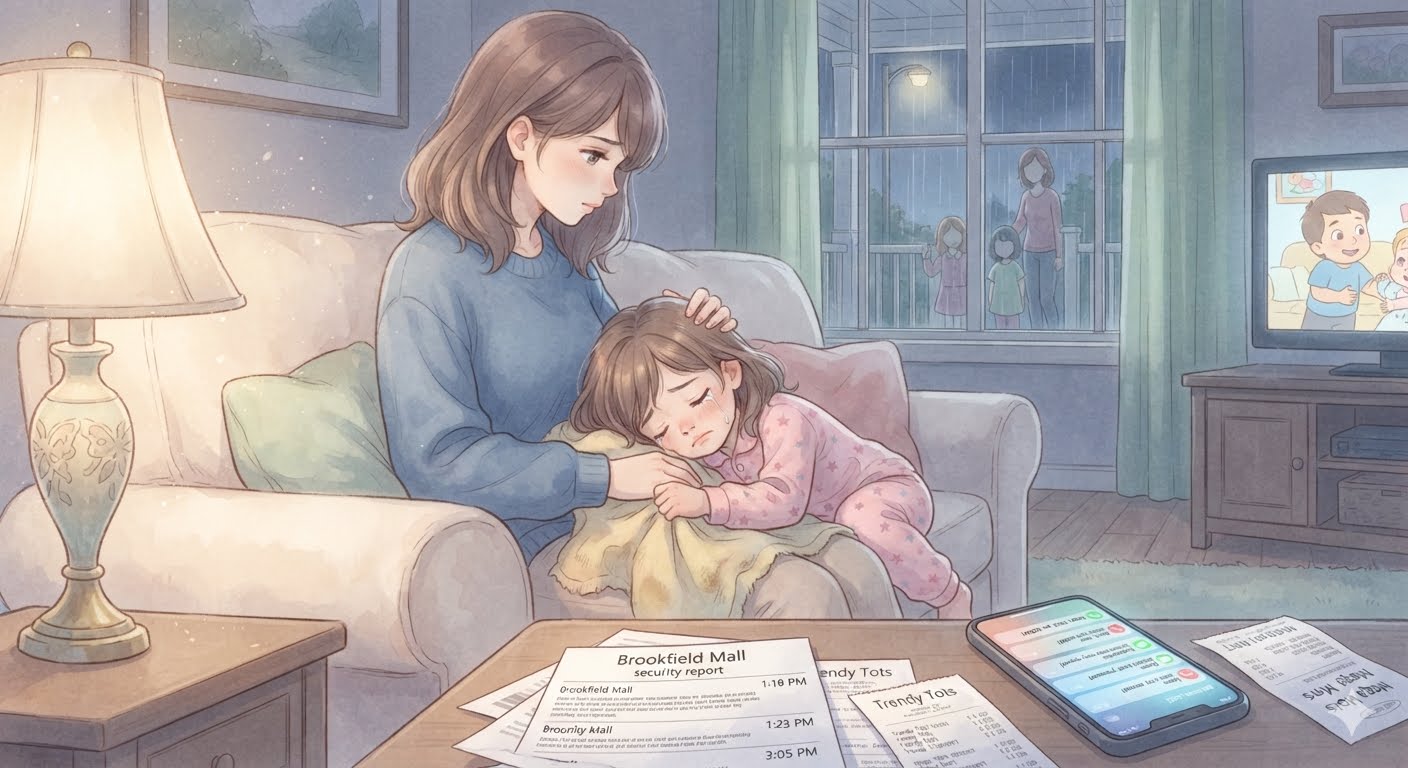
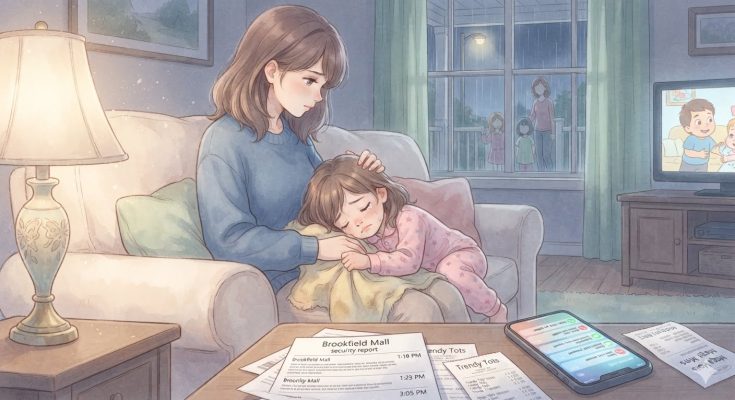
- I laid the mall report out on the table and examined the paper timeline:
-
1:18 PM: Lily was found alone near the exterior exit.
-
1:23 PM: The first announcement was broadcast.
-
1:47 PM: My mother made her first coat purchase.
-
2:16 PM: My mother made a second purchase.
-
2:41 PM: My mother made a third purchase.
-
3:05 PM: My mother finally entered the security office.
- It wasn’t a momentary distraction; it was a sequence of deliberate choices. She had actively continued shopping while missing child announcements echoed through the building.
- I photographed the report and emailed it to Uncle Richard, then called his line. He answered immediately.
- Without crying or hurling insults, I simply read him the facts and the timestamped timeline.
- When I finished, Richard was silent for a long moment. “Is Lily safe?”
- “She’s asleep.”
- “Has her pediatrician been contacted?”
- “I called the after-hours line. They told me to monitor her and bring her in Monday unless something changes.”
- “Good.” He paused. “Your mother continued making purchases after the announcements began?”
- “The receipts appear to show that.”
- “Send me the full report.”
- “I already did.”
- I heard the clicking of his keyboard, followed by a slow exhale. “Amelia, I am sorry.”
- That simple apology almost broke me, because it was the first piece of empathy anyone in my family had offered all day.
- “Did Brenda use the family supplementary card today?” Richard asked, his tone growing hard.
- “I don’t know.”
- “I do. The charges are already appearing.”
- “What are you going to do?”
- “My responsibility as trustee,” he replied sternly. “The trust is not a reward system. Your mother’s allowance is discretionary, and Kendra’s business credit line requires legitimate business expenses. In fact, over sixty-eight thousand dollars has moved through Kendra’s account this quarter with non-matching invoices. Your mother has also been charging luxury items to a card meant for essential household and medical needs.”
- “I don’t want them claiming I destroyed their lives,” I whispered.
- “They will say that because examining you is easier than examining their own records,” Richard said gently. “You reported a serious, documented incident. I am independently fulfilling my legal duty. I am placing a temporary administrative hold on those accounts effective immediately while a full review is conducted.”
- “What about the twins?”
- “Their education accounts are protected. Their essential needs do not depend on Kendra’s business line.”
- “And Mom?”
- “She has her own pension and savings.” He paused. “Do not engage with either of them tonight. Lock your doors.”
- We ended the call.
- Ten minutes later, my phone began vibrating continuously across the counter—first Brenda, then Kendra, alternating non-stop.
- A flood of angry text messages began filling my screen.
- “What did you tell Richard?”
- Then another text flashed: My card was declined in front of everyone.
- Then a third: Kendra’s operating account is frozen. Fix this.
- And finally: You are using Lily to manipulate the family.
- I placed the phone facedown. It continued buzzing against the kitchen table, sending short, angry vibrations through the wood.
- I made tea, checked on Lily, and locked both the front and back doors.
- When I returned to the kitchen, I had twenty-three missed calls. By ten o’clock, there were forty-one. By eleven, fifty-seven. Just before midnight, the count reached sixty-eight.
- Not a single voicemail asked about Lily. Every message concerned money: a boutique had rejected my mother’s card, Kendra’s software subscription had failed, a car payment tied to the business line had been declined, and a hotel deposit for a family vacation had been canceled.
- Their panic exposed how their lives had actually been built. From the outside, they appeared independent; underneath, Uncle Richard’s signature held everything together.
- Headlights swept across my living-room wall. One car sped into the driveway, followed immediately by a second. Doors slammed, footsteps hurried across the path, and someone began pounding furiously on the front door.
- “Amelia!” My mother’s voice carried through the heavy wood. “Open this right now!”
- I checked Lily’s monitor. She stirred beneath her yellow blanket but remained asleep.
- Walking into the entryway, I switched on the porch light. The pounding didn’t stop. I opened the main door, but left the locked glass storm door between us.
- Brenda and Kendra stood beneath the porch light. My mother was still wearing the blouse she’d worn to the mall; Kendra had thrown a coat over her pajamas. Both clutched their phones like weapons.
- “What did you say to Richard?” Brenda demanded.
- “The truth.”
- “You made him cancel my cards!”
- “I didn’t control his decision.”
- Kendra stepped closer to the glass. “My business account is frozen.”
- “He told me the account is under review.”
- “You called him because Mom lost sight of Lily!”
- “Lily was alone for almost two hours.”
- “She wandered!”
- “She is three years old.”
- My mother thrust her phone toward the glass. “You call Richard right now and tell him you exaggerated.”
- “I didn’t.”
- “Tell him it was a misunderstanding!”
- “An incident report is not a misunderstanding.”
- Kendra folded her arms, her tone bitter. “You have always resented the help we receive.”
- I nearly laughed, but stayed silent.
- “You refused your distributions,” Kendra pressed, “and now you want everyone else punished for accepting theirs.”
- “This isn’t about accepting support.”
- “Then what is it about?”
- I lifted the printed security report. “This.”
- Brenda barely looked at it. “You’re waving paperwork around like I committed some unforgivable crime.”
- “You didn’t notice my daughter was missing.”
- “I noticed eventually!”
- Even Kendra looked stunned by that. She turned toward our mother, her voice dropping. “Mom…”
- Brenda immediately turned defensive. “You know what I mean!”
- “No,” I said calmly. “I think you finally said exactly what you mean.”
- Her expression shifted. “Do not twist my words.”
- “I spent my entire life being told I was mature enough to accept less. I will not teach Lily to do the same.”
- “No one treated you badly!”
- “Kendra’s needs always came first.”
- “This again?”
- “Yes, this again—except now the pattern has reached my daughter.”
- Kendra leaned toward the door. “You’re jealous of my boys.”
- “I am protecting my child.”
- “By freezing the money that supports mine?”
- “Their education accounts are untouched.”
- Her eyes widened in surprise. “How do you know that?”
- “Richard told me.”
- “So you discussed our private finances with him?”
- “You came to my house at midnight to discuss them.”
- My mother lowered her voice, trying a softer approach. “Amelia, open the door.”
- “No.”
- “I am your mother.”
- “And I told you not to come.”
- “We need to speak like a family.”
- “We are speaking.”
- “Not through glass!”
- “The glass is the boundary you ignored when you drove here.”
- Her face flushed red. “Do you enjoy this?”
- “No.”
- “You always wanted Richard to think you were better than us.”
- “I wanted someone to believe me.” The words came out softer than I intended.
- For a moment, neither of them responded. Kendra looked away first.
- My mother recovered almost immediately. “You have made your point. Now fix the accounts.”
- “No.”
- “What do you mean, no?”
- “I will not call Richard.”
- “Then I will!”
- “He isn’t answering you.”
- Her tight expression confirmed he hadn’t.
- Kendra raised her phone. “He sent a message saying all communication must be in writing.”
- “That sounds appropriate.”
- “Appropriate?” Kendra repeated, her voice rising. “My company cannot operate!”
- “If it’s a legitimate company, the review will establish that.”
- Kendra’s mouth tightened. “You don’t know anything about my business.”
- “No, but Richard does.”
- My mother’s voice turned razor-sharp. “You are destroying this family over one afternoon!”
- “No. I am refusing to keep this family comfortable by pretending that afternoon didn’t matter.”
- “What do you want, Amelia?” Kendra asked. It was the first honest question either of them had asked all night.
- “I want no contact between you and Lily until I decide otherwise.”
- My mother stared at me. “You cannot do that.”
- “I can.”
- “I’m her grandmother!”
- “You were responsible for her, and she spent two hours believing she had been abandoned.”
- “That is your interpretation!”
- “That is what she told me.”
- For the very first time, Brenda’s certainty faltered—just a fraction. “She said that?”
- “Yes.”
- “What exactly did she say?”
- “Grandma went away.”
- A heavy silence settled across the porch. My mother looked out toward the dark driveway, and for one brief second, genuine shame crossed her face.
- Then Kendra stepped in. “Mom didn’t mean to.”
- Intent—the universal excuse my family always used when they expected the victim to carry the burden of fixing the damage.
- “I know,” I said.
- Brenda looked back at me. “Then why are you doing this?”
- “Because not meaning to harm someone doesn’t erase the harm. It just shows you what you need to repair.”
- “What does repair look like?”
- “Accountability.”
- “That’s a vague word.”
- “No, it’s specific. It means you stop calling it a misunderstanding. You stop blaming a three-year-old. You stop claiming I am jealous. You acknowledge the timeline, cooperate with the trust review, and stay away from my daughter until she feels safe.”
- Kendra gave a harsh, disbelieving laugh. “And if we don’t?”
- I pressed the incident report against the glass door. “Then all future communication goes through legal counsel and the trustee. The mall has archived the security footage, and I will make every single decision based on Lily’s welfare, not your comfort.”
- The last bit of fight left Kendra’s face. My mother just stared at the official seals on the pages.
- “You would involve lawyers against your own mother?”
- “You brought financial demands to my doorstep at midnight.”
- Brenda opened her mouth, but nothing came out.
- I stepped back into the foyer. “You need to leave.”
- “Amelia—”
- “Good night.”
- I closed the heavy inner door. The pounding didn’t resume.
- Through the narrow side window, I watched them linger under the porch light for a moment while Kendra spoke rapidly and my mother stood motionless. Finally, they walked back to their cars and drove away.
- I leaned against the closed door, feeling my knees shake. Strength often looks calm from the outside, but on the inside, it feels like holding up a collapsing wall with your bare hands.
- When I went upstairs, Lily was awake. “People loud,” she whispered.
- “I know, baby.”
- “Grandma?”
- “Yes.”
- She pulled her yellow blanket up beneath her chin. “Is she taking me?”
- “No.”
- “You promise?”
- “I promise.”
- I stayed by her side until sunrise.
- The administrative review lasted six weeks.
- Uncle Richard hired an independent auditing firm to examine the trust’s distributions. What they found wasn’t outright criminal, but it was deeply revealing:
-
Brenda had used her household-support card for designer clothes, luxury resort deposits, personal gifts, and subscriptions.
-
Kendra’s consulting firm had routinely written off family vacations, vehicle payments, private-school donations, and home renovations as “business expenses.” Invoices were frequently written after purchases were made, and client dinners turned out to be family meals.
- The trust hadn’t created their financial dependence; it had simply hidden it.
- Richard scheduled a formal meeting at his office. He asked me to attend because decisions affecting all three grandchildren were on the table.
- The conference room overlooked the renovated brick warehouses our family had owned since my father’s time. Brenda sat at one end of the long walnut table, with Kendra and her husband, Sean, beside her. I sat opposite Richard.
- My mother refused to look at me. Kendra looked exhausted, bitter, and panicked.
- Richard opened a thick folder. “The temporary administrative hold is now permanent under revised terms.”
- Brenda sat up straight. “You cannot cut off my allowance!”
- “I am converting it,” Richard replied calmly. “It will now go directly toward approved housing, medical, and insurance expenses. There will be no unrestricted card.”
- Her face turned bright red. “I am not a child!”
- “Then managing your personal spending should not be an issue.”
- Kendra leaned forward, her voice tight. “What about my company?”
- “The business credit line is closed.”
- “You’ll ruin me!”
- “The trust was never intended to fund your lifestyle indefinitely,” Richard said firmly.
- “My father wanted me supported!”
- “Your father wanted both of his daughters supported.” Richard glanced at me.
- “She refused her share!” Kendra snapped.
- “That did not give you the right to absorb it.” Richard turned a page. “If your firm requires future capital, you must submit standard financial statements. Personal expenses will no longer be reimbursed.”
- Sean rubbed a hand over his face, looking defeated. “We can’t repay all of this at once.”
- “A structured repayment plan has been prepared,” Richard said.
- Kendra whipped her head toward her husband. “You knew about this?”
- “I received the summary yesterday,” Sean said quietly. “I wanted to understand it before bringing it up.”
- The sharp look they exchanged revealed that their marriage was carrying its own financial strains.
- Richard continued. “The grandchildren’s education funds will also be restructured equally.”
- My mother finally looked at me. “Lily already has an account.”
- “One that Amelia funded entirely on her own,” Richard corrected. “That doesn’t justify excluding Lily from her grandfather’s legacy.”
- He placed three identical blue folders on the table—one for Lily, and one for each of the twins—with equal starting balances and matching annual contributions.
- Kendra’s jaw clenched. “You’re taking money away from my boys.”
- “No,” Richard said directly. “I am ending the practice of treating one branch of this family as the only one that matters.”
- The room went completely silent. My mother turned her head toward the window. The truth had taken thirty years to arrive, but it had finally landed.
- Richard closed the master folder. “Furthermore, the mall shopping expenses from that afternoon will be treated as personal debt, not trust-supported expenses.”
- Brenda glared at him. “You are doing all of this because I lost sight of a child for a few minutes?”
- “No,” Richard replied. “I am doing this because that incident forced me to look into an arrangement I should have audited years ago.”
- She turned her anger on me. “You caused this.”
- I held her gaze. “No. I just documented what happened.”
- “You knew how Richard would react!”
- “I hoped someone would finally care.”
- Her expression hardened. “Your father would hate seeing this family torn apart.”
- “My father saw the unfairness while he was alive,” I said softly.
- That stopped her cold. “What?”
- “He apologized to me for it more than once. He told me he was sorry he let my quietness become an excuse to give me less.”
- Brenda looked genuinely shocked. “He never said that to me.”
- “He tried. You just called it another misunderstanding.”
- A heavy silence filled the room. Brenda stood up, grabbing her handbag. “I will not sit here and be judged.”
- “This isn’t a judgment, Brenda,” Richard said calmly. “These are the terms.”
- She walked out without another word.
- Kendra stayed in her seat. Once the door clicked shut, she looked across the table at me. “Are you happy now?”
- “No.”
- “You finally got what you wanted.”
- “What do you think I wanted, Kendra?”
- “To be the good daughter. To win.”
- I shook my head. “I just wanted my daughter to come home safe.”
- Kendra’s defensive posture slipped, replaced by something raw and uncertain. “The boys told me what happened at the mall.”
- I waited.
- “They said Mom was looking at coats when Lily disappeared. Lily asked for a snack, and Mom told her to stay near a bench.”
- “She is three years old.”
- “I know.”
- “Do you?”
- Kendra lowered her eyes, tears forming. “I talked to the boys separately. They both said Mom noticed Lily was gone before she finished shopping. She kept checking out anyway.”
- My hands went cold. “How long before?”
- “They didn’t know exactly.”
- “Did you tell Richard?”
- “Yes.”
- That explained why Richard’s terms had been so unyielding.
- “Why didn’t you tell me?” I asked.
- “I thought you’d use it against her.”
- “Kendra, she already used it against Lily.”
- Kendra buried her face in her hands, sobbing silently. “I know.”
- It was the first time in her life she had admitted fault without adding an excuse.
- I stood up from the table. “I have to go.”
- “Amelia, wait.” I paused at the door. “I’m sorry,” she whispered. “For calling you jealous. For not asking if Lily was okay. For knowing Mom favored my kids and pretending it didn’t hurt you.”
- “Why say this now?”
- “Because when the money stopped, I had to look at how much of my life depended on pretending Mom was always right.”
- “I don’t know what to do with that right now, Kendra.”
- “You don’t have to do anything.”
- I left the office before she could ask for forgiveness I wasn’t ready to give.
- The trauma of that afternoon stayed with Lily for a long time.
- For months, she panicked whenever I stepped out of her line of sight. At preschool, she clung to my coat; at the grocery store, she refused to sit in the cart unless she was holding my sleeve; at night, she asked repeatedly if I would still be there in the morning.
- Her pediatrician recommended a child therapist who specialized in play therapy. During an early session, Lily set up a dollhouse. She placed a tiny girl doll inside the house and a grandmother doll next to a toy store.
- “What is Grandma doing?” the therapist asked gently.
- “Buying,” Lily whispered.
- “And where is the little girl?”
- “Waiting.”
- My throat tightened as I watched from the corner of the room.
- Over time, through therapy, Lily’s narrative shifted. In her play, the little girl found help, her mother arrived to save her, and eventually, the grandmother doll was left out of the game entirely. I never forced her to bring it back.
- My mother tried sending packages and gifts, which I returned unopened. She sent letters making excuses while offering half-hearted apologies. I kept the letters in a drawer, but I didn’t reply. An apology wrapped in self-defense is just a demand to go back to normal without fixing the harm.
- Kendra called occasionally, keeping things brief at first. But one afternoon, she came to my house alone, carrying a small gift box. I met her on the porch.
- “I won’t stay,” Kendra said, handing me the box. “The twins picked it out for Lily. They remembered her seeing this stuffed owl at the mall before she went missing, and Mom telling her it was too expensive.”
- My chest tightened. “They remembered that?”
- “They remember a lot more than I thought,” Kendra said quietly. “They asked me why Grandma kept buying things after Lily was gone, and I told them the truth—that Grandma made a terrible mistake, and that adults have a duty to protect children.”
- I looked at her. “That couldn’t have been easy to tell them.”
- “It wasn’t. But I spent my whole life letting Mom turn favoritism into love. I refuse to let my sons grow up thinking being favored makes cruelty okay.” She paused. “Sean and I sold the extra SUV. We’re paying back the trust.”
- “That’s between you and Richard.”
- “I know. I just wanted you to know I’m not fighting him on it.”
- I gave the stuffed owl to Lily later, telling her it was a gift from her cousins. She squeezed it tight. “My boys?” she asked with a smile.
- “Your boys,” I agreed.
- My mother’s first real apology arrived eight months after the incident in a handwritten letter:
-
Amelia,
I have spent months trying to frame that day in a way that wouldn’t make me feel so ashamed. I blamed the crowds, Lily’s energy, the loud noise, your anger—anything to avoid the truth.
The truth is that I realized she was missing before I finished shopping. I told myself she couldn’t have gone far, and I was too embarrassed to ask security for help because I didn’t want anyone to think I was careless. I completed my purchases because I thought I could find her afterward and no one would ever know.
I chose my pride over her safety. And when you showed up, I chose my pride again.
I am deeply sorry. I don’t expect you to let me see Lily. I just need you to know that I finally understand why you closed the door.
Mom
- I read it three times before placing it in the drawer next to the mall report. Words didn’t instantly rebuild trust, but for the first time, honest accountability made future healing possible.
- A year after the mall incident, I agreed to meet my mother at a public park while Lily stayed with a friend.
- When Brenda walked up to the bench, she looked different—simpler clothes, no expensive shopping bags, no defensive posture. She sat down, leaving a respectful distance between us.
- “I read your letter,” I said.
- “I meant every word.”
- “Why did it take eight months?”
- “Because as long as I could make excuses, I didn’t have to look at who I really was.” She folded her hands. “Losing the unrestricted money forced me to go through three years of financial statements with Richard. Seeing how much I showered on Kendra’s kids while ignoring Lily… it broke something in me.”
- “You shouldn’t need a financial ledger to see your own granddaughter,” I said quietly.
- “I know. I’ve been going to therapy.”
- I looked at her, surprised. “Why?”
- “Because Richard told me the trust could pay my living expenses, but it couldn’t force my family to love or respect me.” Her voice was free of self-pity. “I don’t expect you to trust me with Lily. I just hope to earn the right to know how she’s doing.”
- We met a few more times over the following months—always in public, always without Lily. She listened, answered my questions without getting defensive, and never asked when her “punishment” would end.
- Eventually, Lily felt ready to see her. We met at the park, with me standing right beside my daughter.
- My mother knelt down on the grass, keeping a gentle distance. “Hi, Lily.”
- Lily hid slightly behind my leg. “You went away at the mall,” she said quietly. “You bought coats.”
- Tears welled in my mother’s eyes, but she didn’t wipe them away. “Yes, I did. And it was the worst mistake of my life. I am so, so sorry, Lily.”
- Lily studied her face for a long moment. “Will you do it again?”
- “No,” my mother said firmly, her voice trembling. “Never again.”
- Lily didn’t rush to hug her, but she nodded and walked over to the sandbox to play. My mother sat on the bench and watched quietly, content just to be near her. Rebuilding didn’t happen in a grand cinematic moment; it started with ten peaceful minutes in a park.
- Over the next two years, the structure of our family shifted entirely.
- Without the safety net of the trust, Kendra’s firm downsized into a legitimate, manageable business. She worked hard, paid back her debt, and became a far more grounded sister and mother. Her twin boys grew close with Lily, treating her with protective affection.
- Uncle Richard kept the trust’s strict oversight in place, ensuring that distributions were fair, transparent, and dedicated strictly to health, housing, and education.
- With my share of my father’s legacy, I helped fund a non-profit community initiative that partners with local shopping centers to provide free emergency identification kits and staff training for lost children.
- Two years after that terrible day, I took Lily back to Brookfield Mall.
- She was five years old then—confident, tall, and talkative. We walked through the bright concourse, visited the bookstore, and grabbed lunch. As we passed the security office, Mr. Ellis happened to walk out.
- When I introduced her, his face lit up. “I remember you, Lily. I remember your little stuffed ladybug.”
- Lily smiled proudly. “I still have her.”
- As we walked back toward the exit, Lily ran a few steps ahead to look at a toy display. Then she stopped and turned around to check on me.
- I was standing right where she left me.
- She offered a bright, easy smile, walked back, and took my hand.
- My family didn’t fix itself overnight because of one dramatic phone call. That call simply stopped the flow of unearned money long enough for everyone to confront the truth beneath it.
- My mother finally saw the cost of her favoritism; Kendra learned to stand on her own two feet; Uncle Richard realized that structure is a form of protection; and I learned that being the dependable daughter didn’t mean allowing my child to be treated like an afterthought.
- The sixty-eight missed calls on my phone that night weren’t attempts to repair a broken relationship—they were the sound of a toxic dynamic collapsing under its own weight. Letting the phone keep ringing was the best decision I ever made.
- I didn’t destroy my family that night. I just rebuilt it on honest ground.