- For a heartbeat, the only sound was the gentle lap of waves against the dock.
- Behind Rebecca, her husband, Trent, lingering near a black SUV with his sunglasses resting atop his head, tried to look nonchalant. Madison, my granddaughter, leaned against a silver convertible with her arms folded and her eyes glued to her phone, wearing the bored expression of someone entirely unimpressed by eleven acres of prime waterfront. Cooper, who had been a little boy the last time I saw him, was now tall enough to meet my gaze, though still young enough to look uncertain of what to do with it.
- Rebecca offered a smile.
- It wasn’t a warm one—it was calculated.
- I looked from her to the lakehouse Eleanor had entrusted to me, then down the long gravel driveway that had brought them here after nine years without so much as a phone call.
- “No,” I said softly. “You won’t.”
- Her smile froze.
- My name is Walter Hayes. I was sixty-eight when my sister, Eleanor, passed away and left me Birchwood—the lakehouse on Lake Marlin where we had spent almost every summer of our youth. By that point in my life, people didn’t expect much from me. I rented a tiny studio apartment on the rougher side of Cedar Falls, picked up occasional carpentry jobs whenever my back allowed, and drank cheap gas station coffee because it saved money.
- Those mornings were always quiet.
- Not peaceful. Just quiet.
- Peace is something you build for yourself; quiet is simply what remains after everyone stops calling.
- The phone rang at 6:12 on a Wednesday morning. I was standing at my scratched kitchen counter, watching steam rise from burnt coffee, when my cell buzzed. At my age, early calls rarely bring good news. I almost let it ring—only a few people even had my number: the pharmacy, a local foreman named Hank who threw me work now and then, and robocallers trying to sell warranties for trucks I no longer owned.
- Still, I picked up.
- “Walter Hayes?” the woman asked, her tone calm and businesslike.
- “Speaking.”
- “My name is Caroline Briggs. I’m an attorney with Briggs & Thornton. I’m calling regarding your sister, Eleanor Hayes.”
- My grip tightened around the receiver.
- Over the decades, Eleanor and I had drifted apart the way siblings sometimes do—pulled by pride, distance, old grudges, and financial stress. We still exchanged birthday cards, talked on Thanksgiving, and every Christmas she mailed me a tin of homemade shortbread, even when I couldn’t afford a gift in return. She was two years older, twice as sharp, and the kind of woman who could overhaul an engine, navigate tax codes, and quote poetry while doing it.
- Most importantly, she was the only person from my past who never looked at me with pity or embarrassment.
- “What happened?” I asked.
- “I’m so sorry,” Caroline said softly. “Eleanor passed away four days ago. Her heart gave out. She died peacefully in her sleep at the lakehouse.”
- My legs gave way, and I sank onto the edge of my mattress.
- The small room felt instantly suffocating—the water stain on the ceiling, the mini-fridge, my worn boots by the door. For nine years, everything I owned had fit into that single space, and now the walls felt like they were pressing in on me.
- “Mr. Hayes?”
- “I’m here.”
- “There’s also the matter of her estate. Eleanor named you as her sole beneficiary.”
- I thought grief was playing tricks on my hearing. “I’m sorry?”
- “She left you Birchwood,” Caroline explained. “The eleven-acre property on Lake Marlin, including the main house, the dock, two boats, and the bait-and-tackle business she ran on the south shore.”
- A dry, disbelieving laugh escaped me. “That can’t be right.”
- “It is.”
- “She had nieces. Friends. Half the town loved her.”
- “Yes,” Caroline replied gently. “And she chose you.”
- After hanging up, I sat in the dim morning light, staring at the phone in my hand.
- Birchwood.
- Just saying the word brought back a flood of memories: running barefoot down the wooden dock while Eleanor yelled that I’d crack my head open; skipping stones until dusk while our father called us in for dinner; the smell of pine needles, lake water, fried perch, and my mother’s lemon soap. Back then, family was the foundation you leaned on, never imagining it could collapse beneath you.
- Nine years ago, I learned just how fragile that foundation was.
- At fifty-nine, after thirty-one years of driving long-haul rigs, my back finally blew out. Two ruptured discs. Surgery offered temporary relief, but eventually a doctor gently told me my heavy-lifting days were over. Disability checks were small and slow to arrive, while medical bills were neither. Within a year, my savings were depleted, my tools sold off, my truck mortgaged, and I lost the modest home on Sycamore Street I’d spent two decades paying off.
- It wasn’t a castle—just two bedrooms, a small kitchen, and a maple tree that clogged the gutters every autumn—but it had been my home. When Rebecca was eight, I’d painted her walls lavender because she’d told me white reminded her of hospitals.
- After losing the house, I packed my remaining belongings into a few boxes and did the one thing I promised myself I’d never do: I went to my daughter for help.
- Rebecca lived forty minutes away in an upscale neighborhood featuring stone mailboxes, sprawling driveways, and homes referred to by grand names rather than simple house numbers. Her husband, Trent, sold high-end real estate and always looked as if he had a more important meeting to get to. Boat shoes in winter, sunglasses resting on his head indoors. Rebecca had inherited her mother’s striking looks and my stubborn streak, though she masked hers behind a polished exterior.
- Standing in their bright, modern kitchen, nervously clutching my hat, I asked if I could stay in their finished basement for a couple of months—just until my disability payments kicked in, just until I got back on my feet.
- Rebecca couldn’t meet my eyes. “Dad… this really isn’t a good time.”
- Trent folded his arms, standing in the doorway. “Walter, we’ve got our own overhead to worry about. Madison’s private school tuition is due. We can’t take on another mouth to feed.”
- Another mouth.
- That’s what thirty-one years of fatherhood had been reduced to in my daughter’s kitchen.
- Part of me wanted to list everything I’d done for them: the eleven thousand dollars I’d handed Trent for their down payment, the tuition fees I covered when Rebecca’s scholarship fell short, the countless weekends spent driving down to tile their bathrooms, repair fences, build patios, and paint nurseries. Every check written without expecting a dime back, because fathers aren’t supposed to keep score.
- But standing there, surrounded by family photos that didn’t feature me in a single frame, reality set in.
- None of those years had bought me a place to sleep.
- “There’s a motel off the interstate,” Trent had said, quietly ushering me toward the entrance. “Weekly rates. Pretty cheap.”
- That was nine years ago. I never stepped foot in their house again.
- Rebecca called once six months later to ask if I’d seen a box of holiday decorations in storage; when I said no, she hung up shortly after. I sent birthday cards to my grandkids for a few years, but stopped when they went unacknowledged. Every Thanksgiving, Eleanor called to ask if I was eating well, and I lied every time—even the year dinner was peanut butter on toast and a bruised apple.
- Now Eleanor was gone, and somehow, after all those years in the cold, she had placed Birchwood in my hands.
- It took eleven days before I arrived at the property—eleven days of legal paperwork, hunting down my one decent suit jacket, standing quietly by Eleanor’s grave, and letting Caroline Briggs walk me through the estate with unexpected kindness.
- “Your sister left explicit instructions,” Caroline noted.
- “Sounds like her.”
- “She wanted you to have peace and quiet, and she insisted the title transfer be handled discreetly.”
- “Why discreetly?”
- Caroline paused just long enough to catch my attention. “She felt it would spare you unnecessary trouble.”
- Those words lingered in my mind.
- When I finally drove down the gravel lane toward Birchwood, the sun was hitting Lake Marlin like shattered glass. I had to pull over because my throat tightened up. The stone chimney, the porch, the dock, and the weathered bait shop looked slightly smaller than in my memories, yet completely unchanged.
- Inside, the house still smelled of her—lemon oil, pine wood, brewed coffee, and lake air. Her boots sat by the back door, a cardigan hung over a chair, and a book lay face-down on the dining table as if she’d only stepped away for a moment.
- It took a few nights for sleep to come, but by the fifth day, my body finally realized it was safe to let its guard down.
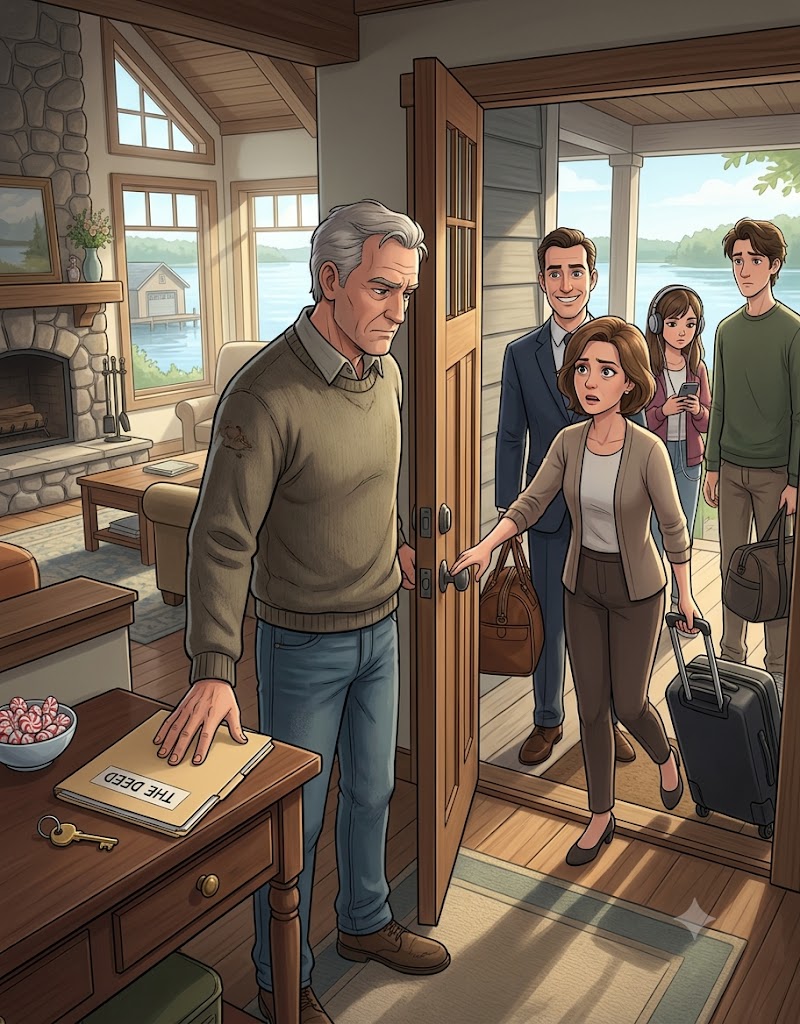
- Then, while pouring coffee at the sink one morning, I heard tires crunching on the gravel drive.
- My stomach dropped before I even looked out the window.
- A black SUV. A silver convertible.
- Both pulled into the yard with an air of complete ownership.
- Rebecca stepped out first in a white linen dress, gold sandals, and designer sunglasses, her blonde hair styled to look effortlessly tossed. Trent followed in pressed slacks and loafers. Madison, now seventeen and taller than her mother, stepped out with expensive impatience written across her face. Cooper brought up the rear, hunched over his phone.
- Nine years without a word, and now here they were, smiling.
- I stepped onto the porch before they reached the steps.
- “Daddy,” Rebecca began, her tone thoroughly rehearsed. “Oh, my goodness… you look great.”
- I didn’t answer.
- Trent extended a polished hand. “Walter. It’s been far too long. We were utterly devastated about Eleanor. Truly. We would have come to the service, but we only heard after the fact.”
- We both knew that was a lie; her obituary had run in three local papers.
- “What are you doing here?” I asked plainly.
- Rebecca placed a manicured hand over her chest. “Daddy, we’re family. We came to help you through this difficult time.”
- “Where was this family nine years ago?”
- Her smile flickered, then she gestured toward the grounds. “A property this size is a massive burden for someone your age. What if you slip? What if you get sick out here alone?”
- Trent chimed in smoothly. “She’s right. We discussed it, and the most logical setup is for us to move in together. We can oversee the grounds and keep Birchwood in the family.”
- Oversee the grounds.
- Rebecca peeked past me into the house. “We’ll take the main house, of course. The master suite is ideal for us, and the kids need their own space. You’d probably prefer somewhere quieter anyway—the boathouse has that cozy loft, doesn’t it?”
- The boathouse. They were relegating me to an outbuilding on my own property—not for my well-being, but so they could claim the lake view, the bedrooms, the wrap-around porch, and everything Eleanor had left to me.
- Madison glanced up from her screen. “Does this place even have working Wi-Fi?”
- Cooper just shrugged.
- Rebecca turned back to me. “It’s only temporary, until everything gets settled.”
- I knew what settled meant. They’d move in, stake their claim, and within a year I’d be a nuisance on my own land, quietly nudged out.
- “No,” I said.
- Rebecca blinked. “What?”
- “You’re not moving in.”
- Trent’s face flushed red. “Walter, be sensible. We’re trying to help you.”
- “Like you helped me nine years ago?”
- Rebecca’s polished facade cracked. “That’s not fair! We were going through a hard time back then.”
- “You had a finished basement.”
- “We had a young child!”
- “You had an empty guest room, too.”
- “We had tuition to pay!”
- “And now you have teenagers and even bigger expenses,” I replied. “Fascinating how your hard times always coincide with wanting my resources.”
- “This isn’t about money!” Trent asserted, though his voice lacked conviction.
- Rebecca placed a restraining hand on his arm. “Dad,” she said evenly, “do you have any idea what property taxes cost on a lakefront estate? The insurance? Dock upkeep? You’ll burn through Eleanor’s savings in months. This way, we preserve Birchwood.”
- “That’s my burden to carry.”
- “It becomes ours if you lose it and come to us for help again,” she snapped.
- There it was—the ugly truth beneath the refined exterior.
- For a brief, heavy second, I almost faltered. Loneliness can make a desperate man accept terrible terms. Rebecca was my daughter, and these were my grandchildren. Maybe I really was too old to handle eleven acres. Maybe bitterness was clouding my judgment.
- Then I saw the look in Rebecca’s eyes: she believed she’d already won. She was already redecorating in her head, already banishing me to the boathouse.
- “Get in your cars,” I said quietly, “and get off my property.”
- Her eyes narrowed to slits. “You’ll regret this. When you’re sitting in this empty house wondering why no one calls, remember that you chose this.”
- “The choice was made nine years ago,” I answered. “I’m just enforcing it.”
- They packed back into their cars and backed down the drive.
- At the end of the lane, the SUV paused, and Trent stepped out alone. Walking toward the porch with his hands jammed in his pockets and his shoulders sloped, he looked older without Rebecca beside him.
- “Walter,” he called out.
- I stayed silent.
- “I’m sorry,” he offered awkwardly. “For all of it.”
- It was nine years late, but it sounded genuine—unpolished and tired.
- “She found out about the estate from Dale,” he admitted, staring at the gravel. “Your cousin. She’s been planning this for two weeks—mapping out rooms, school districts, everything.”
- “I figured.”
- “I just go along with her,” he said quietly. “It’s easier.”
- “That’s how a lot of lives get ruined.”
- He gave a small, weary nod. “I know.”
- As their dust trail faded down the road, I felt a sensation I hadn’t known in nearly a decade. It wasn’t triumph, nor was it complete relief. It was simply the quiet dignity of standing my ground without asking permission.
- Still, I knew my daughter. Rebecca was not the type to walk away empty-handed—not with a prime piece of real estate on the line.
- Three days later, I uncovered Eleanor’s first letter.
- I was going through the rolltop desk in her study, trying to make sense of the bait shop ledgers, when I noticed a plain white envelope tucked behind an insurance file. My name was written on the front in Eleanor’s bold cursive.
-
Walter,
If you’re reading this, I’m gone, and you’ve inherited more than just property. You’ve inherited a fight I knew was coming.
- I sat down slowly in the wooden desk chair.
-
I’ve watched from afar these past nine years. I know what happened when you needed a roof over your head. You were too proud to tell me the full story, but Cedar Falls isn’t as big as people think. I know enough.
- My throat felt tight.
-
The moment they hear about Birchwood, they will come knocking with warm smiles. They’ll call it family, concern, and help. They’ll call it everything except what it truly is. So, I took precautions.
- Eleanor had known all along.
- Her second letter was taped beneath the lid of a metal minnow cooler in the bait shop, exactly where the first note said it would be. That letter contained more than just comfort—it contained leverage.
- Eleven months before her death, Eleanor had quietly hired a private investigator to look into Rebecca and Trent’s financial standing. She wanted to know what kind of vultures would circle once she was no longer around to protect me.
- The glamorous life they projected was a house of cards: Trent’s real estate firm hadn’t closed a major deal in months; their home was leveraged with a secondary mortgage; and Rebecca was juggling multiple credit cards while maintaining minimum payments. Yet they continued to spend lavishly on luxury cars, vacations, and private schools to preserve their image.
-
They are drowning, Eleanor wrote. Birchwood looks like a lifesaver to them. Do not let them pull you under.
- The final document was waiting in a safe deposit box at Caroline Briggs’s office.
- I sat across from Caroline as she laid a thick legal folder on her desk. “Your sister anticipated their next move,” she said.
- “Sounds like her.”
- “She put ironclad protections in place.”
- The codicil to Eleanor’s will was signed, witnessed, and notarized. The clause was razor-sharp:
- For seven years, Birchwood could not be sold, subdivided, transferred, or leveraged as collateral. During that time, I was required to reside in the main house as its sole owner. No relatives were permitted to move onto the property under any circumstances. If those terms were breached, ownership of Birchwood would automatically transfer to the Lake Marlin Conservation Trust as a public nature preserve.
- Neither Rebecca nor I would get a single acre.
- Eleanor had built a legal fortress around me. Furthermore, she had established a dedicated trust to cover property taxes, insurance, maintenance, dock repairs, and utility costs for a full decade, leaving behind a curated list of trusted local contractors, plumbers, and accountants.
- Inside the file lay one last sealed envelope marked: Open only if they return.
- They returned two and a half weeks later, and this time, Rebecca brought a crowd.
- Looking out the kitchen window, I watched a convoy of cars park across the grass. Rebecca stepped out wearing a tailored black dress—her idea of a somber, respectful outfit. Trent looked pale and reluctant beside her. Behind them were his parents, Gerald and Diane Mercer, looking stern and businesslike. Gerald carried a thick leather portfolio; Diane held a digital camera.
- My cousin Dale trailed behind them, looking like he wanted to sink into the ground.
- Rebecca marshaled her team with quick gestures before marching up to the porch and knocking.
- I opened the door.
- “Daddy,” she began, her tone dripping with forced gentle sympathy. “We need to address this as a family.”
- “My family is buried in the churchyard next to Eleanor,” I replied calmly. “You discarded the rest nine years ago.”
- Gerald stepped forward, puffing out his chest. “Now see here, Walter! That’s no way to speak to your daughter.”
- I turned my gaze to him. “And who asked for your input on my front porch?”
- Diane raised her camera and began taking photos of the porch, the roof, the dock, and me.
- “What is that for?” I asked.
- “Documentation,” she stated bluntly.
- Rebecca’s lip curled into a slight smile. “We’ve done our research, Dad. A property like this is a legal liability. One slip on that dock, one maintenance failure, or an accident at the bait shop, and you could be sued for everything you have. We are trying to safeguard you.”
- Gerald unzipped his portfolio. “We’ve consulted legal counsel. Given your age, financial track record, and strained family relations, there are clear grounds to challenge Eleanor’s competency and the validity of the deed. A judge will certainly question whether you are fit to manage an eleven-acre commercial asset alone.”
- I stared straight at my daughter. “Are you threatening legal action on my own lawn?”
- “We’re offering a compromise,” she said smoothly. “We move in, share expenses, manage the risk, and everyone wins. Otherwise, we take this to court. It will be drawn-out, expensive, and stressful. At your age, is that really how you want to spend your remaining years?”
- Trent stayed in the background, silent as usual.
- Old anger flared in my chest, but then I remembered Eleanor’s final envelope.
- “Stay right there,” I said. “I have something to show you.”
- I walked back to the study, opened the final note, and read Eleanor’s words:
-
Walter,
 If they bring legal papers, show them mine. If they question your health, show them the doctor’s clearance. If they pretend to act out of love, show them who they really are when they think no one is watching.
Check the bottom drawer.
-
You don’t owe them another second of your peace.
Love, Eleanor.
- The bottom drawer held a binder nearly two inches thick. I picked it up and walked back out onto the porch.
- Rebecca was busy pointing toward the boathouse, explaining to Gerald how it could be renovated into a guest house, when I cleared my throat.
- “Rebecca,” I said. “How is Trent’s real estate business doing these days?”
- Her speech cut off mid-sentence. “It’s fine. Why?”
- “That’s odd. According to these financial records, his firm hasn’t closed a major sale in eight months. Your home is carrying a second mortgage, your credit lines are maxed out, and you’re living on borrowed time and plastic.”
- The color drained from her face.
- I pulled out several glossy photographs and laid them along the porch railing: photos of expensive dinners at the marina steakhouse, luxury shopping trips, and weekend stays at high-end resorts—all taken while they were actively defaulting on loans.
- Trent turned to his wife, stunned. “Rebecca… you told me those were client meetings!”
- “I was networking!” she snapped, her composure slipping fast.
- “Networking on maxed-out credit for a firm that’s broke?” I asked quietly.
- Gerald slowly closed his leather folder. Diane lowered her camera. Dale looked intently at his shoes.
- Then I pulled out a small digital audio recorder Eleanor had saved with the documents and held it up.
- “Would everyone like to hear the recording from two weeks ago, where Rebecca explains her plan to move me to the boathouse and gain control of the deed?”
- Rebecca’s eyes went wide with pure panic. “Daddy… don’t.”
- I pressed the button.
- Her recorded voice carried crisp and clear across the motionless yard:
-
“He can’t manage that place alone. Once we establish that, we put everything into a structure we control. The lakefront is easily worth two million if we subdivide it properly. We clear our debt, stabilize our situation, and he gets to feel looked after. Everybody wins.”
- A profound silence descended upon the porch.
- Not just quiet—a heavy, suffocating silence that pressed against your skin.
- Diane lowered her camera completely. Gerald snapped his leather portfolio shut. Cousin Dale subtly took a step back toward the cars.
- Trent stared at his wife, completely blindsided. “You planned this.”
- Rebecca’s eyes darted from him to me, then to the recorder, her mind frantically working through damage control. “Trent, I can explain—”
- “From the moment you heard about the inheritance,” he said, the realization settling in.
- “It was just a contingency plan!”
- “You lied to me.”
- “I was trying to protect our family!”
- “By burning through money we didn’t have while telling me your father was the burden?”
- “We were drowning!” she snapped, every bit of her polished facade vanishing. “We need this property!”
- “No,” I corrected her softly. “You wanted it. There’s a world of difference.”
- The entire confrontation fell apart right there on the grass.
- Gerald and Diane hurried toward their vehicle, desperate to distance themselves from the humiliation. Dale offered a weak, mumbled apology before retreating after them.
- Madison stood by the convertible, no longer acting bored, stripped of the illusion that her family was pristine. Cooper stared at his mother with a look I recognized from Rebecca’s own childhood—the haunting moment a kid realizes their parent is deeply flawed.
- Trent remained rooted to the spot. “Nine years,” he whispered. “For nine years you convinced me Walter was the problem.”
- Rebecca let out a bitter, cold laugh. “He came to our doorstep with nothing! We had every right to guard our own interests.”
- “He was your father.”
- “He was a washed-up truck driver with no money and nowhere else to go!”
- The harsh truth hung in the air, completely unvarnished.
- Something inside Trent snapped—a final thread tying him to her narrative broke for good.
- “Get in the car,” he commanded coldly.
- When their vehicles reached the end of the gravel drive, they turned in opposite directions. His taillights disappeared down the west road; hers vanished to the east.
- Trent reached out three days later.
- I was sitting on the porch watching the setting sun turn the lake a deep crimson when my phone rang. The peace I was slowly discovering at Birchwood still felt fragile, and I hesitated before picking up.
- Ultimately, I answered.
- “Walter?” His voice sounded utterly exhausted. “Can I come by? Just me?”
- I looked out over the quiet water. “Is Rebecca with you?”
- “No. She’s staying at her mother’s.”
- An hour later, an old pickup truck I’d never seen before pulled up. Trent looked like he hadn’t slept a full hour since he’d last stood on my porch. We sat outside in the gathering twilight while the bullfrogs began their evening chorus in the reeds.
- Rebecca had served him with divorce papers.
- There were other painful truths, too—red flags Trent had deliberately ignored over the years. Secret money transfers between accounts, hidden bills, and a suspected affair he had refused to confront because denial was easier than starting over at forty-eight. His real estate business was in even worse shape than he’d let on; without a miracle, their home would be foreclosed on within weeks.
- The bitter irony wasn’t lost on either of us.
- Nine years ago, I had stood in his kitchen with nowhere to lay my head, and he had directed me toward a budget motel. Now, he sat on my porch, his pride completely shattered, hands tightly wrung together.
- “Walter,” he said, his voice barely carrying over the frogs, “I have zero right to ask this… but is there any way I could stay out here for a bit? I’ll work. I’ll do whatever needs doing—the boathouse, a sofa, a storage closet, I don’t care. I literally have nowhere else to go.”
- The old, lonely part of me wanted to say yes instantly. I wanted to feel needed, generous, and useful. I wanted to prove I was a better man than the ones who had turned their backs on me.
- But Eleanor hadn’t built this legal wall around me just so I could compromise my security all over again.
- “Trent,” I said, “Eleanor’s deed explicitly states I must live here alone for seven years, or the whole estate is forfeited to a land trust. If I let you move in, I lose everything. Do you understand?”
- His face fell. “I understand. I shouldn’t have put you on the spot.”
- “I’m not finished,” I added.
- He looked up.
- “There’s a guy named Pruitt who operates the marina at the north end of the lake. His dockmaster quit last month. It’s hard, dirty work, long hours, minimal pay, but it comes with a small room over the boat shed. I can throw your name in. But make no mistake—this isn’t a rescue. It’s me pointing to a door. Walking through it is entirely on you.”
- He searched my face for a long moment.
- “If you ever bring up money or try to squeeze me for this property again,” I warned, “we are completely done.”
- He gave a firm nod. “I get it.”
- “Do you?”
- “Yes.”
- “Then take the job if he offers it.”
- “I will.”
- Pruitt brought him on.
- Trent phoned a week later to share the news. His voice was weighed down by exhaustion and embarrassment, but there was a new, steady undertone taking root.
- “Hard, honest labor,” he remarked. “I forgot how good that feels at the end of the day.”
- He started calling every couple of weeks after that. He never asked for financial help or a bed at Birchwood. He simply called to check in and share updates about repairing boat slips, pumping fuel, securing lines, and helping elderly fishermen off the lake before storms hit. He picked up night shifts at the local hardware store. On Tuesdays, he joined a support group for divorced fathers in a church basement. He retained a modest lawyer to fight for proper visitation rights with Madison and Cooper.
- Step by step, patiently, he began piecing together a life from the wreckage. For the first time in years, I allowed myself to feel hopeful without letting my guard down.
- Roughly eight months in, Trent mentioned something that caught my attention.
- “Walter, have you ever explored the ridge past the north woods?”
- “Not really.”
- “Pruitt and I took a skiff along that shore yesterday. There’s a cabin up there hidden among the pines. Looks like Eleanor owned more acreage than just the main lakefront.”
- After hanging up, I couldn’t stop thinking about it. Eleanor kept meticulously detailed records; why hadn’t she mentioned a second cabin?
- The next morning, I took an old utility cart up a rutted dirt trail beyond Cedar Ridge. The path climbed through thick pines and laurel bushes before clearing out onto a high bluff overlooking the water.
- Sitting beneath the trees was a charming stone cabin topped with a green metal roof—weathered, rustic, and stunning.
- The front door was unlocked. Inside was a large open room featuring a massive stone hearth, shelves packed with books on forestry, boatbuilding, and poetry, and a smooth ladder leading to a sleeping loft. Sunlight streamed through the windows, illuminating dust motes in the air.
- On the dining table lay a sealed envelope.
-
Walter,
If you’ve found your way here, then the picture is coming into focus.
This cabin sits on twenty acres held under a separate deed, completely free of the conditions tied to Birchwood. It belongs to you, to do with as you see fit.
I bought it as a quiet retreat for myself, but in my heart, I always intended it for you.
- Behind a stack of books, I discovered a legal folder containing blueprints, permits, cost estimates, and handwritten notes. Eleanor’s vision was so vividly mapped out I could almost feel her presence in the room.
- She had envisioned transforming the ridge into a sanctuary: a cluster of simple cabins, a workshop, communal dining, and practical support—a refuge for men who had lost their marriages, livelihoods, homes, pride, or sense of purpose. Men who didn’t want charity, but needed solid ground while they got back on their feet.
- Men like I was nine years ago.
- Men, she noted, like Trent might one day become.
- I spent the entire day sitting in that cabin. Eleanor had taken the most painful experience of my life and re-imagined it as a sanctuary for others.
- That night, I called Trent. “How do you feel about a change of scenery?”
- He arrived three days later.
- I watched his expression shift as he took in the cabin, the high ridge, and the sweeping lake view below. I walked him through Eleanor’s blueprints and the trust fund she had established to finance the construction: six small guest cabins, a communal workshop, and a broad porch overlooking the water.
- He examined every document with the same intense focus he’d once brought to high-end real estate deals, but the greed was gone. In its place was genuine, thoughtful determination.
- “A sanctuary,” he murmured. “A place for men to rebuild.”
- “For men who need to find their footing.”
- He flipped through the plans. “This is precisely what I needed nine years ago.”
- I nodded quietly. “Me too.”
- He turned a page. “You’ll need someone to manage construction, pull permits, source materials, hire crew, and handle budgeting.”
- “I do.”
- He looked at me directly. “Why are you showing this to me?”
- “Because I don’t need a former son-in-law doing me a favor,” I said clearly. “I need a partner.”
- Something shifted in his posture. It wasn’t relief—it was accountability settling onto his shoulders.
- “A real partnership,” I emphasized. “Real responsibility, real work, real ownership. But the terms on Birchwood remain absolute—seven years. This ridge is independent. If we partner up, we do it as two men building something worthwhile, not as broken family pretending the past didn’t happen.”
- He stood in quiet thought for a long time.
- “I’d like to add a woodshop,” he said finally. “Not just for maintenance, but for skill-building—carpentry, mechanical repair, maybe job placements with local businesses.”
- “Put it on paper.”
- “I can’t guarantee I won’t make mistakes.”
- “I’m not looking for perfection.”
- He turned to look out over the water. “I’ll give this everything I’ve got,” he said quietly. “Because for the first time, I’ll be building something meaningful instead of trying to patch up a lie.”
- For the very first time, I saw the real man standing before me—not the polished figure who had let me be turned away in his kitchen, nor the husband who bowed to Rebecca’s every command for the sake of quiet compliance. I saw a man who had hit rock bottom, owned up to his failures, and decided to pick himself back up.
- “Alright,” I said. “Let’s build it.”
- That conversation was two years ago.
- This morning, I stood on the porch of the stone cabin, watching the sunrise over what folks now call the Birchwood Refuge.
- Six sturdy cabins line the ridge, each featuring a simple porch, a clean bed, and a window facing the woods. The main shop smells constantly of fresh sawdust and hot coffee. Our garden still produces more hope than crops, though it gets better each season.
- Men arrive here with that same hollow, exhausted look I used to see in my own reflection.
- Frank is sixty-three, a former welder whose thirty-year marriage ended with him living out of his truck behind an auto shop. Manny lost his small freight business after a partner embezzled the funds, arriving here unable to make eye contact. Alan came after a severe health crisis cost him his career and his self-esteem.
- When they first arrive, they are silent and defensive. Some are bitter; others just feel empty. But after weeks of honest labor, shared dinners, fresh air, and the quiet brotherhood of men who don’t ask for explanations, you can see their shoulders drop and their heads lift.
- Trent manages the workshop now. He works harder than anyone on the mountain—leaner, stronger, and deeply tanned. He looks far healthier than he ever did back when he was wearing designer loafers and drowning in hidden debt.
- He maintains a steady, meaningful relationship with Madison and Cooper now—real visits, growing a little more honest each time.
- Last Thursday, Madison drove up by herself in a beat-up little sedan. At eighteen, fresh out of high school, her hair was shorter and her eyes still carried that sharp intelligence, though the defensiveness had softened. At first, she addressed me as “sir” and kept her arms folded, clinging to the cautious distance her mother had instilled in her for years.
- But she stayed for three days.
- She pitched in at the shop, sat in on our evening circle, and listened quietly while Frank talked about starting over at sixty-three. She heard Manny explain that a man earns his dignity back by helping the next guy up.
- On her last morning, she caught me weeding the vegetable patch.
- She stood near the row for a second. “Grandpa.”
- The word echoed deep in my chest. I kept my eyes on the soil for a moment until I was sure my voice was steady.
- “Yes, ma’am?”
- She gestured toward the ridge. “Mom always said you and Dad abandoned your responsibilities.”
- I pulled a stubborn weed and dropped it into my bucket. “And what do you think?”
- “These men didn’t abandon anything,” she said firmly. “They got knocked down, and now they’re getting back up. That’s totally different.”
- “No,” I replied gently. “It certainly isn’t the same.”
- She knelt down beside me in the dirt and started weeding without saying another word.
- Eleanor left me far more than an estate and a collection of letters—she gave me back my self-respect. She showed me how to transition from the man standing hopeless outside a locked door into the man who can open doors for others.
- She gave me a true family, even if it wasn’t the kind I had once begged for. Not a family held together strictly by blood, guilt, or staged photo frames, but one forged by showing up for people when they have nothing to offer in return. True family doesn’t audit your net worth before deciding if you deserve a seat at the table.
- Some nights, I still walk the length of the Birchwood porch and think of Eleanor. I envision her sitting at her kitchen table, penning those letters with absolute clarity, already seeing right through Rebecca’s plans. I imagine her chuckling softly as she drafted the land trust clause.
- She knew my daughter would come to claim the land. She also knew I might be lonely enough to hand it over. So, Eleanor protected me from Rebecca—and in a way, she protected me from my own weaknesses.
- The lake is completely still tonight.
- Up on the ridge, Trent is locking up the shop. Frank and Manny are out back arguing good-naturedly over whether the tomato plants need staking. Madison drove home yesterday, but she texted me a picture of a wooden bookshelf she built for her dorm room.
- It was a little crooked. But it was sturdy.
- Cooper might come out to visit next month. He said maybe. At his age, a maybe is a bridge—as long as you don’t put too much weight on it right away.
- The old boathouse still sits down by the water, quiet and simple. Rebecca once thought that was where I belonged. Now it just holds extra life vests, spare paddles, and folding chairs for when families visit on weekends.
- The main house belongs to me—not because of its market value, but because someone loved me enough to guarantee I’d never be cast out again.
- And the ridge belongs to all of us. Not because bloodlines dictated it, but because hard work, truth, and community built it.
- Because a man who was once shown the door can still learn how to build a home. And sometimes, the place no one can take away from you becomes the very place where forgotten men remember how to live again.