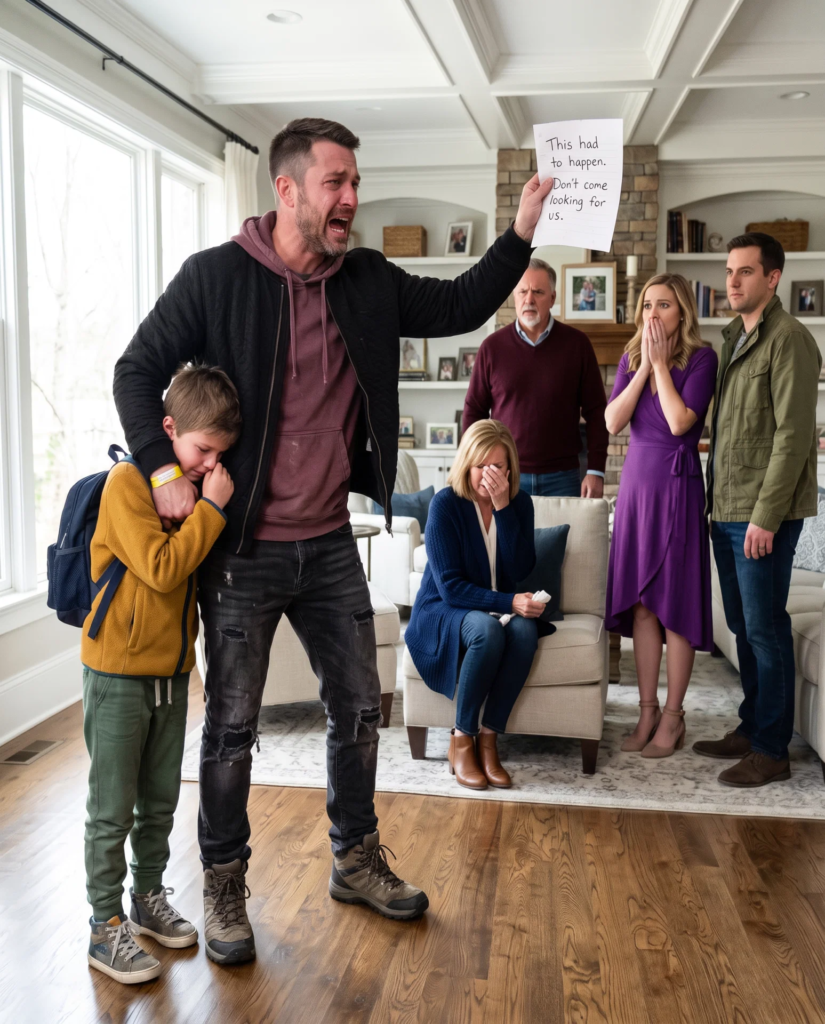
- I took my nine-year-old son on a short hike during a family cabin trip. When we returned, the cabins, vehicles, food, and every person we trusted had vanished. Only one note remained: “This had to happen. Don’t come looking for us.”
- My name is Daniel Mercer. I was thirty-eight when my parents invited us to what they called a “family reset weekend” in Colorado’s San Juan Mountains.
- There were two rental cabins, three vehicles, and enough food to feed twelve people for four days.
- My parents, Richard and Elaine.
- My older sister Melissa, her husband Troy, and their two daughters.
- And me with my nine-year-old son, Noah.
- My wife, Claire, had died eighteen months earlier. Since then, my family had treated my grief as though it were a burden they were tired of carrying.
- Melissa called me “too sensitive.”
- My father told me I needed to “act like a man again.”
- My mother only seemed to cry when someone else was there to witness it.
- Still, I accepted the invitation.
- I did it for Noah.
- On the second morning, Noah asked to hike to a creek we had spotted from the road.
- I told everyone we would be gone for less than an hour.
- Melissa stood over a pan of pancakes. Troy was splitting wood. My father sat on the porch drinking coffee.
- “Don’t get lost,” Dad called.
- Those were the last ordinary words I ever heard from him.
- The trail was easy, but Noah kept stopping to collect rocks and ask about animal tracks.
- When we returned ninety minutes later, the clearing was empty.
- Not peaceful.
- Empty.
- Both cabins had disappeared.
- At first, my mind refused to understand what I was seeing.
- Where the cabins had stood, there were only flattened patches of soil, deep tire marks, and scattered pine needles.
- The cars were gone.
- The coolers were gone.
- So were the camp chairs, lanterns, blankets, firewood, and sleeping bags.
- Noah whispered, “Dad?”
- I ran toward the larger patch of dirt, dropped to my knees, and clawed at the ground.
- Fresh drag marks crossed the clearing.
- The cabins had been prefabricated rentals mounted on skids.
- Someone had deliberately hauled them away.
- Then I noticed an envelope nailed to a pine tree.
- My name was written across it in my mother’s careful handwriting.
- Inside was a single sheet of paper.
- Daniel,
- This had to happen. Don’t come looking for us. Noah is your responsibility now. You have taken enough from this family. We are done paying for your mistakes.
- There was no signature.
- No apology.
- No map.
- No food.
- No water.
- And no phone signal.
- Noah began crying without making a sound. His mouth trembled, but he was trying not to frighten me.
- That broke something inside me.
- I searched the clearing until my hands bled.
- The only things I found were half of a crushed plastic bottle beneath the bushes and a granola-bar wrapper Melissa’s youngest daughter had dropped the previous night.
- The access road looked identical in both directions.
- We were far from the highway, much deeper into the mountains than I had realized. Troy had driven the final section while I followed his dust and brake lights.
- When evening came, the temperature dropped sharply.
- I built a shelter from branches and gave Noah my jacket.
- Then I promised him we were going to survive.
- Nine days later, a rescue helicopter finally spotted us.
- I had lost thirty pounds. I had a fever, and the skin on my feet had been torn open.
- But Noah was alive.
- And the people who abandoned us were about to discover what that survival meant.
- PART 2
- The deputy who reached us was named Carla Reyes.
- She jumped from the helicopter before the rotors had fully slowed, ducking beneath the blades with a medical bag in one hand.
- Noah was wrapped in my shirt and shaking so violently that his teeth clicked together.
- I remember trying to tell Deputy Reyes not to give him water too quickly. I had read somewhere that it could be dangerous.
- Or perhaps I only thought I had.
- My lips were split, my tongue swollen, and my voice sounded like stone scraping against concrete.
- “He’s nine,” I said. “His name is Noah. His mother was Claire. Don’t let him die.”
- Deputy Reyes looked directly into my eyes.
- “He is not dying today.”
- It was the first statement I had believed in nine days.
- The hospital in Durango smelled of disinfectant and warm plastic.
- Doctors treated Noah for dehydration, exposure, malnutrition, infected cuts, and early kidney stress.
- I had an infection in my calf, two fractured ribs from a fall, and nerve damage in two toes.
- For the first twenty-four hours, I did not fully understand what had been done to us.
- I assumed my family had left after some kind of cruel argument or sudden panic.
- I thought they had returned home and lied about what happened.
- Then Sheriff Andrew Voss entered my room with Deputy Reyes and a representative from child protective services.
- He closed the door.
- “Daniel,” he said, “we found the company that moved the cabins.”
- My throat tightened.
- The sheriff placed a printed receipt on the rolling table beside my bed.
- The relocation had been arranged three weeks before the trip.
- It had been paid in full by Troy Whitaker, my brother-in-law.
- Scheduled collection time: 10:30 a.m. Saturday.
- Special instructions: remove all structures and refuse from site. No customer contact necessary.
- “Refuse,” I repeated.
- No one corrected me.
- The vehicles had not mysteriously vanished either.
- My family had driven them out in a planned convoy.
- Food, water, and emergency supplies were loaded into Troy’s truck and my father’s SUV before Noah and I returned from the creek.
- The only fingerprints on my mother’s note belonged to her.
- Sheriff Voss asked whether I understood why my family might have done it.
- I looked toward the curtain separating my bed from Noah’s.
- He was sleeping, one small hand wrapped around a stuffed fox a nurse had given him.
- “Yes,” I said.
- Claire had left me a life-insurance policy after a drunk driver killed her.
- Most of the money went toward medical bills, therapy, and our mortgage.
- My parents believed I should have sold the house and given them part of the money because they had loaned me twenty thousand dollars during college.
- Melissa agreed.
- Troy had more serious problems.
- Gambling losses.
- Business debts.
- Unpaid taxes.
- All weekend, he had been smiling far too hard.
- “They wanted custody rumors,” I told the sheriff. “They wanted me unstable. Dead would have been easier. If Noah died too, they could say I wandered off with him.”
- Sheriff Voss did not react visibly.
- By my third day in the hospital, Troy had been arrested.
- The next day, police detained Melissa and my father.
- My mother surrendered through an attorney.
- They expected sympathy.
- They believed everyone would accept their story that I was grieving, unstable, reckless, and suicidal.
- They did not expect Noah to remember Troy whispering into his phone before breakfast.
- “They’re leaving now. Be ready.”
- They did not expect my mother’s note to survive.
- And they did not expect me to keep walking.
- PART 3
- The trial began eleven months later in La Plata County District Court.
- By then, Noah and I had relocated to Oregon near Claire’s sister, Mara.
- We lived in a small blue house three blocks from an elementary school and five blocks from the ocean.
- Noah slept with a light on.
- I stored bottled water in every room.
- Neither of us tolerated silence well anymore.
- Prosecutors charged my father, Richard Mercer; my mother, Elaine Mercer; my sister, Melissa Whitaker; and my brother-in-law, Troy Whitaker, with attempted murder, serious child abuse, conspiracy, reckless endangerment, evidence tampering, fraud, and false statements.
- Their defenses were insulting from the beginning.
- Troy claimed it was intended as “a lesson.”
- Melissa insisted she believed we had a satellite phone.
- My mother said the note had been “misinterpreted.”
- My father said I had always exaggerated everything.
- But evidence replaced every excuse.
- The cabin company testified first.
- Their records showed Troy repeatedly called to confirm the removal time.
- He asked whether both cabins could be cleared quickly and emphasized that “nobody would be on-site except authorized family.”
- He even paid extra for a weekend pickup.
- Then the trailer company presented its records.
- Troy had rented a flatbed under his landscaping business and removed supplies before the cabin crew arrived.
- A gas-station camera captured my father’s SUV, Troy’s truck, Melissa’s van, and my mother’s sedan leaving the mountain road together at 11:46 a.m.
- Noah and I returned to the clearing around 12:12.
- Twenty-six minutes.
- That was all that separated abandonment from attempted murder.
- The prosecutor, Helen Park, rarely raised her voice.
- She did not need to.
- She presented the timeline with such calm precision that every excuse sounded smaller.
- “At 8:57 a.m.,” she said, “Daniel Mercer and his son left for a short hike. At 9:03, Troy Whitaker sent a text message that read: They’re gone. Start now. At 9:14, Richard Mercer moved the first cooler into the truck. At 9:31, Elaine Mercer wrote the note. At 10:28, the cabin removal crew arrived. By 11:46, all four defendants drove away.”
- She paused beside an enlarged photograph of the note.
- “This had to happen,” she read. “Don’t come looking for us.”
- Then she faced the jury.
- “Those are not the words of people expecting a father and child to walk safely out of the woods.”
- My mother cried during that testimony.
- Not honestly.
- Not privately.
- She dabbed her eyes while glancing toward the jury, arranging grief across her face as carefully as makeup.
- Then Noah testified.
- He was ten by then, still small for his age after what those nine days had done to him.
- He wore a navy blazer Mara had purchased and held a smooth gray stone in his left hand.
- It was one he had collected at the creek on the morning we were abandoned.
- The judge spoke gently.
- Helen Park spoke even more softly.
- Noah answered every question clearly.
- He remembered the pancakes.
- He remembered Aunt Melissa appearing nervous.
- He remembered Uncle Troy walking behind the cabin with his phone.
- He remembered Grandpa saying, “Once it’s done, it’s done.”
- Then Helen asked, “What happened when you and your dad came back?”
- Noah looked at me.
- Everything inside me wanted to stand, take his hand, and carry him out of the courtroom.
- I wanted to shield him from the attorneys, the cameras, and the strangers watching our suffering become public evidence.
- But Noah had chosen to speak.
- So I remained still.
- “When we came back,” he said, “everything was gone. I thought we were in the wrong place. But my rock pile was there. I made it before we left. So I knew.”
- “What did your father do?”
- “He looked for everyone. Then he found the note.”
- “What did he tell you?”
- Noah swallowed hard.
- “He said nobody was coming right then, but he was there, and he would not leave me.”
- The courtroom became silent.
- “And did he leave you?”
- “No.”
- “What did he do during those nine days?”
- Noah closed his fingers around the stone.
- “He gave me the food first when we found berries. He made me drink first when we found water. He let me sleep against him because I was cold. He told stories about my mom so I wouldn’t forget her voice.”
- Melissa lowered her head.
- For the first time, I saw shame on her face.
- It meant nothing.
- Shame was not restitution.
- The most difficult day came when prosecutors played Troy’s recorded police interview.
- He had spoken freely after his arrest, convinced he could explain his actions.
- On the recording, he sounded irritated rather than frightened.
- “Look, Daniel always lands on his feet,” Troy said. “He’s dramatic. He wanted everyone to pity him after Claire died. This was supposed to snap him out of it.”
- A detective asked, “By removing shelter, transportation, food, and water from a remote area?”
- “He knew the general direction of the road.”
- “Did Noah know?”
- There was a long pause.
- Then Troy answered, “That wasn’t my problem.”
- Noah’s breathing changed beside me.
- I placed my arm around him, and he leaned against my shoulder without looking away from the screen.
- The detective continued.
- “Why leave the note?”
- Troy laughed once.
- “Elaine wanted closure.”
- Closure.
- My mother wanted closure from her son and grandson.
- When I testified, the defense attorney tried to portray me as unstable.
- He questioned me about my grief after Claire’s death, my therapy appointments, and a Thanksgiving argument when I had shouted at my father.
- He asked whether I might have misunderstood their intentions.
- “No,” I said.
- Then he asked if I hated my family.
- I looked at all four defendants.
- My father stared at me with the same cold expression I had feared since childhood.
- My mother looked wounded, as though I had embarrassed her.
- Melissa appeared hollow.
- Troy looked angry that consequences were taking so long.
- “I don’t know what I feel for them anymore,” I said. “But I know what they did.”
- The prosecutor asked me to describe the ninth day.
- I told the truth.
- By then, hunger no longer felt normal.
- It had become a vibration inside my bones.
- Noah had a fever.
- I used my belt to secure branches together so I could drag him when he became too weak to walk.
- We followed the slope downward because I believed water might lead toward people.
- On the eighth night, rain began falling.
- I opened my mouth toward the sky.
- Noah could barely sit upright, so I soaked my shirt and squeezed drops between his lips.
- The next morning, we heard the helicopter.
- “I thought I was hallucinating,” I told the jury. “Then Noah heard it too. He tried to wave, but he couldn’t lift his arm. So I took off my shirt and climbed onto a rock.”
- Earlier, the defense had implied I might have found help sooner if I had made better decisions.
- Helen asked, “Why didn’t you leave Noah and search faster alone?”
- I answered before she finished.
- “Because I promised his mother I would protect him. Because he was nine. Because people had already left him once.”
- Two jurors began crying.
- Six weeks after opening statements, the jury returned its decision.
- Guilty.
- On nearly every charge.
- My father received twenty-eight years.
- Troy received thirty-five because prosecutors proved he had organized the plan.
- Melissa received twenty-two.
- My mother received eighteen.
- At sentencing, each defendant was permitted to speak.
- Troy blamed debt and stress.
- Melissa blamed Troy.
- My mother blamed confusion.
- My father blamed me.
- “You destroyed this family,” he said, pointing at me with a shaking hand.
- For the first time in my life, his anger did not shrink me.
- When the judge allowed my victim-impact statement, I stood.
- “No,” I said. “You destroyed it the morning you watched your grandson walk into the trees and decided he was acceptable damage.”
- My father looked away.
- I continued.
- “For nine days, Noah asked me why. I had no answer that would not break him. I still don’t. But I can tell him this now: what happened was real, what you did was deliberate, and the law saw it clearly.”
- Then I turned toward my mother.
- “You wrote, ‘This had to happen.’ You were right about one thing. Something did have to happen. Just not what you planned.”
- The judge imposed every sentence without sympathy.
- Outside the courthouse, reporters surrounded us with questions.
- I ignored all but one.
- A young reporter asked, “Mr. Mercer, do you feel like you got justice?”
- I held Noah’s hand.
- He was looking toward the mountains rather than the cameras.
- “No,” I said. “Justice would be my son never learning what betrayal feels like. This is accountability.”
- Then we went home.
- Life did not become perfect after the trial.
- Stories like ours do not truly end in courtrooms.
- Noah still had nightmares.
- I still woke reaching for supplies that were not there.
- Both of us panicked when someone left without saying goodbye.
- But our lives slowly became ours again.
- Noah joined a robotics club.
- He learned to surf badly and proudly.
- The gray creek stone remained on his desk beside a photograph of Claire.
- On the anniversary of our rescue, we only discussed the mountains if Noah wanted to.
- Some years, he did.
- Other years, we ordered pizza and watched old monster movies.
- I returned to work as a civil engineer.
- Quiet work suited me.
- Bridges, drainage systems, foundations—structures that failed when people ignored pressure or lied about what they could bear.
- Mara became family in every way that mattered.
- She showed up.
- She listened.
- She never told us to move on.
- Three years after the trial, Noah asked whether we could hike again.
- My instinct was to say no.
- Instead, I packed food, water, emergency blankets, two maps, a satellite messenger, whistles, medical supplies, and enough backup equipment to survive an entire week.
- Noah watched me load the car.
- “Dad,” he said, “we’re going for two hours.”
- “I know.”
- He smiled.
- “Mom would laugh at you.”
- “She would,” I replied.
- We chose a coastal path rather than a mountain trail.
- The ocean remained visible through the trees.
- Noah walked ahead of me, taller and stronger now, carrying his own backpack.
- At a viewpoint, he stopped and looked across the gray water.
- “Do you think they’re sorry?” he asked.
- I knew who he meant.
- For a moment, I considered giving him a gentle lie.
- The kind adults tell children when they want them to sleep peacefully.
- But Noah survived because I gave him truths in pieces he could carry.
- “I think they’re sorry they got caught,” I said. “I don’t know if they’re sorry they hurt us.”
- He nodded slowly.
- Then he said, “I’m glad we came back.”
- I looked at my son standing alive in the wind, sunlight shining through his hair.
- “So am I,” I said.
- Those nine days in the mountains took things from us that no sentence could restore.
- Trust.
- Ease.
- The simple belief that family always meant safety.
- But they also revealed something stronger than the people who abandoned us.
- Noah survived.
- I survived.
- And the people who left us there to die had spent every day since wishing we had not.
I took my 9-year-old son on a short hike during a cabin trip with my parents and sister’s family. When we came back, the cabins, cars, food, and everyone we trusted were gone. Only one note remained: “This had to happen. Don’t come looking for us.”