- When my marriage ended, I was thirty-one years old with a four-year-old daughter, $1,100 in my bank account, and a car that only started if I turned the key twice.
- That was everything I had left to my name.
- My daughter, Trixie, was too young to understand why her father had packed his bags and left, or why we were piling our entire lives into cardboard boxes.
- “Are we going somewhere fun?” she asked, holding up a little purple sweater.
- “We’re going somewhere new,” I told her, trying to keep my voice light.
- “Will Daddy come with us?”
- “Not today, sweetheart.”
- She accepted the answer, dropped the sweater into the box, and went back to packing. I turned my head toward the closet so she wouldn’t see the tears spilling over my cheeks.
- I worked part-time as a receptionist at a local dental office, but my modest paycheck barely stretched to cover basic groceries. Most apartments in the area demanded security deposits, credit checks, references, and proof of steady income that I simply couldn’t provide. A few landlords stopped responding altogether the moment I mentioned I was a single mother.
- Then, I spotted a handwritten flyer taped to the corkboard inside a neighborhood grocery store:
-
GARAGE APARTMENT FOR RENT. PALMER STREET. $800. ASK FOR ALVAREZ.
- The unit sat directly behind a faded blue house. It had a single bedroom, a tiny galley kitchen, and a living room floor that noticeably tilted down near the bathroom door. The old refrigerator hummed constantly, and the single window above the kitchen sink looked out over a tidy row of tomato plants.
- To anyone else, it was cramped and run-down. To me, it looked like safety.
- Trixie immediately darted into the bedroom. “Can I put glowing stars on the ceiling?”
- “We’ll see,” I replied.
- “That means no.”
- “It means we’ll see.”
- She peered into the closet and wrinkled her nose. “It’s really small.”
- “So are your clothes.”
- That brought a bright little giggle out of her.
- Mr. Alvarez met us out in the driveway. He was in his seventies, dressed in a faded gray work shirt, with a calm, unreadable face that looked as though nothing on earth could surprise him anymore.
- He looked at me, glanced at Trixie, and then took in my beat-up car.
- “Do you smoke?” he asked.
- “No.”
- “Do you have a dog?”
- “No.”
- “Is the little girl yours?”
- “Yes.”
- He gave a slow nod. “Eight hundred a month. Payment due on the first. No formal lease—I don’t care much for paperwork.”
- I almost wept with relief right there on the pavement. “Is there a deposit?”
- “No.”
- “An application fee?”
- “No.”
- “Do you need to see proof of income?”
- He stared at me for a beat. “Can you pay the eight hundred?”
- “Yes.”
- “Then move in Saturday.”
- That was our entire agreement.
- We arrived that weekend with six boxes, two suitcases, and a second-hand twin mattress my sister had given us. Trixie took the bedroom, while I set up a narrow sofa in the living room.
- On our first night, heavy rain hammered against the roof so loudly that Trixie crept out holding her favorite blanket. “I can’t sleep.”
- I lifted the corner of the blanket. “Come here.”
- She curled up tight against my side. “Do you like our new house?”
- I looked around the dark, tiny room. “I think I do.”
- “I like the tomatoes outside.”
- “They belong to Mr. Alvarez, sweetie.”
- “We can still look at them through the window.”
- That became our life. I worked mornings at the dental office and took on late-night shifts at a bakery three times a week. I clipped coupons, patched the worn soles of my shoes, and calculated which utility bills could be held off until the next paycheck.
- But the rent was sacred.
- On the first morning of every month, I wrote out a check for $800, crossed the lawn, and slipped it beneath Mr. Alvarez’s back door. He never gave me a receipt, and I never thought to ask for one.
- For the most part, he kept to himself, but he had a way of quietly fixing things before I even had the chance to bring them up. He repaired a loose wooden step on the porch, left fresh oranges on our doorstep—pretending his tree had simply produced too many for him to eat—and checked the oil in my car when he saw me struggling with the hood.
- Then, three months after we moved in, I noticed something strange.
- My rent checks had never cleared. The first $800 payment was still sitting untouched in my account.
- Assuming he had mislaid it, I immediately crossed the yard and knocked on his back door. “Mr. Alvarez, I think you might have misplaced my rent check,” I explained. “I can easily write you a replacement.”
- He looked at me quietly for a long moment. “It’s handled.”
- Then he closed the door.
- December came and went, and the next check remained uncashed. So did January’s. And February’s.
- Every single month, I dutifully wrote out a new check and slid it under his door. And every single month, the money stayed inside my checking account. Whenever I dared to ask him about it, he offered the exact same brief answer:
- “It’s handled.”
- Part 2: The Shoebox
- The years moved forward.
- Trixie turned five, then six, then seven. She learned to read, stopped asking when her father was coming back, and began pleading to paint her small bedroom pale yellow.
- I picked up additional hours at the dental clinic, allowing me to finally quit the late-night bakery shifts. I paid off my credit card debt, and our lives slowly began to feel stable and secure.
- Yet the rent checks still never cleared.
- By the end of our third year in the garage apartment, nearly $29,000 sat untouched in my bank account. I had never spent a single penny of it, treating the money as though it already belonged to Mr. Alvarez.
- Finally, the relentless uncertainty pushed me to my breaking point. I marched across the grass, knocked firmly on his back door, and told him I wasn’t leaving until he gave me a straight answer.
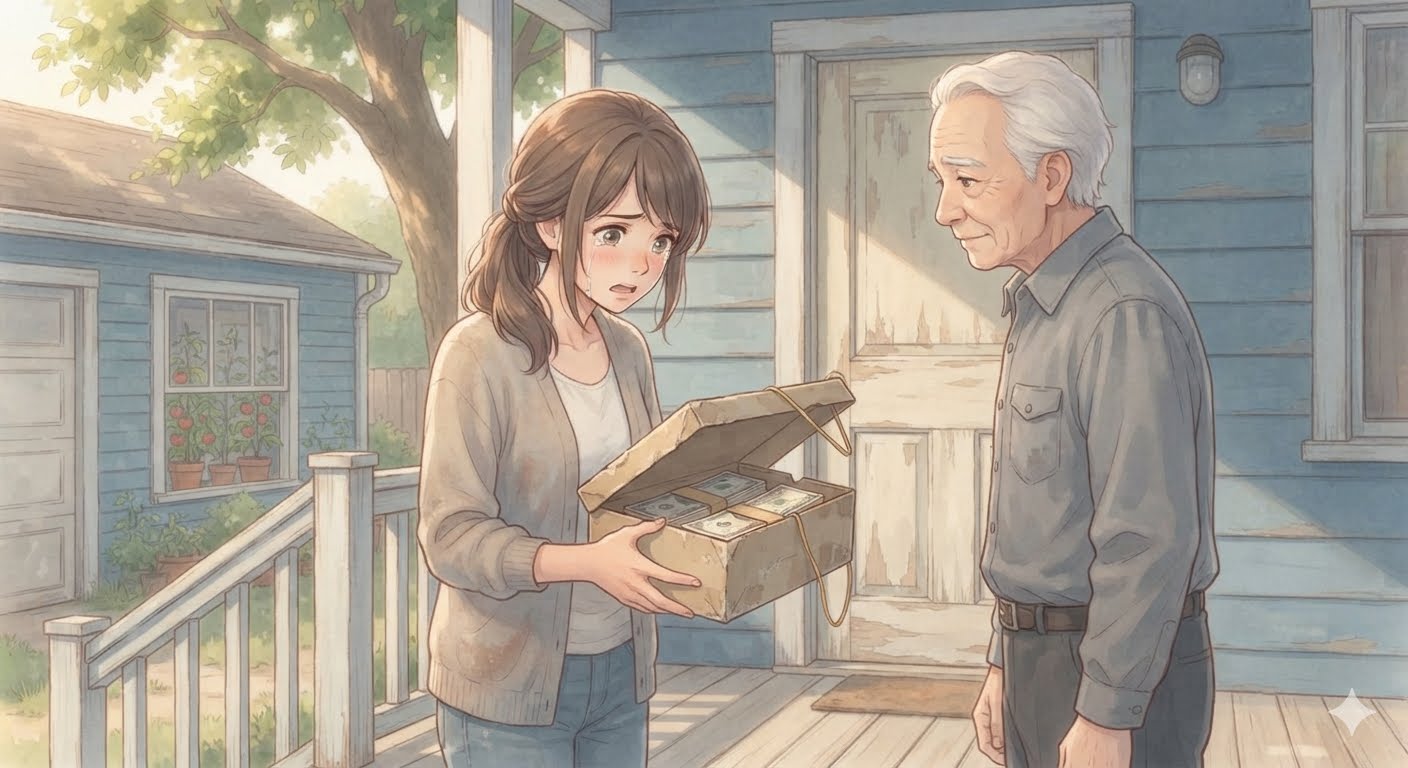
- Without saying a word, he turned around and walked deep into his house. A moment later, he returned carrying a battered cardboard shoebox. The corners were fraying, and one side was patched with yellowed tape.
- “What is this?” I asked.
- “Open it,” he said softly.
- He invited me inside his kitchen for the very first time. It was immaculately tidy and quiet. Old framed photographs lined one wall, several of them featuring a younger Mr. Alvarez standing beside a dark-haired woman who shared his sharp, dark eyes.
- I sat down at the table and removed the lid.
- Inside rested every single rent check I had ever written him. Every single one, arranged in neat bundles secured with rubber bands and marked by month and year.
- August. September. October. Three full years of payments.
- “You kept them all?” I whispered, stunned.
- “Yes.”
- “Why?”
- He took a seat across from me. “You paid on time.”
- “That doesn’t explain anything, Mr. Alvarez.”
- “No,” he conceded quietly. “It doesn’t.”
- He turned his gaze toward the photographs on the wall. “My daughter’s name was Sofia.”
- The dark-haired woman in the pictures wasn’t his wife; she was his child.
- “She had a little girl named Camila,” he continued, his voice dropping. “Sofia married quite young. Her husband was charming early on, but over time he became controlling—demanding to manage her money, picking her clothes, and cutting her off from her friends.”
- His jaw tightened. “One afternoon, she called me in tears and asked if she and Camila could come stay with me here.”
- “What did you say to her?”
- He closed his eyes, heavy with regret. “I told her to go back home and work on her marriage.”
- The ticking of the kitchen clock sounded deafening in the silence.
- “Why?” I asked gently.
- “Because I was stubborn. I was raised to believe marriage was a sacred promise you kept, no matter how much it hurt.”
- “What happened to them?”
- His expression told me the terrible truth before he could form the words. “They were killed six weeks later in a car crash. Her husband was driving. He had been drinking.”
- I pressed my hand over my mouth.
- Mr. Alvarez stared down at his worn hands. “I had a vacant apartment sitting right behind my house. I had savings in the bank. She reached out to me for help, and I turned her away.”
- “You couldn’t have known what was going to happen,” I said softly.
- “I knew she was terrified,” he replied. “That should have been more than enough.”
- He looked up, meeting my eyes. “When you showed up in my driveway three years ago, you had the exact same look in your eyes that Sofia had that day.”
- “What look?”
- “Like you were terrified of asking for too much space in the world.”
- Tears welled up in my eyes.
- “You had your daughter by the hand, a car that barely ran, and yet you looked at that tiny garage unit as if it were a palace,” he said softly.
- “It felt like one to us.”
- “I decided then and there to give you time.”
- “Time for what?”
- “To stand back up on your own two feet.”
- I gestured toward the open shoebox. “Then why make me write out the checks every month?”
- “Because I knew you had your pride. I didn’t want you to feel like a charity case.”
- The sheer kindness of his answer broke through something deep inside me.
- He gestured toward the box. “You paid your rent every month. You held up your end of the bargain. What I chose to do with those checks afterward was entirely my business.”
- I wiped my wet cheeks. “Nearly twenty-nine thousand dollars isn’t a small choice, Mr. Alvarez.”
- “No, it isn’t.”
- “You could have used that money for yourself.”
- “I have everything I need.”
- “You wear the exact same shirt every single day.”
- “I own seven identical shirts,” he countered flatly.
- A startled, tearful laugh escaped my throat. For the very first time since I’d known him, the faint trace of a smile appeared on his face.
- He reached under the bundles of checks, pulled out a thick white envelope, and slid it across the table toward me. My name was written neatly on the front.
- Inside was a signed, legal letter confirming that all funds currently sitting in my bank account were mine, and that he relinquished any right to cash the checks.
- Beneath that was a second legal document. I read through it once, then twice, unable to process what my eyes were seeing.
- I looked up at him. “This can’t be real.”
- “It is.”
- He was legally deeding the garage apartment directly to me—not the main house, but the converted unit and the small plot of yard surrounding it.
- “I can’t possibly accept this,” I stammered.
- “Yes, you can.”
- “You barely know me, Mr. Alvarez.”
- “I’ve watched you closely for three years,” he corrected me gently.
- He began listing off everything he had quietly observed: me leaving for early morning shifts before the sun came up, helping Trixie read on the porch steps, paying every bill on time before spending a cent on myself, and keeping every single dollar ready for him in my bank account just in case he asked for it.
- “The money belonged to you,” I insisted softly.
- “It never did,” he said.
- Part 3: The Home That Became Ours
- I began to cry—not softly or quietly, but deep, racking sobs.
- I wept for the terrified woman who had pulled into that driveway three years prior with six boxes and no clear future. I wept for Sofia and little Camila. And I wept for Mr. Alvarez, who had carried the crushing weight of a tragic mistake for decades, choosing to channel his grief into a quiet, life-changing act of mercy.
- He sat quietly at the table, allowing me to let all the pain out.
- When I finally managed to compose myself, I asked, “Why give me the papers now?”
- “Because you knocked on my door demanding answers today.”
- I blinked at him.
- He gave a slight shrug. “You weren’t afraid anymore.”
- His answer struck a deep chord in me. Three years ago, I would have apologized for even disturbing him, accepted his brief answer, and quietly slipped back to my apartment to worry alone in the dark. But today, I had stood my ground and demanded the truth. Somewhere along the way, I had rebuilt myself.
- I looked back down at the property transfer documents. “What about Trixie?”
- “The home is yours now,” he said gently. “And one day, it will be hers.”
- “When did you decide to do all this?”
- He glanced over at the photograph of his daughter. “The afternoon I watched Trixie learning to ride her bicycle in the driveway.”
- “She wobbled right into your tomato plants,” I remembered.
- “And she went up to every single damaged stem and apologized out loud.”
- “She felt awful about it.”
- “She is a good girl,” he said simply.
- I reached across the table and placed my hand over his weathered one. “You saved our lives.”
- He shook his head gently. “You saved your own lives. I only kept the door unlocked for you.”
- That evening, I sat Trixie down on the sofa and told her that our little apartment officially belonged to us now.
- She looked at me with wide eyes. “Even the window above the sink?”
- “Even the sink window.”
- “And the floor that tilts?”
- “That too.”
- She threw her arms around my neck, hugging me tight. Then she happened to glance out the window and saw Mr. Alvarez standing near his tomato garden in the evening light. Before I could say a word, she raced out the back door and wrapped her arms tightly around his waist.
- He went completely rigid with surprise. For a second, he seemed lost on how to react. Then, very slowly, he rested his weathered hand against her back.
- For the first time since I had met him, his guarded face revealed everything he held inside. The grief was still there, but beneath it was something warm, gentle, and full of love.
- Years have passed since that day, but the cardboard shoebox still sits on the top shelf of my bedroom closet. Every single uncashed check remains inside.
- I keep them to remind myself that real kindness doesn’t always arrive with grand speeches or big promises. Sometimes it looks like a quiet old man in a gray work shirt refusing to deposit a check. Sometimes it looks like a tiny garage apartment with a crooked floor, a noisy refrigerator, and a window overlooking a garden.
- And sometimes, the person who helps you rebuild your shattered life isn’t someone who solves all your problems—it’s simply someone who holds the door open long enough for you to learn how to stand on your own again.
Part 1: The Apartment That Saved Us