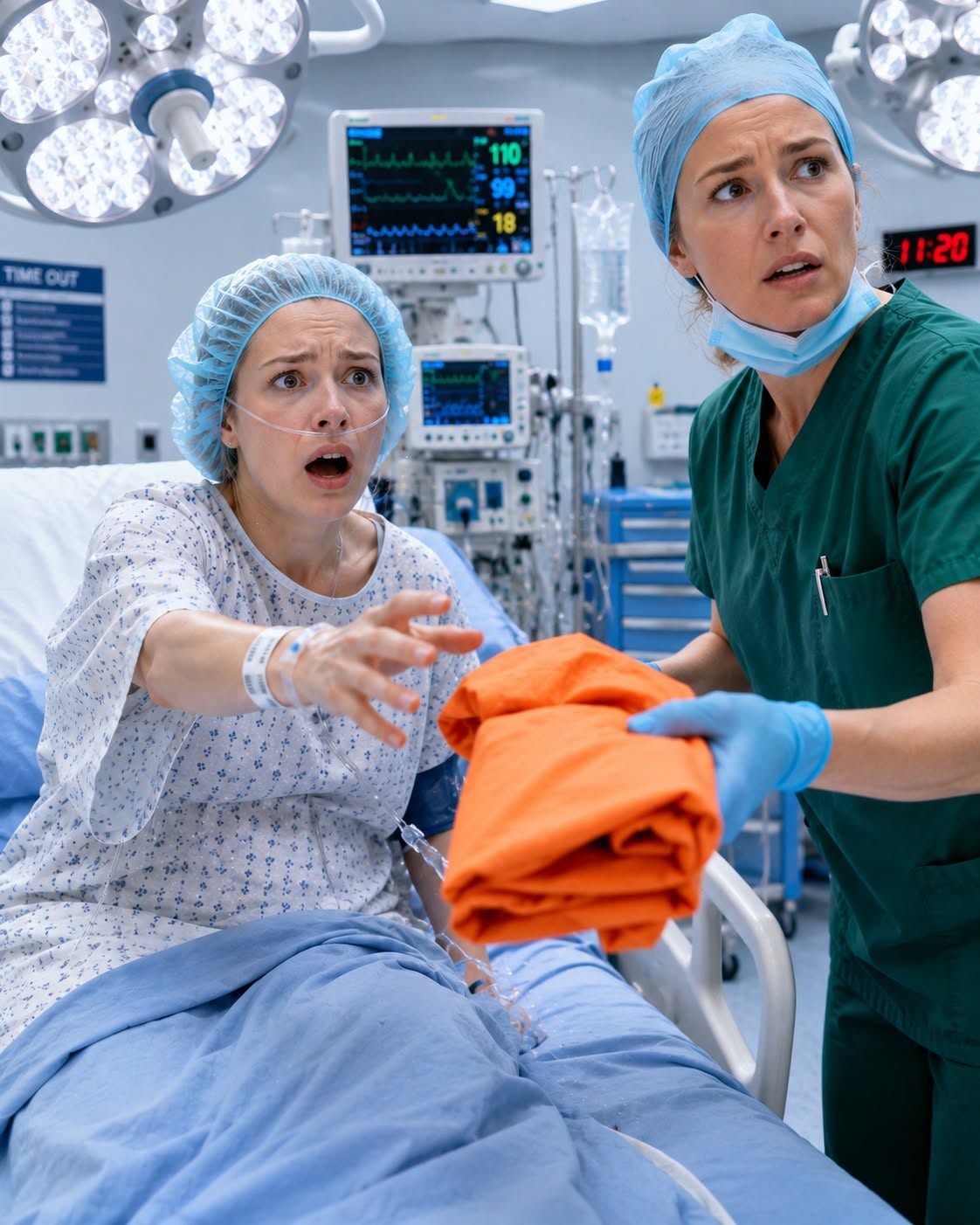
“They aren’t planning to remove one of your kidneys, Claire. Tonight, they’re planning to take your heart.”
Nurse Hannah tossed a gray custodial uniform onto my lap and locked the door of the pre-op room. It was 11:20 p.m. According to Dr. Whitmore, I was supposed to be wheeled into surgery in forty minutes to donate a kidney to my husband.
Until that moment, I had genuinely believed I was going to save his life.
Ethan Carter and I had been married for five years. He worked as an architect, while I managed human resources for a cosmetics company in Seattle. We lived in a comfortable apartment near Queen Anne, took one vacation every year, and looked to everyone around us like a steady, ordinary couple.
Everything began to change when Ethan started losing weight, throwing up, and passing out. Dr. Jonathan Whitmore, a close friend of my mother-in-law and a highly respected specialist at a private hospital, delivered the diagnosis: terminal kidney failure. Without a transplant, Ethan had only a few months left.
Margaret, my mother-in-law, fell to her knees beside his hospital bed and sobbed.
“Take one of my kidneys, Doctor. I’ve lived long enough. Save my son.”
Whitmore shook his head with grave concern. She had high blood pressure. Ashley, Ethan’s younger sister, was not a compatible donor either.
But I was.
The doctor claimed our compatibility was remarkable. Ethan pretended to object.
“I’d rather die than let anything happen to you.”
I wrapped my arms around him and promised that we would survive this together. Margaret began calling me “the family’s angel.” For a month, she stayed in our apartment, prepared broths, juices, and supplements for me, and refused to let me return to work or leave the house alone. Ashley brought fruit, silk robes, and fresh flowers.
I thought they were protecting me.
Now Hannah stood in front of me, visibly shaking.
“Ethan isn’t sick,” she whispered. “His medical records were fabricated. Men are guarding every entrance. Once they put you under anesthesia, you won’t wake up.”
I wanted to tell her she had lost her mind, but then she showed me a photograph she had secretly taken: a cardiac transport container, documents listing my blood type, and a signed order instructing staff to report an “irreversible anaphylactic reaction.”
“They selected you months ago,” she said. “Your husband owes millions because of illegal gambling. He sold your heart to an organ-trafficking operation.”
My legs went numb beneath me.
Hannah forced me to change clothes, tucked my hair beneath a cap, and covered my face with a surgical mask.
“Push the cleaning cart, take the waste-disposal route downstairs, and don’t make eye contact with anyone.”
I stepped into the hallway with my heart slamming against my ribs. Two men wearing security uniforms passed close beside me. One lifted a radio to his mouth.
“The merchandise is missing from Room Eight. Seal the elevators and all exits.”
They did not call me a patient.
They called me merchandise.
I climbed inside an empty medical-waste container that was scheduled to be moved to the service parking lot. Surrounded by the smell of bleach, plastic, and discarded gauze, I heard Ethan’s voice outside, performing panic.
“Find my wife! She’s weak. She could hurt herself.”
The truck pulled away in the middle of a storm. Several blocks from the hospital, I crawled out from between bags of waste, landed in the mud, and ran without a phone, money, or identification until I reached the home of Megan, my closest friend and attorney.
At three in the morning, filthy and trembling, I told her that my husband’s family had tried to kill me.
Megan held me, closed every curtain in the house, and opened her laptop.
That was when we found the video Ethan had just uploaded. He was begging the public to help locate his “cowardly wife,” who had disappeared before donating the kidney that could save him.
Thousands of people were already attacking me online.
And during the final second of the video, just behind Ethan’s tears, I saw my mother-in-law smiling.
I could not believe what they were preparing to do.
The next day, Hannah called from an unfamiliar number.
She had resigned from the hospital and was hiding with her son in Spokane. Years earlier, I had anonymously covered part of the cost of a surgery the boy needed. When she reviewed my medical file and recognized my name, she decided it was time to return the life I had helped preserve.
“The entire thing was planned,” she explained. “Whitmore falsified the tests. Ethan owes almost forty million pesos to a criminal organization called the Black Wolves. Through the dark web, they found a foreign businessman willing to pay two million dollars for a heart compatible with his daughter.”
The year before, during a routine medical screening through my employer, Ethan had secretly kept a sample of my blood. The results matched what the buyer needed.
The fake kidney donation was the perfect excuse to admit me willingly, place me under anesthesia, and describe my death as an unexpected surgical complication. My body would be cremated almost immediately. Ethan would collect the life-insurance payout, clear his debt, and receive a share of the sale.
“Did Margaret and Ashley know?” I asked.
Hannah played an audio recording.
My mother-in-law’s voice came through clearly.
“When Claire dies, Ethan will be free, we’ll collect the insurance money, and everyone will come out ahead. She has already given enough to this family. She might as well make herself useful one final time.”
I did not cry.
The pain was too vast to become tears.
Megan wanted to go directly to the District Attorney’s Office, but a single recording could be disputed, and Whitmore had influential connections. We decided to keep Hannah safe and gather evidence that could be independently verified before revealing that I was alive.
A forensic accountant reviewed Ethan’s business records. He uncovered transfers to online casinos, illegal loans, and cryptocurrency payments connected to Whitmore. A private investigator also documented Ethan’s affair with his secretary, Brooke, who was four months pregnant. He had promised to take her to Spain after “handling the Claire problem.”
But the most important evidence came from inside the hospital. Before escaping, Hannah had copied the original medical file. My test results were labeled “cardiac donor,” along with an air-transport schedule and the buyer’s encrypted identity.
Megan contacted a federal prosecutor specializing in organized crime. We handed over the files, bank transfers, and medical documents. She agreed to open a sealed investigation, but she still needed a direct confession tying Ethan to the planned murder.
The Black Wolves began threatening him for failing to deliver “the asset.” Ethan called Whitmore and blamed him for my disappearance.
With court approval, investigators placed a wiretap on the doctor’s phone.
That same night, Whitmore arranged to meet Ethan at a roadside motel outside Tacoma. The room had been fitted with legally authorized cameras.
“You forged my diagnosis,” Ethan accused him. “You said that once she was unconscious, you would remove her heart and report a reaction to the anesthesia.”
“And you gave me your wife’s test results,” Whitmore answered. “Your mother and sister signed as witnesses. Don’t pretend you had nothing to do with this.”
Ethan slammed his hand against the table.
“I need that money! If Claire shows up alive, every one of us goes to prison.”
From a nearby surveillance room, I listened through headphones. Five years of marriage had been reduced to two men arguing over the price of my body.
Then Ethan revealed something even Hannah had not known.
“If Claire is alive, maybe we can use my mother or Ashley to satisfy the buyer. I just need more time.”
The man willing to sell his wife was already prepared to sacrifice his own family.
The prosecutor turned off the monitor and looked toward Megan.
“We have the confession. Now we need to arrest the entire organization in one coordinated operation.”
On the screen, Ethan received a message from the Black Wolves.
“Tomorrow at midnight. Deliver a donor, or all three of you are dead.”
And I knew the truth was about to enter that house.
Over the next twenty-four hours, investigators organized a discreet operation. Margaret’s home in Bellevue was watched from an unmarked vehicle. The family’s phones were monitored under a court order, and two agents posed as employees of a medical company connected to Whitmore.
I stayed inside a protected apartment. I wanted to confront Ethan, demand an explanation, and ask when he had stopped seeing me as a person. The prosecutor would not allow it.
“If he discovers you’re alive, he may flee or retaliate against the nurse. Let him continue believing the plan can still save him.”
Ethan arrived at his mother’s house shortly before nine that evening. His face was hollow, one arm was wrapped in bandages, and he looked like a man who had not slept in several days. The Black Wolves had already kidnapped and beaten him in an effort to force payment.
Ashley confronted him as soon as he entered.
“You promised Claire’s money would solve everything.”
“She escaped because somebody talked!” he screamed. “Now all of us are finished.”
Margaret knelt in front of a small religious statue, praying quietly, but she was not asking forgiveness for what had been done to me.
She was praying that her son would survive.
At ten o’clock, Ethan received a call from Whitmore. The doctor, unaware investigators were listening, explained that the foreign buyer was still willing to make a deal if they could provide another compatible donor. He instructed Ethan to bring medical supplies to an abandoned clinic outside Everett.
Ethan looked at his mother and sister exactly as he had once looked at me.
He was calculating their value.
“Ashley is young,” he said quietly. “We share the same blood type. She might qualify.”
Her face drained of color.
“What are you talking about?”
“They only need to run some tests.”
Margaret stepped between them.
“You are not touching your sister.”
Ethan gave a cold, bitter laugh.
“But Claire was acceptable? When it was her, you said her death would be a blessing to this family.”
The silence that followed was more brutal than any shouting.
Ashley turned toward her mother.
“You said that?”
Margaret tried to deny it, but Ethan, desperate and unraveling, exposed everything: the insurance policy, the cryptocurrency deposit, the planned cremation, and the amount each person was expected to receive.
The same family that had joined together to sacrifice me began destroying one another with accusations.
“I only agreed because you promised she would not suffer,” Margaret said.
“You signed the papers,” Ethan replied. “And Ashley delivered the documents to the hospital.”
“Because both of you told me it was just routine paperwork!” she screamed.
The court-authorized recording captured every admission.
At 11:30, a black SUV stopped outside the house. Four members of the Black Wolves stepped onto the sidewalk. They did not rush inside with guns raised. They entered calmly, with the confidence of men who believed the entire street belonged to them.
Their leader set an empty medical cooler on the dining table.
“Time is over, architect. Money or a donor.”
Ethan pointed at Ashley.
“Take her. She’s young. She might be compatible.”
His sister stumbled backward in horror. Margaret wrapped both arms around her.
“She is your own blood!”
“Claire was my wife, and all of you agreed to sacrifice her,” he replied. “No one in this house is innocent.”
That sentence finished tearing them apart.
The agents had been waiting for a specific exchange that would connect the organization to the buying and selling of human organs. When one of the men removed medical forms and asked for Ashley’s blood type, the prosecutor gave the signal.
The flashing lights of multiple police vehicles filled the front windows. Federal agents and state officers surrounded the property. All four men were restrained before they could reach the back exit. Ethan tried to escape through the yard, but he slipped beside the fountain and fell onto his knees.
Ashley stood completely frozen.
Margaret began screaming that everything was the fault of her missing daughter-in-law.
At the same time, another team raided the clinic near Everett. They found Whitmore, two anesthesiologists, controlled drugs, organ-transport containers, and records connected to other victims.
The organization was far larger than any of us had understood.
The prosecutor called me at two in the morning.
“It’s finished. They’re all under arrest.”
I did not feel relief.
I felt exhausted.
It was the kind of exhaustion that settles deep inside the bones, as though I had been running without rest ever since the night inside that hospital room.
Even so, I needed to witness the ending for myself.
I arrived at Margaret’s house with Megan and two officers. I wore a simple black suit. I did not want to resemble a queen returning for revenge or a ghost rising from the dead.
I wanted to look exactly like what I was.
A woman who had survived.
Ethan stood in handcuffs beside a police cruiser. When he saw me, his mouth opened, and he stumbled backward.
“Claire…”
Margaret, sitting inside an ambulance, crossed herself.
“You’re alive.”
“That ruined the transaction, didn’t it?” I answered.
Ethan collapsed onto his knees.
“Forgive me. I never meant for things to go this far. They threatened me. I was terrified.”
“I was terrified too,” I said. “I was hiding inside a waste container while I listened to you search for me so you could hand me over. The difference is that fear did not turn me into a murderer.”
“I loved you.”
“No. You loved my income, my obedience, and even my organs. You never truly saw me.”