- When I first agreed to the four-day business trip, it hadn’t seemed so long.
- Four days pass quickly, I had told myself while zipping my suitcase on Monday morning. But four days turned out to be just long enough to miss my seven-year-old son Bennett’s bedtime stories. Long enough to miss the way he always demanded a second glass of water after I had tucked him in. Long enough for every quiet, hesitant phone call—“When are you coming home, Mom?”—to twist a knife of guilt deep into my chest.
- Bennett had never handled my travel well. He understood my job required it, but logic did little to comfort a lonely child at night.
- On the first evening, he called from his bed, his voice small.
- “Your Aunt Lauren checked under the bed twice, right?” I assured him from my quiet hotel room.
- “Did she check the windows?”
- “Yes, sweetie.”
- “All of them?”
- I smiled into the receiver. “Every single one.”
- A pause drifted across the line. “Can you tell me the dragon story?”
- So I did. Still wearing my stiff corporate clothes, sitting alone on a king-sized hotel bed, I told him the story I’d invented years ago about a timid dragon who was terrified of the dark.
- By the third night, frustration cracked through his little voice. “You said four sleeps, Mom.”
- “I know, sweetheart.”
- “I already did three.”
- “That means there’s only one left.”
- Another long pause. “When are you coming home?”
- “Tomorrow evening.”
- “Promise?”
- “I promise.”
- The next afternoon, my final meeting ran agonizingly long. I spent two hours staring at the clock, pretending to take notes during a tedious presentation, when my manager suddenly stepped into the room to announce the final session was canceled.
- I didn’t hesitate. I rebooked my flight on the spot.
- When my plane touched down early, I decided to keep it a secret. I wanted to give Bennett the ultimate surprise. I pictured walking through the front door, hearing him gasp, and watching him race across the hardwood in his grip-socks to throw himself into my arms. Lauren would roll her eyes, and I’d laugh as Bennett tried to climb me like a tree, even though he was growing far too big to carry.
- The taxi dropped me off shortly after four o’clock.
- Lauren’s sedan sat in the driveway, exactly where I expected it. The front curtains were drawn open, though I saw no movement inside. I quietly rolled my suitcase up the paved walkway, planning to slip the key into the lock, sneak into the living room, and yell his name.
- I never got the chance.
- The front door swung wide open before my hand even reached my pocket. Bennett threw both arms tightly around my waist.
- “Mom!”
- His hair smelled like the strawberry shampoo he always insisted he was too grown-up to use. His cheek pressed hard against my coat, holding me as if he genuinely feared I might dissolve into thin air. For a fleeting second, the warmth of coming home washed over me, and everything felt blissfully normal.
- I closed my eyes and hugged him back with everything I had. “I missed you so much,” I whispered.
- “I missed you more.”
- “Impossible.”
- “No, I counted,” he said, pulling back to look at me with fierce seriousness. “A lot.”
- Then his smile evaporated.
- At first, I assumed he had remembered some minor household disaster. Bennett had a very distinct guilty face—eyes widened, lips tightly compressed, suddenly finding the weave of the entryway rug deeply fascinating.
- But this wasn’t that. The color drained entirely from his face. His voice trembled.
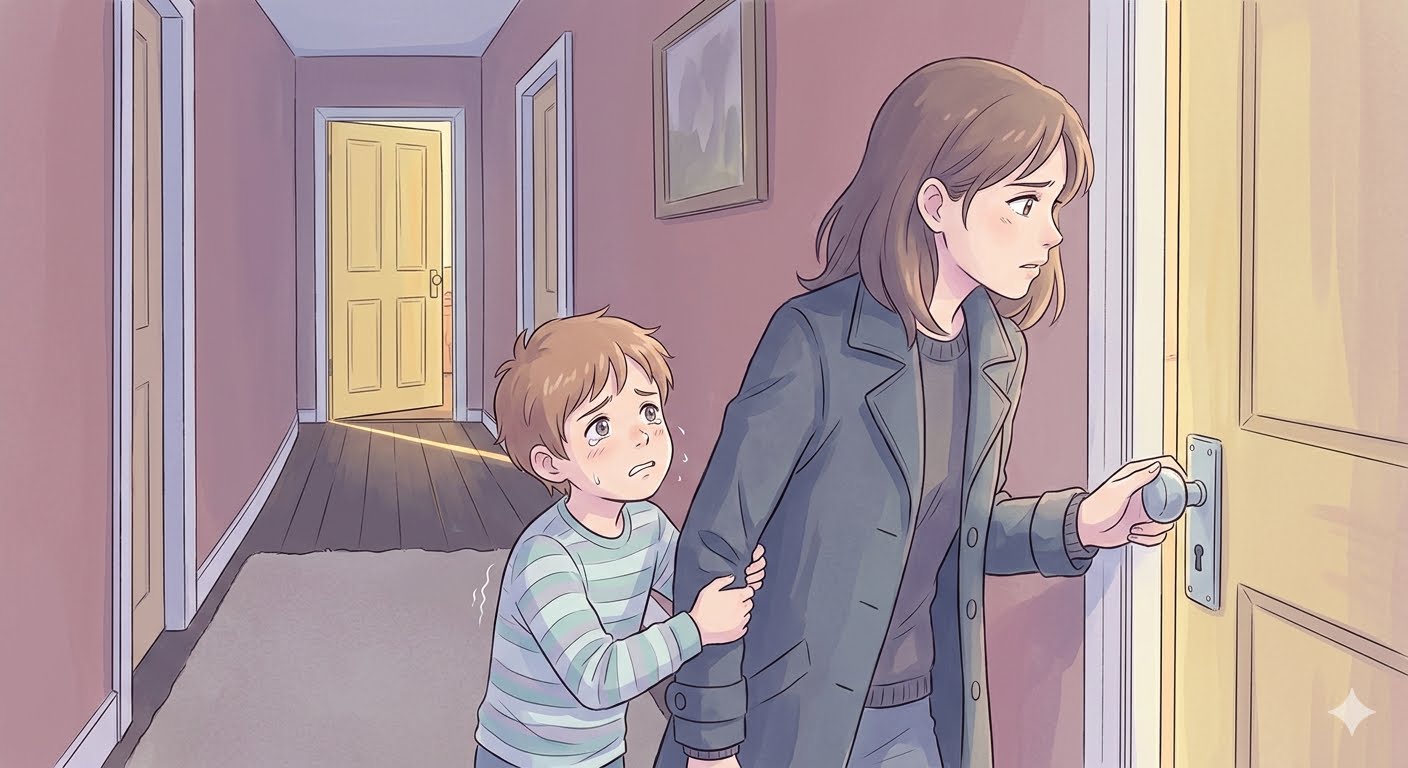
- “Please… don’t go into my room.”
- I stared at him, then let out a light laugh, assuming he’d made a catastrophic mess while I was away. Once, Bennett had built a sprawling cardboard metropolis across his floor and painted half his bedroom wall blue because “every city needed a sky.”
- “What happened, sweetie? Did you draw on the walls again?”
- He shook his head so violently that tears pooled in his eyelashes. “No.”
- The sheer terror in his tone killed my laughter instantly. He glanced anxiously down the dark hallway behind me.
- “I promised I wouldn’t let anyone in.”
- I frowned, a cold prickle rising on my neck. “Promised who, Bennett?”
- He didn’t answer. His small fingers tightened around my coat sleeve, trembling against my arm.
- That was when the strangeness of the house truly hit me. It wasn’t just quiet—it was suffocatingly, unnaturally silent. No music echoed from the kitchen, even though Lauren habitually blared indie playlists while cooking. The television was dead. No hum from the laundry room, no footsteps upstairs.
- My sister Lauren was thirty-two, fiercely dependable, and treated my son with a protective devotion that rivaled my own. She had rescheduled her entire work week without hesitation to watch him.
- “Lauren?” I called out.
- Nothing.
- I stepped inside, letting the heavy front door click shut behind us. Bennett stuck to my hip like glue, his shoulder pressing hard against my thigh.
- “Maybe she’s in the kitchen,” I murmured, trying to convince myself as much as him.
- The kitchen was deserted. Two mugs rested on the counter beside the sink—a discarded tea bag floating in one, the other entirely untouched. I checked the backyard through the sliding glass door. Empty. Yet Lauren’s car was sitting right out front.
- My pulse began to hammer against my ribs.
- We returned to the hallway. Bennett stood frozen, staring at his socks.
- “Bennett,” I asked, dropping to one knee and placing my hands gently on his shoulders. “Where is Aunt Lauren?”
- “I… I don’t know,” he whispered, his lower lip quivering.
- “Did she go outside?”
- He shook his head.
- “Did someone come to the house?”
- His eyes darted nervously back down the hall.
- Following his gaze, I saw it: a sharp, narrow strip of golden light shining from beneath his closed bedroom door. Bennett was meticulous about turning off lights—Lauren had spent the weekend drumming into his head that left-on bulbs cost a fortune.
- And then I heard it. A sound so faint it was almost swallowed by the rushing of my own blood.
- A low, urgent whisper.
- Followed by the slow, grinding scrape of something heavy being dragged across the floorboards.
- Bennett gripped my arm with desperate strength. “Mom… please,” he sobbed softly. “They said you’d be angry if you found out.”
- My stomach dropped into a abyss.
- They. Not she. Not he. They.
- I stood up, pushed Bennett gently behind me, and moved down the hallway toward the light.
- The moment my shadow crossed the strip of light beneath the door, the whispering stopped dead. The room plunged into total, suffocating silence.
- I gripped the cold metal doorknob, turned it, and pushed the door open a few inches.
- Then I froze.
- The first person I saw was Lauren. She was crouching beside Bennett’s bed, one hand pressed tightly over her mouth.
- The second person was a man I hadn’t laid eyes on in eight long years.
- My father.
- He looked older—far older than the memories I’d spent nearly a decade trying to bury. His dark hair was almost completely silver, his shoulders stooped beneath a worn brown jacket. An open cardboard box sat on the carpet near his boots. Beside him, Lauren had hauled Bennett’s heavy wooden toy chest away from the baseboard, exposing the bare wall. That had been the scraping sound.
- “Dad?” I whispered, the word tasting like ash.
- My father stood up slowly, joints popping in the quiet room. “Ingrid.”
- The sound of my name in his voice tightened a band around my chest. He used to say it like that when I was a girl—softly, carefully, right before delivering an excuse for another missed milestone or broken promise.
- “What are you doing in my house?”
- Lauren scrambled to her feet. “Ingrid, before you get angry, please let us explain—”
- “You told Bennett not to let anyone in?” I rounded on her.
- “No,” she said quietly, gesturing toward our father. “Dad did.”
- My father looked down at the floorboards, shame heavy on his features. “I thought we would be packed up and gone long before your flight landed.”
- Bennett slipped into the room behind me, wrapping his small arms tightly around my waist again. “I didn’t tell her,” he whimpered into my back. “She just came early.”
- I reached down, squeezing his small hand. “You did nothing wrong, sweetie.” Then I looked back at Lauren, my voice dropping an octave. “Why were you hiding in my son’s bedroom?”
- Lauren glanced down at the open cardboard box. “We were looking for something.”
- “You brought him into my home without my permission, and you’re tearing apart my son’s room?”
- “We weren’t searching through his toys, Ingrid,” Lauren pleaded. “We were looking behind the trim.”
- “For what?”
- Without a word, my father knelt down and pulled a loose length of wooden baseboard away from the wall behind where the toy chest had sat. Hidden inside the narrow wall cavity, wrapped securely in a yellowed kitchen towel, was a small, rusted metal tin.
- I recognized it instantly. It was my mother’s old recipe box.
- The breath left my lungs in a sharp gasp.
- My mother had died when I was nineteen. She had fought a grueling, painful illness for nearly a year, but my father had vanished long before the end—claiming he “couldn’t bear to watch her deteriorate.” Lauren and I had been left entirely alone. We took turns spoon-feeding her, washing her hair, and holding her hand through the worst nights. After the funeral, my father called twice, then vanished into the ether. I had spent fifteen years convincing myself that his abandonment no longer had the power to hurt me.
- “What is that doing in Bennett’s wall?” I asked, my voice dangerously tight.
- My father held the tin with trembling, weathered hands.
- “Dad realized Mom hid it in this room decades ago—back when this was just an old family property, long before you bought it and renovated,” Lauren explained gently.
- I stared at him. “You knew this was here all this time?”
- What I couldn’t comprehend was why they were standing in my son’s room, unearthing something my mother had concealed twenty years ago.
- My father carefully lifted the latch of the rusted tin. It didn’t contain handwritten recipes.
- It held letters. Dozens of them, tightly packed, written on faded stationery. Each envelope bore a neatly penned date, and every single one was addressed to either Lauren or me.
- My knees felt suddenly hollow. “What are those?”
- “Your mother wrote them during her last months,” my father said, his voice raspy.
- I turned my glare to Lauren. “You knew about this?”
- “Dad contacted me three days ago,” she admitted quietly.
- A bitter, humorless laugh burst from my chest. “Of course he did.”
- “Ingrid, please,” my father tried.
- “No!” I snapped, the rage finally spilling over. “You don’t get to say my name with affection. You left her to die. You left us. You missed her funeral. You missed Lauren’s wedding. You missed the birth of my son! You disappeared for nearly a decade, and now you think you can break into my home and hollow out my walls?”
- “I came because your mother made me promise I would bring you these letters when you were ready,” he blurted out.
- “When I was ready?” Tears of pure fury burned my eyes. “I was nineteen! Lauren was twenty-three! We needed our mother’s words then! We needed a father!”
- “I was a coward,” he said simply.
- The sheer, unvarnished honesty of the admission hit harder than any defensive excuse ever could.
- “I told myself I was sparing you more pain,” he whispered, staring down at his worn boots. “The truth is, I couldn’t face what I had done. And every year I hesitated, the shame built a higher wall between us.”
- Lauren stepped closer to me, her voice barely audible. “Ingrid… he called me because he’s sick.”
- I looked at her sharply, then at him.
- My father slowly sat down on the edge of Bennett’s unmade bed. “Pancreatic cancer,” he said quietly. “It has spread.”
- The bedroom felt like it was shrinking, squeezing the air right out of my chest. I had rehearsed meeting him again a thousand times in my head. In some fantasies, I screamed until my voice gave out; in others, I slammed the door in his face and left him in the cold. I had never pictured him looking this fragile—small enough to be erased by the light filtering through the window.
- “How long?” I managed to ask.
- Bennett tightened his grip on my waist, sensing the shift in the room. He looked up at the old man sitting on his bed, his eyes wide with innocent confusion. “Mom… is he my grandpa?”
- Silence descended on the room. My father looked at Bennett with a raw, agonizing tenderness that made my throat ache.
- “Yes, Bennett,” I finally choked out. “He is.”
- Bennett took a small step forward, studying the gray-haired man. “Why were you hiding behind my toys?”
- My father swallowed hard, taking an uneven breath. “Because I made a terrible mistake a long time ago, buddy.”
- “Did you say sorry?” Bennett asked simply.
- “Bennett—” I started.
- But my father shook his head, looking directly into my eyes. “No, Bennett. Not properly.” He looked at me, tears spilling over his wrinkled cheeks. “I am sorry, Ingrid. Not because I am sick, and not because I’m afraid of dying alone. I am sorry because I failed you when you needed me most. I know I can never rebuild the years I tore down, but I couldn’t leave this world without giving you what your mother left for you.”
- My anger didn’t vanish. The grief didn’t magically dissolve. But beneath the sharp edges of my resentment, something heavy and calcified inside my chest began to crack open.
- For years, I had secretly tormented myself with the belief that my sister and I had meant so little to him that walking away had been easy. Looking at him now—broken, frail, and weeping on a child’s bed—I finally understood that it hadn’t been easy at all. It had been cowardly, selfish, and devastatingly destructive. But it hadn’t been easy.
- I looked down at the metal tin. Resting right on top was an envelope with my name written across the front in my mother’s unmistakable, elegant cursive.
- My legs gave out, and I sank directly onto the floorboards. My hands shook violently as I broke the aged seal and pulled out the folded paper.
- “My darling Ingrid,” I read, my voice breaking on the very first line. “If you are reading this, then I am gone, and you are angry. You have every right to be. But please, my love, do not let anger become the house you live in. It will keep you safe from the cold for a little while, but eventually, it will lock you inside.”
- I couldn’t read any further out loud. Sobbing quietly, I pressed the paper against my chest. Lauren slid down onto the floor beside me, wrapping her arm around my shoulders, while Bennett scrambled into my lap, burying his face in my neck.
- After a long moment, my father slowly lowered himself down off the bed, kneeling on the carpet a few feet away—uncertain, waiting, not daring to presume he had earned the right to touch us.
- Forgiveness wasn’t a light switch I could flip simply because a dying man had finally shown up with the truth. But as the afternoon light faded in Bennett’s room, I didn’t push him away either.
- I allowed him to stay for dinner.
- Bennett peppered him with an endless stream of seven-year-old questions—asking about his favorite cereal, whether he’d ever seen a real bear, and what kind of games he liked. My father answered every single one with painstaking, patient devotion.
- When it was time for him to leave, my father stood at the open front door, clutching his coat against the evening chill. He looked at me, his eyes filled with a quiet, desperate hope.
- “May I call you tomorrow, Ingrid?”
- I looked at Lauren, who gave me a faint, supportive nod, and then down at Bennett, who was watching from the hallway. Finally, I looked at my father.
- “Yes,” I said softly. “You can call.”
- He swallowed hard, nodding rapidly as tears filled his eyes again. “Thank you.”
- After his car pulled out of the driveway, I sat on the edge of Bennett’s bed to tuck him in. He snuggled deep beneath his blankets, resting his head against my arm.
- “Mom?” he whispered into the dark. “Are you still angry?”
- “A little bit, sweetie.”
- “At me?”
- I leaned down and pressed a long, soft kiss against the crown of his head. “Never at you, my brave boy.”
- Later that night, sitting in the quiet living room with Lauren, we opened another one of my mother’s letters. And for the first time in eight years, the house didn’t feel empty.
- Sometimes, the secret hiding behind a locked door isn’t something meant to destroy us. Sometimes it’s just the truth, waiting quietly in the dark until we are finally strong enough to open the door.
- What would you do?
- When someone who shattered your world returns bearing the truth you were denied, do you lock the door to protect what you’ve built—or open it just enough to see if something broken can still be healed?
What We Leave Behind in the Walls