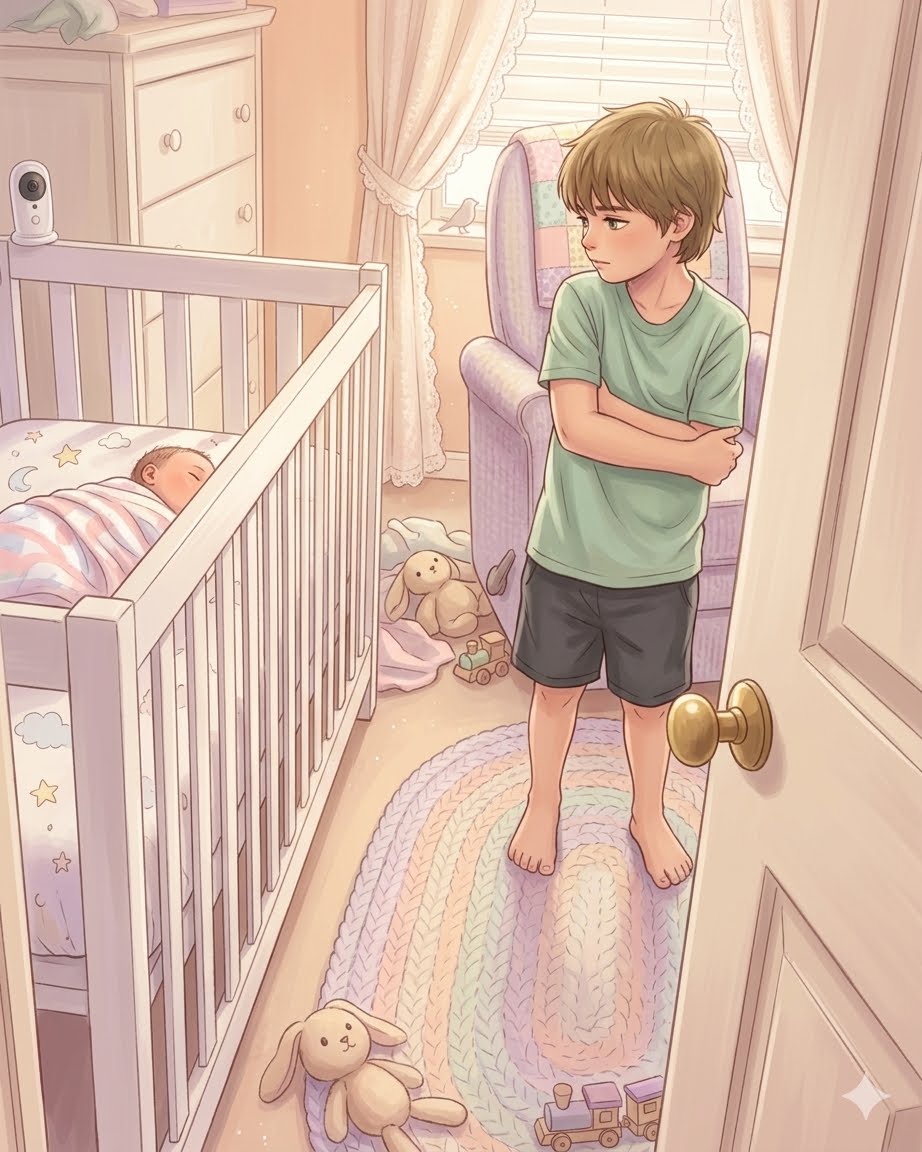
- Even now, Max’s voice echoes in my mind—not the cheerful, energetic little boy who obsessed over superheroes, laughed at everything, and constantly yelled, “Mom, watch this!” before hurling himself off the living room couch.
- The voice I remember most is the whisper.
- If he had shouted, I would have reacted instantly. If he had thrown a fit, I would have blamed sibling jealousy. If he had been angry, I could have understood it. But he wasn’t angry. He was terrified.
- And that fear still haunts me.
- Months before his sister arrived, Max adored her. At Target, he proudly carried tiny yellow baby socks around as if he had uncovered buried treasure. Long before we knew the baby’s gender, he insisted on calling my bump “Baby Bean.” The day the ultrasound technician announced we were having a girl, he clapped so enthusiastically that people out in the hallway turned around to see what the commotion was.
- “My sister,” he had repeated endlessly. “My sister is in there.” He even informed his kindergarten teacher that he planned to be “the best big brother in the whole state.” Apparently, being the best in the world wasn’t ambitious enough.
- When he visited us at the hospital, he couldn’t take his eyes off her. Standing carefully on a chair beside my bed, one hand gripping the safety rail, he gazed down into her tiny face like she was the most precious thing on earth.
- Daniel chuckled. “Most newborns are tiny, buddy.”
- Max shook his head seriously. “No, Dad. I mean tiny tiny. Like if I sneeze wrong, she’ll fly away.” Then he leaned close to her bassinet and whispered, “I’m your big brother. I got you.”
- I wept tears of pure joy right from my hospital bed.
- That was why, when we brought our daughter home the very next afternoon and Max suddenly refused to step inside the nursery, I assumed reality had finally caught up with him. I was running on empty—my body still aching from childbirth, my shirt damp with milk, exhausted down to my bones after surviving on barely two hours of sleep.
- Daniel carried the baby into the nursery while I followed, balancing a diaper bag over my shoulder and dragging an overnight bag across the carpet. Max walked silently behind us until we reached the threshold.
- Then he froze.
- He didn’t hesitate; he simply stopped moving. One hand rested against the doorframe as he stared into the crib after Daniel gently placed the infant inside. I watched every drop of color drain from his face. His lips parted slightly, his eyes widening not with wonder, but with pure terror.
- Slowly, he took a step backward. Then another.
- “Max?” I asked, softening my voice. “Honey, what’s wrong?”
- He turned toward me and spoke barely above a whisper. “That’s not my sister.”
- Daniel let out a weary laugh. “Buddy, come on.”
- “I want to go to my room,” Max insisted.
- I caught Daniel’s eye. Every parent knows that silent, knowing look. Here we go. Daniel rolled his eyes ever so slightly before mouth-shaping a single word: Jealous.
- I nodded along because, at the time, it seemed like the only logical explanation.
- That evening, Max refused to come down for dinner until I went upstairs to get him. He barely spoke throughout the meal. Whenever the baby cried, he startled so violently that he knocked over his cup of juice. Daniel scolded him for being careless, causing Max to dissolve into heavy tears so fast that both of us were caught completely off guard.
- Later that night, after the baby finally settled, I found Max sitting alone in the dark hallway outside the nursery, his knees pulled tightly against his chest.
- “Sweetheart?” I asked, kneeling beside him and brushing his hair off his forehead. “Talk to me. Why do you keep saying that?”
- He shook his head so frantically it frightened me. “I don’t want Daddy to hear.”
- A strange, quiet chill settled deep in my stomach. “Okay,” I whispered. “Daddy can’t hear us. Tell me.”
- Max grabbed my hand with both of his tiny hands. “Because I saw what they did at the hospital after Daddy took me to get juice.”
- I stared at him. “What do you mean?”
- His breathing turned ragged, the way it always did when he was fighting back tears. “Daddy said we were getting apple juice from the machine. But he didn’t go to the machine. He took me down another hallway, and he told me to stand by the wall and be quiet.”
- “Why?”
- “I don’t know,” his voice trembled. “He looked mad.”
- Every trace of my physical exhaustion evaporated in an instant. “What happened next?”
- Max swallowed hard. “A lady came.”
- “What lady?”
- I remember every excruciating detail of that moment: the faint humming of the fluorescent hall light, the lingering scent of baby lotion on my shirt, the sudden pressure building behind my ears.
- “What do you mean she looked like me?”
- “Same hair,” he whispered softly. “Same face shape. But older. And she was crying.”
- I tried to rationalize it. He was only five. Children misinterpret things, notice strange details, and fill in the blanks with wild imagination when they’re scared.
- Max glanced fearfully toward the nursery before dropping his voice even lower. “Daddy gave her a big envelope. Like the kind in movies. The fat kind.”
- The hair on my arms stood straight up. “And then?”
- Tears finally spilled over his cheeks. His whole body began to shake. “He told me not to look,” he sniffled. “But I did.”
- “Max…”
- “No!” He pulled back slightly, staring desperate into my eyes for me to believe him. “Mommy, he took the baby from her.”
- My body went numb. “He took the baby, and she was crying, and he said, ‘This is the only way this works.’”
- My throat went completely bone-dry. “Did you see the baby’s face?”
- Max nodded. “She had the pink hat. Not the flower hat.”
- At the hospital, our daughter had worn two different hats because she had spit up earlier that day. One was plain pink; the other had a tiny fabric flower.
- I had never mentioned that detail to Max.
- I can barely remember what I did immediately after that conversation. I tucked Max into bed, staying beside him until he finally fell asleep with his little fist wrapped tightly in my shirt.
- I walked downstairs feeling like I was moving underwater. Daniel was standing in the kitchen preparing a bottle.
- He looked up calmly. “Did he calm down?”
- I leaned heavily against the doorframe, searching his face. “What happened when you took Max to get juice at the hospital?”
- His reaction unsettled me far more than the question itself. “What?”
- “At the hospital.”
- “We got juice.”
- “Max said you walked down another hallway. He said he saw you with a woman.”
- The expression on Daniel’s face shifted instantly—not to surprise or confusion, but to cold calculation. He carefully set the bottle down on the counter.
- “Are you seriously doing this right now?” he scoffed. “We have a newborn at home, you’re hormonal, and Max is acting out. Can we please not turn this into some insane drama?”
- There it was—a swift shift in direction. We had been married for nine years, long enough for me to recognize when he was buying himself time.
- “Who was the woman?”
- “No one,” Daniel sneered, laughing louder than necessary. “An envelope? From a five-year-old witness?”
- “Stop talking about him like that.”
- “Then stop interrogating me over a child’s imagination!”
- Upstairs, the baby started crying. Daniel looked toward the ceiling, picked up the bottle, and headed for the stairs. “We’re not doing this tonight.”
- I stood alone in the kitchen, trembling. That should have been the exact moment everything shattered and pushed me into immediate action. But betrayal rarely arrives in a way your heart is ready to accept. When the first crack appears, your mind desperately scrambles to protect the life you’ve spent years building. I wanted a logical explanation. I wanted to believe it was all a terrible misunderstanding.
- More than anything, I just wanted to sleep.
- The next morning, Daniel kissed my forehead, handed me a mug of coffee, apologized for raising his voice, and blamed the sheer stress we were both under.
- “Max is just adjusting,” he assured me, looking straight into my eyes. “He’ll come around. You know I’d never do anything to hurt this family.”
- Looking back, I realize families like ours weren’t held together by truth—we survived on reassuring lies.
- For the next two days, I forced myself to pretend everything was normal. Max still refused to set foot inside the nursery. When I asked him to bring me a diaper while changing the baby, he quietly walked away. When relatives smiled and asked, “Don’t you love your baby sister?”, he lowered his head and said nothing.
- On the third night, I snapped awake at 2:14 a.m.
- Daniel wasn’t in bed beside me. The baby wasn’t crying. His phone was missing from his bedside charger.
- I slipped out of bed and followed a sliver of light spilling from beneath the office door downstairs. When I pushed the door open, Daniel jumped so violently he nearly dropped his phone.
- “Who are you talking to?” I asked.
- He stood up immediately. “Jeez, Hannah!”
- Before he disconnected the call, I distinctly heard a woman’s voice over the speaker. She wasn’t a coworker. She wasn’t family. She was young.
- Something inside me finally broke.
- Keeping my voice eerily calm, I demanded, “Give me the phone.”
- “No.”
- “Give me the phone, Daniel.”
- Instead, he slid it deep into his pocket. “You’re acting crazy.”
- A bitter laugh escaped me—not because anything was funny, but because screaming felt worse. “Your son says he watched you take a baby from a crying woman at the hospital, and now you’re making secret phone calls in the middle of the night—and I’m crazy?”
- He rounded the desk so quickly I instinctively stepped back. “Keep your voice down!”
- “Why? So the fake baby doesn’t wake up?”
- Everything changed in that fraction of a second. His face gave him away entirely. Once you’ve seen undeniable, raw guilt, it’s impossible to mistake it for anything else.
- He stared at me for several long seconds before slowly sinking back into his chair, as though every ounce of strength had left his body. When he finally spoke, his voice was hollow.
- “You’re not going to like the truth.”
- My fingernails dug into the doorframe so hard they bent.
- Daniel rubbed his hands heavily over his face. “That baby is mine.”
- A sharp ringing filled my ears. “What?”
- He looked at me with dead eyes. “She’s my daughter.”
- I stared at him, bewildered. “Of course she’s your daughter. She’s our daughter.”
- He slowly shook his head.
- Time seemed to freeze. The silence stretched until it was utterly unbearable. Finally, I heard my own voice ask, “Whose baby is in my nursery?”
- He swallowed hard. “Her name is Ava.”
- “Whose. Baby.”
- He couldn’t meet my eyes. “Mine. And Nicole’s.”
- The name hit me like a physical blow. Nicole—a woman from his office. Beautiful in a polished, effortless way. The kind of person described as “easy to talk to” because she made certain men feel worshipped.
- My knees nearly buckled. “You had an affair.”
- “Yes.”
- “And you brought her baby here? While I was in labor?!”
- He closed his eyes. “Nicole gave birth three days before you.”
- A sound escaped my throat that I didn’t even recognize. Daniel kept speaking mechanically, as if stopping would force him to confront the horror of his own confession.
- “Our baby didn’t make it,” he said. Then he repeated it, slower: “Our daughter was stillborn.”
- I shook my head violently. “No.”
- “Yes.”
- “No! Because I held her!”
- He stayed silent.
- My memories of the hospital suddenly fragmented into terrifying, disjointed pieces: heavy pain medication, bleeding, beeping monitors, exhaustion so profound that hours bled together. I remembered someone placing a bundle against my chest. I remembered Daniel crying. I remembered feeling too weak to lift my head. I remembered thinking she felt strangely cold. I remembered nurses taking her away quickly, claiming they needed to examine her.
- I remembered Daniel leaning close to whisper, “She’s okay. Rest.”
- A wave of violent nausea rolled through me. “Oh my God… you switched them.”
- He didn’t deny it.
- I lunged forward, shoving him backward into his chair. “You let me nurse another woman’s baby! You let me name her!”
- “Hannah—”
- “Save it!” I gasped, backed against the wall. “Save it!”
- That was when the rest of the disgusting truth spilled out—not all at once, but piece by horrifying piece.
- His parents had been running out of money for months. His father’s trust depended entirely on appearances: legacy, grandchildren, a stable, respectable family image. Meanwhile, Daniel had plunged us into secret, crippling debt through terrible investments and hidden credit cards, shuffling minimum payments around month after month to delay disaster.
- Then came Nicole. The affair resulted in an unexpected pregnancy he desperately tried to hide. When our daughter was born dead, Daniel saw a grotesque opportunity. Nicole had delivered a healthy baby girl she didn’t want, while I had pink blankets, announcements, and a nursery waiting for a child who was gone. His parents expected proof of a perfect family to keep the money flowing.
- So while he supposedly took Max to get apple juice, he met Nicole in a quiet hospital corridor. A newborn exchanged for a massive envelope of cash and a lifetime of lies.
- “You sold our daughter’s death,” I whispered, horrified.
- He winced. “Don’t say it like that.”
- “Then how should I say it?!” I sobbed. “Where is my baby?”
- His lips pressed into a thin line. “Safe.”
- That was the exact moment I stopped seeing him as my husband.
- “Where is she?”
- He refused to answer, repeating empty phrases: “You need to calm down.” “Think about Max.” “If this gets out, everything falls apart.”
- Then he spoke the sentence that still haunts my nightmares: “This only worked because you agreed.”
- I stared at him, my mind spinning. “What?”
- “You said yes,” he whispered softly. “After the doctor told you.”
- “No! No!”
- “You did,” he insisted, rising from his chair. “You were crying. You kept saying we couldn’t lose everything. You asked what my parents would do if they cut us off. You said Max deserved stability. You said if Nicole wanted money and didn’t want the baby, then maybe…”
- “Stop!”
- “You said no one had to know,” he pushed.
- Shattered fragments of memory slammed back into my consciousness—not full pictures, just terrifying flashes. A doctor speaking softly. Daniel gripping my hand too tightly. Someone saying, “There are options.” I remembered asking if our baby was really gone. I remembered the blinding pain, the blood, the sheer terror… and Daniel leaning down to whisper, “We can still fix this.”
- He watched my face crumble as the realization hit me. “You knew,” he said gently. “Maybe not all of it. Maybe you blocked it out. But you knew enough.”
- That is the part people struggle to understand when I tell this story. Everyone wants the victim to be pristine, entirely innocent, and completely blameless. I wish I could be that woman. I can’t.
- By sunrise, I had searched our joint bank accounts and uncovered the wire transfers. I logged into our shared tablet—the one syncing with his phone—and read the text messages between him and Nicole:
-
“You promised she’d go to a good home. I don’t want contact after this. Just make sure the payment clears. Your wife agreed. You said she agreed.”
- That was when I realized my five-year-old son had possessed the courage to face the truth long before I ever did.
- Around seven that morning, Max wandered downstairs in his dinosaur pajamas and found me sitting on the kitchen floor. Without a word, he climbed into my lap. I held him so tightly he complained I was squeezing him too hard.
- He looked up into my swollen eyes. “I told you.”
- Tears streamed down my face. “Yeah, buddy,” I whispered. “You did.”
- I called 911. Then I called an attorney. Then I called my sister.
- Only after the calls were made did I walk into the nursery and stand over the crib. The baby looked up at me—warm, healthy, and completely innocent. But she wasn’t my daughter.
- None of this was the children’s fault. Adults had created the monster, exchanged infants, laundered money, and rehearsed lies until they sounded like gospel. Trapped in the middle were two blameless baby girls and one terrified five-year-old boy who knew, deep down, that something evil had entered his home.
- Daniel was arrested that afternoon. Nicole was taken into custody two days later.
- I gave my statements to the police through dry-heaves, panic attacks, and the painful, agonizing recovery of memories I wished had stayed buried forever. The detectives treated me with a mixture of profound compassion and relentless questioning.
- Oddly enough, I felt I deserved both.
I believed my five-year-old son was simply having a difficult time adjusting to life with a newborn, right up until he looked straight into my eyes and whispered, “Mommy, that baby isn’t ours.” What he confessed next shattered my world beyond recognition.