- Warm afternoon sunlight rested against the kitchen window while I sat with both hands wrapped around a mug of tea I could barely make out. Eleven years of marriage had shaped my daily life down to its smallest, most predictable routines.
- I recognized my home through sound alone: the gentle hum of the refrigerator, the steady, rhythmic ticking of the hallway clock, and the low, familiar growl of Brian’s car pulling into the driveway every evening.
- I was thirty-five years old, and I had not clearly seen my own face in nearly a decade.
- When Brian and I first married, my eyesight was perfectly normal. But just a year after we exchanged vows, a rare, progressive eye disease appeared and steadily began stealing my vision.
- At first, distant street signs grew blurry. Then the fine details of people’s faces melted away. Eventually, everything faded into a soft landscape of pale shapes and shadowy outlines.
- By our fourth year together, I was using a white cane.
- By the sixth, I stopped pretending I could manage on my own because navigating unfamiliar places had become far too terrifying.
- Within a few more years, nearly all my sight was gone. I could detect little more than shifting light and large, dark silhouettes.
- As my world shrank, Brian took total responsibility for everything. He drove me everywhere, read the daily mail, and handled any household task requiring clear vision.
- “Don’t worry about the garage, honey,” my husband told me once, gently taking my elbow and steering me back toward the safety of the kitchen. “I’ll sort it out now that you’ve got your footing.”
- The garage had been neglected, filling up over time with various machines and medical supplies supposedly meant to help with my condition. Brian also explained that he kept his tools, heavy storage bins, and automotive supplies out there.
- “I could at least help you organize it,” I offered one afternoon.
- “Gina, please,” he said, his tone firm. “There’s nothing in there for you. Let me take care of it. I’ll grab whatever you need.”
- I remembered the subtle tension that crept into his voice whenever I brought up that room. At the time, I convinced myself it was just protective affection. That was what devotion looked like, I believed. That was what love sounded like.
- My best friend, Marissa, was far from convinced.
- “You’ve been shrinking, Gina,” Marissa told me frankly as she sat across from me at the kitchen table one afternoon. “You used to argue with me about everything. Now you just sit back and wait for Brian to decide.”
- “He’s just trying to take care of me,” I defended softly.
- “I know he is. But have you looked into that clinical trial I sent you?”
- “Brian says it’s a long shot. He doesn’t want me to get my hopes up for nothing.”
- My friend went quiet for a long moment. “And what do you want, Gina?”
- I had no answer. At some point over the dark years, I had simply stopped asking myself that question.
- For a long time, specialists had told me there was nothing modern medicine could do. Then, a month earlier, Marissa learned about an experimental laser procedure available through a specialized clinical program. The medical team warned that success was far from guaranteed, and Brian insisted I was merely setting myself up for heartbreaking disappointment.
- Still, I mustered the courage to bring it up over dinner.
- Brian placed his fork down on the table with a sharp clink. “Sweetheart, we talked about this.”
- “I know. I just thought… maybe it’s worth a try?”
- “You’ll break your own heart,” he said, and I heard that familiar tightness tighten his throat again. “I don’t want to watch you fall apart when it doesn’t work.”
- I released a slow, steadying breath. “I’ve thought about it a lot, Brian,” I said calmly. “Marissa’s willing to stay with me and help me through the recovery either way.”
- “Marissa,” my husband repeated flatly. “Of course.”
- He didn’t refuse again. Instead, he smoothly changed the subject to the dinner leftovers, and I allowed him to—because arguing with Brian had never come naturally to me.
- A few days later, Brian left on another one of his routine week-long business trips. He kissed my forehead, murmured that he loved me, and promised to call every single night.
- As his car pulled away, the house fell completely silent around me.
- With Marissa’s unwavering support, I chose to take the chance on the surgery anyway. The very next afternoon, she arrived at my door carrying a letter from the clinic: I had been accepted into the trial.
- That night, as I lay in the quiet darkness, I thought about the woman I had been before my diagnosis. The woman who had passionately argued with a contractor until he tore down and rebuilt our entire back porch. The woman who hand-selected her own paint colors and drove herself to Asheville just to watch the autumn leaves turn gold.
- Little by little, I had handed those vibrant pieces of myself over to Brian, until total dependence became a daily routine, and that routine became my entire identity.
- For the first time in years, I was making a choice entirely for myself.
- The following morning, Marissa arrived at my door with warm coffee and a bag packed for the clinic.
- “Are you still sure about this, Gina?” she asked softly.
- I nodded. “I’m sure.”
- Dr. Halim was careful, patient, and thoroughly honest about every risk involved. The procedure itself took far less time than I had braced for.
- The recovery, however, was strange and disorienting. For two days, the world looked like a blurred watercolor painting left out in the rain.
- On the third morning, I opened my eyes and looked up.
- I saw the ceiling fan.
- I truly, clearly saw it—the wooden blades, the metallic pull chain, even the fine layer of dust gathered along the edges. I sat up and cried for an hour.
- A few days later, once Dr. Halim was fully satisfied I could safely manage, Marissa drove me back home.
- I stepped through my front door and stood in the hallway, staring at details I had forgotten even existed.
- “The curtains are blue,” I whispered, my voice catching in my throat. “I thought they were green. Brian always told me they were green.”
- “They’ve been blue the whole time, Gina,” Marissa said gently.
- I moved through each room like a stranger touring someone else’s life. I marveled at the framed photographs on the mantel, the small chip in the corner of the coffee table, and my own reflection in the bathroom mirror—a woman older than I remembered, marked by years of quiet endurance, but unmistakably mine.
- “I don’t want to tell him yet,” I said, turning to Marissa. “I want him to walk through that door and see me seeing him.”
- Marissa smiled, though her eyes held a touch of caution. “Whatever you want, Gina.”
- She left that afternoon after making me promise to call if I needed anything.
- Left alone in the quiet house, a fond memory suddenly resurfaced: the boxes of colorful Christmas lights Brian always claimed were stored in the garage. He had mentioned them countless times over the years—boxes of tangled lights left from a long-ago December, sitting on a shelf, waiting.
- I wanted to hang them across the living room ceiling and turn them on—just to watch them glow, simply because I finally could.
- I walked toward the heavy wooden door at the back of the kitchen, the one I hadn’t opened in longer than I could remember. My hand rested on the knob. The metal was cool and slightly loose, exactly as I had imagined it during all those blind years without ever touching it.
- I turned it.
- The garage door opened with a slow, dry creak. I stepped inside, bracing myself for the smell of dust, old motor oil, and crowded tools.
- Instead, the soft scent of lavender washed over me.
- My hand found the light switch through old muscle memory. The overhead bulbs flickered on.
- And the world I had imagined for more than a decade instantly vanished.
- I stopped breathing.
- There were no machines. No tools. No storage containers or car supplies anywhere in sight.
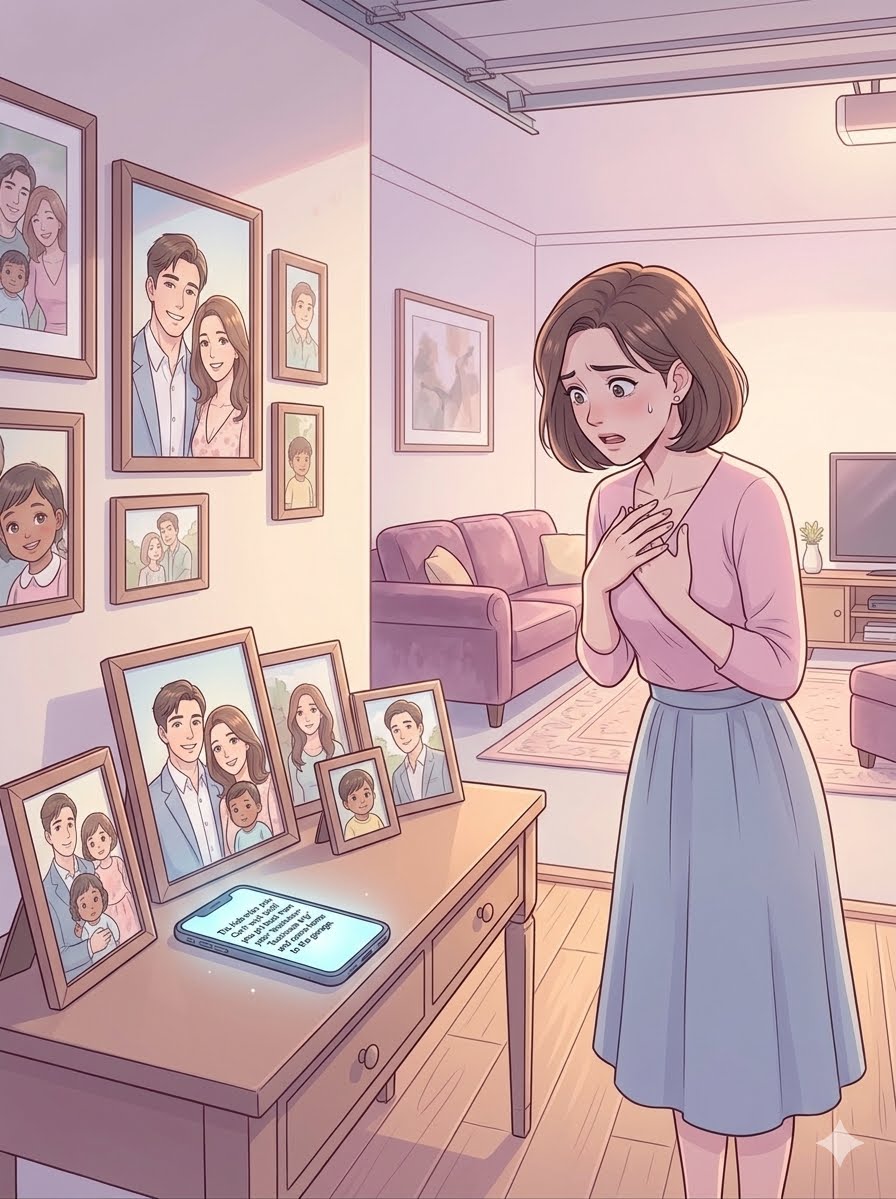
- Instead, a fully furnished, small living area filled the entire garage space. A plush gray sofa stood beside a polished coffee table. A neatly made bed occupied the far corner. A woman’s tailored coat hung from a hook near a private side entrance.
- Framed photographs lined the shelves along the wall.
- I stepped closer, my legs shaking violently beneath me. Brian appeared in every single picture. His arm was wrapped tightly around a dark-haired woman as they smiled together on a sunny beach, at a cozy restaurant, and standing in front of a brilliant Christmas tree I had never seen before.
- My hands trembled out of control.
- “This can’t be real!” I screamed into the empty room.
- A small stack of mail rested on the side table. I picked up the top envelope with numb fingers. It was addressed to a woman named Penelope.
- She was the woman smiling beside my husband in the photographs.
- Shaking, I fumbled with my phone and dialed Marissa.
- “Gina? What’s wrong?” her voice rushed through the speaker.
- “Come back,” I choked out. “Please, just come back right now.”
- She returned within twenty minutes. I heard her heels clicking rapidly across the concrete driveway before she pushed through the open garage door—and froze dead in her tracks.
- “Oh my God,” she breathed, her face draining of color. “Gina, what is this?!”
- “It’s what Brian’s been doing,” I said, my voice eerily flat. “For Lord knows how long.”
- “We need to look around,” Marissa said, her protective instincts kicking in. “We need to find anything that makes this whole thing make sense.”
- So we searched.
- Inside a side drawer, Marissa discovered a thick folder of documents. It contained construction contracts and city permits showing that Brian had legally converted the garage into a livable space six years ago.
- Six years.
- However, the recent invoices for luxury furniture, utility connections for a second resident, and address-change forms were all dated within the last four months. Before that, a framed certificate on the wall officially identified the room as “B. Whitfield – Private Office.”
- He had built the hideaway long before he ever moved her into it.
- I found a spare set of car keys near the side door. There was a woman’s toothbrush sitting beside the sink in a small adjoining bathroom. Then Marissa handed me a handwritten note she had found on the nightstand.
- “You should read this,” she said quietly.
- The feminine handwriting curled neatly across the page. It was addressed to Brian:
-
“I know this is hard, love, with your estranged wife dying. But once she’s finally moved into the care facility, we can stop hiding. I hate staying out of sight like this, but you’re right—the less she senses, the smoother it’ll be. I’ll be back from Portland Sunday night. Mom’s surgery is Thursday, so don’t call before then. Just a few more months. Penelope.”
- The page rattled violently between my fingers.
- “He told her I was dying,” I said. The voice coming out of my chest sounded entirely unfamiliar. “He told her I was being moved into a care facility!”
- Marissa immediately wrapped a strong arm around my shoulders. “Gina. Look at me. Breathe.”
- I lowered myself onto the edge of the stranger’s bed and stared at the coat hanging by the door.
- For one long, agonizing minute, I allowed myself to feel the soul-crushing weight of all eleven years: the white cane he had guided me with, the meals he had carefully cut into small pieces, every gentle instruction of “Let me get that for you,” and every protective warning that the garage was far too dangerous and cluttered for me to enter.
- Then, deep inside me, something cold and unyielding shifted.
- I stood up straight.
- “Issa,” I said, turning to my friend. “Take pictures of everything. The photos, the paperwork, the note, all of it.”
- She blinked in surprise. “Are you sure?”
- “I’m not going to break down, and I’m not going to fall apart,” I said, my voice steadying. “I can finally see, and I’m going to use my sight to be smarter than Brian ever imagined I could be.”
- Marissa and I spent the next two hours systematically photographing and documenting every square inch of the garage. Before we left the room, she gave me the contact information for a high-powered family law attorney she trusted implicitly. I called the office immediately and booked the earliest available appointment.
- Inside the drawer containing the permits, Marissa had also uncovered a small leather notebook filled with account passwords written in Brian’s cramped handwriting. She read the banking credentials aloud while I typed them into my phone, and together we logged into our joint bank accounts.
- There it was, laid out in undeniable digital black-and-white: years of slow, calculated cash withdrawals and small, routine transfers sent to private accounts I never knew existed.
- Brian hadn’t just betrayed our marriage. He had been actively funding his double life and preparing his escape while keeping me locked in total darkness.
- I barely slept a wink that night.
- By nine o’clock the following morning, I was sitting inside the attorney’s office, spreading high-resolution photographs, financial screenshots, and documents across her broad wooden desk. She listened intently, asked sharp, precise questions, and took detailed notes while nodding gravely.
- She sent me home with an initial legal folder, a strict action checklist, a formal evidence preservation letter, and a draft request for full financial disclosure. Then she instructed me to go home and wait for her signal.
- By evening, the legal folder rested prominently on the kitchen counter. Another follow-up appointment had been scheduled for the end of the week.
- Then I heard the sound of the front door unlocking.
- Brian’s voice floated through the entry hall, relaxed, warm, and cheerful. “Gina? I’m home early!”
- I was standing in the center of the living room. A strand of warm Christmas lights I had uncovered in the hallway linen closet—not the garage—glowed gently across the couches.
- Brian walked into the room, a warm smile on his face—until he saw me standing there, looking directly into his eyes, completely without my cane.
- The color instantly drained from his face. “Gina…?”
- “I had the surgery,” I said quietly, my voice echoing in the still room. “I opened the garage door, Brian. I know about Penelope.”
- A nervous, disbelieving laugh escaped his lips, quickly replaced by a dark frown, and then something far colder.
- “You don’t understand what those years did to me, Gina,” he spat out, defensively shifting the blame. “I needed someone who could actually see me.”
- “Then look at me right now, Brian,” I answered, taking a step closer. “Because I see you completely.”
- I reached down and handed him the folder my attorney had prepared: formal separation papers, mandatory financial disclosure demands, and clear copies of every single document, note, and photograph found inside his secret room behind the garage door.
- “Your mistress thinks I’m dying,” I said coldly. “She thinks I’m being quietly transitioned into a care facility.”
- “Gina, please…”
- His defensive wall crumbled instantly. Brian began to beg, his voice cracking with sudden desperation, his hand reaching out to grab mine just as he had done thousands of times before.
- I stepped back, entirely out of his reach.
- “While Marissa was photographing your little hideaway, I noticed an envelope on the table addressed to Penelope,” I told him smoothly. “Her phone number was written right beneath the return address. I made sure to copy it down before I left.”
- He paled even further.
- “The blind woman you thought would never look at you again is standing right in front of you,” I said softly. “And I see everything.”
- Without waiting for another word, I picked up my coat and walked out the front door, leaving him alone in the glow of the lights.
- Several weeks later, I sat quietly beside the window of my new, sunlit apartment.
- The vibrant Christmas lights I had finally hung shimmered softly against the glass in the evening twilight. A light knock sounded at the door, and Marissa walked in carrying takeout containers and a chilled bottle of white wine.
- “You look completely different,” she said, setting the food down and smiling warmly at me.
- “I feel different,” I admitted.
- On the kitchen counter rested a small piece of paper that had arrived in the mail that morning—a brief note from Penelope. It contained only one sentence:
- “Thank you for telling me the truth.”
- I looked back toward the twinkling lights, then caught my own reflection in the dark glass of the windowpane.
- Losing my eyesight had forced me to depend entirely on others. But getting it back had taught me an even greater lesson: how to finally depend on myself.
Losing my sight changed how I moved through the world, but more than that, it changed where I anchored my trust. Looking back, I understand now that the darkest part of those years had very little to do with what I could or could not see with my eyes.