- I watched her name flash across the screen while Elena Marsh stood beside June, examining photographs of the five-course meal. The contrast was almost absurd. In my dining room, strangers were validating my daughter’s talent and telling her that her work mattered. Across town, the woman who had discarded that work was desperately demanding that I rescue her from the consequences of her own arrogance.
- I switched my phone to silent.
- A second banking alert flashed.
- Transaction declined: $1,986.42.
- Then a third attempt for $1,500. Then $1,200.
- Margaret was frantically asking the restaurant manager to split the bill, hoping smaller chunks might pass through. They didn’t.
- A string of texts flooded in:
- “Your card isn’t working. Fix it immediately.”
- “You are humiliating me in front of the entire family.”
- “This is my birthday. Do not be cruel.”
- I read that last sentence twice. My mother had exploited a teenager for free labor, lied to our family about why June wasn’t there, and intended to stick me with a two-thousand-dollar dinner bill. Yet in Margaret’s twisted narrative, the “cruelty” only began when I cut off the money.
- June walked over to me. “Is Grandma calling?”
- “Yes.”
- “Is something wrong?”
- I hesitated, not wanting to poison the magic of her night with more toxicity. “She tried to put the entire restaurant bill on my card.”
- June’s eyes widened. “How much?”
- “Nearly two thousand dollars.”
- “For dinner?”
- “Apparently, they didn’t hold back.”
- June glanced over at the dining table, where Mrs. Palmer was aggressively offering a third slice of tart to a smiling firefighter. “Are they stuck there?”
- “They’re adults,” I said. “They’ll manage.”
- For a fleeting second, a flicker of concern softened June’s face—she had inherited my reflex to care for people who didn’t deserve it. Then her eyes fell to the blister on her thumb.
- “She didn’t worry about us,” June said softly.
- “No, sweetie. She didn’t.”
- Meanwhile, Elena Marsh asked June to compile her menu, photographs, and prep schedule to submit for early portfolio review at the North Harbor Culinary Institute.
- “I can’t guarantee admission,” Elena said honestly, “but talent is only half the battle. Discipline and adaptability are what make a real chef. Tonight, you showed both.”
- June’s eyes shone, but this time, the tears came from pure pride. “Thank you so much.”
- As Elena prepared to leave, she pressed her card into my hand. “Don’t let your mother minimize what happened here,” she whispered. “Young women remember who teaches them to doubt themselves.”
- “I know,” I replied quietly.
- By nine-thirty, the community dinner began winding down. Neighbors stacked dishes, wiped down counters, and packed leftovers for the firehouse night crew. June was showered with handwritten notes, phone numbers, and two requests to cater local events. Mrs. Palmer had even improvised business cards for her by ripping recipe cards in half.
- By ten, our home was peaceful again. The air smelled of roasted garlic, coffee, and dish soap.
- June sat at the kitchen table, tracing the wood grain. “Mom?”
- “Yeah, bug?”
- “Did Grandma plan the restaurant before today?”
- I stopped wiping the counter. “I don’t know.”
- “Aunt Linda said she brought it up last week.”
- “She might have just been keeping her options open,” I offered weakly.
- June looked up, her gaze steady. “Why are you still defending her?”
- The towel went limp in my hands. I was trying to cushion the blow, to shield her from believing her grandmother was actively spiteful. But June was seventeen. She didn’t need comforting lies.
- “I’ve spent my whole life making excuses for your grandmother,” I admitted. “Because accepting the truth meant admitting she was never going to be the mother I needed.”
- My phone buzzed with a voicemail notification. The automatic transcript read:
- “Claire, this has gone far enough. Your uncles had to split the bill because of your temper tantrum. You will reimburse everyone tomorrow and apologize.”
- June read the screen over my shoulder. Her face hardened into something firm and unwavering.
- “No,” she said.
- “No what?”
- “Don’t pay them back,” June said firmly. “You always pay. You always fix everything when Grandma acts like this. That’s why she never stops.”
- There it was. The brutal truth I had spent decades dodging, spoken clearly by the daughter I was trying to protect.
- Before I could speak, another notification popped up—this time a message from Aunt Linda:
- “I found this in photos from last week. You need to see this before Margaret comes to your house.”
- It was a screenshot of a relative’s social media post from nine days prior. My mother was standing inside Bellweather, posing right next to the host stand.
- In the background, a small chalkboard proudly displayed her name next to a confirmed reservation date: Tonight’s Date.
- Margaret hadn’t made a last-minute decision. She had booked the restaurant over a week ago—and still watched my daughter spend six weeks planning, $600 of my money, and twelve hours slaving over a stove.
- The next morning at 7:00 a.m., the heavy banging began at my front door.
- I didn’t rush. I poured myself a fresh mug of coffee, walked down the hallway, and opened the door.
- Margaret stood on the porch, her face pale with fury, her designer coat wrapped tightly around her. Behind her in the driveway sat my brother’s car.
- “Have you lost your mind?!” she shrieked, shoving past me into the foyer. “You locked your card! You forced your brothers to pay a two-thousand-dollar bill! You humiliated me on my sixty-fifth birthday!”
- “You’re standing in my house, shouting on a Sunday morning,” I said, keeping my voice dangerously quiet. “Lower your tone.”
- “I want my money reimbursed today, Claire! And June is going to write an apology to the entire family for throwing a sulky fit and boycotting my birthday!”
- I didn’t yell. I didn’t cry. Instead, I pulled up the screenshot Aunt Linda had sent me and held the screen inches from her face.
- Margaret went completely still. Her mouth opened, but no sound came out.
- “Nine days ago, Margaret,” I said coldly. “You reserved that restaurant nine days ago. You let a seventeen-year-old spend twelve hours cooking in a hot kitchen for twenty-three people, knowing full well you were going to ditch her.”
- “I… I was keeping options open,” she stammered, using the exact excuse I had almost made for her the night before. “I wanted a backup plan in case her food wasn’t good enough!”
- “Her food was extraordinary,” a voice called out.
- June stood at the top of the stairs, wearing a clean sweater, her hands folded calmly in front of her.
- “The director of admissions at North Harbor Culinary Institute reviewed my menu last night,” June said, her voice completely free of tremor. “She said my preparation and execution were professional grade. Our neighbors ate every single bite. You didn’t ruin my night, Grandma. You just showed me who you are.”
- Margaret turned back to me, looking for her usual ally—the daughter who smoothed things over, paid the bills, and apologized for existing.
- “Claire, tell her not to speak to me like that!” Margaret demanded. “I am her grandmother!”
- “Not anymore,” I said smoothly.
- I walked over to the front door and opened it wide to the crisp morning air.
- “You owe me six hundred dollars for ingredients. You owe my daughter an apology you are far too arrogant to give. Until both of those things happen, you are not welcome in this house, and you do not have access to my daughter or my bank account.”
- “You’re cutting off your own mother over a dinner?!” she gasped, clutching her chest dramatically.
- “No,” I replied, looking her dead in the eye. “I’m cutting you off because my daughter deserves to see what happens when a woman finally stops tolerating a bully.”
- Margaret stared at me, realizing for the first time in forty years that her grip was completely broken. Without another word, she turned on her heel and walked down the steps.
- I closed the door, locked it, and turned back to June. She smiled at me—a bright, genuine, unburdened smile.
- “So,” I said, leaning against the banister. “What’s for breakfast, Chef?”
- A single screenshot had shattered forty years of rationalizations. For nine days, my mother had known there would be no dinner at our house. For nine days, she had actively coached June on the menu, demanded elegant presentation, and requested extra desserts. She hadn’t encouraged her out of anticipation, but out of malice—either to harvest the leftovers or to enjoy the dark satisfaction of proving that our time belonged to her.
- That night, I opened a spreadsheet and itemized every expense I had absorbed for Margaret over the past three years: her phone plan, property taxes, home insurance, heating repairs, grocery deliveries, and her exclusive club membership. The grand total came to $\$31,420$.
- Margaret wasn’t impoverished; she owned her home outright and drew a generous pension. I hadn’t been helping a struggling mother—I had been subsidizing an illusion.
- The Confrontation
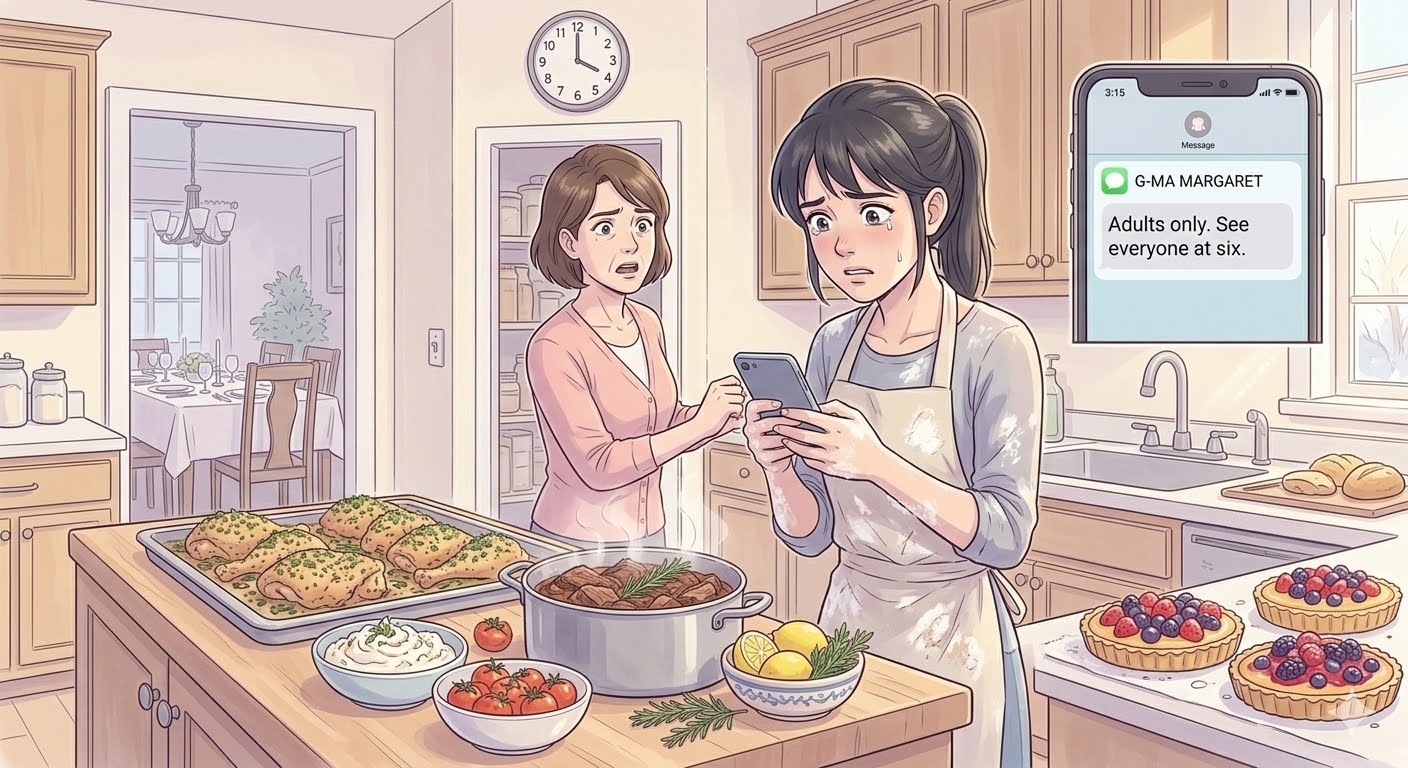
- At 7:52 the next morning, three violent thuds shook our front door.
- “Claire! Open this door!”
- I calmly poured my coffee. June came down the stairs in an oversized sweater, her face set. When I opened the door, Margaret stood on the porch wearing yesterday’s rumpled clothes, her hair flat on one side, her eyes burning with rage.
- “How could you do that to me?!” she shrieked. “You locked the card! You left twenty-two people with no way to pay!”
- “There were twenty-two adults at that table,” I replied evenly. “I assume some of them had money.”
- “They had to split the bill! Raymond paid four hundred dollars! Linda paid three hundred! Do you have any idea how humiliating that was?!”
- She caught sight of June behind me and doubled down. “And you! This entire disaster happened because you couldn’t accept a simple change of plans!”
- June went pale. I stepped onto the porch, pulling the door almost shut behind me. “Do not speak to her like that.”
- “Plans changed nine days ago, Mom,” I said, holding my phone inches from her face with the timestamped reservation photo. “You knew. You lied to the family, told them June refused to come, and tried to charge a two-thousand-dollar bill to my account.”
- “Unlock the card and transfer the money to Raymond and Linda,” she demanded, her voice rising. “Then we can put this behind us.”
- “No,” I said smoothly. “I am not paying them back. And I am done paying your bills.”
- Margaret froze, searching my eyes for the familiar hesitation she had manipulated for decades. She found none.
- Behind me, the door opened. June stepped out holding a manila folder containing every grocery receipt, the menu, photographs of the dishes, and an itemized breakdown of her labor.
- “You owe us eight hundred dollars, Grandma,” June said, her voice remarkably steady. “Five hundred eighty-seven for ingredients, and the rest for labor.”
- “I am your grandmother!” Margaret gasped. “You don’t invoice family!”
- “If I’m family when you need free labor, I should have been family when you chose who got to eat,” June fired back.
- Margaret turned to me, desperation creeping into her voice. “Claire, you’ve filled her head with resentment over your own childhood grievances!”
- “You have until noon to transfer eight hundred dollars to June,” I said coldly. “Or you lose access to both of us. No phone calls, no visits, no holidays, no financial safety net. Nothing.”
- Margaret stared at me, dumbfounded. “You would cut off your own mother over a dinner?!”
- “No. I am cutting you off because you deliberately humiliated my daughter, lied about her, tried to steal my money, and demanded we apologize for it.”
- “You’ll be alone when the family hears about this!” Margaret spat, backing down the steps.
- “Then we’ll be alone,” I said, and closed the door.
- At 11:43 a.m., June’s phone chimed with an $800 transfer, accompanied by a text from Margaret: “I’m sorry you misunderstood my intentions.”
- June tore up the sentiment. It wasn’t an apology, but the debt was settled. An hour later, I called my mother’s insurance provider and canceled my auto-pay.
- Cutting the Strings
- By Monday, I had scrubbed my financial footprint from Margaret’s life. Her grocery app was unlinked, her insurance was set to expire, and her club membership lapsed.
- When Uncle Raymond sent a venmo request for his $400, I forwarded him Margaret’s original texts with a note: Please discuss repayment with the person who ordered the food.
- Aunt Linda called to apologize, confessing she had enabled Margaret for years because it was easier than fighting her. Cousin Rebecca revealed the truth behind Bellweather: Margaret had invited two wealthy socialites to the restaurant and wanted the family there as decorative props to show off her “devoted” inner circle.
- Meanwhile, June focused entirely on her future. Elena Marsh invited her to an early portfolio workshop at North Harbor Culinary Institute. Two hours north, in a high-stakes 90-minute practical exam, June accidentally lost one of her prepared components to another student. Instead of panicking, she adapted on the fly and executed an alternative element seamlessly.
- “That adaptability matters more than a perfect garnish,” Elena told us afterward.
- When we returned home, we found Margaret sitting on our porch steps with a small suitcase. She looked tired, her weaponized fragility on full display.
- “My insurance is past due, my phone is going dark, and I need a place to stay,” she pleaded through my half-open car window. “We’re family, Claire.”
- I looked at my daughter, remembering her words: You always fix everything. That’s why she keeps doing it.
- “No, Mom,” I said smoothly. “You came because the consequences finally caught up with you.”
- I rolled up the window and drove away, leaving her and her suitcase behind.
- The Legacy
- Margaret didn’t end up on the street. Aunt Linda stepped in, audited her finances, and discovered Margaret had more than enough pension income to live comfortably—she simply preferred spending her money on status symbols while leeching off mine. Forced to live within her means, she sold off her designer bags and canceled her luxury appointments, blaming me for her downfall until the bitter end.
- Two months later, an official envelope arrived from North Harbor Culinary Institute.
- June couldn’t bring herself to open it, so I unsealed the letter and read it aloud. It was an early acceptance, accompanied by a merit scholarship covering over half her tuition.
- The girl who had once stood crying beside twenty-three untouched place settings collapsed into my arms, weeping tears of pure joy.
-
June’s Journey to Culinary School
-
Community Pop-up: Raised over $\$1,200$ in unsolicited donations from neighbors and first responders to launch her school fund.
-
Early Acceptance: Received merit scholarship covering over 50% of tuition based on her portfolio and crisis-management skills.
-
Professional Growth: Booked multiple local catering gigs, secured a summer coastal internship, and graduated near the top of her class.
-
- A year later, I dropped June off at her dorm overlooking the harbor. Above her desk, she pinned a photograph from the night of the community dinner—wearing her flour-dusted shirt, surrounded by smiling strangers eating her food.
- Across the bottom of her original five-course menu, she had written a new title:
- The Dinner That Opened the Door.
- Margaret tried to reach out over the years with hollow letters, missing checks, and guilt trips through distant relatives. But forgiveness without accountability is just permission for further abuse. We never answered.
- Three years after the canceled dinner, I sat in the auditorium at North Harbor as June walked across the stage to receive her diploma, flanked by Mrs. Palmer, Aunt Linda, Elena Marsh, and the off-duty firefighters who had driven three hours to celebrate her.
- Today, June runs her own successful catering studio. Framed on the wall beside the entrance is the menu from her grandmother’s 65th birthday.
- Beneath the original date, a brass plaque reads:
-
“Your value does not disappear because the wrong people fail to recognize it.”
- My mother thought she was canceling a dinner. What she actually canceled was her power to ever make us feel small again.
My mother called eleven times in four minutes.