- PART 1 — THE CONTAINERS
- I spent two hundred and fifty dollars on thirty-three pounds of beef for our Sunday family barbecue.
- Thirty-three pounds may sound excessive for eight people, but no one had ever left my home hungry. That was one of the simple, unspoken rules I had lived by for decades. Whenever family walked through my front door, they received a full plate, a cold drink, a comfortable chair, and enough leftovers to remind them they were loved.
- At least, that was what family gatherings used to mean to me.
- I never expected my daughter-in-law, Rachel, and her mother, Stella, to show up empty-handed with bags packed with plastic containers, treating my backyard like a free buffet. And I certainly never imagined my own son, Julian, would help them pack up the expensive food I had bought, seasoned, cooked, and served without ever bothering to ask my permission.
- But that was exactly what happened.
- When I finally spoke, three simple words silenced the entire patio.
- My name is Betty Miller. I am sixty-five years old, married to my husband, Tom, and for most of my adult life, I had been proud to host every family gathering.
- Our home stood in a quiet neighborhood outside Fort Worth, Texas—the kind of place where neighbors watered their lawns before the summer heat settled in, hung small flags near their porches, and waved at passing cars even when they didn’t recognize the driver.
- Our backyard wasn’t luxurious. It had a brick patio, a large wooden table, a sprawling pecan tree that provided shade, and a heavy grill Tom had cared for like a treasured heirloom for nearly twenty years.
- That yard had hosted birthdays, graduations, holiday cookouts, Easter egg hunts, and more Sunday meals than I could possibly count. I loved hearing laughter beneath the branches. I loved watching people carry heavy platters from the kitchen. I loved the rhythmic clap of the screen door as someone popped in to ask if there was any more potato salad.
- Tom often told me I had a natural gift for making people feel cared for.
- Maybe I did. Or perhaps I had simply spent too many years believing love meant doing more than everyone else while pretending not to notice when they offered nothing in return.
- The Saturday before the barbecue, I woke before seven and sat at the kitchen table with a fresh cup of coffee and my small planning notebook. Tom sat across from me, reading the local newspaper while I listed everything I intended to serve:
- Brisket. Beef ribs. Skirt steak. Sausages. Roasted potatoes. Garden salad. Fresh tomatoes. Grilled onions. Crusty bread and provolone. Sweet iced tea, lemonade, and homemade peach cobbler.
- Tom lowered his newspaper, peering over his reading glasses. “Betty, how many people are you feeding? The entire Dallas Cowboys roster?”
- “There will only be eight of us.”
- “Then why does that list look like you’re opening a restaurant?”
- “There will be leftovers.”
- “There are always leftovers when you cook.”
- “That is the point.”
- He shook his head, though he was smiling. After thirty-nine years of marriage, Tom knew there was little point in arguing once I had made up my mind to feed the family.
- Around noon, I drove to Davis Market. The Texas heat shimmered off the blacktop as I walked inside. Mr. Davis stood behind the butcher counter, just as he had for as long as I could remember.
- “What are we preparing today, Mrs. Miller?”
- “A big family barbecue.”
- He beamed. “Then I’d better bring out the good cuts.”
- He hand-selected brisket with a generous layer of fat, thick-cut meaty ribs, beautifully marbled skirt steak, and several prime steaks for Tom to grill and slice. When everything was weighed, wrapped, and set on the counter, the scale read thirty-three pounds.
- “Big crowd today?” Mr. Davis asked, wiping his hands on his apron.
- “Not really. Just family.”
- He gave me a subtle, knowing smile. “Sometimes family eats more than a crowd.”
- I laughed, assuming he meant it affectionately. Only later would I realize his words carried a far sharper truth.
- I paid $250 without a second thought and loaded the heavy paper bags into my car.
- Julian was my only child. He was thirty-two, hardworking, intelligent, and once deeply thoughtful. As a boy, he used to help set the table without ever being asked.
- Then he married Rachel.
- I didn’t believe she transformed him overnight—life was rarely that simple—but gradually, my son grew quieter around her. He learned to check her face before answering simple questions. He canceled plans with us whenever she felt slightly annoyed. Whenever she made a sharp remark, Julian would laugh nervously, staring at his shoes and hoping everyone would ignore it.
- But I noticed. A mother always does.
- Rachel was beautiful in a carefully polished, high-maintenance way. Her hair was always perfectly smooth, her nails immaculate, and her perfume expensive. Her smile appeared warm in photos, but it rarely reached her eyes.
- Her mother, Stella, was sixty, divorced, and immensely proud of being what she called “particular.” In my experience, “particular” was simply a polite word for criticizing everyone else while expecting praise for her honesty.
- Still, I continued to invite Stella. I told myself she lived alone; I told myself perhaps she just needed a family to belong to.
- That was one of my oldest mistakes: repeatedly confusing generosity with my own silence.
- On Saturday afternoon, I called Julian to confirm the headcount.
- “We’ll be there tomorrow,” he said.
- “Around noon?”
- “Of course. Rachel is looking forward to it. Stella would also like to come. Is that okay?”
- “Everyone is welcome here, son.”
- There was a strange, subtle pause on the line. “Thanks, Mom.” He sounded relieved, almost as if he had expected me to object.
- I should have paid closer attention to that relief.
- The following morning, I was up before sunrise. I seasoned the meats, sliced the onions, washed the greens, prepared the potato dish, and filled our large glass dispenser with fresh iced tea. By nine, the house smelled of dark coffee, hickory spices, and roasting vegetables.
- Tom stood outside prepping the smoker and grill, wearing his old Texas Rangers cap with a hand towel slung over his shoulder. “You happy in there?” he called through the screen door.
- “I am,” I called back. And in that moment, I truly was.
- At eleven, my nieces Erica and Louisa arrived. They were my sister’s daughters, but I had always loved them as if they were my own. Erica brought a warm apple pie wrapped in a clean dish towel. Louisa carried a large bowl of fruit salad and a bottle of wine.
- “It smells incredible in here, Aunt Betty,” Erica said, kissing my cheek.
- “What can we do to help?” Louisa asked, already putting down her bag and washing her hands.
- That simple question showed the world of difference between them and certain other guests. People who respected a host didn’t arrive expecting to be served while everyone else worked.
- At twelve-thirty, the doorbell rang.
- Julian stood on the porch with the same boyish smile that had always melted my heart. “Hi, Mom.”
- I hugged him tightly, and for one brief moment, he held me back like he used to when he was younger.
- Then Rachel stepped forward in a brilliant red sundress that seemed better suited for an expensive rooftop brunch than a dusty backyard barbecue. Behind her stood Stella in crisp beige slacks and gold jewelry that clicked loudly whenever she moved.
- Rachel gave me an air kiss near my cheek. “Betty, your house smells wonderful.”
- “Thank you, sweetheart.”
- Stella peered into the entryway. “It’s a beautiful day for it.”
- Then I noticed the bags.
- A massive canvas tote hung from Rachel’s shoulder. It was zipped open just enough for me to see several plastic containers stacked high inside. Stella carried an oversized tote bag and a folded grocery bag tucked under her arm. As she took a step, I heard the telltale clatter of loose plastic lids.
- I waited for one of them to mention a side dish, a dessert, a bottle of wine, or even a bag of ice. Neither did.
- Rachel stepped into the entryway and took a slow look around. “It’s so warm and cozy in here.”
- Stella nodded politely. “Yes. Very lived-in.”
- It was the first subtle dig of the afternoon. To a gracious guest, “lived-in” meant comfortable. From Stella, it meant outdated.
- I offered a pleasant smile anyway. “Everyone is outside.”
- When we walked onto the patio, Tom waved from the grill. “Good to see you, Julian!”
- Stella surveyed the preparation table. “This is quite a feast.”
- Tom beamed with pride. “Betty bought thirty-three pounds of beef today.”
- The moment the words left his mouth, Rachel and Stella exchanged a swift, silent glance. Their expressions held no trace of gratitude—only calculation.
- “Thirty-three pounds?” Rachel chuckled softly. “No wonder we brought containers.”
- The patio instantly grew quiet.
- Realizing what her slip of the tongue had revealed, Rachel quickly added, “You always make too much, Betty. We just didn’t want anything expensive to go to waste.”
- Lunch had not even been served yet.
- The meal began pleasantly enough on the surface, but Rachel and Stella immediately took seats at the shaded table, making no offer to help carry platters or pour drinks.
- Then, the commentary began.
- Stella looked toward my garden beds. “Your roses are surviving the heat surprisingly well, though that pink one near the fence looks rather tired.”
- I had been out at six that morning watering those very roses.
- Rachel picked up a corner of my green tablecloth. “This is cute. Is it vintage?”
- “It belonged to my mother.”
- “Oh,” she murmured. “That explains it.”
- When Tom brought out the first platter of smoked sausages, Stella took a small bite. “They’re tasty. Perhaps a bit less salt on the rub next time.”
- Rachel sampled the salad. “Very fresh. I normally prefer a much lighter vinaigrette, but this is fine too.”
- Every sentence sounded polite on the surface until you caught the hook hidden inside it. Julian sat beside Rachel, staring down at his plate and saying nothing. His total silence bothered me far more than their jabs.
- When the prime cuts of beef were finally brought to the table, the spread was magnificent. Tom had grilled everything to perfection. For about ten seconds, I felt a deep surge of pride.
- Then Rachel pushed back her chair and pulled out her phone. “This will look perfect on Instagram.”
- She staged the food from several angles, capturing the platters, the smoke, and the arrangements. Not the family—just the food.
- Stella pulled out her phone as well. “My friends are going to be so jealous. They’ll think we eat like royalty every Sunday.”
- Rachel typed beneath her photo and read the caption aloud: “Sunday barbecue with the best home cooking.”
- Home cooking. She hadn’t peeled a single potato, carried a dish, or spent a single dollar.
- Still, the tipping point had yet to arrive.
- Rachel loaded her plate with two large portions of brisket. Stella asked Tom for another prime rib cut. But as soon as everyone’s eating slowed down, Rachel leaned back and sighed dramatically.
- “There is no possible way all this food will be eaten.”
- “It would be a absolute crime to waste such expensive beef,” Stella agreed smoothly.
- I already knew what was coming next.
- Rachel turned toward my son. “Babe, go grab my tote from the hallway.”
- Julian stood up immediately. He didn’t question her. He didn’t look at his father, and he didn’t glance at me.
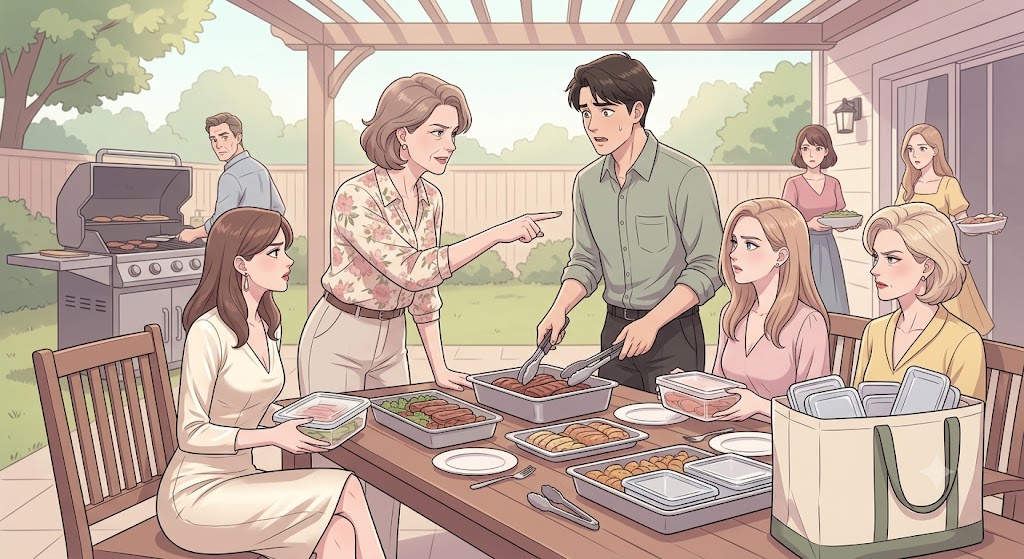
- He retrieved the tote, set it on the patio table, and Rachel began pulling out plastic storage containers one by one. Stella unzipped her own bag, retrieving hers. Within seconds, our family table had been turned into a assembly line.
- “We’ll just take a little for the coming week,” Rachel announced, pointing at the main platter. “Julian, grab that brisket. No, get the tender center cuts.”
- I stood near the kitchen doorway, holding a stack of empty plates. Tom looked across at me from the grill, his face hardening. Erica stopped folding napkins. Louisa froze with the sweet tea pitcher suspended over a glass.
- Julian picked up the metal tongs and began filling the containers.
- First went the brisket. Then the beef ribs. Then the skirt steak. Rachel instructed him to scrape in the grilled onions as well because they reheated so nicely.
- Nobody asked me.
- “Mom always cooks way too much,” Julian said lightly, trying to brush off the heavy air. “It’s much better than letting good food spoil.”
- Something inside me quietly closed.
- I set the plates down on the outdoor counter and walked across the brick patio toward my son. He was holding the largest container of them all, packed tight with the prime beef I had purchased.
- For the first time that day, I saw him clearly. I no longer saw the thoughtful little boy who used to help me set the Sunday table. I saw a grown man too afraid to be fair because fairness might upset his wife.
- I reached out, took the heavy container directly out of his hands, and set it firmly back down on the table.
- Rachel gave a sharp, nervous laugh. “Betty?”
- I looked at her. Then I looked at Stella. Finally, I turned my eyes to my son.
- “Please leave now.”
- The entire patio fell completely silent.
- PART 2 — THE LINE I FINALLY DREW
- Rachel stared at me as though I had spoken to her in a foreign language. “Excuse me?”
- “You heard me.”
- Stella slowly pushed herself up from her chair, her golden jewelry clinking. “Betty, that is unbelievably rude.”
- “No,” I replied, my voice steady and measured. “Rude is arriving at someone’s home empty-handed with bags full of empty containers. Rude is criticizing the meal while eating multiple portions. Rude is assuming another person’s hard work and generosity automatically belong to you.”
- Rachel’s face flushed bright red. “We were just taking leftovers!”
- “You were packing up the best cuts of meat before anyone else had even finished their meal or been offered a second helping.”
- Julian finally found his voice. “Mom, come on. You’re making this way bigger than it needs to be.”
- Those words hurt deeper than anything Rachel or Stella had said all afternoon. I turned to look at him.
- “I spent two hundred and fifty dollars on this beef, Julian. Your father and I have been working since five this morning. Erica and Louisa brought dishes and spent the afternoon helping. Your wife and her mother arrived carrying empty bags, and now you are packing up what I paid for as if I owe it to them.”
- Julian’s face drained of color.
- Rachel slammed her chair back against the brick. “I knew it! I knew you hated me!”
- “This has nothing to do with whether I like you, Rachel.”
- “Yes, it does! You’re just jealous because Julian has his own family now!”
- It was the classic accusation—the predictable script meant to make a mother look irrational and overbearing.
- Stella lifted her purse. “My daughter warned me that you had serious trouble letting go.”
- For a second, a dark laugh almost escaped my throat. The accusation was so absurd that my body didn’t know how else to process it.
- Then Tom stepped up beside me, his broad shoulder touching mine. “That’s enough,” he said, his voice quiet but commanding. “Betty opened our home to you. We fed you. You disrespected her in her own backyard. She asked you to leave, so please pack up your things and go.”
- Rachel whipped around to face Julian. “Are you just going to stand there and let them talk to us like this?”
- Julian looked at me, then at Rachel, then at Stella. Panic filled his eyes. “Mom,” he pleaded softly, “can’t you just apologize so everyone can calm down?”
- Something inside me snapped cleanly—not with anger, but with finality.
- “No,” I said. “I will never apologize for demanding respect in my own home.”
- Rachel grabbed her tote and angrily stuffed her empty containers back inside. “Fine! We’re leaving. And don’t count on seeing us again!”
- Stella held her chin high. “I have never been treated so terribly in my life.”
- I looked at her tote bag. “You arrived fully prepared to treat me terribly.”
- They marched through the house, with Julian trailing behind like a shadow. He paused briefly near the kitchen doorway, and for one desperate second, I hoped he would turn around. I wanted him to say I was right. I wanted my son to choose integrity over convenience.
- Instead, he kept walking. A moment later, the front door shut, a car engine roared to life, and they were gone.
- The patio remained deathly quiet. Tom wrapped a heavy arm around my shoulders. “You did the right thing, Betty.”
- I nodded, but I didn’t feel victorious. I felt hollow.
- Erica came over and took my hand. “Aunt Betty, we saw the whole thing. They were completely out of line.”
- “Completely,” Louisa added softly.
- Their support was a comfort, but it couldn’t change the crushing reality that my only son had walked out that gate with them.
- That night, I lay awake staring up at the ceiling fan. I replayed every detail: the empty containers, Rachel’s backhanded compliments, Stella’s smirk, and Julian asking me to apologize.
- By Friday, he still hadn’t called. So, I called him.
- He answered on the fourth ring. “Hi, Mom.” His voice sounded hollow and distant.
- “Julian, we need to talk about Sunday.”
- “I really don’t think we do.”
- “You don’t think what happened in my backyard warrants a conversation?”
- “I think what you did was completely humiliating.”
- “What I did?”
- “Rachel has been crying for days, Mom. Stella is furious. You embarrassed them in front of the whole family.”
- I closed my eyes, taking a deep breath. “They embarrassed themselves, Julian.”
- “They’re family!”
- “Family does not enter your home looking to take advantage of you.”
- “They just wanted leftovers!”
- “No,” I said firmly. “They wanted permission to treat me like a catering service, and you gave it to them.”
- Silence stretched over the line.
- Then he said, “If you want any kind of relationship with us, you need to call Rachel and apologize.”
- Tears welled in my eyes, but I kept my voice steady. “And what about how they treated me?”
- “What about it?”
- That four-word answer stayed with me long after the call ended.
- For over a month, I heard nothing directly from my son.
- Instead, I heard Rachel’s spin on the story through distant relatives. People like Rachel know exactly how to craft a narrative: they cut out the beginning, gloss over the middle, and play the victim at the end. In her version, she was simply trying to prevent food waste, while I had exploded without warning because I couldn’t accept my son’s marriage.
- Tom reminded me that anyone who actually knew my heart wouldn’t buy her story for a second. “The people who believe her without asking you aren’t worth your energy, Betty,” he told me.
- He was right, but I was exhausted—not from the physical labor of cooking, but deep down in my spirit.
- A few weeks later, I packed a bag and drove down to stay with my sister, Isabella, in San Antonio. Isabella was sixty-eight, widowed, and one of those rare people who knew how to sit quietly with your pain without trying to rush you out of it.
- When she opened the door and saw my face, she pulled me into a long hug. “You finally got tired, didn’t you?” she whispered.
- That was all she said. And I finally broke down and cried.
- I stayed with Isabella for six weeks. At first, sleep came hard. Every night, I questioned whether I had been too strict; every morning, I remembered the sight of those plastic containers lined up on my table and knew I hadn’t imagined the disrespect.
- One afternoon, as we sat on her porch drinking iced tea, Isabella looked at me thoughtfully. “Betty, you know this was never really about thirty-three pounds of beef.”
- “I know.”
- “No, I don’t think you fully do,” she said gently. “The beef was just the moment the truth became impossible to hide. For years, you taught everyone that your kindness had no boundaries and no cost. You gave food, money, time, and forgiveness. You ignored insults to keep the peace. You made yourself easy to take from. And the very first time you set a boundary, the people who were used to taking acted like you had betrayed them.”
- Her words hit me hard because they were true. I had always believed that love meant giving without keeping score. But there is a vast difference between keeping score and recognizing when you are being used.
- One evening, Tom called me from Fort Worth. “Julian came by the house today.”
- My heart skipped a beat. “What did he want?”
- “He claimed he needed to grab some old books from his childhood room, but I think he just wanted to ask about you.”
- “What did you tell him?”
- “I told him you were staying with Isabella until you felt ready to come home.”
- There was a long pause on the line. “Did he say anything else?”
- “He asked if I thought he had been a terrible son.”
- I sat down on the edge of the bed. “And what did you say?”
- “I told him the truth,” Tom said softly. “I told him his mother was humiliated in her own home, and instead of standing up for her, he handed over the tongs. And then I watched him cry, Betty.”
- I covered my mouth, tears spilling over.
- “I think he’s finally starting to see it,” Tom said.
- Two days later, my phone rang. It was Julian.
- “Mom… I want to see you. Please. I need to apologize to your face.”
- “Why now, Julian?”
- He went silent for a long moment. “Because I finally saw what you saw.”
- That weekend, Julian drove down to San Antonio. He looked thinner, his eyes were shadowed with exhaustion, and his hands trembled slightly as we sat in Isabella’s living room.
- “After the barbecue, I took Rachel’s side,” he began, staring at the floor. “Or maybe I just wanted to take her side because it was easier than dealing with the alternative.”
- “That isn’t a very comforting confession, Julian.”
- “I know. But it’s the truth.” He swallowed hard. “Two weeks ago, we went to her father’s birthday cookout in Arlington. And Rachel brought the containers.”
- I sat perfectly still.
- “She told me it was completely normal,” he continued, his voice shaking. “And when we got there, she did the exact same thing. She criticized her stepmother’s potato salad. She complained that the brisket was dry. And then, before half the family had even eaten, she started packing up containers.”
- He looked up at me, tears brimming in his eyes. “And suddenly, Mom, I saw you standing on the patio. I remembered the look on your face. And I saw myself standing there holding that plastic tub like a fool.”
- He wiped his eyes with the back of his hand. “Rachel’s father pulled me aside in the garage. He told me she does it everywhere she goes. He told me I needed to stop letting my wife convince me that every host was the problem.”
- I took a slow breath. “What happened then?”
- “I confronted her in the car on the way home. I asked her why she had lied to me about what happened at your house. And she told me that you deserved it.”
- My heart sank.
- “She told me you needed to learn that you weren’t in charge of the family anymore,” Julian said, his voice dropping to a whisper. “She said if I drove down here to apologize to you, she would never forgive me.”
- “And yet, here you are.”
- “I should have been here weeks ago.”
- “Yes,” I said quietly. “You should have.”
- He didn’t make an excuse or try to defend himself. That silence spoke louder than any justification could have.
- “Mom, I am so sorry,” he choked out. “I am sorry I let them treat you like that. I am sorry I packed that food. And I am so, so sorry I asked you to apologize when you were the one who was hurt. I was a coward.”
- The mother in me wanted to reach across the table and hold him; the woman in me stayed right where she was.
- “Rachel hurt my feelings,” I told him softly. “Stella insulted my home. But you broke my heart, Julian. You were my son long before you were her husband. That doesn’t mean you have to choose me over your wife—it means you ought to know right from wrong, no matter who is standing beside you.”
- He nodded slowly, tears streaming down his cheeks. “I know.”
- “I can’t just sweep this under the rug because you’re crying today.”
- “I’m not asking you to.”
- “Then what are you asking for?”
- “Just a chance to earn your trust back.”
- An opportunity was very different from immediate forgiveness. So, I gave him one.
- Before he left San Antonio, Julian shared one more piece of news: Rachel was pregnant.
- The announcement landed like a blessing wrapped in a thunderstorm. I was going to be a grandmother, but the mother of my grandchild was a woman who had tried to humiliate me and force my son to abandon his own moral compass.
- “What are you going to do?” I asked him.
- “I’m going to be a real father,” Julian said, his jaw setting firmly. “A present one, no matter what happens between Rachel and me.”
- For the first time in a very long time, I believed him.
- PART 3 — A DIFFERENT KIND OF FAMILY TABLE
- Over the next few months, Julian called every single week. Some conversations were stiff and cautious, but slowly, the warmth returned. Trust isn’t rebuilt by a single dramatic apology; it is restored through a hundred small, consistent choices.
- Before the baby was born, Julian and Rachel legally separated. It was neither easy nor quiet. Stella even called my house once, leaving a long, screeching voicemail accusing me of destroying her daughter’s marriage. I deleted it before it finished playing. I had finally learned that not every drama requires my participation.
- When I finally moved back home to Fort Worth, Tom wrapped his arms around me at the front door and held me for a long time. “You look different, Betty.”
- “I feel different.”
- “Are you okay?”
- “I’m getting there,” I smiled. And I was.
- The first time Julian came over to visit us alone, he walked through the door carrying a bouquet of flowers and a brown paper grocery bag.
- “What’s all this?” I asked.
- “Paper plates, napkins, and a case of sweet tea,” he said, looking a little bashful. “I thought it might save you some trouble.”
- It was a small gesture, but small gestures carry immense weight when they represent a real shift in heart. He helped Tom clean the gutters. He asked before grabbing a drink from the fridge. After lunch, he carried his own dish to the sink and washed it.
- That was where we rebuilt—not through grand speeches, but through quiet respect.
- When Rachel gave birth to a baby girl named Sophia, Julian called me from the hospital parking lot, his voice trembling with emotion. “Mom… she’s here.”
- I sat down right at the kitchen table. “Is she healthy?”
- “She’s perfect.”
- I wept tears of pure joy.
- Three weeks later, Julian pulled into our driveway with a baby carrier. I opened the front door before he could even ring the bell. He stood on the porch, holding a tiny bundle wrapped in a pale yellow blanket.
- “Mom,” he whispered, “meet Sophia.”
- Holding my granddaughter for the first time, the noise of the past year faded into absolute silence. “Hello, sweet girl,” I whispered, kissing her forehead. “I’m your Grandma Betty.”
- Julian wiped a tear from his cheek. “I want her to grow up knowing you.”
- “She will.”
- The next two years were far from simple, but they were honest.
- When Sophia was still an infant, Rachel relocated to Las Vegas with a man she met through her work. Julian stepped up, fighting for primary custody and becoming a steady, devoted single father. He learned how to braid Sophia’s hair (badly, but with immense pride), scheduled every pediatrician visit, and carried juice boxes and wet wipes in every coat pocket.
- Slowly, he became the man and father I had always known he could be.
- I changed, too.
- I still love to cook, and I still love feeding the people I care about. But I no longer confuse generosity with an open invitation to walk all over me. Guests are always welcome at my table—they can bring a salad, a dessert, or simply offer to help clear the dishes—but they cannot bring entitlement.
- Two years after the cookout that changed everything, I stood in my kitchen prepping another Sunday meal. This time, I bought eleven pounds of beef—not thirty-three. Eleven pounds was more than enough.
- Tom was outside by the grill. Isabella had driven up from San Antonio for the weekend. Erica and Louisa were on their way, both insisting on bringing side dishes. Julian was in the living room packing up Sophia’s diaper bag while she ran around the yard in pink sneakers, chasing butterflies.
- “Grandma Betty!” she chirped through the screen door. “Come look!”
- I wiped my hands on a towel and stepped outside. Sophia was holding a tiny yellow dandelion she had pulled from the lawn. “It’s beautiful, sweetie.”
- “Can we keep it on the table?”
- “We sure can.”
- We placed it in a small glass of water right in the center of the wooden table. It sat right where my mother’s green tablecloth used to be. I still have that tablecloth, and I still use it sometimes—not to impress anyone, but simply when I feel like it.
- Sophia climbed into a patio chair and looked at me thoughtfully. “Daddy says you’re very brave.”
- I glanced over at Julian, who was standing in the doorway trying to look busy. “Does he now?”
- She nodded emphatically. “He says you tell the truth even when everyone else gets quiet.”
- My chest tightened with quiet pride. I brushed a curl from her face. “Sometimes being brave just means standing up for yourself when people treat you unfairly.”
- She thought about that for a second. “Like when Mason takes my markers at school?”
- “Exactly like that.”
- “I tell him, ‘Please stop right now.’”
- I smiled softly. “That is a wonderful place to start.”
- Later, as Tom carved the beef and Isabella poured fresh iced tea, Julian set the outdoor table without being asked. Erica arrived with a fresh corn salad, and Louisa brought a tray of warm brownies. Everyone brought something; everyone helped; everyone laughed.
- And not a single plastic container made an appearance until the meal was completely over.
- After we finished, I packed up the extra food myself. I put a little brisket aside for Erica, some roasted potatoes for Louisa, a plate for our neighbor Mr. Hernandez, and a small container for Julian so Sophia could have bites for lunch the next day.
- The difference was simple, yet profound: this time, I offered. No one took.
- That evening, after the family had packed up and gone home, Tom and I sat together beneath the soft string lights on the patio. He reached across the table and took my hand in his.
- “Do you ever regret it, Betty?”
- “Regret what, dear?”
- “Saying those three words.”
- I thought back to that afternoon—Rachel’s bright red dress, Stella’s cold smirk, the stacks of plastic containers, and Julian’s pale, panicky face. I remembered the weeks of painful silence, the long drive to San Antonio, and the slow, tearful work of rebuilding our family from the ground up.
- Then I thought of Sophia wrapping her little arms around my neck and Julian clearing the table with a smile.
- “No,” I said firmly. “I don’t regret a single second.”
- Those three words had done far more than put an end to an uncomfortable cookout:
-
They put an end to the version of me that believed love required endless silence.
-
They put an end to my habit of smiling while people pushed past my boundaries.
-
They put an end to the foolish lie that being a mother means accepting disrespect just to keep your children close.
- For a season, I lost my peace. But in exchange, I gained my self-respect.
- I lost a son who was too afraid to stand up for what was right, and in time, I gained a man who knew how to apologize, face his mistakes, and grow into a true partner and father. I lost the kind of family gathering where I did all the work while everyone else took what they pleased, and I gained a table where love is not just served by one person—it is shared by everyone.
- Now, whenever I host a barbecue, I still cook with my whole heart. I season the meat early in the morning, make a little too much potato salad, fill the iced tea dispenser, and make sure everyone has a seat at the table.
- And I still send my guests home with leftovers.
- But only after everyone has eaten. Only after everyone has been offered a share. And only with people who walk into my home bringing respect alongside whatever dish they carry.
- Because I am still Betty Miller. I am still Tom’s wife. I am still Julian’s mother. I am still Sophia’s grandmother.
- But before any of those roles, I am a woman with a home, a heart, and a right to be treated with dignity.
- And should anyone ever forget that again, I know exactly which three words I am prepared to say:
- “Please leave now.”
The Containers on Miller’s Patio