PART 2 – When I Opened the Door, the Secret Behind My Marriage Began to Fall Apart – 1!001
PART 2
My fingers closed around the doorknob.
For one terrible second, Trevor’s hand stayed locked around my arm.
His nails pressed into my skin, a silent command, a warning, a final attempt to keep the walls of our life standing.
Then Emma whimpered.
That tiny sound broke something in me far deeper than the tooth he had shattered.
I turned the knob.
The door opened only a few inches before my father pushed it the rest of the way with one firm hand.
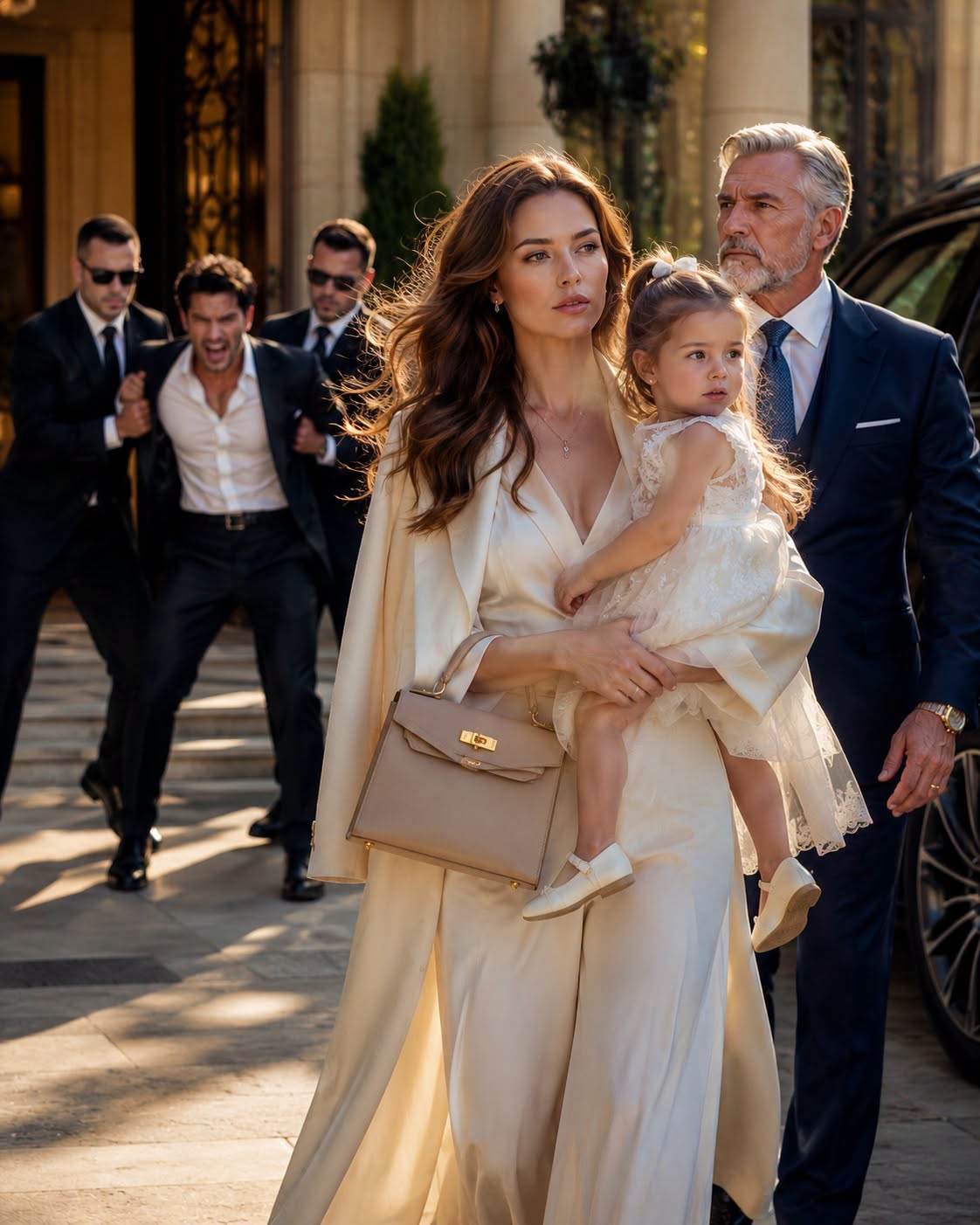
Richard Lawson stood on my porch in his dark overcoat, silver hair neat despite the rain beginning to fall behind him.
His chauffeur waited by the black car at the curb, but my father did not look back.
His eyes found me.
For the first time in my life, I saw my father lose every trace of composure.
“Rebecca,” he whispered.
I tried to say his name, but blood and pain tangled the word in my throat.
His gaze moved from my swollen mouth to my stained shirt, then to Emma clinging to me, then finally to Trevor.
The air changed.
My father did not shout.
He did not lunge.
He did not make some dramatic threat the way people did in movies.
He simply stepped inside, slowly, as if entering a room where a bomb might go off.
“Take your hand off my daughter,” he said.
Trevor released me so fast I nearly stumbled.
“It’s not what it looks like,” Trevor said immediately.
My father did not answer him.
He reached for me with both hands, careful, gentle, as though I were made of glass.
“Can you walk?”
I nodded, though my knees trembled.
“Emma,” he said softly, crouching just enough to meet her frightened eyes.
“It’s Grandpa.
You’re safe now.”
Emma buried her face against my neck.
Trevor moved toward us.
“Rebecca tripped.
She fell.
I was trying to help her.”
My father finally looked at him.
Something cold passed between them.
“Do not speak to me until I ask you a question.”
Trevor’s jaw tightened, but he stopped.
My father took out his phone and called for an ambulance.
His voice was calm, precise, almost frightening in its steadiness.
He gave the address, described my pregnancy, the injury, the bleeding.
He did not say Trevor had hit me.
Not yet.
When he ended the call, he looked at me again.
“Sweetheart,” he said, “did he do this?”
The question stood in the center of the room.
Trevor shook his head behind him, eyes wide now, silently pleading and warning all at once.
For years, that look had worked.
It had made me smooth foundation over bruises.
It had made me cancel plans, avoid photographs, laugh off questions.
It had made me say I was clumsy, tired, emotional, dramatic.
But Emma’s hand was still pressed to my cheek.
And inside me, my unborn daughter moved again.
I swallowed blood and fear.
“Yes,” I said.
The word was small.
But it changed everything.
Trevor stepped back as if I had struck him.
My father closed his eyes for half a second.
When he opened them, there was grief there, but not surprise.
That hurt almost as much as my face.
“You knew?” I whispered.
He looked at me, and the grief deepened.
“I suspected.”
The sirens were still distant, but growing closer.
Trevor began talking quickly.
“This is ridiculous.
She’s emotional.
She’s pregnant.
We had an argument, and she slipped.
Rebecca, tell him.
Tell him you’re confused.”
I turned toward him.
For a moment, I saw not the man who had terrified me minutes before, but the man I had married.
The man who had cried when Emma was born.
The man who used to bring me peppermint tea when morning sickness left me curled on the bathroom floor.
The man whose good moments had kept me trapped inside a hope that kept shrinking.
“I’m not confused,” I said.
His face twisted—not with rage this time, but with panic.
My father guided me toward the sofa, away from him.
He stood between us until the paramedics arrived.
Everything after that blurred into bright lights, careful hands, questions I answered through swelling and pain.
They checked the baby’s heartbeat first because I begged them to.
The moment the steady rhythm filled the room, I began to cry.
Emma cried too, not understanding the sound, only understanding that I had finally let go.
A police officer arrived with the ambulance.
Then another.
Trevor became charming again.
He lowered his voice.
He explained.
He expressed concern.
He called it a misunderstanding, an accident, a stressful day taken out of context.
I watched the performance from a distance, wrapped in a blanket, Emma tucked against me while a paramedic checked my blood pressure.
How many times had I believed that version of him?
How many times had I helped him build it?
My father stayed beside me until I was loaded into the ambulance.
Before the doors closed, he leaned in and touched my hair the way he had when I was little.
“I’m following right behind you,” he said.
“You are not alone.”
Those five words undid me.
At the hospital, everything smelled of antiseptic and old coffee.
Nurses moved around me with quiet efficiency.
A doctor examined my mouth and confirmed what I already knew: one front tooth was broken badly, another loosened.
My lip needed stitches.
They monitored the baby for hours.
Emma slept against my father’s chest in the corner of the room, her tiny hand clutching his tie.
I had not seen him hold a child in years.
He looked older beneath the fluorescent lighTS. Not powerful.
Not untouchable.
Just a father holding his granddaughter after realizing he had nearly arrived too late.
When the nurse stepped out, he spoke without looking away from Emma.
“I failed you.”
“Dad—”
“No.” His voice cracked slightly.
“Let me say it.”
I looked down at my hands.
There was dried blood beneath my nails.
“I saw signs,” he continued.
“Your canceled dinners.
The way you stopped answering calls when he was home.
The bruises you explained too quickly.
I told myself you were private.
I told myself you would come to me when you were ready.”
“I didn’t want you to hate him.”
“I did not need your permission for that.”
Despite everything, a broken laugh escaped me, and pain shot through my jaw.
His expression softened.
“I also knew,” he said slowly, “that if I pushed too hard, you might disappear further into that house.”
I stared at him.
That was exactly what would have happened.
Trevor had always been skilled at turning concern into control.
If my father had confronted him too soon, Trevor would have moved us, isolated us, convinced me my family was trying to ruin our marriage.
“I came today because of a phone call,” my father said.
“What phone call?”
His hand tightened around Emma’s back.
“Your neighbor, Mrs. Alvarez.
She called my office.
She said she had not seen you outside in days, and yesterday she heard Trevor shouting on the porch after you brought groceries in.
She said Emma was crying.”
My throat tightened.
Mrs. Alvarez lived beyond the line of hedges, far enough that I had believed no one ever noticed anything.
“She was scared to interfere,” he said, “but she was more scared not to.”
I turned my face toward the window.
Rain streaked the glass, turning the city lights into trembling lines.
For years, I had thought silence protected my family.
Now I wondered how many people had been quietly trying to protect me.
A social worker came before midnight.
Her name was Melanie, and she had kind eyes that did not pity me.
She spoke to me as though I were still a person capable of making decisions, which felt strange after so long.
She explained options: a protective order, temporary housing, counseling, documentation, legal help.
My father wanted me at his penthouse immediately, surrounded by security and lawyers, but Melanie gently reminded him that I needed to choose.
Choice.
The word felt unfamiliar.
I looked at Emma asleep in the hospital crib they had brought in, then at the monitor tracing my unborn daughter’s heartbeat.
“I want to go somewhere Trevor doesn’t know,” I said.
My father looked wounded for half a second, then nodded.
“Then that is what we will arrange.”
It was the first time in years someone had not argued with my fear.
By morning, my face had swollen enough that I barely recognized myself in the bathroom mirror.
One side of my lip was stitched.
My smile, when I tried to make one for Emma, came out crooked.
She touched my cheek again.
“Mama boo-boo?”
“Yes,” I whispered.
“Mama has a boo-boo.”
“Kiss?”
I bent carefully, and she kissed the air near my mouth.
My eyes burned.
A detective came later that day.
She asked careful questions, not just about last night, but about before.
I told her some things.
Not everything.
The words came out like stones from a pocket, each one heavier than I expected.
The first shove.
The first apology.
The first time he locked my phone in his car because I had “embarrassed” him at dinner.
The first time I lied to my obstetrician.
My father sat in the hallway while I spoke.
He did not interrupt.
He did not storm in demanding action.
He waited, which may have been the hardest thing for him to do.
When the detective left, she gave me a card.
“You may remember more later,” she said.
“That’s normal.”
Normal.
Nothing about my life felt normal, but the word gave me a strange comfort.
As if my confusion was not proof of weakness.
As if my fear had a shape other people recognized.
Two days later, I left the hospital through a private exit arranged by my father’s security team.
I hated the secrecy, hated the dark car, hated the way I flinched when a phone buzzed.
But Emma sat beside me in her car seat, hugging a stuffed rabbit the nurses had given her, and the baby moved softly beneath my ribs.
We did not go to my father’s penthouse.
We went to a small house near the coast, owned by one of his companies but never used.
It was painted gray with white shutters, tucked behind pine trees and wild grass.
The ocean was visible only as a silver strip beyond the dunes.
“It has a security system,” my father said, almost apologetically.
“And Mrs. Nolan will stay nearby if you need help.
She was your grandmother’s housekeeper years ago.”
I remembered Mrs. Nolan as a warm woman with flour on her hands and peppermint candies in her apron pocket.
Seeing her waiting on the porch made something inside me loosen.
She did not gasp when she saw my face.
She simply opened her arms.
“Oh, child,” she said.
I stepped into them and cried like I had been holding my breath for years.
The first week in the gray house passed in fragmenTS.
Emma learned the word ocean.
I learned how quiet mornings could be when no one was angry about the coffee, the noise, the mail, the toys, the way I breathed.
My father visited daily but never stayed too long.
He brought groceries, legal updates, and once, awkwardly, a stack of picture books for Emma that still had price tags attached.
He was trying.
So was I.
At night, though, fear returned.
Every creak of the house became Trevor’s footsteps.
Every passing car became his.
I slept with my phone under my pillow and a lamp on in the hallway.
Sometimes I woke with my hands over my stomach, heart racing, unable to remember where I was.
One night, after a nightmare, I found Emma awake in her portable crib, watching me silently.
I lifted her into bed beside me.
“I’m sorry,” I whispered into her hair.
“I’m so sorry.”
She patted my arm with sleepy tenderness.
“Shh, Mama.”
That nearly broke me.
Children should not learn to comfort their mothers before they learn full sentences.
The next morning, I called the therapist Melanie had recommended.
Her name was Dr. Sayeed.
During our first session over video, I expected her to ask why I had stayed.
Instead, she asked what had helped me survive.
I had no answer.
She waited.
Finally, I said, “Emma.”
Dr. Sayeed nodded.
“And before Emma?”
 Wife Threatens Divorce After Husband Ignores Daughter Over Misophonia And College Prep
I thought of younger Rebecca, before Trevor, before marriage, before fear became routine.
I had been stubborn then.
Curious.
I loved restoring old houses with my father, walking through dusty rooms and imagining what they could become.
“I used to believe broken things could be repaired,” I said.
“Do you still believe that?”
I touched the temporary dental appliance covering my broken tooth.
“I don’t know.”
“That’s an honest place to begin.”
Meanwhile, Trevor called constantly from blocked numbers until the protective order was filed.
I did not answer, but he left messages.
At first, they were apologies.
Rebecca, I lost control.
Baby, please, we can fix this.
I miss Emma.
Then came anger.
Your father planned this.
You’re making me look like a monster.
You’re going to ruin our family.
Then came something worse: calm.
You don’t understand what your father has done.
Ask him about the money.
Ask him why he really came that night.
I replayed that message three times, each time feeling colder.
When my father arrived that afternoon, carrying a bag of tiny socks for the baby, I was waiting at the kitchen table.
“Trevor left a message,” I said.
My father’s smile faded.
“He said to ask you about the money.”
For a moment, my father looked genuinely confused.
Then something shifted behind his eyes.
“What money?” I asked.
He set the bag down carefully.
“Rebecca—”
“No.” My voice trembled, but I did not lower it.
“I am done being protected by people who decide what I can handle.”
He pulled out a chair and sat across from me.
The kitchen smelled like chamomile tea and rain-damp wood.
Emma napped upstairs.
Mrs. Nolan was in the garden, giving us privacy without being asked.
My father folded his hands.
“Three months ago,” he said, “Trevor came to my office.”
I stared at him.
“He told me he wanted to start a development firm.
Said he had contacts, ambition, plans.
He asked for an investment.”
“How much?”
“Two million dollars.”
The number made me dizzy.
“I told him no,” my father said.
“Not because I wanted to humiliate him.
Because the proposal was reckless.
Inflated costs, vague partners, no permits, no real asseTS.”
“Did he tell you not to tell me?”
“Yes.”
I closed my eyes.
Of course he had.
Trevor had complained for months that my father looked down on him.
That Richard Lawson never gave him a chance.
That I should stand up for my husband instead of staying loyal to “Daddy’s empire.”
But he had never mentioned asking for money.
“There’s more,” my father said.
I opened my eyes.
“A week after I refused, someone attempted to access one of your trust accounTS.”
My pulse thudded.
“My what?”
My father went still.
The silence that followed was different from all the others.
Larger.
Older.
“What trust account?” I asked.
He looked as if he had aged ten years between one breath and the next.
“When your mother died,” he said quietly, “she left assets for you.
Substantial asseTS. I placed them in a protected trust until you turned thirty-five, with emergency access under specific conditions.”
My chair scraped against the floor as I stood.
“My mother died when I was ten.
I’m thirty-two.
You never told me?”
“I planned to.”
“When?”
He flinched.
I had never seen my father flinch before.
“I thought I was protecting you from people who might see you as a fortune instead of a person.”
The irony landed between us with cruel precision.
I laughed once, but there was no humor in it.
“So Trevor was right.
There was money.”
“Yes,” my father said.
“But not in the way he thinks.”
“How did he find out?”
“I don’t know.”
That answer frightened me more than any explanation would have.
My father stood, but he did not come closer.
“Rebecca, I made a mistake.
A serious one.
I believed secrecy could keep you safe.
I see now that secrecy helped isolate you.”
I wanted to be angry, and I was.
The anger came hot and clean, almost refreshing after years of swallowing it.
But beneath it was grief.
My mother had left something for me.
A piece of her future.
A message from a life I barely remembered.
And my father had locked it away like every other difficult truth.
“I need time,” I said.
He nodded.
“You can have all of it.”
After he left, I sat on the porch wrapped in a blanket, watching the ocean darken under evening clouds.
Mrs. Nolan joined me with two mugs of tea.
“Your father told you, then,” she said.
I turned slowly.
“You knew?”
“I knew your mother left you something.
Not details.” She handed me a mug.
“Your mother was a careful woman.”
I stared at the steam rising between my hands.
“What was she like? Really?”
Mrs. Nolan smiled sadly.
“Braver than she believed.
Kinder than she allowed people to see.
And very stubborn when she loved someone.”
That sounded painfully familiar.
“She would be proud of you,” Mrs. Nolan said.
“For what? Letting things get this bad?”
“For opening the door.”
The words settled over me as the waves rolled in beyond the dunes.
Opening the door had felt like an ending.
Maybe it was also the beginning of something I did not yet have a name for.
Over the next two weeks, my life filled with appointmenTS. Legal consultations.
Therapy sessions.
Medical checkups.
Dental repairs.
Forms, statements, signatures.
Every practical step felt both empowering and exhausting.
Trevor’s attorney requested visitation with Emma.
The email made my hands shake.
My own attorney, a calm woman named Elise Tran, explained that the court would consider safety, evidence, and supervised arrangemenTS.
“He is still her father,” I said, hating how small my voice sounded.
“Yes,” Elise said gently.
“And you are her mother.
Your job is not to erase that fact.
Your job is to protect her within it.”
That became a sentence I repeated to myself whenever guilt crept in.
I am not erasing.
I am protecting.
Then, one Thursday afternoon, a package arrived.
No return address.
Mrs. Nolan found it on the porch and brought it in with a frown.
“Security camera caught the delivery truck, but not the sender.”
Inside was a small wooden box.
My hands went cold before I opened it.
There was no threat inside.
No note from Trevor.
No ugly reminder.
Only a silver locket.
I knew it instantly from photographs.
My mother’s locket.
I had worn it once as a child during a Christmas party, then never saw it again.
My father told me it had been misplaced after we moved.
Inside the box was a folded piece of cream-colored paper.
The handwriting was elegant, slanted, unmistakably feminine.
Rebecca, if this reaches you, it means the truth has taken longer than I hoped.
I stopped breathing.
Mrs. Nolan whispered, “What is it?”
I could not answer.
My hands shook as I unfolded the rest of the letter.
My darling girl, there are things your father does not know.
Not because I wished to deceive him, but because I feared the wrong person might one day use you to reach what I protected.
The trust is not only money.
It contains records, names, and proof of decisions made long before you were old enough to understand them.
I read the paragraph again.
Records.
Names.
Proof.
Mrs. Nolan sat beside me, her face pale.
“There’s something inside the locket,” she said suddenly.
With trembling fingers, I opened it.
Behind my mother’s tiny photograph was a thin piece of folded paper, so delicate I had to use tweezers from Mrs. Nolan’s sewing basket to pull it free.
It was not a letter.
It was a list.
Five names.
The first was my mother’s.
The second was my father’s.
The third was a man I did not recognize.
The fourth made my stomach twist.
Trevor Hale.
But the fifth name stopped my heart completely.
Emma Lawson Hale.
My daughter.
Written in my mother’s handwriting.
My mother had died twenty-two years before Emma was born.
And somehow, she had known my daughter’s name.
END OF PART 2 – LIKE, SHARE AND COMMENT “THE ENTIRE STORY” IF YOU WANT TO READ THE FULL STORY