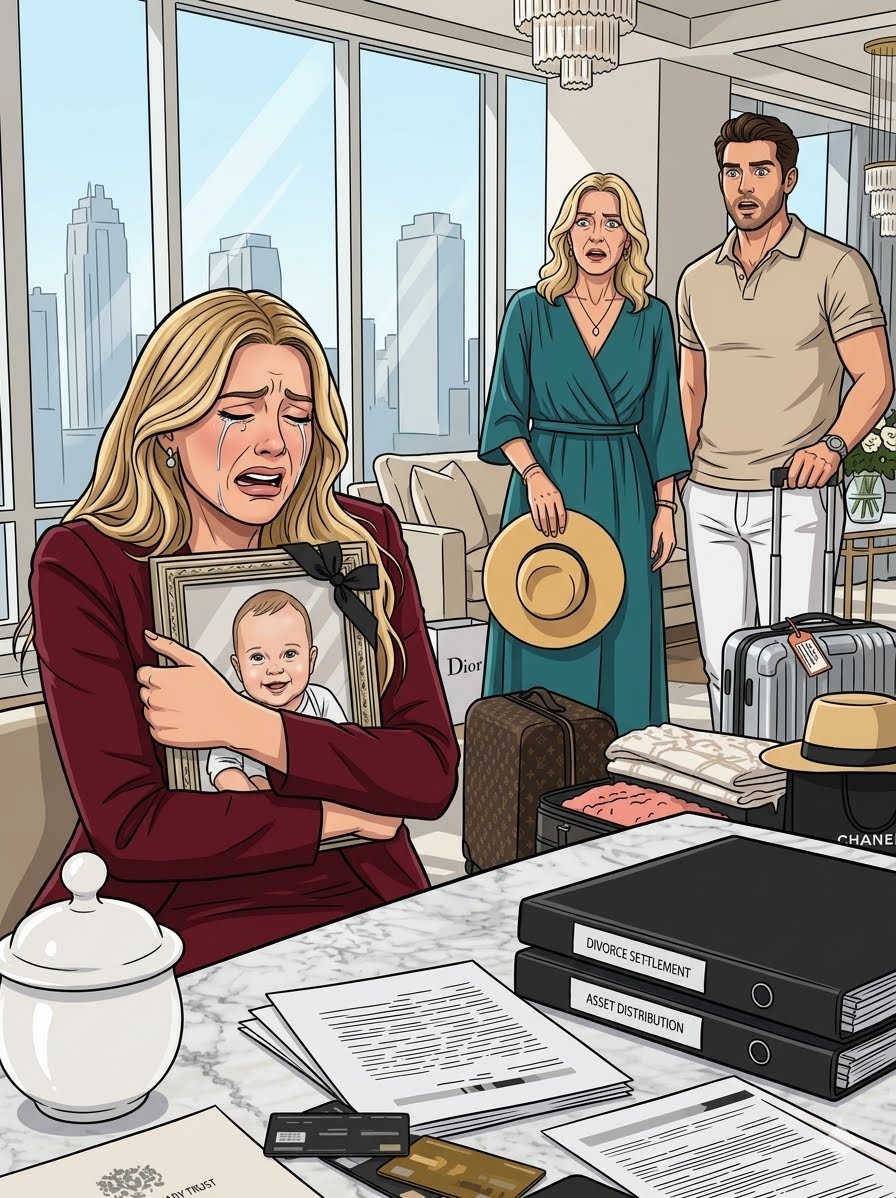
- “If your baby’s lips are blue, wrap him in another blanket and stop acting like you’re the one suffering.”
- My mother-in-law, Theresa, dismissed me with a careless flick of her hand while slipping her passport into an expensive carry-on bag.
- My little boy was only three days old. Exactly seventy-two hours had passed since his first cry echoed through a Portland hospital room—seventy-two hours since my husband, David, wept as he held him, swearing no harm would ever come to his child. We had named him Ethan, a name David said carried strength. A name worthy of a child meant to overcome anything.
- Yet that morning, Ethan was slipping away.
- I stood in the middle of our living room clad in a milk-stained nursing gown, my C-section wound burning with every breath, my body shaking from relentless exhaustion. My mind, however, was razor-sharp. My baby’s breathing came in terrifying, uneven bursts interrupted by long, silent pauses, as though his tiny lungs kept forgetting their purpose. A pale bluish tint shaded his lips, and his small fingers felt painfully cold to my touch.
- “David, please call an ambulance,” I pleaded.
- He kept his eyes glued to his phone screen, reviewing his flight reservation without bothering to look up. “Valerie, here we go again.”
- Theresa released a short, cold laugh. She had stayed with us for the past week under the guise of “helping,” yet every bit of that support was delivered through sharp criticism: how I nursed, how I walked, how often I cried, and even the way I cradled my son. She loved reminding everyone that women from her generation delivered babies and were back preparing full meals the very next afternoon.
- “First-time mothers panic over every little thing,” Theresa sighed, waving her hand dismissively. “David, your son is completely fine. The only unstable person in this house is your wife.”
- Ethan parted his tiny lips, but no cry escaped—only a faint, scratchy gasp for air that sent cold terror racing through my veins.
- “Please… just look at him!”
- David finally strolled over, glanced at Ethan for barely two seconds, and exhaled with profound annoyance. “My mother successfully raised four children, Valerie. You’ve only been doing this for three days.”
- Those words severed something deep inside me. In the central emergency of my life, my husband chose to trust his mother’s arrogant assumptions over his own child’s desperate struggle to breathe.
- I reached toward my phone on the couch, but Theresa moved first. She snatched it up, clicked it off, and slid it deep inside the pocket of her cardigan.
- “We’re not calling 911 over obvious postpartum anxiety,” she announced flatly. “Go lie down and sleep. Conversation over.”
- “Give me back my phone.”
- “No.”
- Ignoring the sharp, tearing pain stretching across my surgical incision, I forced myself to stand tall. “David, tell her to return it! I’m calling 911!”
- My husband remained silent. Instead, he walked over to the entry table, unzipped my purse, and pulled out my primary credit card.
- “We’re leaving before you turn this into another ridiculous performance,” he said, his tone devoid of all emotion.
- “We’re leaving? Where?”
- Theresa smiled with cold, unmistakable satisfaction. “Key West. Five days. Everything’s already reserved. Your credit card has plenty of room on it, doesn’t it?”
- “You’re flying to Florida while your newborn son is struggling to breathe?”
- “My child deserves a father who isn’t surrounded by panic,” David muttered, sliding the card into his wallet. “And I deserve a vacation away from your non-stop hysteria.”
- They turned and went upstairs to retrieve their luggage. I stood motionless in the living room, barefoot and trembling, holding Ethan tightly against my chest.
- Just before walking out the front door, David bent down and kissed our son’s chilly forehead. “When I come home, we’ll have a calm conversation like grown-ups.”
- From the threshold, Theresa added a parting blow: “I also hid her phone charger. That should keep her from spending the next five days convincing herself WebMD knows more than experienced mothers.”
- The heavy oak door closed with a dull, final click.
- Instantly, the house fell into a suffocating silence, broken only by my son’s weak, irregular wheezing.
- They believed they had left me entirely powerless because I was recovering from surgery, isolated, stripped of my phone, and cut off from my finances. What they had forgotten was my life before David: I had spent eight years as a senior forensic analyst at a corporate law firm in Seattle.
- Reconstructing digital trails, establishing exact timestamps, recovering financial records, analyzing security footage, and retrieving hidden data was my trade.
- As Ethan’s breathing faltered again in my arms, a icy clarity washed over me. The closing of that front door wasn’t the ending of my story—it was the opening move in a battle they had already lost.
- Part 2: The Evidence Locker
- I eventually discovered my lifeless phone stuffed into the bottom of the diaper bin beneath wet towels, hidden to muffle any sound.
- My hands trembled so violently I nearly dropped it. I searched every drawer, scoured behind couch cushions, checked our bedroom nightstands, and tore through my hospital bag for a charging cord. There was nothing. Theresa hadn’t acted out of impulse; every detail of her cruelty had been calculated.
- In my arms, Ethan released another faint, fragile gasp.
- I staggered out the front door and onto the street, my vision swimming with tears. Running was physically impossible—my body was tearing at the seams—yet I screamed into the freezing morning air until my lungs burned raw.
- “Help! My baby can’t breathe! Please!”
- Mrs. Gable, the retired teacher who lived across the street, was walking up her driveway with groceries. The instant she saw Ethan’s pale, bluish face, she dropped her bags onto the pavement. She dialed 911 immediately and gripped my shoulders to keep me from collapsing onto the asphalt.
- At the hospital, everything dissolved into glaring overhead lights, frantic footsteps, and overlapping medical commands. A pediatric emergency team lifted Ethan onto a gurney, demanded high-flow oxygen, and rushed him through double doors while a nurse pressed a wheelchair under me.
- “How long has he had this blue tint?” the attending pediatrician asked.
- “Since this morning… I tried to call for help… they took my phone.”
- The hospital social worker paused her typing mid-sentence. “Who took your phone, Valerie?”
- I stared through the glass window of the resuscitation room as doctors attached tiny monitors to a body that looked heartbreakingly small. “My husband. And his mother.”
- Several hours later, the pediatric cardiologist delivered the devastating diagnosis: Critical Congenital Heart Disease, severe hypoxia, and acute respiratory failure. Surgery was possible, but every hour of delayed medical intervention had caused catastrophic, cascading organ failure.
- That night, Ethan fought for every breath. The following day, he kept fighting.
- While my son lay tethered to life support in the Neonatal Intensive Care Unit, David posted a polished photo on Instagram from a private charter yacht off Key West. He wore a crisp linen shirt, Theresa stood beside him beaming, and the sun set brilliantly behind them.
- “Finally enjoying some peace after all that unnecessary drama,” the caption read.
- I took a screenshot.
- Theresa shared her own photo showing designer boutique bags spread across a resort bed: “Some women create tragedies. The rest of us simply appreciate the blessings we’ve been given.”
- I captured that screenshot as well.
- On the third day, Ethan’s oxygen saturation plunged. By the fourth, his kidneys failed completely. I stopped crying. The overwhelming grief inside me didn’t disappear—it hardened into something precise, analytical, and deadly serious.
- I formally requested certified copies of every piece of objective evidence: the hospital’s exact admission timestamp, the 911 dispatch audio, the ambulance telemetry logs, the attending physician’s clinical notes, the social worker’s intake report, and Mrs. Gable’s sworn statement. From my hospital room, I contacted Rachel Cole, my closest friend and a ruthless family law attorney.
- “I need emergency evidence preservation notices served today,” I instructed her.
- “Who are we targeting, Valerie?”
- “My husband, my mother-in-law, the bank, the airline, the resort, the rideshare service, and the HOA security footage from our street. They abandoned my dying child and fled the state using my stolen credit card.”
- A long silence hung over the line before Rachel answered: “We are going to make every single second of this timeline completely undeniable.”
- By the time David finally deigned to reply to one of my emails, Ethan had been dead for ten hours.
- His response was a single, callous line: “Stop trying to manipulate everyone with your panic attacks. We’ll be home Sunday.”
- I didn’t reply. Instead, I forwarded the message directly to Rachel, checked out of the hospital, and returned to the empty house.
- The nursery was frozen in time. A soft yellow blanket still rested over the arm of the rocking chair. In David’s home office, I powered up his desktop computer; he had never changed his password. Within an hour, I extracted and recovered the deleted text thread between him and his mother from the morning they left.
-
Theresa: Take her phone and the charger. If she contacts emergency services, she’ll destroy the entire vacation.
David: Already done. I took her credit card too. It’s time she paid for something after putting me through all this pointless drama.
- I printed three certified copies of the exchange.
- Five days after they had left us, I heard a car door slam in the driveway. I sat at the head of the mahogany dining table dressed entirely in black, four meticulously organized legal binders set before me, with a small handcrafted wooden urn placed quietly at the center.
- David was about to walk through that door believing he was resuming his comfortable life. He had no idea that everything he cared about had already burned to the ground.
- Part 3: The Price of Silence
- They stepped through the front entrance laughing, carrying armfuls of shopping bags, their skin glowing from the Florida sun.
- Theresa entered first in a flowing white resort dress, designer sunglasses resting atop her head, gold bangles clinking against her wrist. She carried the scent of expensive perfume, sunblock, and the absolute arrogance of someone whose vacation had gone precisely as planned. David followed right behind, rolling his suit carrier with an easy stride, looking like a man utterly convinced he had handled a domestic inconvenience masterfully.
- Their laughter died the instant their eyes landed on the dining room.
- The diaper bag was absent from the entryway. The infant swing no longer sat in the corner. The soft lullaby from the nursery monitor was dead quiet.
- Only I remained, seated at the head of the table in black, the legal binders laid out before me, and the small wooden urn illuminated under the chandelier.
- David frowned. “Valerie… what is this?”
- Theresa’s eyes caught the urn, and her expression instantly hardened—not with sorrow, but with profound annoyance. My grief was an offense to her itinerary.
- “Oh, honestly, Valerie,” she scoffed, rolling her eyes. “What dramatic performance is this supposed to be now?”
- I didn’t even look at her. My gaze remained locked on David, searching for the faintest trace of the man who had once held my hand through every ultrasound. I found only the coward who had turned his back while his son fought to breathe.
- “Where’s Ethan?” he asked, his voice wavering.
- I answered without raising my tone. “He died Thursday morning.”
- David’s suitcase slipped from his grip, slamming against the floorboards. Theresa dropped her shopping bags, a gold designer shoe tumbling from an open box onto the rug.
- “No,” David stammered, shaking his head violently. “No… don’t do this. Don’t play these sickening mind games.”
- “I am stating a certified medical fact.”
- He buried his face in his hands, weeping hysterically. But whatever capacity for mercy I possessed had died in that ICU room. I remembered his email word-for-word: Stop trying to manipulate us.
- Theresa immediately stepped in front of him, her voice rising in pitch. “David, do not listen to her! She is completely unhinged! She probably stashed the baby with a neighbor just to spite us for taking a trip!”
- I slid the first binder across the polished table.
- “Official death certificate,” I stated coldly. “Hospital intake records. The 911 dispatch log. The diagnosis of Critical Congenital Heart Disease. And Mrs. Gable’s sworn affidavit documenting how she found me bleeding in the street after you stole my phone.”
- David couldn’t bring himself to touch the folder. He stared at the documents as his breath hitched uncontrollably.
- I slid the second binder forward.
- “Every single itemized transaction from Key West. First-class flight upgrades, five-star hotel suites, luxury dining, boutique receipts—all billed to my personal credit card without authorization while your son’s organs were failing.”
- Theresa bristled defensively. “We used the family funds!”
- “No,” I corrected her. “You used my private account after robbing me while I was hemorrhaging in our living room.”
- Then I pushed the third binder to the center.
- “The deleted text log from your phone, David. Your mother instructing you to confiscate my phone and charger. You agreeing. Her stating I would ruin the vacation. Your response that it was time I paid for the ‘drama.’”
- David slowly leaned over the table, staring at his own words printed in black and white. Every drop of color drained from his face, replaced by a shame so profound he looked physically hollowed out.
- “I… I never thought it was an actual emergency,” he choked out, sobbing into his hands.
- “You chose not to believe it,” I replied. “Because your personal comfort was more important than your son’s life.”
- He collapsed into a dining chair, burying his head on the table, emitting a broken, guttural cry.
- Theresa slammed her hand on the wood. “This is a trap! She’s trying to ruin us! She’s been scheming to turn my son against me since day one!”
- Three sharp knocks resonated against the front door.
- I stood up, walked calmly to the foyer, and opened it. Two plainclothes detectives stood on the porch alongside Rachel Cole, who held a thick legal briefcase.
- “Mrs. Valerie Prescott,” the lead detective said respectfully, “we’re here to execute the warrants and gather official statements.”
- Rachel stepped past them into the dining room, her eyes fixing onto David and Theresa with lethal precision.
- “David Mercer and Theresa Mercer,” Rachel announced, “you are officially under criminal investigation for felony endangerment of a dependent, domestic neglect, grand theft, unauthorized use of financial instruments, and intentional obstruction of emergency communications. Temporary restraining orders have been served, and the petition for dissolution of marriage has been filed with the court.”
- Theresa clutched at her pearl necklace. “This is absurd! I was protecting my daughter-in-law from a severe episode of postpartum hysteria!”
- Rachel opened her briefcase. “The recovered text messages prove you were fully aware of her intent to call 911, and that you conspired to prevent it. Neighborhood security cameras captured both of you loading luggage into a rideshare while Valerie was visibly incapacitated on the property. The evidentiary trail is complete.”
- David raised his bloodshot, swollen eyes toward me. “Valerie… please. I loved him. I’m so sorry.”
- I looked at him, and for the first time since this nightmare began, I felt absolute stillness. No anger. No bitterness. Just a vast, immovable silence.
- “I left this marriage the second you locked that front door, David,” I said softly. “Everything happening now is just legal accounting.”
- The Legacy of Ethan
- Justice rarely moves with the dramatic speed of a television script. It unfolds through the methodical grind of depositions, forensic device audits, financial tracing, and preliminary hearings.
- Yet the evidence locker we constructed left David and Theresa with no avenue of escape. Their smiling vacation photos, matched against the minute-by-minute timeline of Ethan’s fatal decline, laid bare an undeniable record of criminal indifference that no jury would ever forgive.
- To avoid a public trial, both defendants accepted felony plea bargains.
- David pleaded guilty to criminal neglect of a dependent and financial fraud. He was sentenced to three years in a state correctional facility and was summarily terminated from his corporate position.
- Theresa pleaded guilty to criminal conspiracy and obstruction of emergency services. She received a two-year prison sentence and was forced to sell her suburban home to satisfy mounting legal fees and civil restitution judgments awarded to my son’s estate.
- Yet my true victory was never realized inside a courtroom.
- One year after Ethan’s death, I returned to the pediatric wing of the hospital carrying a small, handcrafted wooden box. In the courtyard garden adjacent to the NICU, a young cherry blossom tree had been planted in his honor.
- At its base rested a simple bronze marker:
-
Ethan Prescott
A voice that taught the world to listen to mothers.
- Using the court-ordered restitution and a groundswell of corporate donations that followed the public disclosure of our case, Rachel and I launched The Ethan Project. The foundation equips post-partum mothers in controlling, abusive, or isolated environments with secure, pre-activated emergency cellular devices. We also developed mandatory training modules for medical staff and social workers to identify the early markers of domestic medical gaslighting and family coercion.
- A senior NICU nurse named Sarah met me in the courtyard holding a framed photograph.
- “I wanted you to see this, Valerie,” she said softly.
- The picture showed a exhausted young mother in a hospital bed holding her healthy newborn, tears of overwhelming relief streaming down her cheeks.
- “She used one of your foundation’s emergency devices last night,” Sarah told me. “Her family insisted she was overreacting to her baby’s high fever. She called our hotline directly instead. We brought him in just in time to treat a rapidly spreading bacterial infection.”
- I pressed my fingers against the glass frame, feeling a quiet, enduring warmth bloom in my chest.
- For a long time, I believed justice meant watching David and Theresa lose everything they valued. In the end, they did—their freedom, their assets, their reputations, and their pride were stripped away completely. But true justice was never the sound of a prison door locking or a judge’s gavel striking the bench.
- It was the immediate answer of an emergency dispatcher.
- It was a mother being believed before it was too late.
- It was the sound of a newborn baby taking a deep, healthy breath.
Part 1: The Cold Front