- “Stop pretending,” my mother scoffed, her words slicing through the heavy air of the kitchen.
- I was bent double over the sink, one hand white-knuckled against the laminate counter while the other pressed hopelessly into my chest. Beside me, a mountain of dirty dinner dishes sat submerged in lukewarm water, slick with grease and mashed potatoes. The edges of my vision grew soft and dark, narrowing the entire world into a beam of dim yellow light, the oak cabinets, and my mother’s irritated face.
- “Mom,” I wheezed, the air catching like glass in my throat. “I can’t… breathe.”
- Uncle Ray leaned back against the refrigerator, a silver beer can balanced in his palm as he rolled his eyes. “She’s doing it again. Every time there’s a pile of work, the big performance starts.”
- I tried to defend myself, but my lungs offered only a quiet, pathetic rasp.
- Across the room, my sixteen-year-old brother, Caleb, froze beside the table. “Mom… her lips look blue.”
- “They do not,” she snapped, not even bothering to look closer. “Emma, stand up straight. You’re eighteen years old, not eight. Stop acting like a child.”
- Then my knees simply uncoupled from my hips.
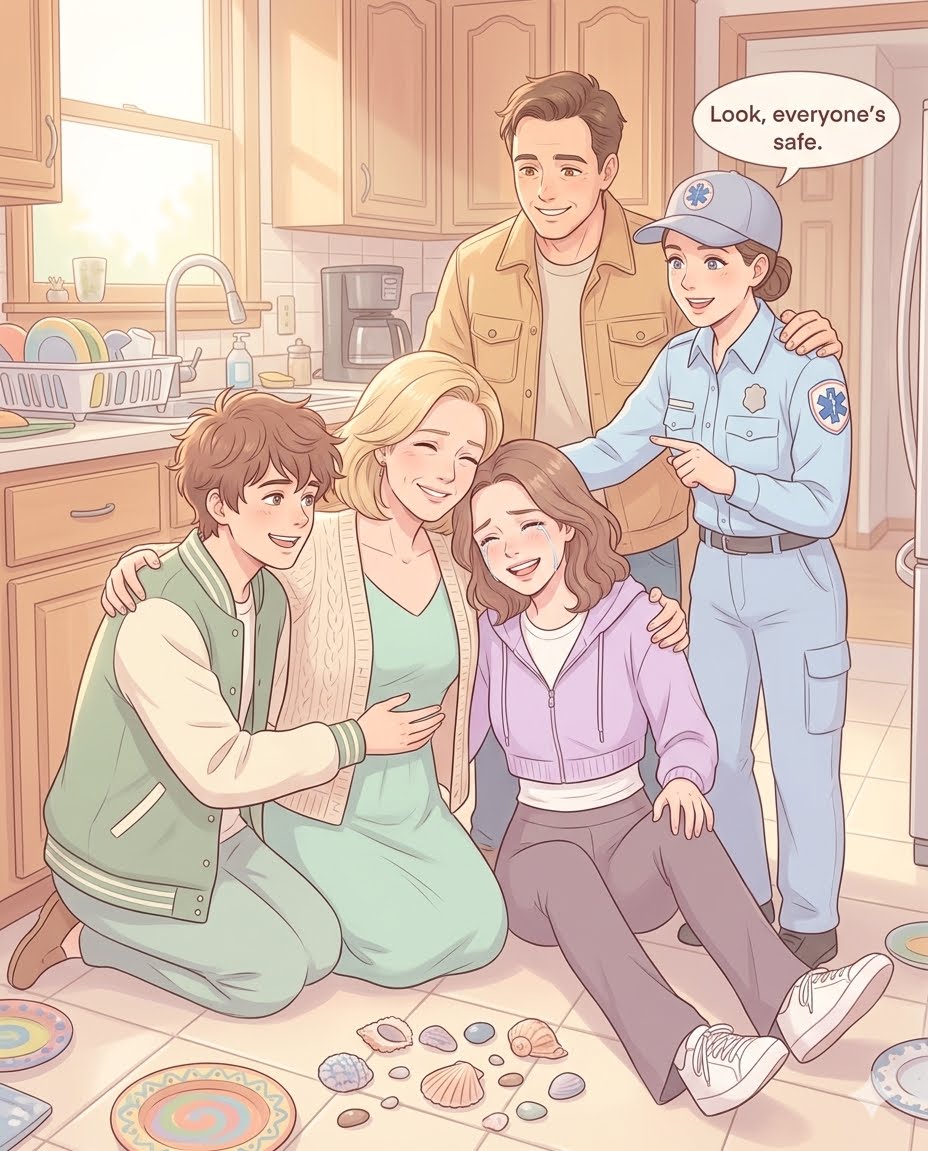
- As I dropped, the drinking glass I’d been washing slipped from my numb fingers, shattering against the porcelain basin before I hit the linoleum floor. The sharp crack brought my stepfather, Daniel, striding in from the living room. The moment he saw me crumpled on the tile, his expression shattered.
- “Call 911,” Daniel said.
- Mom spun toward him, her hands on her hips. “Daniel, do not encourage this drama.”
- “Call them!” he shouted, his voice echoing off the walls.
- Caleb was already at the wall phone, his trembling voice giving our Cedar Rapids address to an dispatcher while cold sweat pooled along my hairline. My chest felt as though a steel band had been wrapped around my ribs and ratcheted down until something inside me was physically tearing apart.
- Mom crouched nearby, careful not to touch me. “Emma, this is enough. You’re frightening your brother.”
- I’m terrified, too, I wanted to scream. But my body had revoked my right to speak.
- The paramedics arrived in less than seven minutes. A woman with dark hair pinned under a navy cap dropped her kit and knelt beside me.
- “Emma? Can you hear me?”
- I blinked once.
- She pressed two fingers firmly into the side of my neck. Instantly, her professional calm vanished.
- “Get the gurney in here! Now!” she yelled toward the front door.
- The second paramedic sprinted back outside, and the quiet kitchen erupted into chaos.
- “What?” Mom asked, her voice suddenly small, high, and stripped of its authority. “What’s wrong with her?”
- The paramedic ignored her completely, snapping an oxygen sensor onto my fingertip. “Pulse is thready. Oxygen’s plummeting. We have to move.”
- Uncle Ray set his beer down so hard it sloshed over the wood table. My mother reached out for my hand at last, but the paramedic stepped cleanly between us.
- “Ma’am, give us room. Step back.”
- As they lifted me onto the stretcher, I caught a glimpse of Caleb silently sobbing by the entryway. Daniel stood beside him, pale, furious, and entirely helpless. Mom kept repeating my name, her voice rising in pitch, but by the time they wheeled me through the front door, I could no longer answer her.
- Act II: White Noise and Silver Hair
- The heavy doors of the ambulance slammed shut, instantly severing the sound of my mother’s voice. Even as the siren flared to life overhead, a strange, surreal quiet settled over me.
- The paramedic hovered above my face, carefully securing an oxygen mask over my nose and mouth. “Stay with me, Emma,” she instructed. “I’m Alicia. We’re heading to the hospital.”
- I wanted to explain about the crushing pain in my chest, the numbness creeping down my left arm, and the fact that I had never been exaggerating—not during the dizzy spells, the racing pulse, or the suffocating tightness that hit every time I climbed a flight of stairs. I wanted to tell her how my mother dismissed every symptom as mere anxiety, and how Uncle Ray just laughed, asking if I had been searching my symptoms online again.
- Instead, my warm, shallow breaths fogged the plastic mask, dissolving my words into condensation.
- Alicia fired off rapid questions that I struggled to process. My name. My age. Allergies. Medications. Had I taken anything or used drugs? Was there a history of heart conditions?
- I could only manage a faint shake of my head.
- At St. Mark’s Medical Center, the emergency department swallowed me whole under blinding fluorescent lights. The medical team moved with frantic precision. Electrodes were pressed against my skin, someone snipped my shirt collar open, and orders were shouted for blood work, a chest scan, and a cardiac panel. Phrases floated above me that felt far too grave to belong to my life:
-
“Possible pulmonary embolism.”
“Could be myocarditis.”
-
“Pressure is dropping.”
- A physician, Dr. Helen Morris, materialized at my right shoulder. She had sharp, observant eyes and silver hair pulled back into a tight bun.
- “Emma,” she said, her voice steady and immovable. “We’re going to take care of you. Just focus on breathing with the oxygen, okay?”
- I blinked.
- Outside, my mother had arrived, but the staff held her back behind the heavy doors. Her voice echoed angrily from the hallway: “I’m her mother!”
- “Then you need to let the team do their work,” a nurse countered sharply.
- It was the very first time I had ever heard anyone challenge my mother’s authority.
- The next few hours collapsed into a blur of intense pain, needles, humming machinery, and the cold slide of a scanner as ceiling tiles drifted past above me. Eventually, Dr. Morris stood at the foot of my bed, addressing my mother, Daniel, and Caleb, who had finally been permitted into the room.
- “She has blood clots in both of her lungs,” Dr. Morris announced plainly. “A pulmonary embolism. It’s fortunate she got here when she did.”
- My mother gasped, covering her mouth with her hand.
- Daniel turned to her, his gaze harsh. “You said she was faking it.”
- “I didn’t know,” she stammered in a whisper.
- Caleb wiped his face with a sleeve, his voice shaking. “She’s been telling you something was wrong for months.”
- Silence fell over the room.
- I was far too exhausted to utter a word, but I absorbed every detail: the heavy guilt weighing on my mother, the complete absence of my uncle, Daniel’s quiet fury, and Caleb’s white-knuckled grip on the bed rail, as if letting go meant losing me entirely.
- “Emma requires immediate treatment, close monitoring, and further testing,” Dr. Morris added firmly. “This wasn’t drama. It was life-threatening.”
- My mother turned her eyes toward me, completely stripped of her usual lectures.
- And for the first time in my life, I looked away from her before she could tell me how I was supposed to feel.
- Act III: The Weight of an Apology
- I remained in the hospital for six days.
- The first two were the hardest. Every breath felt borrowed. My chest burned from the strain, and my body seemed impossibly heavy against the narrow mattress. Nurses rotated in every few hours to check my vitals and push blood thinners into my IV—a medication that stung as it entered my veins. The steady, rhythmic beep of the heart monitor became the ambient soundtrack of my survival.
- My mother visited daily. At first, she brought flowers, magazines, and a carefully sorrowful expression, sitting beside the bed and speaking as though we were an ordinary mother and daughter recovering from a routine family scare.
- “You gave us all such a fright,” she said on the second afternoon.
- I turned my head toward her on the pillow. The words sounded soft, but something beneath them curdled in my stomach.
- “I gave you a fright?” I asked, my voice raspy from the oxygen.
- Her hands tightened around her paper coffee cup. “I didn’t mean it that way.”
- “How did you mean it?”
- She glanced out the rain-streaked window. “Emma, I was scared.”
- “You were annoyed,” I said flatly. “You were annoyed right up until a paramedic told you I was dying.”
- Her face crumbled. “Don’t say that.”
- “That is what happened.”
- She inhaled sharply, as if I had struck her. For eighteen years, that exact look of hurt on her face would have panicked me into an apology. I would have backtracked, softened my tone, and managed her emotions for her. But lying there with deep purple IV bruises across my arms, I realized something terrifyingly simple: I no longer had the energy to shield her from reality.
- “You called me dramatic when I said my heart was racing,” I continued, my voice steady. “You told me I was seeking attention when I got dizzy at work. You said I was lazy when I couldn’t carry laundry upstairs.”
- “I thought it was just anxiety,” she whispered.
- “You didn’t think,” I said. “You decided.”
- The truth hung in the sterile air between us. My mother began to cry quietly, but her tears no longer had a hold over me. I felt no urge to comfort her. I understood she felt guilty, but I also knew that her guilt couldn’t erase the months I had spent doubting my own sanity because my family treated my physical agony like an act.
- Daniel visited that evening with Caleb, bringing clean socks, my phone charger, and an oversized sweatshirt from my room. Caleb sat quietly in the visitor’s chair, looking far older than sixteen under the harsh fluorescent lights.
- “Uncle Ray said he’s sorry,” Caleb muttered, staring at his shoes.
- I nearly laughed, but the movement pulled at my lungs. “Did he say that to you, or to me?”
- “To Mom.”
- “Then he isn’t sorry.”
- Daniel placed the bag of clothes on the table and gave a single, firm nod of agreement, choosing not to start a fight in front of me, but making his stance entirely clear.
- Over the next few days, the puzzle of my diagnosis came together. Dr. Morris explained that the clots were likely the result of a perfect storm: a genetic predisposition to clotting, dehydration from long shifts at the diner, and the hormonal birth control I had been prescribed months earlier for heavy periods.
- None of those causes had been visible from the outside. But the body had been sending flares for months:
-
Shortness of breath
-
Chest pressure
-
Chronic fatigue
-
Sudden lightheadedness
- I had reported every single one of them. Repeatedly.
- When Dr. Morris went over my discharge instructions—blood thinners, hematologist follow-ups, strict rest—she looked directly at my mother and added, “And she needs a primary care doctor who takes her physical symptoms seriously.”
- Mom lowered her eyes and said nothing.
- On my fifth day, a hospital social worker named Marlene stopped by. She was direct, kind, and spoke to me with a calm respect I wasn’t used to.
- “Emma, you’re eighteen,” Marlene said softly. “Medically and legally, you are an adult. Your medical choices are yours, and your family is only as involved as you want them to be.”
- I looked toward the closed door; Mom was downstairs in the cafeteria. “I still live at home.”
- “That makes setting boundaries harder,” Marlene admitted, “but not impossible. Do you feel safe going back there?”
- My mind flashed to the kitchen floor. My mother’s irritation. Uncle Ray’s dismissive laugh. Caleb’s tears. I remembered every time I had been told I was oversensitive, dramatic, or making excuses.
- “I don’t know,” I said honestly.
- Marlene didn’t push. She simply handed me a folder with information on patient rights, community resources, and housing options for young adults. Later that afternoon, Daniel quietly offered a safety net: I could stay with his sister, Melissa, in Des Moines for a while.
- The idea of leaving home terrified me. But the idea of walking back into that kitchen terrified me more.
- On the morning I was cleared to leave, my mother arrived early, wearing the gray church cardigan she only wore when she wanted to look respectable. The dark circles beneath her eyes were heavy. For once, she didn’t bustle around the room rearranging my pillows or telling me how I ought to feel.
- “I spoke to Ray,” she said quietly.
- I waited.
- “He won’t be coming over for Sunday dinners anymore.”
- I blinked, caught off guard. “Did Daniel tell him to stay away?”
- “No,” she said. “I did.”
- I searched her face for the catch—the inevitable speech about how family forgives, or how Ray didn’t mean any harm. But none came.
- “He was cruel,” she said, her voice cracking. “And I allowed it because agreeing with him was easier than admitting that something might actually be wrong with my daughter. I’m sorry, Emma. Not because the doctors scolded me, and not because Daniel is furious with me. I am sorry because you were drowning right in front of me, and I demanded you prove you deserved to be saved.”
- A knot tightened in my throat. A single apology couldn’t undo the trauma of those months or erase the terror of suffocating on the floor. But it was the first entirely honest thing she had said to me in years.
- “I’m going to stay with Aunt Melissa for a few weeks,” I told her.
- A flash of pain crossed her face, but she didn’t argue or play the victim. “Okay,” she said softly. “I’ll help you pack your things.”
- Act IV: Clear Air
- Daniel drove me away from the hospital that afternoon. Caleb sat in the back next to me, ignoring the empty front passenger seat, constantly checking my profile as if I might stop breathing the moment he looked away.
- “I’m not made of glass, Caleb,” I said gently.
- “I know,” he muttered, looking out the window. “It’s just… glass doesn’t usually turn blue and get hauled off in an ambulance.”
- A real, genuine laugh escaped me—it hurt my chest, but it felt incredible.
- We stopped by the house so I could grab my belongings. The kitchen was immaculate. The broken glass had been swept away, the sink was empty, and the linoleum floors shone under the light, completely erased of what had happened.
- I hated it. The silence felt suffocating.
- I stood frozen in the doorway, one hand resting against the doorframe. “I can’t go in there.”
- “You don’t have to,” Daniel said instantly.
- He went upstairs himself and packed my clothes. Caleb went to my room and retrieved my laptop, my sketchbook, and the worn stuffed bear I kept hidden behind my pillows. My mother stood at the counter, carefully organizing my prescription bottles and follow-up appointment cards into a neat blue folder. Her hands shook as she handed it to me.
- “I know you don’t trust me right now,” she said.
- “I don’t,” I replied directly.
- She absorbed the blow with a faint nod. “Then I’ll spend as long as it takes earning it back.”
- When we pulled out of the driveway, my mother was standing on the porch, looking small and fragile in her gray cardigan. She raised a hand, though she didn’t wave, watching us disappear down the street.
- Aunt Melissa’s house in Des Moines was quiet, warm, and smelled faintly of cedar and lemon oil. She had set up the guest room with extra pillows, bottled water, and a nightstand for my medications. She didn’t press me for details or offer unprompted advice. She simply hugged me and said, “Rest as long as you need.”
- And I did.
- Recovery wasn’t a sudden, cinematic triumph; it was slow, agonizingly cautious work. I had to relearn how to take a deep breath without panicking that my lungs were failing. I set phone alarms for my blood thinners. I learned the precise difference between normal healing fatigue and an emergency. There were endless lab visits, scans, and appointments with specialists whose every word I recorded on my phone.
- I also started seeing a therapist named Dr. Kwan. In our first session, I told her I was there because I had almost died of a pulmonary embolism.
- By our third session, I admitted the deeper truth: a part of me still felt guilty for making a scene and needing an ambulance.
- Dr. Kwan looked at me over her glasses. “Emma, who taught you that your pain was an inconvenience?”
- The answer was immediate. Saying it out loud took weeks.
- My mother called every evening at seven. For the first fortnight, I let every call go straight to voicemail. Her messages were brief, stripped of any guilt-tripping or demands:
-
“Hi, Emma. Just checking in. I hope today was a bit easier. No need to call back.”
-
“I called to confirm your hematology appointment for Tuesday. Daniel has the directions.”
-
“Caleb got an A on his history exam. He asked me to tell you, though he’s trying to act like it’s no big deal.”
- Eventually, I started answering.
- Our early conversations were stiff and cautious, but remarkably real. She asked how I was feeling and listened to the answer without interrupting or downplaying it. When I told her I was exhausted, she didn’t say everyone was tired. When I told her I was still angry, she didn’t tell me I needed to forgive and move on.
- She simply listened.
- Uncle Ray sent a single text message a month later: Sorry things got blown out of proportion.
- I deleted it without replying.
- Epilogue: The Loudest Voice
- By the time winter set in, I felt strong enough to move back home—though I was not returning to the same house I had left.
- Without a word, my mother had removed Uncle Ray’s assigned chair from the dining table and moved it out to the garage. Daniel had installed a low shelf right by the kitchen entrance where my medication and medical binder were kept within easy reach. Caleb had researched pulmonary embolisms on his own and turned into a relentlessly vigilant younger brother, constantly nagging me to stay hydrated.
- The kitchen still gave me a phantom tightness in my chest on bad days. But when that happened, I would step out onto the back porch, take a deep gulp of the crisp winter air, and remind myself: I survived that floor.
- The biggest change, however, wasn’t in the house. It was in me.
- I stopped framing my symptoms like a lawyer trying to win a case. I stopped making self-deprecating jokes about my health just to put other people at ease. I completely stopped letting someone else’s skepticism overrule what my own body was telling me.
- Shortly before summer, Dr. Morris cleared me for light exercise. She pulled up my latest CT scans on the monitor and smiled warmly.
- “Your lungs are completely clear, Emma,” she said. “You’ve done a wonderful job.”
- Mom had driven me to the clinic, but at my request, she had remained in the waiting room. When I walked out through the double doors, she stood up instantly, her purse clutched to her chest.
- “Well?” she asked, her voice tight with tension.
- I held up the paperwork. “Clear.”
- She closed her eyes, exhaling a long, shuddering breath. “Thank God.”
- On the drive home, we passed the glowing neon sign of the diner where I used to work. I thought about the girl I was on the day the ambulance came—the girl collapsed over a sink full of dirty dishes, gasping for air, begging her own family to believe she was hurting.
- If I could go back to that kitchen, I would kneel beside her on the tile, lay a hand on her shoulder, and tell her the truth:
- You are not lazy.
- You are not dramatic.
- You are not making this up.
- And one day soon, the loudest, most undeniable voice in the room won’t belong to your mother or your uncle. It will belong to you.
- That evening, after dinner, Caleb began clearing the table and loading the dishwasher. He paused, looking back over his shoulder with a cheeky grin.
- “Don’t worry, guys,” he said. “I’m not gonna fake a medical emergency just to get out of doing the pans.”
- The kitchen went dead silent. Caleb froze instantly, his face dropping. “Okay, wow. That came out wrong. I’m sorry—”
- For a second, nobody moved.
- Then, a sudden, loud laugh burst out of my chest.
- It wasn’t just that his panic was funny; it was the sheer absurdity of the moment. Caleb looked mortified, Daniel choked on his glass of water, and at least five distinct emotions crossed my mother’s face before settling into an awkward, relieved smile.
- My laughter melted the tension in the room. Mom shook her head with a faint, wry smile.
- “I think we can all agree,” she said softly, “that no one in this house is ever allowed to diagnose anyone from the kitchen again.”
- “Agreed,” I said, wiping a tear from my eye. “Especially not from the kitchen.”
- “Especially not here,” she echoed.
- The dishwasher began its low, steady hum. Outside, rain tapped softly against the windowpane. Daniel silently cleared the remaining serving dishes while Caleb grumbled under his breath about his algebra homework. Mom asked if I wanted a cup of herbal tea, and when I said no, she simply accepted it without pushing.
- It wasn’t a fairy-tale ending where every wound was magically healed. It was something far better: a real beginning, built on boundaries, hard truths, and genuine accountability.
- It was my mother realizing that love without listening can be dangerous. It was Caleb learning the courage to speak up. It was Daniel realizing that keeping the peace isn’t worth sacrificing someone else’s well-being.
- And it was me, finally understanding that surviving wasn’t just about walking out of the hospital alive.
- Sometimes, real survival means standing firmly in the very room where nobody believed you, taking a full, deep breath, and knowing that you will never need anyone’s permission to trust yourself again.
Act I: The Broken Countertop