
My Husband Brought His Mistress Into Our House, and His Mother Helped Force Me and My Daughter Out. When I Told My Mom They Said We Were Beneath Them, She Removed Her Glasses and Said, “Get in the Car. They Messed With the Wrong Mother.”
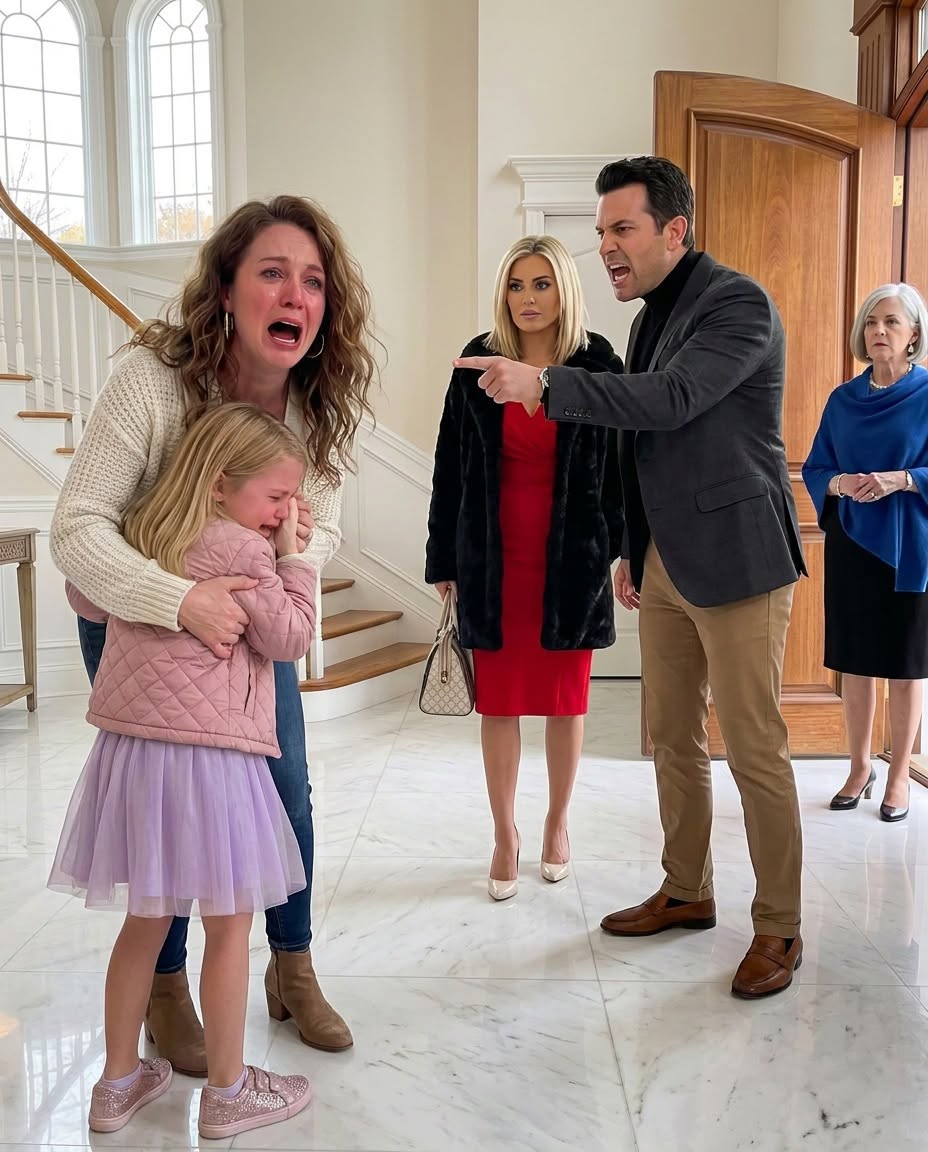
Daniel brought his mistress into our home at exactly 6:17 p.m., while our eight-year-old daughter, Lily, was arranging three plates on the dining table.
The woman stood just behind him in cream-colored heels and a red coat, one hand resting confidently on his arm as though she had rehearsed this entrance into my life.
Daniel showed no sign of shame.
His mother, Margaret Whitmore, was already seated in my living room, the pearls around her neck gleaming beneath the chandelier I had selected after our wedding.
She had opened the door for them.
“Claire,” Daniel said, loosening his tie, “we need to talk like adults.”
Lily stopped moving, a fork still clutched in her hand.
I looked from my husband to the stranger beside him. “Who is she?”
The woman gave me a gentle smile. “I’m Vanessa.”
Margaret released an impatient sigh. “Don’t make this ugly.”
My chest tightened, but I kept my voice controlled. “You brought her here? In front of our daughter?”
Daniel’s expression hardened. “This house belongs to my family. You’ve been comfortable here because I allowed it.”
Lily moved closer to my side.
Vanessa lowered her gaze, but I caught the satisfied curve at the edge of her mouth.
Margaret rose from the sofa. “Pack what you need tonight. Daniel has made his decision.”
I stared at her.
This was the woman who had eaten the Thanksgiving meals I cooked, accepted birthday presents from Lily, and proudly called herself my daughter’s grandmother.
“You’re helping him do this?” I whispered.
Margaret’s eyes turned cold. “Claire, you were never a Whitmore. You were a girl from a poor neighborhood who married up. Be grateful it lasted this long.”
Daniel added, “Vanessa fits my life better.”
Lily’s small voice broke. “Daddy?”
He barely glanced at her. “You’ll understand when you’re older.”
Something inside me shattered.
I went upstairs, filled two bags, and held Lily’s trembling hands while she cried silently. When we returned downstairs, Margaret was standing beside the front door like a security guard.
“Don’t take anything expensive,” she said.
I looked at Daniel one final time. “You’re really doing this?”
He placed an arm around Vanessa. “You and Lily can stay with your mother. That’s where you belong.”
Rain blurred the driveway outside.
Lily climbed into my aging Honda with her stuffed rabbit pressed against her chest. I drove through the storm to my mother’s modest brick home in Arlington, Virginia.
Mom answered the door wearing her robe, her silver hair loosely pinned and her reading glasses resting low on her nose.
The moment she saw Lily crying, her expression changed.
“Mom…” I said, my voice cracking. “They said we were beneath them.”
My mother, Evelyn Carter, slowly removed her glasses.
For several seconds, the entire house became silent.
Then she picked up her car keys and said in an icy voice, “Get in the car. They messed with the wrong mother.”
PART 2
My mother did not drive like a woman in her sixties.
She drove like a prosecutor racing after the truth before it could disappear.
Lily sat in the back seat wrapped in one of Mom’s quilts. I kept turning around to check on her, but she only watched the rain outside, her small face reflected in the window.
“Mom,” I said, gripping the door handle as she entered the interstate. “Where are we going?”
“To your house.”
“It’s not my house anymore. They made that very clear.”
Mom kept her eyes fixed on the road. “No, Claire. They said it clearly. That does not make it legally true.”
I wiped my tears with the sleeve of my sweater. “Daniel said the house belongs to his family.”
Mom gave a cold, humorless laugh. “Daniel says many things. Unfortunately for Daniel, arrogance is not a deed.”
I stared at her.
She continued, “When you married him, I told you to keep copies of everything. You thought I was being dramatic.”
“I remember.”
“And did you?”
I paused. “Yes. In the blue folder.”
“Where?”
“In the storage bench in the garage.”
Mom nodded once. “Good girl.”
The rain struck the windshield even harder.
When we returned to the Whitmore property, Daniel’s black Mercedes remained in the driveway. Margaret’s Cadillac was there too. Vanessa’s white BMW sat beside the front steps like a symbol of victory.
Mom parked directly behind Daniel’s car, trapping it in place.
“Stay here with Lily,” she said.
“Mom, no.”
She turned toward me. “Claire, for eight years you tried to be polite to people who mistook manners for weakness. Tonight, you are going to watch what happens when a woman stops asking permission to exist.”
She climbed out into the rain.
I followed her anyway.
Mom pressed the doorbell once.
Margaret answered with irritation already written across her face. “Evelyn. This is not a good time.”
Mom smiled, though there was no warmth in it. “Move.”
Margaret stared at her. “Excuse me?”
“I said move.”
Daniel appeared behind his mother with his shirtsleeves rolled up. “What the hell is this?”
Mom walked straight past them and entered the foyer.
I had never seen anyone force Margaret Whitmore to step aside before.
Vanessa stood near the staircase holding a glass of wine. Her confidence had noticeably weakened.
Mom faced Daniel. “You threw my daughter and granddaughter out in the rain?”
Daniel folded his arms. “This is a private family matter.”
Mom’s smile disappeared. “You stopped being family the moment you humiliated a child.”
Margaret raised her chin. “Evelyn, Claire came from nothing. Daniel gave her a life.”
Mom slowly turned toward her. “Claire gave him eight years, a daughter, and a reputation clean enough to sit at your charity tables.”
Daniel scoffed. “You don’t know anything.”
“No?” Mom reached into her coat and removed her phone. “Then perhaps your father’s attorney will.”
Daniel’s expression changed immediately.
Margaret’s body stiffened. “Why would you call Richard Whitmore’s attorney?”
Mom glanced at me. “Because Richard Whitmore was smarter than his son.”
My breath caught in my throat.
Mom continued, “Before he died, Richard asked me to review a few documents. He worried Daniel would become exactly the kind of man standing in front of us now.”
Daniel stepped toward her. “You’re lying.”
Mom raised the screen of her phone. “Am I?”
The call connected.
“Mr. Abrams,” Mom said clearly, “this is Evelyn Carter. Yes. I’m at the Whitmore residence. Daniel has attempted to remove Claire and Lily from the property. I need the trust documents and the marital residence clause sent to Claire’s email immediately.”
Daniel’s face drained of color.
Margaret whispered, “Daniel…”
Mom ended the call and looked directly at him.
“The house was placed in a family trust,” she said. “But Richard included a condition. As long as Claire remains Lily’s custodial parent, she and Lily have the right to occupy this residence. Not you. Not your mistress. Them.”
Vanessa quietly put down her wineglass.
Daniel swallowed hard. “That can’t be real.”
My phone vibrated.
An email had arrived from Abrams & Lowe.
Mom turned toward me. “Open it.”
My fingers trembled as I opened the attachment.
There it was in precise legal language, cold and beautiful.
Right of residence granted to Claire Mitchell Whitmore and minor child Lily Anne Whitmore.
Margaret reached out to steady herself against the wall.
Mom faced Daniel again. “Now. Pack your things.”
His mouth opened, but nothing came out.
Mom stepped closer, lowering her voice. “You wanted to teach my daughter where she belonged. Tonight, I will teach you.”
PART 3
Daniel did not begin packing right away.
Men like Daniel Whitmore rarely recognize consequences the first time they encounter them. He remained in the foyer of the house he had treated like his personal throne room, staring at my phone as though the legal language might rearrange itself if he glared hard enough.
Margaret recovered first.
“This is absurd,” she snapped. “Richard would never have done this behind our backs.”
Mom held her gaze without blinking. “Richard did many things behind your backs. Mostly because you and Daniel were too busy spending money to notice who was protecting the family.”
Vanessa reached for the purse resting on the side table. “Daniel, maybe we should go somewhere and talk.”
He spun toward her, panic making his voice sharp. “Don’t start.”
Her expression tightened.
For the first time that evening, I clearly saw what existed between them. Vanessa had not fallen in love with a man. She had fallen in love with access.
And that access was disappearing.
Daniel pointed at me. “You planned this.”
I nearly laughed. “Planned what? Being thrown out in the rain with my child?”
“You and your mother set me up.”
My mother moved between us. “No, Daniel. You set a table for your own humiliation and invited witnesses.”
Lily stood beside the open front door, still wrapped in Mom’s quilt. Her cheeks remained wet, but now she was watching carefully.
Listening.
I suddenly understood that whatever I chose to do next would remain in her memory forever. Not only as the night her father chose another woman, but as the night her mother decided who she would become afterward.
I straightened my shoulders.
“Lily,” I said softly, “go sit in Grandma’s car for a minute.”
Daniel finally looked at her. “Lily, come here.”
She flinched.
The quiet sound of my daughter’s shoes moving backward across the tile felt like a verdict.
Mom’s expression hardened. “Do not use that child to soften the consequences of what you did.”
Daniel turned his anger toward me again. “You can’t keep my daughter from me.”
“I’m not keeping her from you,” I said. “Your choices are doing that.”
The email from Mr. Abrams contained more than one attachment. I opened the second document and scanned it quickly. My eyes passed over phrases I did not immediately understand: misconduct clause, misuse of marital residence, protection of minor beneficiary, emergency petition.
Mom had not returned with me merely to reclaim the house.
She had brought me back to begin the fight properly.
“Mr. Abrams is coming here,” Mom said.
Daniel’s head jerked upward. “Tonight?”
“Yes.”
Margaret’s voice became thin. “There is no need for lawyers.”
“There was no need to throw a child out of her bedroom either,” Mom replied.
Vanessa cleared her throat. “I don’t want to be involved in this.”
Bitterness rose inside me. “You walked into my house wearing perfume strong enough for my daughter to smell from the dining room. You’re involved.”
She closed her mouth.
Twenty minutes later, headlights swept across the rain-covered driveway. A dark sedan stopped beside Vanessa’s BMW, and a tall man wearing a gray overcoat stepped out with a leather briefcase.
Mr. Samuel Abrams looked like the type of attorney who never needed to raise his voice because his paperwork could do it for him.
“Mrs. Carter,” he said, nodding toward my mother. “Claire.”
I had met him only twice, both times while Daniel’s father, Richard, was still alive. Richard had been stern, traditional, and difficult, but he had always shown me a courtesy Margaret had never learned.
Mr. Abrams entered the foyer and pulled a folder from his briefcase.
“Daniel,” he said, “I strongly recommend you listen carefully before speaking.”
Daniel’s face reddened. “I want my own attorney.”
“You should call one. But tonight, the trust terms are active with or without your approval.”
Margaret stepped closer. “Samuel, this is a family misunderstanding.”
“No,” he replied. “This is precisely the situation Richard anticipated.”
The entire room became silent.
Mr. Abrams opened the folder. “Richard Whitmore amended the family trust eighteen months before his death. He did so after reviewing Daniel’s financial behavior, his extramarital conduct, and his lack of practical involvement in Lily’s care.”
Daniel snapped, “That’s private.”
Mr. Abrams glanced briefly at Vanessa before returning his attention to Daniel. “You surrendered privacy when you brought a third party into the protected residence and expelled the protected beneficiaries.”
Those words settled over me like armor.
Protected beneficiaries.
Only hours earlier, I had felt homeless.
Insignificant.
Thrown away.
Now I understood that Daniel had not expelled us from his castle. He had violated the rules of a home legally designed to protect my daughter.
Mr. Abrams continued, “Claire and Lily have immediate residential rights. Daniel, you are required to vacate the premises pending review. You may collect personal clothing, work materials, and medication. Larger assets will be inventoried.”
Daniel released one harsh laugh. “You think I’m leaving my own house?”
Mr. Abrams closed the folder. “I think you should avoid forcing Mrs. Whitmore to call the police and explain why you are refusing to leave a residence where a minor child has legal occupancy protection.”
Margaret caught Daniel by the arm. “Do not make this worse.”
He pulled away from her.
“You did this,” he said to me.
I looked directly into his eyes. “No. I survived it.”
The quiet answer silenced him more effectively than shouting could have.
Vanessa lifted her purse and headed for the door. “Daniel, call me later.”
He stared at her. “You’re leaving?”
She offered him a tense smile. “This is complicated.”
Mom made a quiet sound that was almost laughter. “Amazing how quickly love checks the property records.”
Color rose into Vanessa’s cheeks. Without another word, she hurried outside.
Daniel watched her leave. When the front door shut behind her, part of the fantasy he had created about becoming a free man inside his own home seemed to vanish too.
Margaret lowered herself onto the edge of the staircase. She appeared older now. Not exactly weak, but exposed.
“Claire,” she said suddenly, “you must understand. Daniel has been under pressure.”
I faced her. “Lily was under pressure too. She still knew not to be cruel.”
Margaret looked down.
Mr. Abrams instructed Daniel to gather his belongings. My mother stood in the hallway as he went upstairs, unwilling to leave him alone near my bedroom. I followed several steps behind.
Our room appeared untouched yet unfamiliar, like a theater after the actors had forgotten their lines. My perfume remained on the dresser. Our wedding photograph still hung on the wall. Daniel looked handsome and certain in it. I looked young enough to believe certainty meant safety.
Daniel pulled shirts from the closet and shoved them into a suitcase.
“You won’t manage this house,” he muttered. “You don’t even know the accounts.”
“I handled the bills for six years.”
“Because I let you.”
I studied him carefully. “That sentence is the reason your father changed the trust.”
His hand stopped.
For one moment, his mask slipped, revealing fear.
Not regret.
Not love.
Fear of losing control.
Then he forced the suitcase closed with too much strength.
“You’ll regret humiliating me.”
“No,” I said. “I regret waiting this long to believe what you showed me.”
Downstairs, Lily had returned inside and was sitting beside my mother on the couch. Mom had prepared hot chocolate in my own kitchen, using the mug decorated with a chipped sunflower. Lily held it between both hands.
When Daniel descended carrying his suitcase, she looked up at him.
He stopped.
For one brief second, I thought he might kneel beside her. Apologize. Say something human.
Instead, he said, “Your mother is making this difficult.”
Lily stared at him with the exhausted expression of a child forced to grow older in a single evening.
“No,” she whispered. “You did.”
Daniel’s face hardened because the truth spoken by a child was more difficult to challenge than an adult’s anger.
He left without kissing her goodbye.
Margaret followed after Mr. Abrams informed her that she had no legal authority to stay. At the doorway, she turned back toward me.
“This family will not forget this.”
I replied, “Neither will mine.”
The door shut behind them.
For several seconds, nobody moved.
Then Lily placed her mug down and ran into my arms. I dropped to my knees and held her tightly enough to feel her heartbeat against my chest.
“I’m sorry,” I whispered into her hair. “I’m so sorry.”
She finally cried aloud, painfully and without restraint, as though she had been holding her breath since the moment in the dining room. Mom knelt beside us and wrapped both of us in her arms.
The house felt changed afterward.
Not peaceful.
Not yet.
But it no longer belonged to their cruelty.
By midnight, Mr. Abrams had explained what would happen next. In the morning, he would file for emergency temporary custody protections. The trust would formally notify Daniel. The property and its contents would be inventoried. An independent attorney recommended by Mr. Abrams would help me begin divorce proceedings.
“Do not speak with Daniel alone,” Mr. Abrams told me. “Everything through counsel. Save every message. Record only if your attorney confirms state requirements. Virginia is a one-party consent state, but let your lawyer guide strategy.”
I nodded and wrote down every instruction.
Mom sat beside me at the kitchen island, calm and unmoving.
By the time Mr. Abrams left, the rain had ended.
I took Lily upstairs and helped her change into pajamas. Her bedroom still carried the scent of strawberry shampoo and crayons. The stuffed animals on her bed remained exactly where she had left them before dinner, unaware their owner had briefly been forced out of her own life.
“Mommy,” she asked, “is Daddy coming back?”
I sat beside her on the bed. “Not tonight.”
“Is he still my dad?”
That question hurt more deeply than anything Daniel had said.
“Yes,” I answered carefully. “But being a dad means more than having the name. He has choices to make, and we cannot make them for him.”
She hugged her stuffed rabbit. “Grandma was scary.”
Despite everything, I smiled. “Grandma loves us.”
“She looked like a judge.”
“She used to scare insurance companies for a living.”
The corners of Lily’s mouth lifted slightly. It was the first hint of a smile I had seen from her all evening.
After she fell asleep, I stood in the hallway and allowed my body to tremble.
Mom found me there.
“You did well,” she said.
“I didn’t do anything.”
“You came back.”
I rested against the wall. “I was ready to disappear.”
“I know.”
“How did Richard know?” I asked. “About Daniel?”
Mom folded her arms. “Richard saw more than people thought. Daniel missed Lily’s school recital because he was in Miami with Vanessa. He told everyone it was a work trip. Richard had already received the credit card statement.”
I shut my eyes.
“There were others before Vanessa,” Mom added softly.
My stomach twisted. “You knew?”
“I suspected. Richard knew more. He asked me once whether you would leave Daniel if you had enough protection.”
“What did you say?”
“I said my daughter would leave when staying became more dangerous than starting over.”
I looked toward Lily’s closed bedroom door.
Mom’s voice softened. “Tonight, he made that decision for you.”
The following morning, Daniel began sending messages at 6:03 a.m.
At first, they were furious.
You and your mother are insane.
You embarrassed me.
You have no idea what you’ve started.
Then the tone changed.
Let’s talk.
I was overwhelmed.
Vanessa means nothing.
Don’t destroy Lily’s family over one mistake.
I took screenshots of every message and forwarded them to my attorney, a sharp woman named Rachel Kim, who called before nine that morning.
“Claire,” Rachel said, “do not respond emotionally. Daniel is trying to move the conversation from facts to feelings. We are staying with facts.”
Facts became the language I trusted.
Fact: Daniel brought Vanessa into our home.
Fact: Margaret helped him.
Fact: Lily witnessed the confrontation.
Fact: Daniel ordered us to leave.
Fact: the trust guaranteed our right to remain.
Fact: Daniel’s behavior followed a pattern.
Rachel filed the emergency motion. Mr. Abrams submitted the trust records. Before the week ended, Daniel was ordered to remain elsewhere until the court reviewed the custody and residence disputes. He received supervised visitation at a family services center while awaiting evaluation, not because the court hated him, but because his judgment had failed openly in front of his daughter.
Margaret called me once.
I did not answer.
She left a voicemail.
“Claire, this has gone too far. Daniel is suffering. Lily needs her father. We should resolve this privately.”
I saved the message and sent it to Rachel.
Mom listened to it while sitting at my kitchen table and observed, “Notice how she mentioned Daniel’s suffering before Lily’s.”
I had already noticed.
The divorce did not unfold the way divorces happen in movies. There was no single explosive courtroom scene or sudden confession under oath that resolved everything within minutes.
There were legal filings.
Financial statements.
Custody interviews.
Property valuations.
Coldly written emails.
Nights when Lily woke from nightmares.
Mornings when I cried beneath the shower because I did not want her to hear.
Daniel moved repeatedly between rage and charm. At one mediation meeting, he arrived wearing the navy suit I had once loved and spoke in a gentle voice.
“Claire, we had good years.”
I studied the man sitting across the table and remembered laughing together in grocery store aisles, painting Lily’s nursery, and falling asleep against his shoulder during old films.
Those memories had been real.
That was the cruelest part.
But Vanessa standing beside him in my dining room had been real too.
So had Lily’s flinch.
“We had years,” I said. “Good is no longer the word I would use for all of them.”
His attorney shifted uneasily.
Daniel challenged the trust and lost. Richard had created it too carefully. Daniel could not sell the house. He could not remove Lily from it. He could not force me out and replace me with Vanessa, who disappeared once she discovered that the Whitmore name came with legal restrictions and locked doors.
Pieces of the truth eventually reached Margaret’s social circle, as they always do.
Not through me.
I said nothing publicly.
I did not need to.
People had seen Vanessa. They had heard Margaret defend Daniel. They had watched my mother enter that front door and emerge with the law supporting her.
Six months later, the divorce agreement became final.
I received primary physical custody. Daniel was given structured visitation under conditions that could expand only if he attended parenting counseling and remained consistent. The trust preserved the house to provide Lily with stability, not as a reward for me, but as protection for her.
Daniel hated that distinction.
At the final hearing, he seemed smaller.
Not impoverished.
Not destroyed.
Not helpless.
Simply smaller without everyone around him rearranging the room to suit him.
The judge asked whether we understood the agreement.
“I do,” I said.
Daniel paused before muttering, “Yes.”
After the hearing, he approached me in the courthouse hallway.
Mom stood beside me carrying Lily’s backpack. Rachel Kim remained several feet away.
Daniel looked exhausted. “Was it worth it?”
I remembered the rain.
Vanessa’s red coat.
Margaret telling me I had married above my place.
The fork frozen in Lily’s hand.
Then I remembered my daughter sleeping safely in her own room again. My mother’s steady hand on my shoulder. The first morning I woke without waiting for Daniel’s mood to determine the atmosphere inside the house.
“Yes,” I said. “It was.”
He appeared ready to say more, but nothing remained that could alter the shape of what he had done.
A year later, the house had changed.
Not because I filled it with expensive furniture or tried to erase every trace of him. I made smaller changes. I painted the dining room a warm shade of blue. I replaced the chandelier with a simple brass light that Lily selected. We planted lavender beside the walkway because Mom believed every house needed something capable of returning after winter.
Lily grew loud again.
She sang while we cooked. She invited friends over. She stopped asking permission to use the good plates.
One Sunday afternoon, Mom arrived carrying groceries and found me standing in the dining room, looking at the table.
“What?” she asked.
I smiled. “I just realized I don’t hate this room anymore.”
Mom lowered the bags onto the counter. “Good. Rooms should not get to keep the worst thing that happened in them.”
Lily rushed inside wearing soccer cleats and scattered small pieces of grass across the floor.
“Grandma! Mom! Coach said I might play forward next week!”
Mom reacted as if Lily had announced breaking national news. “Forward? That is a serious promotion.”
Lily grinned widely. “I’m fast.”
“You come from fast women,” Mom said.
I laughed, and this time the sound did not feel borrowed from a previous life.
Later that evening, after Lily went upstairs to shower, Mom and I sat together on the porch. The sun dropped behind the neighborhood rooftops, covering the street in golden light.
“I never thanked you properly,” I said.
Mom glanced at me over her cup of tea. “For what?”
“For that night. For coming back with me. For knowing what to do.”
She remained quiet for several moments.
“When your father died,” she said, “I learned something. People will tell a grieving woman to be graceful because graceful women are easier to rob. I decided then that if life ever came for my child, I would not be graceful. I would be ready.”
Emotion tightened my throat.
“You were terrifying,” I said.
She gave me a faint smile. “Good.”
I rested my head briefly against her shoulder. I was thirty-four, divorced, exhausted, stronger than I had ever wanted to become, and still somebody’s daughter.
From upstairs, Lily shouted, “Mom! Where are my blue pajamas?”
I called back, “In the dryer!”
Mom laughed quietly. “Real life continues.”
“Yes,” I said, looking through the window toward the house Daniel had once tried to turn into a weapon.
Real life continued.
Not flawlessly.
Not without pain.
But honestly.
And the next time someone looked at me and decided I belonged beneath them, I would remember exactly what my mother had shown me.
You do not need to shout in order to rise.
Sometimes you simply return, open the door, and make them read the documents.