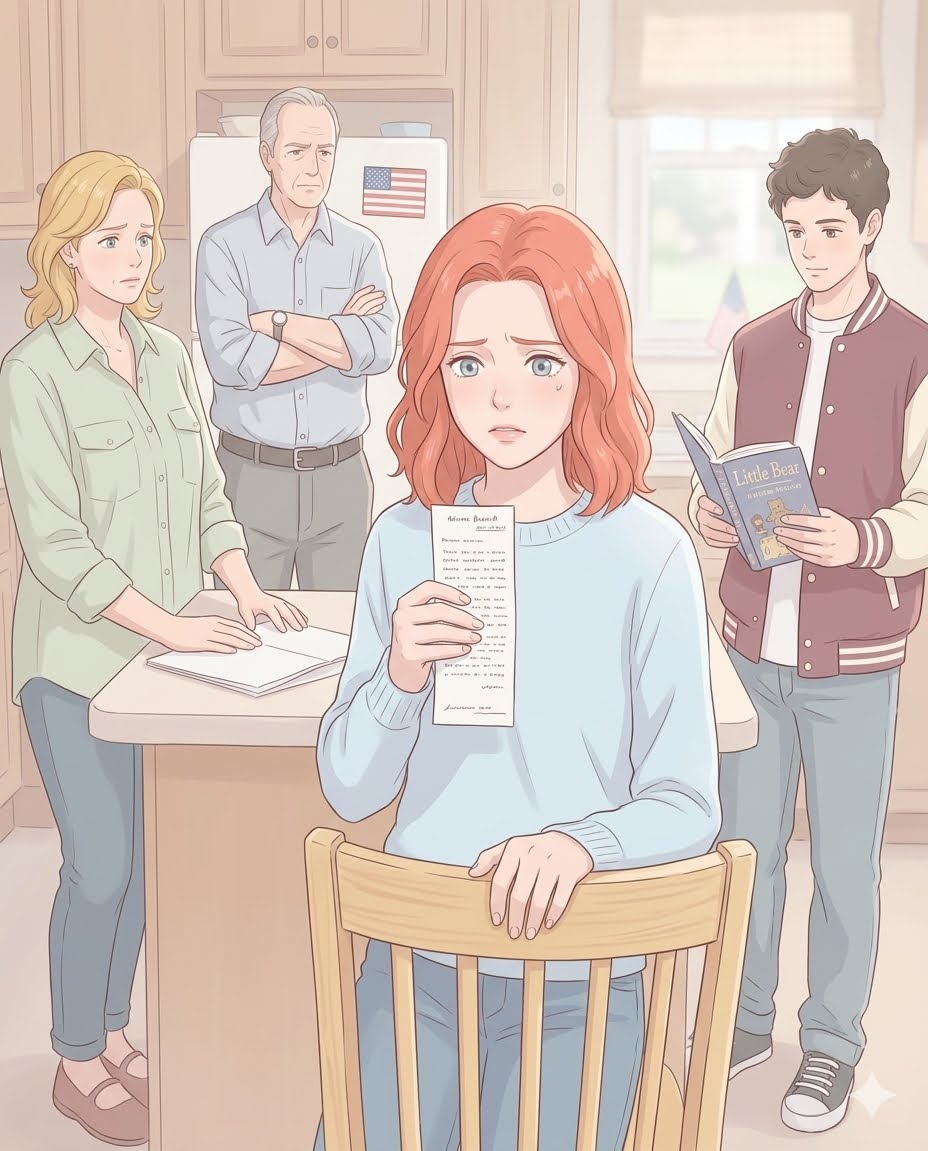
- I was fifteen when I learned that, in my family, a college plan mattered far more than my future.
- I can still picture the kitchen exactly as it appeared that afternoon. Long bands of sunlight slipped through the white blinds, stretching across the polished oak table. A bowl of untouched green apples sat directly in the center, each one buffed to a shine.
- My mother, Melissa Hart, sat opposite me with her hands neatly folded beside a letter from the insurance company. My father, Victor, stood behind her with his arms crossed over his chest, one shoulder blocking out part of the sunny window.
- They looked so remarkably composed, as though we were sitting down to discuss an ordinary adjustment to the family budget.
- They had just ended a phone call with the insurance company. The specialized treatment my doctor recommended would not be fully covered. I understood that the out-of-pocket cost was substantial, and I knew my parents feared expenses they couldn’t predict or control.
- But I also knew they had the money.
- They had spoken proudly about that savings account many times, and every single conversation about it centered on my older brother, Caleb.
- “What happens now?” I asked.
- Mom glanced down at the letter, then looked back up at me. Her face held that unsettling, eerie calm she always wore whenever she decided another person’s emotions were inconvenient.
- “We’re not going to move forward with the treatment,” she said flatly.
- For several seconds, my brain couldn’t process her words. I assumed they wanted a second medical opinion or were looking at a different hospital. Perhaps they were waiting on an updated estimate, preparing an insurance appeal, or expecting a call from another specialist.
- “What do you mean?”
- She let out a quiet, weary breath. “Your father and I have talked about it. We believe that if this is meant to work out, a way will present itself.”
- I turned my head toward Dad.
- He had always been the quieter parent—not because he disagreed with Mom, but because remaining silent allowed him to avoid taking direct responsibility for decisions he fully supported.
- At last, he uncrossed one arm and rested his hand against the back of her chair.
- “We can’t spend everything on this, Elena,” he said. “Caleb starts university next year. Tuition, housing, books, transportation—it’s all planned out. We made commitments.”
- Behind me, the refrigerator hummed quietly. From upstairs, the bass from Caleb’s music drifted faintly through the ceiling.
- “You have the money,” I said, my voice barely above a whisper.
- “It is not that simple,” Mom replied.
- “It sounds simple.”
- Dad’s jaw tightened. “We cannot throw away your brother’s future.”
- That single sentence fundamentally altered the air in the room.
- I stared at him, waiting for him to realize what he had just said, waiting for the regret to show on his face. He didn’t correct himself. Mom didn’t even flinch.
- The insurance letter remained perfectly aligned with the table’s edge, as though its precise placement could somehow make their decision appear reasonable.
- “My treatment is throwing away his future?”
- “That is not what your father meant,” Mom said smoothly.
- “It is exactly what he meant.”
- “Elena, do not turn this into an accusation.”
- I looked from one parent to the other. Neither seemed confused. Neither acted as though they needed more information. Their expressions were entirely composed, almost rehearsed.
- “You’re choosing his education over me.”
- Mom looked genuinely offended. “Do not say it like that.”
- “How else should I say it?”
- “This is not a choice between two children. We are simply making the most responsible decision we can with limited resources.”
- I pointed toward the insurance letter. “That treatment is what the doctor said I need to survive.”
- “And doctors always recommend the most aggressive options,” she shot back. “They have to. That does not mean every family can destroy its entire financial standing following every single recommendation.”
- My fingers turned icy cold where they gripped the edge of the table.
- Upstairs, when Caleb’s music grew louder, Dad glanced nervously toward the staircase. “Your brother has worked hard for this opportunity.”
- “So have I.”
- Neither of them answered.
- Caleb had always occupied the exact center of our family’s universe. He was two years older—intelligent, confident, and completely comfortable taking up space. When he struggled with a school subject, my parents immediately hired a private tutor. When I earned top grades, they treated it as the bare minimum.
- When he wanted a new laptop, they spent a week comparing models. When mine would only charge if the cord was held at a precise angle, Dad told me to be thankful it turned on at all.
- I had noticed every single disparity. I simply never believed their favoritism could go this far.
- Before that afternoon, the bias had manifested through a thousand smaller wounds: brand-new shoes for Caleb and repaired soles for me; a lavish birthday party for him and a brief text message for me; private driving lessons for him and endless promises of “later” for me.
- I had survived those moments by shrinking myself down. I worked harder, asked for less, and convinced myself that if a genuine emergency ever occurred, the divide between us would evaporate.
- Instead, the emergency made that divide impossible to deny.
- Mom slipped the insurance letter into a manila folder. “We are not going to discuss this all evening. You’re upset, and that’s understandable. You need time to calm down.”
- I pushed my chair backward. The wooden legs scraped loudly across the floorboards.
- “Elena,” she warned, her voice dropping.
- I stood up and looked directly at Dad. “Are you really doing this?”
- For a fleeting second, he met my gaze. Then his attention shifted down toward the folder in Mom’s hands.
- “We are doing what we think is best for the family.”
- The family.
- That was the exact moment I understood my parents could use that word without including me in it.
- I turned and walked upstairs.
- Caleb’s bedroom door was shut, a thin strip of blue LED light shining from beneath it. I passed the framed photographs lining the hallway wall: Caleb holding a science-fair trophy, Caleb in his baseball uniform, Caleb smiling proudly between our parents at his middle-school graduation.
- I appeared in only two older photographs tucked near the very bottom of the staircase—both taken before I learned how easily I could be erased.
- I entered my bedroom and closed the door. I didn’t slam it. I didn’t scream. I refused to give them anything they could later categorize as a dramatic teenage outburst.
- Then I sat on the edge of my bed and waited.
- No one followed me.
- For the next hour, I sat in the dark and listened as the house continued to function normally without me. Cabinets opened and closed downstairs. Water ran in the kitchen sink. The television came on in the living room, followed by my father’s familiar cough and the artificial burst of a sitcom laugh track.
- And then my mother began cooking dinner.
- That detail never left me. She had just informed her sick daughter that her life-saving treatment was canceled, and then she immediately went to prepare a meal—as though the most exhausting task of her day was finally behind her.
- Here is a complete, polished rewrite that sharpens the dramatic tension, deepens the emotional weight, and elevates the narrative prose while meticulously preserving every single character, detail, and core plot point:
- The light in my room slowly shifted from gold to gray.
- I remained seated on the edge of the bed with my shoes still on, my hands resting numbly in my lap. I had expected sheer panic to consume me. Instead, something much colder arrived first.
- Absolute clarity.
- If I wanted to survive, I could not depend on my parents changing their minds.
- I flipped open the old laptop on my desk. Its hinge was loose, and the screen flickered twice before finally lighting up. I began typing every desperate question I could think of:
- Can a minor consent to medical care without a parent?
- What legally counts as medical neglect?
- Can a relative request emergency guardianship?
- How long does the emancipation process take?
- Would foster care cover necessary specialized treatment?
- The answers were legalistic and overwhelming—filled with complex statutes, mandatory waiting periods, formal court hearings, endless paperwork, and stern warnings that the rules varied drastically from state to state. Every single path required time, an adult willing to fight for me, or both.
- I found the phone number for a youth emergency shelter and jotted it down on the back of an old homework assignment. The shelter was nearly two hours away and had a strictly limited number of beds. A legal-aid website explained that emancipation usually required proof of steady employment and independent housing. I had neither. Emergency court intervention might be possible, but someone would need to formally report my parents and help gather the documentation.
- For several horrifying minutes, I researched whether children placed in state custody were guaranteed necessary medical care.
- I wasn’t planning anything reckless. I was simply trying to figure out how far I would have to go to place my health in the hands of someone—anyone—other than my parents.
- The fact that I was asking those questions terrified me. Remaining in that house terrified me more.
- At dinner, no one called for me.
- The mouth-watering scent of roasted chicken drifted up through the floorboards. I heard Caleb come downstairs, heard his chair drag across the dining room floor, and heard him ask if there was any more bread. Their voices blended seamlessly into the cozy, familiar rhythm of an ordinary family meal.
- I sat alone in my dark bedroom with the medical folder open beside me. Near the bottom of the treatment estimate, I located the specialist’s direct phone number. I saved it to my contacts, then took clear photos of every single page on my phone in case my parents tried to destroy the paper originals.
- That was the first choice I had ever made entirely for myself.
- The second choice was leaving.
- The decision didn’t come with panic or high drama. It took shape quietly, one practical step at a time.
- I pulled an old, faded backpack from the back of my closet and packed two shirts, a pair of jeans, underwear, socks, my phone charger, a toothbrush, my school ID card, and every single medical document. I threw in a thick sweatshirt because the autumn nights were turning cold.
- At the very back of the closet sat a glass jar where I kept birthday money and cash I had earned helping classmates edit their essays. I tipped it over onto the carpet.
- Seventy-three dollars.
- I counted the folded bills twice, tucked them securely into the backpack’s inner pocket, and waited.
- The house finally settled into complete silence shortly after midnight. The pipes clicked inside the walls. The floorboards creaked as Dad crossed the hallway after using the bathroom. Mom murmured something behind their closed bedroom door, followed by still silence. Eventually, Caleb’s music stopped.
- I lifted the backpack and slid the straps over my shoulders.
- My room suddenly felt smaller than it had that morning. Library books were stacked neatly beside the bed. A chipped ceramic cup filled with pens sat on the desk beneath a second-place ribbon from a school writing contest.
- When I had brought that ribbon home, Mom had merely said, “That’s nice, sweetie,” before asking me to set the dinner table. For years, I had believed that if I could just accomplish something truly grand, they would finally look at me the way they looked at Caleb.
- Now I understood that the size of my achievements had never been the problem.
- I opened my bedroom door. The hallway was pitch-black except for the tiny night-light glowing near the stairs. Family photographs seemed to watch me in silence as I passed.
- At the front door, I froze with my hand resting on the lock.
- I considered leaving a note. I imagined writing, You chose him. I imagined telling them where I was going, even though I didn’t know yet. I imagined begging them one last time to reconsider.
- Then I remembered the cold, calm certainty on my mother’s face and the exact way my father had said, “We cannot throw away your brother’s future.”
- A note would only give them another opportunity to explain me away.
- I unlocked the deadbolt, stepped out onto the porch, and pulled the door shut as quietly as I could.
- The suburban street was completely empty. Sprinklers clicked rhythmically across a lawn two houses down. A small flag hanging from a neighbor’s porch rustled softly in the night breeze. In the far distance, tires hissed along the main road.
- At first, I walked as fast as I could, terrified that a porch light would suddenly flick on behind me. None did.
- After five blocks, my legs began trembling uncontrollably. I hadn’t eaten since lunch, and the backpack felt heavier with every step. Near a twenty-four-hour grocery store, I found a cold metal bench beneath a streetlamp. The store’s bright red sign cast a weak glow across the edge of the asphalt. Employees pushed long lines of shopping carts toward the entrance while a delivery truck idled by the loading dock.
- No one asked why a fifteen-year-old girl was sitting alone outside past midnight.
- I pulled my sweatshirt tighter and watched the automatic doors slide open and closed. For the first time, I allowed myself to think clearly about what my parents had actually done.
- They hadn’t misunderstood the diagnosis. They had spoken at length with the insurance company, carefully reviewed the estimate, calculated their savings, and reached a deliberate, calculated decision. Their calmness hadn’t come from confusion—it had come from absolute certainty.
- They believed Caleb’s future was worth protecting. Mine could be left to chance.
- I remembered Mom reading to me when I was little. I could still picture us curled up together under a yellow blanket as her finger guided mine along each line of text. Those memories felt as though they belonged to another child entirely.
- By the time Caleb reached middle school, virtually all the energy in our household had shifted toward him—his grades, his sports, his goals, his college applications. Dad spent hours teaching Caleb how to drive in the high school parking lot while I stayed home doing the dishes. Mom spent entire weekends helping him refine his science fair projects. When I asked her to read a short story I had written, she promised she would look at it later.
- The pages sat untouched on the kitchen counter for three weeks before I quietly threw them in the trash.
- Even so, I had always believed there was a line they would never cross. Sitting beneath that buzzing streetlamp with seventy-three dollars and a backpack, I finally understood that no such line existed.
- There was only the exact amount of sacrifice they believed I was worth.
- I stayed on that bench until the sky began to lighten.
- The blackness above the grocery store roof softened into a pale gray, followed by a thin strip of gold breaking beyond the shopping center. Commuters began crossing the parking lot with paper coffee cups, gym bags, and tired expressions. A woman walked a golden retriever past my bench without looking up. Two workmen in heavy boots loaded bottled water into a pickup truck.
- Every single one of them could see me. None of them noticed me.
- It should have surprised me, but it didn’t. I had spent fifteen years learning how to disappear while standing right in front of people.
- I knew how to keep my voice low enough not to interrupt. I knew how to take the smaller portion without complaining. I knew how to stop asking after the first refusal.
- My parents were not loud, violent, or openly abusive people. They didn’t need to be. Their neglect came neatly wrapped in organization, politeness, and explanations that sounded entirely reasonable—until you compared everything Caleb received with what was left for me.
- When Caleb caught the flu, the entire household halted for him. Mom checked his temperature every hour; Dad drove across town to buy his favorite soup. When I got sick, someone left a box of tea on the kitchen counter with instructions to rest.
- When Caleb won a middle school science fair, my parents threw a backyard party with balloons and invited the neighbors. When I took second place in a statewide writing competition, Mom glanced at the certificate and said, “That’s nice. Can you help me set the table for dinner?”
- Those disparities were so constant they became part of the background noise of my life. Caleb got name-brand sneakers every school semester; I wore the same pair until the heel split and rain soaked my socks. He received a brand-new laptop for his thirteenth birthday; I inherited an old hand-me-down that roared like an engine and shut off without warning. He got paid professional driving lessons; I was told we would “work something out later.”
- Later never came.
- In seventh grade, I brought home a straight-A report card to Dad while he was sitting in the den. I expected him to be proud. He glanced at the paper and handed it back, saying flatly, “That is what we expect from you. Caleb has to work much harder, so his progress means more.”
- After that day, I stopped showing him my grades.
- Even birthdays laid bare where I stood. Caleb’s birthday meant fancy restaurant reservations, expensive gifts, and a customized cake. On my fifteenth birthday, Mom forgot until late in the afternoon, sending a brief text from her office: Sorry, super busy day. Happy birthday. I bought myself a single cupcake from the school cafeteria and ate it alone at the bus stop.
- Yet none of those moments had been enough to make me run away. I rationalized every single one of them: Caleb needs extra support. My parents are stressed. Money is tight. I’m independent. They trust me. I became remarkably skilled at transforming neglect into proof of my own maturity.
- The conversation at the kitchen table shattered that illusion forever.
- This wasn’t a forgotten birthday or worn-out shoes. My life was on the line, and the adults responsible for protecting me had decided my brother’s college tuition was more important.
- I pulled out my phone and briefly considered calling my school counselor. Ms. Grant had told our class that her door was always open, and I knew she was a kind person. But I also knew she was a mandatory reporter. One call could initiate a flurry of social worker interviews, police visits, and temporary shelter placements—with a very real risk of being sent back home while the adults “investigated.” I couldn’t chance being placed back at that kitchen table.
- I scrolled through my contact list until I landed on Ruth.
- Aunt Ruth was my mother’s older sister. She lived about forty minutes away in an aging apartment building on the west side of town. We rarely visited her because my parents always manufactured excuses to avoid her. They called her “difficult.” They claimed she judged everyone, spent too much money feeding stray neighborhood animals, ordered too much takeout, and lived in a shoebox. Dad frequently pointed out that she only worked part-time tutoring struggling students, while Mom cited Ruth’s unmarried life as ultimate proof that she had never built anything stable.
- But Ruth was the only adult who had ever looked me in the eye when she spoke to me.
- At family gatherings, she never asked me a question and then turned toward Caleb before I could answer. She remembered the titles of books I mentioned in passing. Once, after I mentioned I wanted to be a writer, she mailed me a secondhand collection of short stories. Inside the front cover, she had written: Your voice belongs on the page. I kept that book hidden in my desk drawer because Mom always rolled her eyes whenever Ruth encouraged me.
- My clearest memory of Ruth was from when I was ten. Mom had put a call on speakerphone while folding laundry. She and Ruth were arguing about something trivial.
- “We are doing just fine,” Mom had snapped. “You don’t need to lecture us on parenting.”
- “I’m not lecturing,” Ruth’s voice had resonated clearly over the speaker. “I’m asking why Elena looks like she hasn’t been hugged in weeks.”
- Mom had instantly taken the phone off speaker, but standing in the hallway holding a stack of towels, something inside me had loosened. Ruth had noticed what I had never been able to put into words.
- Now, her name glowed on my phone screen.
- My thumb hovered over the call button. I didn’t know what I expected her to do. Maybe she would let me sleep on her couch for a night. Maybe she could help me navigate social services or find a legal aid clinic. I didn’t expect her to pay for my medical treatment—my parents had hammered it into my head that Ruth could barely support herself.
- But I trusted her. And right now, trust was worth more than money.
- I pressed call.
- The phone rang once. Twice.
- “Hello?” Ruth answered, her voice raspy with sleep.
- I opened my mouth, but no sound came out. For the first time since walking out of my house, hot tears burned behind my eyes.
- “Ruth,” I choked out. “It’s Elena.”
- She didn’t ask why I was calling before sunrise. She didn’t sound annoyed or demand an explanation.
- “Where are you, sweetie?”
- I looked up at the red grocery store sign and read her the address.
- “Are you alone?”
- “Yes.”
- A brief pause followed. On her end, I heard fast movement, a drawer opening, and keys jingling.
- “Stay right there,” she said firmly. “I’m on my way.”
- Ten minutes later, a faded red sedan pulled into the parking lot too fast, cutting across two empty rows before stopping at an angle right by the curb. Clear packing tape covered one of the rear windows, and the front passenger window was cracked open a few inches.
- Ruth scrambled out before the engine had even fully idled down. She was forty-eight, her auburn hair twisted into a messy knot, wearing a oversized gray cardigan over pajama pants. Her eyes scanned me instantly from head to toe, checking for injuries, making sure I was really standing there.
- I tried to step forward, but my legs had gone completely numb.
- Ruth hurried around the hood of the car and threw her arms wide open. I stepped straight into them.
- Neither of us said a word for a long time. She held me tight, one hand pressing firmly against the back of my head. I hadn’t realized how desperately I needed to be held until my face hit the soft, warm fabric of her cardigan.
- She didn’t demand answers in that cold parking lot. She simply squeezed my shoulder and said, “Let’s get you warm.”
- The drive to her apartment took under forty minutes, but it felt entirely suspended outside of normal time. She pointed the car heaters directly at me and kept both hands glued to the steering wheel. The car smelled faintly of peppermint gum and paper shopping bags stacked in the back seat.
- I stared out the window as the polished suburban cul-de-sacs gave way to older brick buildings, small corner bodegas, and narrow streets lined with mature maple trees. Ruth didn’t fill the silence with pressing questions. She seemed to understand that I needed to feel safe before I could speak.
- Her apartment occupied the second floor of a three-story brick building with chipped white trim and a front door that stuck in damp weather. The wooden stairs creaked beneath our feet.
- Inside, the space was compact but instantly warm. Books filled two tall floor-to-ceiling shelves and spilled over into neat stacks along the walls. A yellow floor lamp cast a cozy glow beside a worn green sofa. The whole place smelled of cinnamon, laundry detergent, and fresh coffee. A gray cat lifted its head from an armchair, gave me a lazy look, and went back to sleep.
- “I can sleep on the floor,” I offered quietly. “Just for tonight.”
- Ruth took the heavy backpack off my shoulders and set it gently beside the couch. “You’re taking the bed.”
- “I really don’t want to put you out—”
- “You are not putting me out, Elena.”
- There was zero room for argument in her tone. She handed me a pair of soft flannel pajama pants, a clean T-shirt, and a tall glass of water, then spread a thick hand-sewn quilt across the mattress in her single bedroom.
- “I’ll be right outside on the couch,” she said softly. “You don’t have to explain anything tonight.”
- The quilt smelled like lavender fabric softener. I crawled beneath it, feeling the built-up tension in my muscles slowly give way. My dark, silent phone lay on the nightstand.
- My parents hadn’t called once.
- For the first time since my diagnosis, I slept through the entire night without waking up in terror.
- The next morning, the soft sound of eggs cracking in the kitchen pulled me awake.
- Sunlight filtered through thin curtains, illuminating the neat stacks of books lining the bedroom walls. Ruth stood at the stove in jeans and a navy sweater, spooning scrambled eggs onto two plates. At home, breakfast had always been a rushed granola bar eaten by the front door while Mom warned me not to drop crumbs.
- Ruth placed a hot plate in front of me without asking if I was hungry. I didn’t realize just how starving I was until I took the first bite.
- She waited patiently until I was halfway through my plate.
- “Are you ready to tell me what happened?” she asked gently.
- My fork paused. I hadn’t prepared a formal explanation. The absolute truth still sounded insane even inside my own head.
- I set the fork down and started from the beginning: the specialist appointment, the call from the insurance company, the brutal conversation at the kitchen table, the untouchable college savings account, and the exact words my parents had used.
- “They said they couldn’t afford both,” I whispered. “Dad said they couldn’t throw away Caleb’s future for a gamble.”
- Ruth’s expression remained perfectly composed, but I saw her fingers tighten around her coffee mug until her knuckles turned white. Her shoulders went completely rigid.
- I told her about my desperate internet searches that night—the youth shelter, emancipation, emergency guardianship, and my overwhelming fear that an official social services investigation would just force me back home before I could get medical care. Then I pulled out my phone and showed her the photos of the medical documents.
- When I finished, the apartment fell dead silent, save for the steady ticking of the kitchen clock.
- Ruth set her mug down on the table with a soft clink.
- “You are not going back there,” she said. It wasn’t a question; it was an absolute decree.
- I looked around the tiny apartment—the single bedroom, the galley kitchen, the couch where she had slept.
- “But there’s barely any room,” I stammered, tears welling up. “And the treatment cost is astronomical—”
- She held up a single hand to stop me. “Do not spend one second worrying about what I do or do not have. You worry about staying alive. We will handle the rest.”
- Something inside me completely shattered at the absolute certainty in her voice. She didn’t say she would try to help. She didn’t suggest talking to my parents first. She didn’t ask if I might have misunderstood them.
- She believed me instantly and completely.
- That very afternoon, Ruth went to work.
- She called my specialist’s office, two specialized medical clinics, a hospital financial aid counselor, a legal-aid clinic, and a family-law attorney recommended by one of her tutoring clients. Every time she spoke to someone, her voice was crystal clear:
- “She is fifteen years old. Her parents have formally refused to authorize or fund her recommended care. She is living with me. Tell me exactly what legal and medical documents we need.”
- When one clinic quoted an out-of-pocket figure large enough to make my stomach drop, Ruth didn’t even flinch. She wrote the number down on a yellow legal pad, thanked the receptionist, and immediately asked about long-term payment plans. She created neat, organized columns: Treatment, Medication, Transportation, Legal Fees, Living Expenses.
- Then, she pulled a heavy metal file box from her bedroom closet. Inside were property deeds, tax returns, retirement portfolio statements, and savings bonds.
- My parents had spent my entire life painting Ruth as a financial failure who could barely scrape by. The documents spread across the kitchen table told a drastically different story.
- She wasn’t rich, but she was extraordinarily disciplined. While she rented her small apartment to keep her living expenses low, she also fully owned a modest residential condominium across town that she had purchased decades earlier and rented to a retired schoolteacher. It was completely paid off.
- Ruth sat at the kitchen table with a calculator, taking notes and making financial transfers.
- “Ruth, you don’t have to do this,” I begged, staring at the numbers.
- She kept writing. “This is not up for debate.”
- “It’s not your responsibility!”
- That made her stop and look up. “You are my family, Elena.”
- “My parents are your family, too.”
- “No,” she said, her voice dropping to a low, fierce whisper. “They are functional adults who made a monstrous decision. You are a child who needs help to survive. Those are not equal obligations.”
- I stared down at the piles of paper covering the table. “If you spend all of this on me, you could lose your security.”
- Ruth closed the calculator with a quiet snap. “Things can be replaced, Elena. You cannot.”
- By the end of that week, Ruth had put the condominium on the market. She never gave a grand speech about her sacrifice, nor did she ever make me feel indebted to her. She never mentioned what that property represented or how many years of hard work it had taken to pay it off. She simply stated that a cash sale would allow my treatment to begin weeks earlier.
- The condo sold rapidly to an investor offering cash. Ruth combined the proceeds with her savings, set up an extended payment arrangement for the remaining medical balance, and executed formal emergency guardianship paperwork with the help of her attorney.
- My parents responded to the formal legal notice with a brief, detached email. They didn’t contest Ruth taking temporary custody. They didn’t request a visitation schedule. They wrote that “perhaps some time apart will allow everyone to reflect and think more clearly.”
- Ruth read the email once, printed a physical copy, and placed it neatly inside the metal file box.
- Then, she grabbed her keys and drove me to my very first treatment appointment.
- The medical treatment didn’t feel heroic or cinematic. There were no sudden miracles or clear lines marking the shift from illness to recovery.
- Instead, there were freezing early-morning drives under overcast gray skies, plastic hospital ID bands snapped onto my wrist, endless hours sitting under buzzing fluorescent lights, and days when every food I tried to eat tasted like metal. There were grueling evenings when my legs shook uncontrollably just walking across the living room, and mornings when getting out of bed felt as monumental as running a marathon.
- Through it all, Ruth never treated my pain or terror as an inconvenience.
- She kept a large dry-erase calendar on the refrigerator with every single medical appointment written in dark blue ink. Before every trip to the clinic, she packed a canvas bag with crackers, bottled water, extra wool socks, and a paperback book.
- When I was too exhausted or depressed to speak, she sat beside my hospital bed in comfortable silence. When I wanted to vent, she listened without interrupting, never trying to force my terrifying reality into a cheesy, fake-positive narrative.
- She just stayed right there beside me, making sure I never had to face a single second of it alone.
- Here is a complete, polished rewrite that sharpens the dramatic payoff, heightens the narrative voice, and deepens the emotional weight while meticulously preserving every single character, detail, and core plot point:
- Part 3: The Reckoning
- At night, she handled bills at the kitchen table after she believed I was fast asleep. More than once, I caught her pressing a hand to her forehead over a calculator while envelopes covered the table. By morning, those papers would be stacked neatly away, and breakfast would be ready.
- I had nothing I could offer her then. So I made a private promise: If I recover, Ruth will never again worry about rent, medical expenses, or whether her car will start.
- I had no idea how I would fulfill that promise. I only knew that I had to.
- Weeks passed. Then months. My strength returned in small, quiet stages. First, I could stand long enough to wash the dishes. Then I could walk around the block without needing to sit down. I began keeping food down and sleeping through most nights. The first time I carried a heavy bag of groceries up the apartment stairs, Ruth pretended not to watch me—but I saw the soft smile on her face when she turned toward the door.
- Recovery gave me time to think. The anger I expected did not arrive as a sudden flame; instead, something far colder and more deliberate formed inside me.
- My parents had reduced my life to a financial calculation. They had assumed their choice would remain hidden within the family, protected by silence and by the polished public image they presented to the world.
- Victor and Melissa Hart worked as high-end education consultants. Their company helped wealthy families prepare children for selective universities, and their website overflowed with language about integrity, compassion, potential, and always putting students first. They gave presentations at prestigious private schools, hosted admissions workshops, and built their entire success around the appearance of being principled parents devoted to young people.
- That image was their greatest professional asset. And there was one person whose opinion mattered to them more than anyone else’s.
- Dr. Malcolm Avery had previously served as an Ivy League dean before becoming director of the National Private Admissions Consortium. My parents spoke about him with the kind of reverence other families reserved for royalty. His endorsement badge sat prominently at the top of their company website; his name gave them direct access to school partnerships and elite clients.
- When I was eleven, he came to our house for dinner. Mom purchased expensive wine that no one was permitted to touch before he arrived. Dad spent hours practicing casual ways to mention the firm’s success statistics. I was forced into an uncomfortable dress and explicitly instructed not to speak unless addressed first. Caleb demonstrated a science project. My parents laughed too loudly at Dr. Avery’s jokes and inserted company metrics into every pause in the conversation.
- After he left that night, Dad stood in the kitchen with both palms pressed against the counter. “If we have Avery’s trust, we are set,” he had declared. “That is all it takes.”
- They had spent years protecting that relationship.
- Once I was strong enough to sit at Ruth’s small desk for more than an hour, I opened my laptop and composed an email.
- I did not write emotionally. I wrote facts.
- I introduced myself as Elena Hart, daughter of Victor and Melissa Hart, and reminded Dr. Avery that we had once met over dinner. I explained that at fifteen, I had received a serious medical diagnosis and that my parents possessed the money to begin my treatment. I told him they chose to preserve that money for my brother’s university education instead.
- I explained that I had left home, that my aunt had taken legal responsibility for me, and that she had sold her own property and drained her personal savings so I could receive medical care.
- Then I explained why I believed he should know.
- My parents were running a business based on the promise that they protected children’s futures. I believed he deserved to understand how they behaved when protecting a child demanded personal sacrifice inside their own household.
- I attached evidence: the medical treatment estimate, the insurance decision, and the formal email in which my parents declined to challenge Ruth’s temporary guardianship. I included a text Mom had sent Caleb after I left, telling him not to worry because I would “come back when she is tired of acting out”—a text Caleb had forwarded to me weeks later with a brief note: I’m sorry. I didn’t know. I also included a screenshot of a message Dad had sent Mom: We cannot throw it all away on a gamble.
- At the bottom of the email, I wrote one final sentence:
- I thought you should know what kind of people are representing your values.
- My finger hovered over the send button for a long time. I was not worried about being discovered; I was deciding whether I wanted to become the person who exposed them.
- Ruth had never encouraged revenge. She cared only about helping me heal. Part of me feared that sending the email would rebind my future to my parents. But then I looked over at the metal file box beside the desk—inside were the sale documents for Ruth’s condominium, the legal guardianship papers, and every medical receipt from my treatment. She had surrendered years of personal security because my parents refused to touch a college fund.
- Remaining silent would protect no one except them.
- I pressed send.
- The message disappeared from the screen. I closed the laptop, went into the kitchen, and poured myself a glass of water. My hands remained steady.
- I did not tell Ruth that day. It was not because I thought she would object—I simply needed the choice to belong entirely to me. She had already carried every burden she could reach; this one was mine.
- Dr. Avery did not reply. For several weeks, nothing appeared to change.
- Then I checked my parents’ business website.
- The National Private Admissions Consortium endorsement badge was gone. The space where it had been displayed now contained an ordinary stock photograph of a college campus. I checked the consortium’s official directory: Hart Educational Strategies was no longer listed.
- There was no public press release, no dramatic accusation—only a swift, precise removal.
- At first, the consequences unfolded quietly. A private academy removed my parents from a scheduled speaking panel. Several glowing testimonials vanished from their site. A long-term client canceled a workshop and requested a full refund. Parent groups began whispering, asking why the consortium no longer recognized the firm.
- My parents attempted to rebrand. They swapped out photographs, rewrote their mission statement, and offered heavy discounts.
- Nothing worked. Their entire business relied on trust, and trust can evaporate without a sound.
- Phone calls slowed to a trickle. Emails went unanswered. Schools declined to renew contracts. Families that had once waited months for consultations began hiring rival firms. Within six months, my parents closed their commercial office and tried operating out of their house.
- Not long after, they lost the house, too.
- I discovered the foreclosure on a local community message board. Someone was asking for affordable real estate agents because a couple who ran an educational consulting firm had defaulted on their mortgage. The listed address was my childhood home.
- Victor and Melissa moved into a modest rental property across town. From the scattered updates that eventually reached me, they remained together more out of economic necessity than affection. Their business was gone, their savings were depleted, and their former professional contacts no longer returned their calls.
- I did not contact them. I did not celebrate online or publish the evidence publicly. I had shared the truth with the one man whose endorsement sustained their reputation; what he chose to do with that information was his decision.
- My responsibility was to build a life of my own.
- By the time I turned nineteen, the tutoring work I had started during my recovery had grown into a full-time company.
- At first, I helped students with English essays and scholarship applications right from Ruth’s kitchen table. I understood young people who didn’t come from polished families, who didn’t have costly advisors or personal histories that fit neatly into an admissions brochure. I knew how to help them find words for the things they had survived in silence.
- Parents began recommending me. A school counselor invited me to run a writing workshop. The waiting list grew until I rented a small office above a neighborhood bookstore and hired two part-time tutors.
- Ruth became my very first full-time employee. She managed scheduling, invoices, and the hundreds of client emails I could no longer handle alone. She was sharper and more capable than anyone else I could have hired, remembering every student’s deadlines and every parent’s concerns.
- I paid her a high salary—though she argued fiercely with me for an entire afternoon before agreeing to accept it.
- “You gave up everything for me,” I told her.
- “I did what family does.”
- “Then let me do what family does, too.”
- On her birthday, I drove her to a small house near a quiet lake. It had pale siding, a sunlit kitchen, and a room with built-in bookshelves overlooking the water. Ruth admired the porch and asked why the real estate agent had left the front door unlocked.
- I pressed the brass key into her palm.
- For once in her life, she was completely speechless. She stared at the key, looked up at me, and burst into tears. I cried, too. We stood in the empty living room holding each other while afternoon light moved slowly across the hardwood floors.
- A month later, I sent her on a trip to Greece. She had kept a postcard of Santorini above her tutoring desk for years, though she had never believed she would actually see it. From the island, she sent a picture of herself smiling by the sea, a glass of wine in her hand. Her caption thanked me for giving her a life she had never permitted herself to dream of.
- That post eventually reached my parents.
- I never learned who showed it to them—perhaps an old client or a former neighbor. Within days, messages began arriving:
- We are so happy you are doing well.
- We would love to reconnect.
- Families make mistakes. Please give us a chance to explain.
- I did not respond. The emails turned into text messages, followed by missed calls from unknown numbers. I changed my number and instructed my staff never to forward communications from them.
- For a long time, silence returned.
- Then, when I was twenty-one, I gave a keynote speech at a regional conference for student mentors at a hotel ballroom outside Columbus, Ohio. For forty minutes, I spoke about honest narrative writing and the importance of allowing young people to speak truthfully about imperfect homes.
- Afterward, I packed up my notes, thanked the organizers, and walked through the hotel lobby toward the parking lot.
- My parents were waiting outside.
- At first, I barely recognized them. Dad looked diminished inside a suit that hung loosely on his frame, the leather of his shoes cracked at the toes. Gray streaked through Mom’s hair—something she once would have covered immediately—and her makeup was uneven. She clutched her purse tightly against her stomach with both hands.
- “Elena,” she breathed.
- I stopped several feet away.
- “Please,” she pleaded. “Just one minute.”
- Dad took a step toward me, then checked himself. “We know we made mistakes,” he said, his voice raspy.
- The hotel doors slid open behind me, releasing a brief burst of lobby noise. A small flag near the entrance rustled softly in the breeze. I waited for the doors to slide shut again.
- “You made a decision,” I said softly.
- Mom’s expression hardened with desperation. “We were terrified.”
- “So was I.”
- “We didn’t realize how serious it all was!”
- “You had the specialist’s report sitting right on the kitchen table.”
- Dad looked away toward the parking lot. “We were under immense financial pressure. Caleb’s future had been planned for years. We genuinely thought there would be another solution.”
- “You decided someone else could figure it out.”
- Mom took a careful step closer. “We saw Ruth’s post online. We had no idea how far you’d come, or how successful you’ve become. You’ve become so generous…”
- I looked closely at her face. “Generous—like paying for someone’s medical treatment when they need it to survive?”
- She flinched as if struck.
- Dad let out a sharp, impatient breath. “Elena, this isn’t helping.”
- “You ambushed me outside my conference.”
- “We have lost everything,” he said, his voice dropping. “The firm, the house, our savings. We are barely keeping our heads above water.”
- Tears welled in Mom’s eyes. “We’re not asking for much. We just need a little help getting back on our feet.”
- For a fleeting second, the six years separating that kitchen table from this hotel driveway dissolved. I saw the insurance letter under my mother’s hand. I heard my father say Caleb’s future couldn’t be thrown away.
- “Does Caleb know you came here?” I asked quiet.
- Neither of them answered.
- “He doesn’t speak to you anymore, does he?”
- Mom lowered her head.
- Caleb had reached out to me while I was still in treatment. He apologized without making excuses for them, swearing he had no idea they were funding his education with my health savings. He deferred university for a year, worked full-time, and eventually put himself through school using scholarships and student loans. Once he understood the full scope of what they had done, he cut ties with them completely.
- Dad lowered his voice further. “This is between us and you, Elena.”
- “No,” I replied. “It was never just between us. Your choice cost Ruth everything she had. It cost Caleb his trust in you. It cost every client who ever believed your speeches about protecting children.”
- Mom pressed her trembling lips together. “We were wrong,” she whispered.
- I believed she regretted what their choice had ultimately cost them. I doubted she had ever regretted the choice itself before the consequences arrived.
- Dad took another step forward. “We are your parents.”
- Ruth’s words echoed in my mind: Things can be replaced. You cannot.
- “You told me you couldn’t afford to keep me alive,” I said, my voice entirely steady. “I cannot afford to rebuild the life your choice destroyed.”
- Mom’s lower lip quivered. Dad turned his gaze to the pavement.
- I didn’t raise my voice. I didn’t list every forgotten birthday, every hand-me-down, or every unequal gift. I didn’t describe the nights Ruth spent crying over a calculator, or remind them of the home she had sold to save my life.
- They already knew.
- I turned on my heel and walked to my car.
- They did not follow me.
- That evening, Ruth and I sat together in the sunlit kitchen of her house by the lake. She poured tea into two chipped mugs she had brought from her old apartment. The windows were propped open, letting the warm summer breeze drift through the screens.
- “How was the conference?” she asked gently.
- “It went well,” I smiled. “The students asked incredible questions.”
- She studied my face for a moment, sensing the weight of something left unsaid, but she didn’t press. She had always known how to leave space for the truth without demanding it.
- She opened a travel magazine on the table and tapped a page. “Somewhere warm next,” she mused. “With a hammock.”
- We clinked our chipped mugs together.
- I thought about the fifteen-year-old girl sitting alone on a cold grocery-store bench with seventy-three dollars in a backpack, convinced that she was entirely alone in the world. She had believed that merely surviving would be the end of her story.
- It was only the beginning.
- I did so much more than survive what my parents decided. I built a life that their choices could never touch.
My parents sat me down at the kitchen table and told me they would not pay for the medical care I needed because the money had already been reserved for my brother’s education.