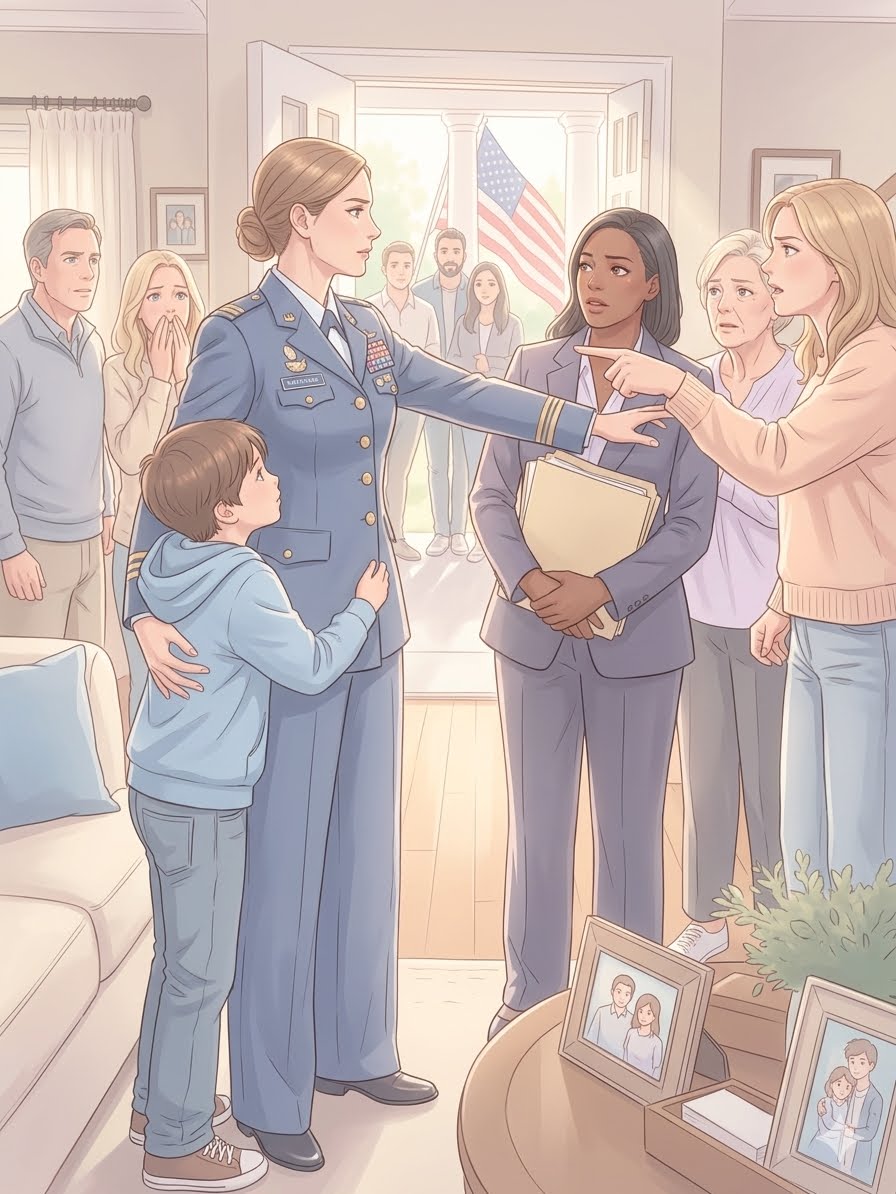
The knock came at precisely 4:47 on a humid Tuesday afternoon. I remember the exact time because I was kneeling in the front entryway, helping my five-year-old son, Eli, fasten the stubborn Velcro strap on his red sneaker. His soccer ball waited by the door, and July sunlight stretched across the hardwood floor. Two sharp, heavy knocks rattled the frame. Then, a woman called out through the door. “Ma’am, I’m with Child Protective Services. I need to speak with you about your son.” Eli’s little fingers froze against his shoe. He looked up at me with the bright blue eyes he had inherited from his father. “Are we still going to the park?” The innocent question nearly broke me. I stood up, smoothed my navy slacks, took a slow breath, and opened the door. A woman in her early forties stood on the porch, wearing a gray blazer despite the Virginia heat. Damp curls clung to her temples. She held a thick manila folder under her arm and showed me her official ID. “My name is Dana Reyes. I’m an investigator with the Department of Social Services.” I carefully checked the agency seal and her photograph. “What can I do for you, Ms. Reyes?” “We received a report alleging neglect, physical mistreatment, and unsafe supervision involving a minor child at this address.” The words hit like freezing water. My heart accelerated, but my face stayed completely still. Eleven years as a Navy attorney had taught me how to remain calm while witnesses lied, commanders shouted, and futures balanced on a single sentence. “May I ask who made the report?” “I’m not permitted to disclose that yet.” She glanced past my shoulder. Eli had moved closer, clutching the hem of my blouse with one hand and a plastic dinosaur with the other. I didn’t need the name. Just two days earlier, my older sister, Monica, had stood in my kitchen and sneered, “A woman who spends her life pretending to be one of the boys has no business raising a little boy alone.” I had asked her to leave immediately.
Before walking out, she looked down at Eli’s backpack and added, “He needs a real home, Rachel. Not a barracks with cartoons on the walls.” Now an investigator stood on my porch. I stepped aside. “You may come in.” Dana seemed to expect anger or panic. Instead, I crouched beside Eli. “This lady needs to ask us some questions,” I told him softly. “We’ll answer honestly, and we’ll go to the park another day.” “Did I do something bad?” “No. You did absolutely nothing wrong.” Inside, the house smelled of lemon cleaner and peanut butter crackers. Toy trucks lined the coffee table neatly. Clean laundry sat on the couch because I had planned to fold it after the park. Dana began taking notes. The report claimed Eli was often left alone, the home was poorly maintained, and he had unexplained bruises. I answered each point calmly. Eli was never left alone. He attended kindergarten and a licensed after-school program. My neighbor watched him only on Thursday afternoons while I coached a legal clinic on base. My current Navy assignment was a shore billet with regular hours.
Dana asked my position.
“Commander Rachel Bennett, United States Navy Judge Advocate General’s Corps,” I said. “I handle military justice cases at Naval Station Norfolk.”
Her pen paused. Not because rank excused anything, but because she recalculated.
“Your profession doesn’t exempt you from investigation.”
“Of course not. I expect you to follow every required procedure.”
And I meant it. I would not bully a caseworker. I knew good systems failed when frightened people obstructed them.
But I also knew something Monica did not.
Every allegation created a record. Every photograph had metadata. Every witness statement could be tested. Every lie eventually showed a seam.
Dana opened her folder. “The reporting party claims to have photographic evidence.”
My stomach tightened into a knot. “What kind?”
“Images of injuries on your son.”
Across the room, Eli roared as two dinosaurs crashed together on the rug.
I thought of his scraped elbow from the playground, the bruise on his shin from falling off his bike, and the faded mark near his shoulder from bumping into the dining table while chasing our dog.
Ordinary childhood marks.
But photos could be cropped. Dates could be removed. Context could be manufactured.
Someone had not accused me in anger. Someone had been collecting evidence.
And only one person had been close enough to do it without making me suspicious.
Part 2: Building the Defense
Dana inspected every room with methodical care.
She checked the refrigerator, pantry, smoke detectors, medicine cabinet, water temperature, locks, and the fenced backyard where Eli’s blue slide leaned beneath the maple tree. She photographed the stocked shelves, clean bedrooms, and emergency contact sheet on the fridge.
I cooperated fully.
The hardest part was when she asked to speak with Eli privately. They sat at the dining table while I waited in the living room, close enough to see them but not hear every word.
Dana showed Eli a page of illustrated faces and asked which one looked like how he felt at home. He pointed to a smiling one.
She asked if anyone frightened him. He shook his head.
She asked if I hit him.
“My mommy doesn’t hit,” he said proudly. “She uses the serious voice.”
Dana’s mouth twitched.
When asked what happened when he got in trouble, he said, “I sit on the quiet chair. And I lose cartoons.”
When she asked what I did at night, he said, “She reads two books unless it’s late. Then one long book counts as two.”
I pretended to cough into my hand to cover a sudden breath.
When she asked about the bruise on his shin, Eli explained the bicycle crash with dramatic detail, including the color of the neighbor’s recycling bin and the squirrel that had watched him fall.
By the time Dana left, the sunlight had turned gold.
“I found no immediate safety concern,” she said. “But the case remains open while I review the photographs and interview collateral contacts.”
Then she added, “The reporting party also indicated a willingness to seek custody.”
There it was. Not concern. Intent.
After she left, I leaned against the door and felt my knees weaken. Eli wrapped both arms around my waist.
“Is the park closed?”
I laughed shakily. “No, buddy. We just missed it today.”
“We can make pancakes.”
“It’s dinner time.”
“Dinner pancakes.”
That night, after Eli fell asleep, I called my former commanding officer, retired Captain Lucas Hale. I told him everything.
He listened without interrupting. When I finished, he said, “Do you believe your sister filed the report?”
“Yes.”
“Belief isn’t evidence. Build the evidence.”
He told me to create a chronology, preserve messages, gather medical records, school attendance, childcare receipts, work schedules, security footage, and witness affidavits.
“Do not confront Monica,” he warned. “Do not give her advance notice.”
“She’s my sister.”
“Tonight, she’s the complaining witness.”
That sentence hurt.
I opened a document on my laptop and typed: Eli Bennett — Child Welfare and Custody Defense Chronology.
For four hours, I gathered everything. Pediatric records showed regular checkups and healthy development. His teacher described him as cheerful and prepared. The after-school program showed digital pickup times, usually between 5:18 and 5:34 p.m. My command calendar showed no overnight duty in fourteen months.
I downloaded photos from my phone showing the bike fall, scraped elbow, and dining-room bump. Each had original dates and context embedded.
Then, at 1:12 a.m., I found something else.
Our family photo-sharing account had been accessed from an unfamiliar device nine times in six weeks. The account contained private pictures of Eli—including the exact injuries Dana had mentioned.
The login location was three blocks from Monica’s apartment.
The first unauthorized login had happened the same night Monica asked me to lend her money.
Part 3: The Pattern of Envy
Three years earlier, I had stood beneath a white canopy at Quantico while a folded flag was placed into my hands.
My husband, Aaron, had been a Marine helicopter pilot. He died in a training accident off the North Carolina coast when Eli was two.
I remembered the funeral in heavy fragments: the distant ceremonial rifles, wet grass, Eli’s warm cheek against my uniform, the weight of the flag in my palms.
One memory remained crystal clear.
Monica stood behind me with our mother, Evelyn. She thought I could not hear her whisper to Mom.
“Maybe now Rachel will understand what it feels like when life doesn’t give you everything.”
I did not turn around. At the time, I blamed grief.
But Monica had always measured herself against me. She was older, charming, social, and forgiven easily. I was the quiet child who studied at the kitchen table. Our parents praised my grades and excused her mistakes. By adulthood, every family dinner repeated the same pattern: Rachel got the scholarship, Rachel entered the Naval Academy, Rachel became a lawyer, Rachel married an officer.
No one mentioned the deployments, missed holidays, sheer exhaustion, or the short phone calls that held my marriage together. Monica saw only the polished surface.
After Aaron died, I moved into a shore assignment and rebuilt my entire life around Eli.
Monica started appearing more often. At first, I welcomed it. She brought groceries, helped assemble furniture, and watched Eli during important meetings. I gave her a spare key.
Then she began arriving unannounced. She criticized his cereal, rearranged his closet, and once threw away his artwork because his room looked cluttered.
“He needs consistency,” she told me.
“I’m home every night.”
“Physically.”
The next morning, I asked for my spare key back.
Part 4: The Three Folders
By Monday morning, I was ready.
Monica had filed an emergency motion for temporary custody, piggybacking on the CPS report she had secretly initiated. She genuinely believed her theatrical narrative—and the surprise CPS investigation—would catch me off guard, forcing me into a defensive panic before a judge.
Instead, Dana Reyes, Captain Lucas Hale, and I walked into the family court building together.
Monica sat at the petitioner’s table with her attorney, wearing a soft pastel dress meant to project maternal warmth. When she saw me walk in, wearing my pristine Service Dress Blue uniform and holding a leather briefcase, a smug, knowing smirk touched the corners of her lips. She thought she had backed me into a corner.
The judge called the emergency hearing to order. Monica’s attorney painted a dramatic picture of a grief-stricken, cold Navy commander whose demanding service led to neglect and unexplained physical injuries on her child.
When it was my turn, I didn’t raise my voice. I didn’t cry. I didn’t engage in emotional mudslinging.
I quietly opened my briefcase, walked to the front, and handed Dana Reyes, the judge, and Monica’s attorney each three meticulously organized, color-coded folders.
“Your Honor,” I said evenly, “I present the defense exhibits.”
-
Folder One: The Unimpeachable Alibi. Certified pediatric records proving Eli was in the 99th percentile for health and development, complete school and childcare digital sign-out logs proving he was never unsupervised, and 14 months of verified Navy duty rosters showing zero overnight absences.
-
Folder Two: The Forensic Metadata. High-resolution digital photographs of every scrape and bruise Eli had sustained, complete with immutable EXIF time stamps, location data, and matching medical notes detailing his ordinary childhood tumbles.
-
Folder Three: The Malicious Intent. Certified IP access logs from my private family photo drive, showing nine unauthorized breaches from Monica’s personal laptop—the same IP address where she had downloaded the exact photos she altered and submitted to CPS. Bound right behind it was a transcript of text messages showing her demanding $15,000 from Aaron’s estate just days before the first illegal login.
The courtroom fell into an absolute, suffocating silence as the judge flipped through the pages.
Dana Reyes stood up and addressed the bench. “Your Honor, Child Protective Services has fully reviewed this evidence. We have closed the investigation as unfounded, unsubstantiated, and a clear case of malicious, fraudulent reporting.”
Monica’s smirk didn’t just fade—her entire face went deathly pale.
The judge’s expression turned to ice as he looked over his glasses directly at my sister.
“Mrs. Vance,” the judge said, his voice echoing off the courtroom walls like thunder. “You have weaponized a state protective agency meant to shield abused children, committed computer trespass, and attempted to perpetrate a fraud upon this court—all to carry out a personal financial vendetta against a military widow.”
The judge dismissed Monica’s emergency petition with prejudice.
He immediately issued a permanent restraining order forbidding Monica from coming within 1,000 feet of Eli, his school, or my house. Before striking his gavel, he formally referred the digital evidence and false statements to the Commonwealth’s Attorney for criminal prosecution.
Outside the courtroom, Monica rushed after me, her voice breaking into hysterical sobs.
“Rachel! Rachel, wait! Please! I’m your sister! You can’t let them file criminal charges against me! I was desperate!”
I stopped at the glass doors, turned, and looked at her with the cool, unshakeable composure I had forged through eleven years in the United States Navy.
“You didn’t care about my son, Monica,” I said quietly. “You cared about your own envy. I am done letting you use our blood as a shield for your cruelty.”
I turned my back on her and walked out into the sunlight.
Epilogue: The Park
An hour later, the Virginia afternoon was warm, clear, and quiet.
Eli ran across the grass at the local park, kicking his red soccer ball toward the net while I sat on a wooden bench nearby, watching his every move under the July sky.
He scored a goal, raised his small hands in the air, and let out a loud cheer before sprinting back toward me.
“Did you see that goal, Mommy?” he shouted, catching his breath.
“I saw the whole thing, buddy,” I smiled, wiping a bead of sweat from his forehead. “It was perfect.”
He sat beside me on the bench, swinging his sneakers, entirely untouched by the storm that had almost torn our world apart. He was safe, he was loved, and no one was ever going to take him away.
I leaned back, taking a deep, clean breath of fresh air. I had spent eleven years serving the law—but the greatest victory of my life was the peace I had just secured right here at home.
Here is a complete, polished rewrite that sharpens the dramatic tension, heightens the emotional weight, and elevates the narrative prose while meticulously preserving every single character, detail, and core plot point:
Part 4: Evidence Against the Lie
Two weeks before Child Protective Services arrived, Monica attended our mother’s seventieth birthday dinner. I missed it because Eli was running a fever.
Three days later, my cousin Paige called me secretly. She said Monica had spent the entire evening telling relatives that Eli was covered in suspicious bruises, that I constantly left him with total strangers, and that I was on the verge of a psychological breakdown due to my military career and the grief of losing Aaron.
“Did Mom defend you or correct her?” I asked softly.
“No,” Paige murmured. Then she added, “Rachel… Monica said she already called CPS.”
The very next morning, the court clerk called to serve me notice: Monica had filed an emergency petition requesting temporary custody of my son. Her filing alleged physical abuse, chronic neglect, and severe emotional instability tied to my Navy career and widowhood.
The emergency hearing was set for Friday.
Three days.
When the copy of the petition arrived, it contained cropped, out-of-context photos of ordinary playground bruises, sworn affidavits from my mother and two aunts, and one line from my mother that made the room spin around me:
“I have long feared Rachel’s rigid military personality prevents her from providing the warmth a young child requires.”
I read that sentence three times, feeling the stinging weight of betrayal.
Then I reached Monica’s proposed placement argument. She claimed to possess a stable marriage, flexible working hours, and a safe, peaceful home.
Yet, eighteen months earlier, Monica had called me sobbing hysterically about money that had vanished from a joint account she shared with her husband. She had begged me not to tell Mom.
I searched my archived text messages and found her exact words from back then:
Please don’t tell Mom what happened with the accounts. She already thinks I ruin everything.
I had protected her back then out of family loyalty. Now, I wondered what kind of toxic behavior I had truly shielded her from.
Part 5: Gathering the Counter-Proof
I spent Thursday preparing as if Eli’s life depended on it—because it did.
Our dining room transformed into a tactical command center. Medical histories, school attendance logs, after-care pickup receipts, Navy work schedules, inspection photos, and witness statements were indexed meticulously by date.
Captain Lucas Hale arrived at noon, carrying coffee and a thick yellow legal pad. He surveyed the mountain of documentation.
“Good start,” he said quiet.
“A start?”
“You have facts showing you’re fit, Rachel. Now you need facts showing why the petitioner is lying.”
I showed him the digital log showing the unauthorized logins to my cloud drive. He instructed me to file an official cyber-intrusion report, preserve all metadata, and formally request local network access records through legal channels.
Then his eyes fell on Monica’s old text message begging me to cover for her financial disaster.
We searched public court dockets and hit pay dirt: Monica had quietly filed her second bankruptcy petition. Even worse, she had filed a petition for legal separation from her husband two months before calling CPS—despite boasting to our family that her marriage was stronger than ever.
The court docket also referenced a temporary protective order involving a domestic incident at Monica’s house. A minor had been present.
Monica had a twelve-year-old son, Owen, from her first marriage. I realized with a sudden pang of guilt that I hadn’t seen my nephew in nearly a year. Every time I had invited him over, Monica had made excuses, claiming he was traveling or at sports camp.
A heavy shame rose in my chest. I had accepted her excuses because my own schedule was so demanding.
I hired a sharp civilian family-law attorney, Mara Sloan, who reviewed the evidence that afternoon.
“Her petition is legally weak,” Mara admitted. “But emergency custody hearings are notoriously unpredictable. Judges sometimes slap temporary restrictions on parents just to be safe while CPS investigates.”
The mere thought of Eli sleeping under Monica’s roof made my stomach clench into a knot.
Mara’s primary concern was the coordinated family testimony. Multiple relatives presenting the same narrative could sound persuasive to a judge—until we proved it was a rehearsed collusion.
That was when I found an archived text message my aunt had accidentally sent to me instead of Monica weeks prior:
Tell me exactly what to write so we all say the same thing.
Mara leaned closer, a razor-sharp smile touching her lips. “Now that helps.”
At 5:40 p.m., the doorbell rang.
My mother stood on the porch holding a glass casserole dish. “I thought Eli might need dinner.”
“You gave Monica a sworn statement supporting her petition to take my son,” I said coldly.
She looked down at her shoes. “I only said I was worried about you, Rachel.”
“You wrote that I am incapable of warmth.”
“Monica told me her attorney would rewrite my thoughts professionally!” Mom insisted.
“Did you even read the final document before signing your name under penalty of perjury?”
Silence fell between us.
I stepped out onto the porch and closed the front door behind me. “You cannot see Eli while this legal case is open.”
Her head snapped up. “Rachel! I am his grandmother!”
“You are a hostile witness attempting to strip him from his home.”
“I’m trying to help both of my daughters!” she cried.
“No,” I replied. “You are sacrificing one daughter’s child to protect the other daughter’s fragile feelings.”
Her face hardened into an ugly mask. “You’ve always thought you were so much better than us.”
I almost laughed—the accusation was so painfully familiar. “I don’t think I’m better than you, Mom. I think my son deserves adults who won’t use him as leverage.”
She set the casserole dish on the porch bench and walked away. As her car reversed down the driveway, I noticed Monica’s sedan idling at the end of the street. She was watching my house.
When Monica realized I had spotted her, she raised her smartphone to her window and took a picture.
Part 6: The Manufactured Witness
The next morning, Dana Reyes returned to my house accompanied by a pediatric medical consultant.
The photos Monica submitted contained no original date or file information. I provided Dana with certified pediatric and school records for every single mark on Eli’s body. The bicycle bruise matched a pediatric doctor’s note. The elbow scrape matched a school accident form. The faded back mark matched a text I had sent Monica months earlier after Eli bumped into the dining table while playing.
The pediatric consultant examined Eli thorough and found zero evidence of physical abuse or neglect.
Then, I handed Dana the documented login records proving my private cloud account had been illegally accessed, along with my formal police report.
“You believe your sister breached these records?” Dana asked.
“I believe the network access records should be thoroughly investigated before anyone jumps to conclusions,” I replied evenly.
By 10:00 a.m., Dana issued a preliminary finding confirming Eli could safely remain in my custody. It didn’t fully close the case, but it neutralized the immediate threat of removal.
At the courthouse, Mara informed me that Monica’s attorney had requested a last-minute continuance, claiming a new key witness had come forward.
The witness was Tessa Reed—a former babysitter I had fired months ago because she was repeatedly late. Tessa provided a sworn affidavit claiming I had once returned home after midnight without warning, abandoning Eli with her for six extra hours while I was out partying.
The date listed on her statement instantly exposed the lie.
On that exact evening, a severe water main break had shut down every road near base. I had texted Tessa repeatedly, paid her a substantial bonus, and returned home at 9:14 p.m.
My front door security camera had captured my arrival. My mobile phone records showed five calls and six text updates. Her electronic payment receipt proved she received a delay bonus.
We immediately subpoenaed the bank records for Tessa’s payment app. Two days later, her bank produced a transaction log showing a direct $1,500 transfer from Monica on the exact morning Tessa signed her affidavit. The memo line read: Childcare debt.
Monica had prepared a story for the money. But she hadn’t prepared for our second piece of evidence.
My home security archive revealed that someone had used a copied key to enter my house while Eli and I were at soccer practice on May twelfth. The entryway camera caught Monica walking toward my home office. She remained inside for thirty-seven minutes.
When she walked out, she appeared empty-handed. But my old digital tablet—the one persistently logged into the family photo account—had vanished from my desk that very day.
Part 7: The Full Hearing
By the time the full custody hearing commenced, my legal defense required two heavy rolling litigation cases.
Judge Eleanor Shaw entered the courtroom at nine sharp. Silver-haired, sharp-eyed, and thoroughly unsentimental, she took her place on the bench.
Monica sat at the petitioner’s table alongside her counsel, Simone Price. My mother and Aunt Lorraine sat directly behind them in the gallery. Tessa Reed waited nervously near the witness stand.
Judge Shaw reviewed the updated CPS file first. “The Department of Social Services has found no safety threat and zero physical evidence supporting claims of abuse,” the judge noted coldly. “Ms. Mercer, your emergency petition relies heavily on photos and witness affidavits. We will address them immediately.”
Simone Price stood and presented the cropped photos of Eli’s bruises. Stripped of context—without the bicycles, playgrounds, laughter, or timelines—ordinary childhood bumps looked sinister.
Next, Price called Tessa Reed to the stand. Tessa testified under oath that I had abandoned my son until after midnight and appeared emotionally cold.
On cross-examination, Mara stepped up and projected the electronic bank receipt, phone logs, text records, and security camera footage onto the courtroom monitor. The video clearly showed me entering my home at 9:14 p.m.
Then Mara confronted Tessa with the $1,500 transfer from Monica.
Tessa looked frantically toward Monica, her voice trembling. “It… it was money she owed me!”
“For what childcare services, Ms. Reed?” Mara asked smoothly. “Please name a single date.”
Tessa choked on her words, unable to produce a single answer.
Next, my mother took the stand. Simone Price attempted to frame my military discipline and private nature as emotional detachment. But when Mara cross-examined her, the entire narrative crumbled:
“Mrs. Bennett, have you ever seen Rachel strike Eli?”
“No,” my mother admitted softly.
“Have you ever seen him left unsupervised?”
“No.”
“Have you ever found her home to be unsafe?”
“No.”
“Have you ever attended his medical appointments, parent-teacher conferences, or soccer practices?”
“No.”
“So your sworn statement regarding Rachel’s ‘lack of warmth’ was based primarily on what Monica told you to say?”
My mother’s lips parted, her eyes filling with tears. “Yes…”
After lunch, Monica took the stand. She produced carefully timed tears, playing the part of a concerned aunt. “Rachel is never fully present,” Monica sobbed softly. “Eli deserves a guardian whose primary identity is being a mother.”
Mara walked up to the exhibit board and placed Monica’s cropped bruise photo directly beside the unedited original photo—which showed Eli beaming proudly next to his shiny red bicycle.
“Why did you crop the bicycle out of this image, Mrs. Vance?” Mara asked.
“I… I didn’t crop it!” Monica stuttered.
“Did you access Rachel’s private cloud account without authorization?”
“No!”
“Did you enter her home without permission using an unauthorized key on May twelfth to steal a tablet?”
“No!” Monica shouted, gripping the edge of the witness stand.
Mara didn’t waste breath arguing. She simply hit play on the courtroom monitor.
High-definition video filled the screen: Monica using a key, entering my home while I was at soccer practice, and walking out of my office. Right beside the video, Mara displayed the certified cyber-forensic report linking the photo downloads directly to Monica’s IP address, followed by her bank records proving the $1,500 bribe to Tessa.
A suffocating, heavy silence descended upon the courtroom.
Monica’s face went deathly pale. The tears vanished instantly, replaced by sheer, unadulterated terror.
Judge Shaw removed her glasses, her eyes burning with quiet fury as she looked down at my sister.
“Mrs. Vance,” Judge Shaw said, her voice cutting through the room like a razor. “You have committed perjury, suborned false testimony, executed illegal computer trespass, and weaponized state agencies to execute a malicious, fraudulent attack on an honorable military officer and her child.”
Judge Shaw dismissed the petition with prejudice.
She immediately issued a permanent protective order barring Monica, my mother, and my aunts from coming near Eli, his school, or my residence. Furthermore, Judge Shaw formally remanded the evidence to the District Attorney’s office for criminal prosecution regarding felony perjury, evidence tampering, and filing false child abuse reports.
As officers stepped forward to escort Monica out of the courtroom, my mother buried her face in her hands, weeping bitterly. Monica looked at me, her mouth moving soundlessly, begging for help that was never going to come.
I picked up my briefcase, stood tall in my Service Dress Blue uniform, and walked out of the courtroom with my head held high.
Epilogue: The Life We Built
An hour later, the afternoon sun was bright and clear over the park.
Eli was sprinting across the green grass, kicking his red soccer ball toward the goal. Retired Captain Lucas Hale sat on the bench beside me, sipping coffee while we watched my son play under the open sky.
Eli scored a goal, threw his small hands in the air, and let out a loud cheer before running back to us, his face flushed with happiness.
“Did you see that shot, Mommy?!” he yelled, out of breath.
“I saw every second of it, sweetie,” I smiled, kneeling down to wipe a bead of sweat from his forehead. “It was a perfect goal.”
He wrapped his arms around my neck, giving me a tight hug before running back out onto the field.
I stood up, taking a deep, clean breath of fresh summer air.
My sister had spent months trying to prove that my military service made me an unfit parent. But she had forgotten the most important rule of the uniform: when you attack a mother who knows how to fight, she doesn’t panic—she executes a flawless plan.
Eli was safe. The truth was on the record. And the life we built was entirely our own.
Here is a complete, polished rewrite of the finale that sharpens the dramatic tension, heightens the emotional weight, and elevates the narrative prose while meticulously preserving every single character, detail, and core plot point:
Part 7: The Petition Falls Apart
Mara played the front entryway security recording on the courtroom monitor.
Monica appeared clearly on screen, using a copied key to unlock my door and stepping uninvited into my empty house.
A heavy murmur rippled through the gallery. Monica gripped the edges of the witness stand, her knuckles turning white.
“I… I still had a key!” she stammered defensively. “I was just checking on the house!”
Then, Mara asked the devastating question we had kept in reserve:
“Ms. Mercer, have you ever been the subject of an official child welfare investigation involving your own son?”
Simone Price immediately leapt up to object, citing statutory confidentiality.
Mara turned to the bench and requested an immediate in-camera review, arguing the record directly went to witness credibility, true motive, and Monica’s baseline claim that her household offered a safer placement.
Judge Shaw slowly removed her glasses.
Monica went completely, terrifyingly still.
“Counsel, approach,” the judge commanded.
In her private chambers, Judge Shaw thoroughly reviewed the sealed, confidential file while the rest of us waited in suffocating silence in the courtroom.
When she finally returned to the bench, her expression had hardened into steel.
She stated for the record that the confidential report concerned Monica’s twelve-year-old son, Owen. Eight months prior, a school counselor had raised grave alarms regarding repeated overnight abandonments by the parent, severe lack of supervision, household instability, and a dangerous domestic incident involving an adult guest.
The prior investigation had not been closed because the allegations were disproven. It had been closed without a definitive finding only because Monica’s family had suddenly changed residences and cut off communication with social services.
That history alone did not decide the outcome of this case, Judge Shaw stated firmly. However, Monica had presented herself to the court as a pristine, stable placement option while actively concealing an unresolved child welfare history within her own home.
Then, Judge Shaw addressed the rest of the case:
-
Eli’s minor injuries were ordinary, documented childhood accidents fully supported by pediatric, school, and photographic records.
-
Monica had deliberately cropped and altered photos to strip them of their innocent context.
-
Tessa Reed had provided false, manufactured testimony after receiving an unexplained $1,500 financial payout.
-
Monica had unlawfully entered my private residence, harvested evidence, and blatantly denied it under oath.
The judge folded her hands over the file.
“The emergency custody petition is hereby denied and dismissed with prejudice,” Judge Shaw declared. “Eli Bennett will remain in the sole, uninterrupted custody of his mother.”
I closed my eyes. Relief didn’t rush in with a dramatic wave; the air simply returned to my lungs.
Judge Shaw was far from finished.
She formally forwarded the entire transcript to the Commonwealth’s Attorney to review for perjury, illegal computer trespass, and witness tampering. Furthermore, CPS was officially directed to reopen and reassess Owen’s living conditions immediately.
Monica let out a small, strangled sound—not of grief, but of pure terror.
Outside the courtroom, my mother caught up to me in the hallway. “Rachel, wait… please. Monica didn’t do this all by herself.”
The hallway suddenly felt narrow and airless.
Mom confessed that she was the one who had submitted her statement, convinced Aunt Lorraine to sign one as well, and told Tessa that Monica needed help.
“Why would you ever help someone try to steal my son?” I asked, my voice barely above a whisper.
Mom wiped tears from her eyes. “Monica was falling apart, Rachel! Her marriage was ending. She was drowning in debt. People were starting to ask questions about Owen! She told me that if everyone just focused on you, they would stop treating her like a total failure!”
I stared at her in utter disbelief. “You used Eli as a sacrifice to distract from her life?”
“I thought he’d just stay with Monica for a few weeks!” Mom cried. “I thought… I thought it would teach you to make more room for your family!”
“You thought losing my child would teach me a lesson?!”
“I didn’t think it would go this far!”
“You signed a sworn statement under penalty of perjury!”
Monica stumbled toward us, her face pale. “Rachel, please! If they reopen Owen’s CPS file, I could lose him completely!”
“You tried to make me lose Eli,” I said coldly.
“I was desperate!”
“No, Monica. You were deliberate.”
“I’m your sister!”
“You stopped being my sister the moment you photographed my child, stole my tablet, paid off a witness, and asked a judge to take my son from his home.”
She reached frantically for my arm. I stepped back.
“Don’t touch me.”
Mom wept harder. “We can fix this as a family, Rachel!”
I looked at both of them, seeing them clearly for the very first time. “You don’t fix betrayal by calling it family.”
“What are you going to tell the investigators?” Monica whispered.
“The absolute truth.”
I turned and walked away. This time, neither of them followed.
Part 8: The Door Finally Closes
The renewed state investigation into Owen’s home lasted seven grueling weeks.
It revealed that the twelve-year-old had routinely been left alone overnight while Monica stayed elsewhere. Utilities in her apartment had been disconnected twice. Owen kept crackers and bottled water hidden in his bedroom closet because he couldn’t rely on groceries being in the kitchen.
The court swiftly placed Owen with his father, Aaron, under a revised custody decree. Monica was restricted to supervised visitation, mandatory parenting classes, financial counseling, and therapy.
She avoided criminal prosecution for the CPS report due to the legal burden of proving explicit criminal intent, but the court levied heavy sanctions against her for false statements. The cyber-intrusion dispute concluded with a permanent protective order barring her from coming near my property or contacting Eli.
Tessa Reed recanted her testimony completely after admitting under oath that Monica had promised her thousands more if the custody transfer succeeded.
My mother called my phone every week for four months. I never answered.
She sent handwritten letters filled with empty phrases like I made a mistake and family shouldn’t stay divided forever.
What she never wrote was the truth: I chose Monica over you. I was willing to traumatize Eli to protect her ego. I believed your strength made you easier to sacrifice.
Six months later, I agreed to meet my mother at a quiet waterfront coffee shop. She looked smaller, her hair almost entirely white, both hands wrapped around a paper cup she never drank from.
“I’m so sorry, Rachel,” she wept quietly. “I should have protected you.”
“You should have protected Eli.”
“Yes… you’re right.”
I told her plainly that while I might someday speak to her without anger, things would never go back to the way they were. No unsupervised visits. No spare keys. No say in Eli’s upbringing. No carrying messages between Monica and me.
Her face fell. “Forever?”
“I don’t know,” I replied. “Trust doesn’t follow a calendar.”
It wasn’t a warm reconciliation. It was a firm boundary built without hatred.
Monica and I never repaired our relationship. She occasionally left voicemails from unrecognized burner numbers—sometimes weeping and apologizing, sometimes blaming me for her ruined life. I saved every recording for my legal archive and never responded.
A year later, my cousin Paige told me Monica had completed her court-mandated parenting classes and was seeing Owen regularly under supervision. I was genuinely glad for Owen, but that joy didn’t require me to forgive his mother.
Forgiveness is not the same as reopening a door. You can release anger and still keep the lock changed.
Life returned to its steady, beautiful rhythm.
I worked at the naval station from eight to five. I picked Eli up from school. I coached his soccer team on crisp Saturday mornings, laughing as five-year-olds chased the ball in completely the wrong direction.
Every Sunday, we made pancakes.
For months, my body still reacted whenever an unfamiliar number called my phone. My shoulders would tense, my appetite would vanish, and I’d brace for an official voice telling me someone was challenging my right to be his mother.
The fear faded slowly, day by day.
One warm evening the following summer, Eli and I sat in the backyard watching fireflies float over the green grass.
“Mom?”
“Yes, buddy?”
“Were you scared when that lady came to our house last year?”
I looked down at him. He had grown so much taller. One of his front teeth was loose, and a bright green popsicle streak marked his chin.
“I was terrified, sweetie.”
He looked surprised. “But you didn’t look scared.”
“Sometimes bravery just means being scared and still doing what needs to be done.”
“Did the Navy teach you that?”
“Part of it.”
“What taught you the rest?”
I brushed a stray blade of grass from his knee. “You did.”
He beamed, turned around, and chased another glowing firefly across the yard.
For a long time, I believed my uniform had saved us. Then I thought it was my legal background, the forensic evidence, the digital timestamps, and the tactical strategy. Those things mattered, of course. But the real truth was much simpler:
We survived because I refused to become the emotional wreck Monica needed me to be. I didn’t explode. I didn’t threaten. I didn’t use rank to crush the process.
I documented. I cooperated. I protected my son. And when the truth reached the courtroom, it didn’t need to shout to be heard.
Late that night, after Eli had fallen asleep, I stood in his doorway listening to his steady, rhythmic breathing. His little soccer trophy leaned crookedly on the dresser alongside a army of plastic dinosaurs, and soft moonlight touched the blanket near his feet.
My mother had tried to teach me that family loyalty meant absorbing abuse so others could stay comfortable.
Monica had tried to teach me that love meant hiding her failures at all costs.
They were both wrong.
Love without safety is not loyalty. Forgiveness without accountability is just surrender. And sharing DNA with someone never gives them the right to dismantle the life you built.
On the kitchen counter sat the old spare key Monica had returned long ago. I had kept it as physical evidence even after changing the locks.
I picked it up one last time, walked to the trash can, and dropped it inside.
The sound was tiny—a single piece of metal striking the bottom of an empty bin.
But to me, it sounded like a heavy door finally closing forever.
THE END