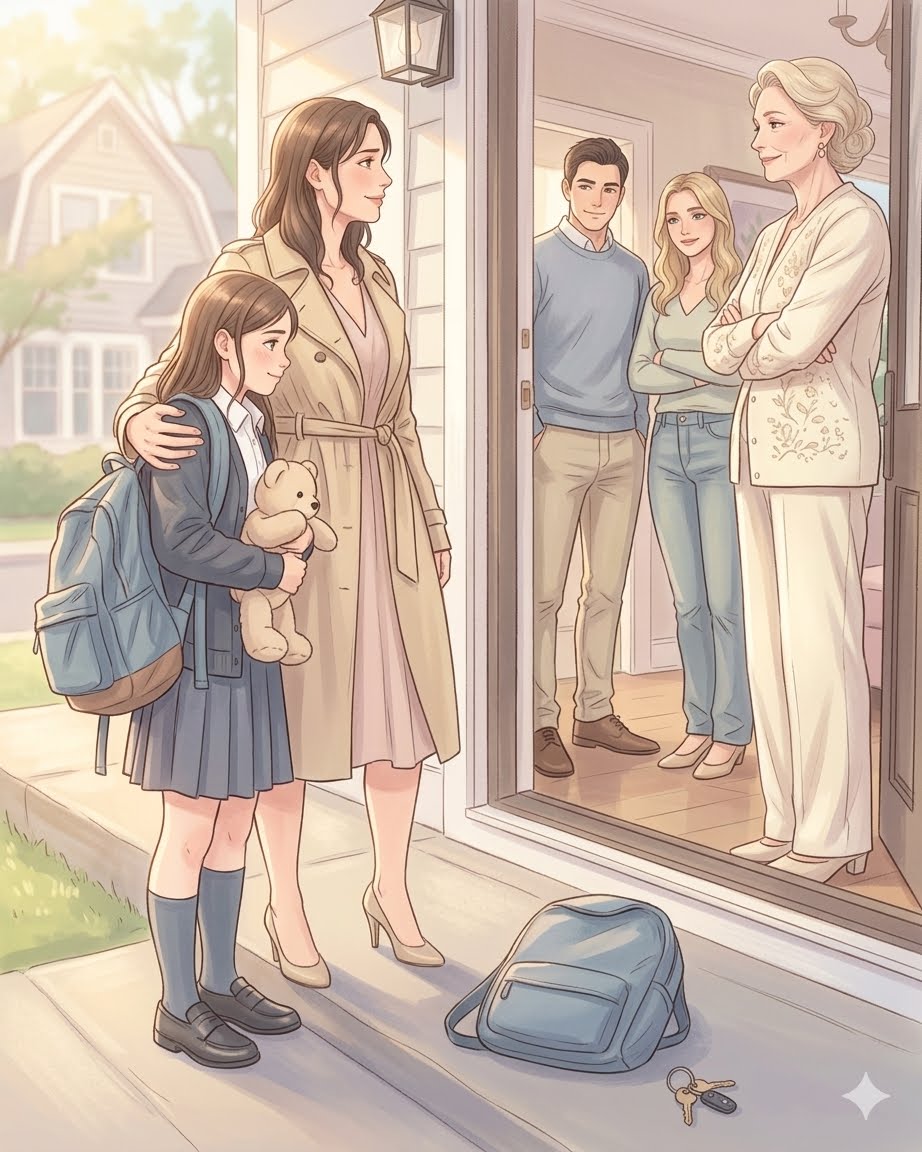
At 4:12 on a rain-soaked afternoon in Portland, eleven-year-old Lily discovered that the key to her own house no longer worked. Her middle school uniform clung to her shivering skin, and water dripped steadily from the frayed bottom of her backpack. At first, she assumed she had simply grabbed the wrong key before leaving for school. She wiped it against the sleeve of her sweater, pushed it into the lock again, and turned it with quiet, careful focus. Nothing happened. The key scraped against the cold metal, shifted less than half a turn, and jammed tight. Lily looked toward the living room window. The curtains had been pulled shut, but through a thin opening between them, she could see a lamp glowing amber inside. Someone was definitely home. With shaking hands, she took out her phone and called her mother. Rachel did not answer. Not because she was ignoring her daughter, but because she was deep in the basement records room of the county family courthouse, reviewing documents for an emergency custody case. Cell service did not reach that windowless concrete part of the building. No phone calls. No texts. Nothing. Lily called her grandmother, Evelyn. Once. Twice. Three times. Then she called her Aunt Megan, and finally Walter, her grandmother’s husband. Not a single person answered. The rain grew heavier over the quiet residential street. Lily sat beneath the narrow porch awning, clutching her backpack against her chest to keep it from becoming completely soaked. At first, she told herself the lock might simply be stuck. After one hour, her shoes made wet squishing sounds every time she shifted her feet. After two hours, her fingers ached from the bitter cold. After three hours, Mrs. Harper, the kind neighbor who lived across the street, crossed over beneath a large black umbrella. “Sweetheart, are you okay? Would you like to wait inside my house where it’s warm?”Lily smiled the way she had trained herself to smile around her grandmother: small, polite, and submissive—the careful expression of a child determined never to become a burden. “I’m okay, thank you, Mrs. Harper. My mom will be home soon.”
But her mother was not coming, entirely unaware of the nightmare unfolding on the front porch.
After four hours, the street began to darken. Passing cars sprayed cold water from the flooded gutters onto the sidewalk. Lily’s lips had turned pale, and her throat was beginning to tighten with acute asthma distress. Her rescue inhaler was inside the house, resting on her bedroom desk upstairs.
After five hours, the front door finally opened.
Evelyn appeared wearing pearl earrings, a pristine cream blouse, and hair styled so perfectly that not a single strand seemed out of place. Megan and Walter stood behind her in the foyer. None of them looked surprised to see the drenched child standing there shivering from head to toe.
Lily slowly stood up on trembling legs. “Grandma…”
Evelyn folded her hands across her chest, her posture icy and unyielding. “We already discussed this. You will not be living here anymore.”
Lily blinked, certain she must have misunderstood. “Where is my mom?”
“Your mother will understand,” Evelyn replied coldly. “This house is for family. Real family. Not mistakes people are forced to tolerate because they feel sorry for them.”
Lily did not cry then. She only looked toward Megan, waiting for her aunt to say something in her defense.
Megan lowered her eyes to the floor.
Walter remained completely silent.
The heavy door closed again and locked.
Mrs. Harper, who had witnessed the entire exchange from her window, rushed across the street, wrapped Lily in a heavy coat, and led her into the warmth of her home.
Part 2: The Silent Vow
Rachel received the frantic notification at 9:37 that night the moment she stepped out of the courthouse basement.
When she arrived at Mrs. Harper’s home, she found Lily sitting on the couch wrapped in thick towels, her skin ice-cold and her eyes swollen from holding back hours of tears. Rachel knelt and pulled her daughter into her arms without saying a word.
Then she helped her into the car, turned the heater as high as it would go, and drove across the street toward the house where Rachel herself had grown up.
Lily’s backpack lay beside the porch in the mud as if it were garbage.
The lock was brand-new, glittering in the porch light.
Evelyn opened the door before Rachel even had a chance to knock. “Before you create a scene, Rachel, this was necessary.”
Rachel looked at her mother.
Then she looked at the door.
Then at the new lock.
She did not raise her voice. She did not insult anyone.
She only said: “Understood.”
She returned to the car, drove Lily to a hotel, ordered her hot soup, and waited by her bedside until her daughter finally fell asleep. Afterward, Rachel made one single phone call.
Three days later, a white envelope arrived at the house in the Westmoreland neighborhood. A court process server delivered it, and the envelope bore the embossed seal of one of the city’s most respected law firms.
Evelyn signed for it while wearing those same pearl earrings. Inside were eleven pages.
The first page informed Evelyn Brooks, Megan Brooks, and Walter Hayes that they had exactly thirty days to vacate the property.
Evelyn read the page twice. Then she gave a dry, disbelieving laugh. “Rachel cannot throw us out of my house.”
That was her first, fatal mistake. The house did not belong to Evelyn. It never had.
The property had been purchased solely by David, Rachel’s father, before he married Evelyn. Before his death, David placed the house into an irrevocable family trust. Rachel was appointed the legal trustee, granted sole authority over the property. Lily was named the primary beneficiary.
Evelyn did have a conditional right to live there, but that privilege was bound by strict legal terms: she could not endanger, harass, exclude, threaten, or deny access to Rachel or Lily.
Evelyn had signed those trust documents eight years earlier, but she had never bothered to read them. Rachel had.
The subsequent pages laid out the violation in devastating detail. On October 16, Evelyn had changed the locks while Lily was at school and denied an eleven-year-old child shelter during a storm for five hours. There were witnesses, and there was video evidence. Mrs. Harper’s doorbell camera had recorded everything: Lily attempting to unlock the door, Lily making frantic phone calls, Lily sitting alone in the freezing rain, and Evelyn opening the door to utter the sentence that destroyed any legal right she had to remain: “You will not be living here anymore.”
The legal documents also cited Child Protective Services, the Portland Police Bureau, and a petition for a protective order preventing Evelyn from approaching Lily or her school.
Megan snatched the pages off the table. “She can’t do this!”
From the kitchen, Walter quietly said: “Yes, she can.”
For the first time, Evelyn did not look angry. She looked unsure. Not remorseful—only unsure.
That night, she called Rachel seventeen times. Rachel did not answer.
The first voicemail was a threat. The second was an accusation. The third claimed Rachel was destroying the family. The fifth was the recording Rachel saved: “You are going to pay for humiliating me. And that girl is going to learn who is in charge of this house.”
Rachel listened to the recording once, then forwarded it directly to her attorney.
Part 3: Reclaiming the Foundation
On Saturday morning, Rachel returned to the house with Lily. She brought her attorney, two police officers, and a locksmith.
Lily held a stuffed rabbit tightly against her chest. “You don’t have to go inside,” Rachel told her softly.
“My sketchbook is upstairs,” Lily whispered.
That sketchbook mattered more to Lily than her clothes. She drew when she could not speak. She had drawn monsters after her father stopped visiting. She had drawn cages when Evelyn began calling her a “burden” in a low voice whenever Rachel was out of the room.
“Then we’ll go get your sketchbook,” Rachel said.
The locksmith opened the door within minutes. Evelyn appeared in the hallway, carrying herself as though she were the owner of an enormous estate.
“You brought police officers against your own mother?”
Rachel held up the certified court order. “No. I brought them to my daughter’s legal residence.”
Megan appeared behind Evelyn. “You’re destroying this family over one mistake!”
“One?” Rachel asked evenly.
Megan did not respond, because it had not been one mistake. It had been the Christmas when Lily’s presents disappeared because Evelyn decided that “spoiled little girls don’t deserve rewards.” It had been every meal when Megan’s son was served first and Lily was told to wait. It had been every time Evelyn referred to Lily as a shameful burden Rachel had dragged into the family.
For years, Rachel had convinced herself that preserving peace meant maintaining a family home. That morning, she understood that peace without safety was nothing more than fear dressed in polite manners.
Lily’s bedroom upstairs was almost untouched, which somehow hurt more. The bedspread was missing. A photograph of Rachel and Lily at Cannon Beach had been placed facedown inside a drawer. Lily’s school certificates were stacked carelessly on the desk, and her old stuffed rabbit—the one she had owned since she was three—had been placed inside a cardboard box labeled in thick black marker: DONATE.
Lily stared at the box without crying. Rachel reached inside, lifted out the rabbit, and handed it to her.
“Your grandmother does not get to decide which things are allowed to comfort you.”
Downstairs, Evelyn was speaking to one of the officers in a gentle, practiced voice. “The child has emotional issues. I was simply setting boundaries.”
The officer looked down at her coldly. “Changing the locks and leaving a minor outside in the rain is not setting boundaries.”
Evelyn’s polite smile tightened. When Rachel came downstairs with Lily, Evelyn stepped aggressively toward the child. “Come here.”
Lily froze. Rachel instantly moved between them, blocking her view. “You do not speak to her.”
“I am her grandmother!”
“You were.”
That was when Evelyn finally lost control, her composure shattering into utter ruin. “You ungrateful woman! I took you in when your marriage collapsed!”
“Dad protected us,” Rachel replied softly. “You used his house to punish a child.”
Megan began to cry. “Where are we supposed to live?”
Rachel looked at her sister—noticing her perfect nails, expensive handbag, leased SUV, and three years of living rent-free without contributing a single dollar. “You have thirty days.”
Then Walter spoke from the kitchen doorway. “Rachel… I’m sorry.”
It was late—far too late—but it was the first honest sentence anyone had spoken in that house for years.
Part 4: The Truth Unmasked
Several weeks later, Rachel’s attorney uncovered financial discrepancies: Evelyn had used funds from the trust to cover Megan’s credit card bills, personal shopping, and luxury purchases she had falsely logged as “property maintenance.”
But the discovery that finally broke something deep inside Rachel arrived in a yellow envelope delivered by her father’s former estate attorney. Inside was a letter David had written shortly before he died.
Rachel opened it while sitting alone in her car. It read:
“Your mother knows how to make people question what they witnessed with their own eyes. I should have protected you sooner. This house is not a reward for Evelyn; it is a refuge for you and Lily. Never let anyone convince you that cruelty is love simply because it comes from family.”
Rachel wept with the letter pressed against her chest—not because her father had left her a multi-million-dollar property, but because she finally knew someone had seen everything.
On the twenty-ninth day, Evelyn moved out. She did not leave with dignity. First, she told the neighbors that Rachel had stolen her inheritance. Then she posted a lengthy message online about disloyal daughters, manipulated granddaughters, and the abandonment of senior citizens.
The comment that caused her to delete the post entirely appeared twelve minutes later from one of Rachel’s cousins: “Are you also going to tell people that you left an eleven-year-old girl outside in the rain for five hours?”
The post vanished in less than an hour.
Megan moved into a friend’s apartment in Gresham. Walter rented a small room near the farmers’ market and filed for legal separation two months later. On Lily’s birthday, Walter mailed her a card containing twenty dollars and no return address.
Lily read the card carefully. “Do I have to forgive him?”
Rachel sat beside her. “No. No one is entitled to your forgiveness just so they can feel less guilty.”
Lily kept the card but donated the twenty dollars to a school fundraiser purchasing winter coats for children in need.
The formal eviction hearing took place in December. Evelyn arrived wearing navy blue, pearl earrings, and a carefully rehearsed expression of deep suffering.
For the first time, Rachel saw her mother as small. Not old—small. Perhaps she had always been small, and everyone else’s fear had simply made her seem enormous.
The judge reviewed the trust documents, security footage, recorded voicemails, witness affidavits, and existing protection order. Evelyn’s attorney argued that removing her from the house was an excessive response.
The judge lowered her glasses. “What was excessive was changing the locks and leaving a child without shelter during a storm. The consequences did not begin in this courtroom. They began with your client’s actions.”
Evelyn stared straight ahead, refusing to look at Lily. In a strange way, that helped the young girl more than a false apology ever could. It proved to Lily that her grandmother’s refusal to look at her had nothing to do with Lily’s worth—Evelyn simply could not face the truth without destroying the delusion she had built.
The judge confirmed the absolute termination of Evelyn’s occupancy rights. The protective order remained active, and the property stayed safely in trust for Lily.
Part 5: Inside
In January, Rachel and Lily returned to the house without attorneys or police officers. Inside, the air smelled stale and closed in. Evelyn had stripped the place, taking the dining room chandelier, two mirrors, patio planters, and even the rosebushes David had planted years earlier. Deep scratches marked the floors where furniture had been dragged out in anger.
Lily stopped just inside the doorway. “Do we have to live here?”
“No,” Rachel said gently. “But it belongs to us.”
“Something belonging to us does not mean we have to give it the rest of our lives.”
So they chose to sell it. A contractor repaired the physical damage, and Rachel’s attorney corrected the property records. Mrs. Harper brought cinnamon rolls on the Saturday when Lily painted the walls of her old bedroom pale green. She wanted to do the painting herself—to erase, with her own hands, the place where people had made her feel unwanted.
The sale closed in April. Rachel used part of the proceeds to purchase the small house they had been renting near Lily’s school. It had two bright bedrooms, a yellow kitchen, and a small backyard where Lily planted sunflowers. The remaining funds were placed into an education account in Lily’s name, exactly as David had intended.
On the first anniversary of that stormy night, it rained again in Portland.
Lily was twelve now. Sometimes she still checked the door lock before going to bed, but she no longer checked it six times, and she no longer asked whether she was truly allowed to stay.
That evening, Rachel found her sitting beside the window with her sketchbook open on her lap.
“What are you drawing?”
Lily turned the page around. It showed a porch, but not the porch from the old Westmoreland house. This porch had two chairs, a hanging plant, a welcome mat, and a bright yellow front door. Inside the house, a little girl watched the rain from a warm, safe place, while a woman stood beside her with a hand resting gently on her shoulder. Far away, beyond a fence, three dark figures stood almost entirely hidden in the gloom.
“What is it called?” Rachel asked softly.
Lily smiled. “Inside.”
Rachel sat with her until the rain softened to a gentle patter.
Later, after Lily had gone to sleep, Rachel opened the drawer where she kept her father’s letter, the eviction notice, and a copy of the protection order.
Many people had asked how she had managed to remain so unnaturally calm that night—how she had looked at her mother, seen her daughter’s backpack discarded in the mud, and said only: “Understood.”
The answer was simple. In that exact moment, Rachel understood everything.
She understood that her mother had mistaken patience for weakness, and silence for permission. She understood that family is not defined by blood, a shared name, or a house filled with old photographs—family is the person who opens the door when it rains.
That night, Rachel decided to open a different door. A small door. A yellow door. A safe door. A door her daughter would never have to knock on from the outside ever again.
Because this time, Lily did not merely have a key.
She had a home.