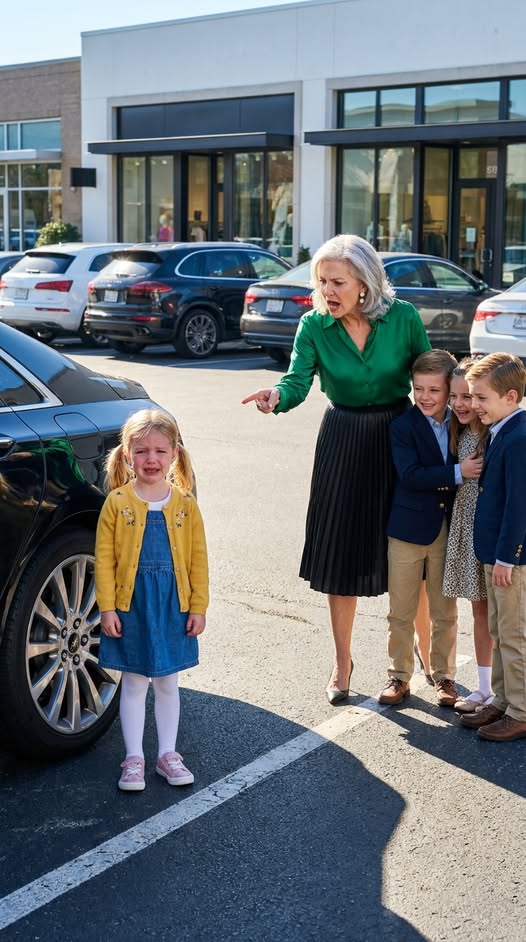
The very second my eyes locked onto the small, trembling silhouette standing beside the grease-stained pillar of the parking garage, the fundamental architecture of my soul permanently realigned.
Mia was only six, delicate, possessing a bird-like fragility that made her look even younger. She was swallowed up by the mustard-yellow cardigan I had meticulously buttoned for her that morning. Tear-tracks had carved angry red chafe marks into her porcelain skin. Her tiny, pale fingers were interlaced so fiercely against her stomach, it was as if she feared her own hands might commit an act of treason if she let them go.
She didn’t sprint toward me.
That was the initial fracture, the first horrific crack in my chest.
She merely stared at me through wet, swollen eyes, her voice barely scraping past her lips. “Grandma instructed me not to move.”
Just yards behind her fragile frame, the brutal machinery of the world ground on. An idling diesel delivery truck belched thick gray exhaust into the loading zone. Hurried strangers marched past with glossy shopping bags, their faces illuminated by glowing smartphone screens, blissfully ignorant that a child had been anchored to this desolate slab of concrete for five agonizing hours. All because a woman she trusted had issued a command and simply vanished.
Beside me, my husband, Daniel, turned entirely to stone.
“Mia?” he choked out, the syllables shredding his throat.
Only then did the invisible chains snap. She took three hesitant, agonizing steps forward, then abruptly froze again, her eyes darting frantically, paralyzed by the terror that she was committing a cardinal sin.
I collapsed to my knees on the filthy asphalt, throwing my arms wide. “Come here, my sweet girl. You are perfectly safe. You did nothing wrong.”
She collided with my chest with such desperate, violent force that I was nearly knocked backward.
Her tiny body was absolute ice. Through the thick wool of my sweater, I felt the hollow rumble of her starved stomach. She buried her face in my neck, her small frame convulsing with violent sobs, chanting a broken, repetitive mantra. “I stayed put. I stayed exactly where she told me. I didn’t move.”
Daniel’s complexion drained to the color of ash.
The itinerary for this Saturday was supposed to be a joyous family excursion. My mother-in-law, Patricia Hayes, had practically demanded the privilege of taking all four of her grandchildren to the upscale commercial center downtown. Mia had been practically vibrating with anticipation because Patricia had sworn they would visit the sprawling, three-story toy emporium.
Instead, it became sickeningly apparent that Patricia had deemed my six-year-old daughter an “inconvenience” for possessing the audacity to request a bathroom break and a pretzel.
So, Patricia had marched her to a load-bearing column in a subterranean, exhaust-choked public parking structure, pointed a manicured finger, and decreed, “Wait right here. Do not take a single step.”
Then, she had gathered the remaining three grandchildren and paraded inside for an afternoon of retail therapy.
I didn’t scream in the echo chamber of that garage.
I didn’t weep.
A cold, methodical stillness washed over me. I stripped Daniel’s heavy wool coat from his shoulders, cocooned Mia in it, scooped her into my arms, and began marching toward the glass doors of the promenade. We were heading straight into the upscale Italian bistro where Patricia had summoned the extended family for a celebratory dinner.
She wants an audience, I thought, the rage crystallizing in my veins. I’ll gladly give her one.
Chapter 2: The Public Execution
The warm glow of the bistro, thick with the scent of roasted garlic and expensive Merlot, hit us the moment the hostess swung the doors open.
They were roaring with laughter when we breached the dining room.
Patricia held court at the dead center of an elongated mahogany table. Her designer sunglasses were casually perched atop her immaculate silver bob, a fortress of glossy shopping bags forming a barricade around her chair. My sister-in-law, Claire, was admiring the silk lining of a freshly purchased trench coat. The three older cousins were happily devouring truffle fries. Not a single adult at that table possessed a shred of anxiety over the missing child.
Then, Patricia’s gaze snagged on the bundled, sobbing form in my arms.
Her theatrical smile evaporated, replaced by a twitch of irritation.
I paced deliberately to the head of the table, the rhythmic click of my boots silencing the conversation nearest to us. I lowered Mia into the vacant chair directly beside me with extreme care, ensuring the coat remained wrapped securely around her trembling shoulders. Reaching into my purse, I retrieved my smartphone, tapped the camera application, hit the red record button, and slammed it face-up on the polished wood.
“Patricia,” I stated, my tone so dangerously level it could have cut glass. “Please, enlighten this entire table. Explain the exact pedagogical reasoning behind leaving my six-year-old daughter completely alone in a subterranean parking garage for five hours.”
Every silver fork clattered against the porcelain plates.
Behind me, I could feel the heat radiating off Daniel. He was vibrating with a silent, catastrophic fury.
Patricia’s jaw unhinged, then snapped shut.
A suffocating vacuum descended upon the family. For ten agonizing seconds, the only sound was the ambient jazz playing overhead.
Patricia’s eyes darted frantically around the table, desperately searching for her usual lifeline. She expected someone to chuckle nervously, to diffuse the tension, to transform this grotesque reality into one of her signature “silly misunderstandings” that she could sweep away with a dramatic flutter of her hand.
Not a single soul laughed.
Claire’s hands went limp, the silk coat sliding off her lap onto the floor. Daniel’s younger brother, Mark, rigidly lowered his highball glass. The cousins stared at Mia’s tear-streaked face. I watched the horrifying realization detonate behind their eyes, one by one. This wasn’t a whimsical grandmotherly lesson. This was calculated abandonment.
Patricia forcibly straightened her spine, attempting to summon her matriarchal authority.
“Oh, for heaven’s sake, Emma, cease the theatrics,” she scoffed, waving a dismissive hand. “She was right outside the entrance.”
“Right outside?” I echoed, the phone capturing every syllable.
“Yes, precisely,” Patricia snapped, her voice tightening defensively. “She was being incredibly difficult. Whining incessantly. I instructed her to wait while we finished our errands. Children must learn the value of obedience.”
Daniel lunged forward, his hands gripping the back of my chair. “Mom.”
It wasn’t a plea. It was a warning. It was a guttural, dangerous octave I had never heard escape my husband’s throat in a decade of marriage.
Patricia recoiled as if he had struck her across the cheek.
“Excuse me?” she bristled, her veneer cracking. “Are you implying I neglected her? I successfully raised three children of my own, Daniel. I am perfectly aware of how to manage a temper tantrum.”
I reached out and adjusted the angle of my phone, ensuring the camera lens was perfectly centered on her defensive posture.
“You abandoned a first-grader in a public transit zone,” I articulated, enunciating every consonant. “Unattended. Without a drop of water, access to a restroom, or any conceivable method of contacting us. For five hours.”
Patricia’s features hardened into a mask of pure, unadulterated pride.
“She was perfectly fine.”
Beside me, Mia violently flinched.
That infinitesimal, terrified flinch accomplished what my barrage of accusations could not. It severed Patricia’s invisible strings.
“Mom,” Claire whispered, her face drained of blood. “Five hours? Are you insane?”
Patricia’s eyes narrowed. “Oh, spare me the self-righteousness, Claire.”
Mark shot to his feet, kicking his chair back. “Where the hell did you expect her to use the restroom, Mom?”
Patricia clamped her mouth shut, her eyes blazing.
Daniel bypassed his mother entirely, dropping to one knee beside our daughter. “Sweetheart,” he murmured gently, “did Grandma ever come back outside to check on you?”
Mia shook her head, burying her chin in the wool collar. “I only saw her once, Daddy. She was really far away. I waved my arms, but she just kept walking.”
Patricia unleashed a theatrical groan, rolling her eyes toward the ceiling. “She’s fabricating the narrative. You know how children exaggerate when they crave the spotlight.”
I stared at the damp, shivering form of my child. I looked at her scuffed knees, her trembling lip, and remembered the cracked, apologetic voice that had begged for forgiveness the entire walk to the restaurant.
I shifted my gaze back to the woman sitting at the head of the table.
“No,” I said, my voice dropping to a lethal whisper. “You do not get to brand my daughter a liar to salvage your ego.”
A waiter cautiously approached our section, took one look at the localized warfare occurring at table seven, and promptly pivoted on his heel.
Patricia aggressively shoved her chair backward, the wooden legs screeching against the tile. “I will not sit here and be subjected to public humiliation by my own family.”
“You achieved that entirely on your own,” Daniel stated.
The sprawling restaurant suddenly felt like a claustrophobic interrogation room.
Patricia snatched her designer purse from the adjacent chair. “I am her flesh and blood. I am her grandmother.”
“Not anymore,” Daniel replied.
Those two words struck the table with the concussive force of a mortar shell.
Patricia froze mid-motion, her knuckles whitening around the leather straps of her bag. “I beg your pardon?”
Daniel didn’t flinch. His arms remained rigidly at his sides. “You are permanently barred from seeing Mia. No unsupervised visits. No supervised visits. You are uninvited from every holiday, every birthday, every milestone. Not until my wife and I conclude that you are a safe presence. And looking at you right now, I heavily doubt that day will ever arrive.”
The table plunged back into silence, but the texture of it had mutated. It was no longer the silence of disbelief. It was the heavy, suffocating silence of absolute judgment.
Patricia’s eyes darted to Claire, silently demanding allegiance. Claire stared firmly at her napkin.
She looked to Mark. Mark gave a slow, disgusted shake of his head.
Finally, Patricia turned her gaze upon me. Beneath the layers of expensive cosmetics, I watched a dark, toxic hatred click into place, like a heavy iron vault being bolted shut from the inside.
“You orchestrated this,” she hissed, her voice vibrating with venom.
A single, humorless laugh escaped my throat. “You literally abandoned a helpless child in a parking garage, Patricia. I simply provided the witnesses.”
But as she turned to storm out, my eyes caught something protruding from the open zipper of her handbag. A receipt from the luxury boutique upstairs. The timestamp printed at the bottom was from exactly twenty minutes ago.
She wasn’t just shopping while Mia froze, I realized, a fresh wave of nausea hitting me. She had taken the time to buy herself a silk scarf before coming to dinner.
Chapter 3: The Sins of the Mother
We didn’t stay to order.
Daniel scooped Mia into his arms, shielding her face from the gawking patrons, while I kept the camera rolling until we breached the safety of our vehicle. I couldn’t trust Patricia not to ambush us in the valet line to stage a dramatic counter-offensive. More importantly, I couldn’t trust myself not to physically dismantle her if she tried.
Mia succumbed to exhaustion before we even cleared the mall’s perimeter. Her head lolled heavily against the cushioned restraint of her car seat, her mouth parted in deep, rhythmic breathing. Yet, her tiny fingers maintained a death grip on the cuff of Daniel’s jacket. Even submerged in sleep, her central nervous system was wired tight, perpetually bracing for an impending reprimand.
Daniel piloted the SUV through the sprawling suburbs in absolute silence for ten agonizing miles.
Suddenly, he wrenched the steering wheel, pulling into a deserted, fluorescent-lit gas station. He jammed the transmission into park beneath the blinding white canopy and gripped the steering wheel until his knuckles threatened to pierce his skin.
“I am so profoundly sorry,” he rasped into the quiet cabin.
I turned my body to face him.
His eyes were brimming, shimmering under the harsh streetlights, but the tears refused to fall. Daniel was a man who had mastered the art of transmuting terror into absolute stillness. He was raised in Patricia’s shadow. He had learned early on that survival meant shrinking, becoming so quiet and unassuming that the predator’s gaze simply passed over him.
“I should have anticipated this,” he continued, his voice thick with self-loathing. “I never should have allowed her to take them out of my sight.”
I reached across the center console, forcing my hand over his rigid, icy grip.
“We trusted a matriarch. We trusted family,” I countered softly. “That is the normal, human thing to do.”
He shook his head violently. “No. I blindly trusted my mother, despite spending thirty years knowing exactly the kind of monster she is.”
It was the first genuinely honest sentence Daniel had ever permitted himself to speak regarding Patricia Hayes.
Our marriage had weathered dozens of micro-aggressions orchestrated by her hand. Patricia loved to critique the nutritional value of the lunches I packed, the perceived “flamboyance” of Mia’s wardrobe, and my absolute refusal to silence my daughter when she expressed frustration. Patricia labeled emotional intelligence as “melodrama.” She weaponized fear and called it “respect.” She operated under the archaic delusion that offspring were decorative subordinates, meant to obey immediately and question never.
But she had always executed her cruelty in microscopic doses, just subtle enough that Daniel could mentally weave a defense for her.
“She has a good heart underneath it all.”
“It’s a generational divide, Emma.”
“She loves Mia; she just shows it poorly.”
“She locked me out of the house for crying once, and I turned out fine.”
Tonight, sitting beneath the humming fluorescent bulbs, the architecture of those excuses finally collapsed.
Upon returning home, the transition from the car to the house jolted Mia awake. Disoriented in the dark, she began hyperventilating, convinced she was still trapped beside the concrete pillar. Daniel frantically unbuckled the harness, murmuring reassurances into her hair as he carried her over the threshold.
I drew a warm, deep bath—not to cleanse her of grime, but to thaw the deep, lingering chill that had seeped into her bones. She sat rigidly in the porcelain tub, her knees drawn tightly against her sternum, making no attempt to play with the floating foam.
“Mommy?” she whispered, her voice bouncing off the tiled walls.
I sank onto the bathmat, ignoring the water soaking through the knees of my jeans as I gripped her slippery little hand. “I’m right here, baby.”
“Was I wicked?”
A jagged shard of glass twisted directly in my chest.
“No,” I stated firmly, locking my eyes onto hers. “You were perfectly wonderful. You are never, ever bad.”
“But Grandma said I ruined the magic.”
I forced my breathing to remain steady. “What were her exact words, Mia? Tell Mommy.”
Mia kept her gaze fixed on a cluster of bubbles near her toes. “She said I was draining everyone’s happiness. She said if I couldn’t fake a smile, I could stay with the parked cars until I remembered how to be grateful.”
I closed my eyes. I permitted myself exactly one second of homicidal ideation. One second, and then I buried it.
“Grandma was entirely wrong,” I told her, my voice unwavering. “The most important job a grown-up has is to keep a child safe from harm. She failed to keep you safe. She broke the rule, not you.”
Mia studied my face with a heartbreaking intensity, calculating whether she was truly allowed to accept this absolution.
A shadow shifted in the doorway. Daniel stood framed by the hallway light. He had heard every single word.
The anguish in his expression had vanished. The mourning period was over.
His face was now carved from granite.
Chapter 4: The Digital Confession
The subsequent morning operated with the brutal efficiency of a military command center.
Daniel initiated the sequence by dialing the mall’s security operations desk, placing his phone squarely in the center of our kitchen island on speaker. A supervisor, identifying himself as Mr. Alvarez, absorbed Daniel’s meticulous recounting of the timeline without a single interruption.
When Daniel provided the specific zone marker of the pillar and the five-hour window, the static on the line seemed to heavily thicken.
“Mr. Hayes,” Alvarez said, his tone shedding any trace of corporate pleasantry. “I will immediately initiate a review of the surveillance archives. However, I must explicitly state that if the footage corroborates this level of abandonment, mall policy mandates we file a formal incident report with local authorities.”
“File it,” Daniel commanded without a fraction of hesitation. “Send me the copies.”
I watched him from across the marble counter. His hands were perfectly steady.
Following that call, we contacted Mia’s pediatrician, requesting an expedited referral to a pediatric trauma specialist. Then, as the afternoon sun began to stretch across the hardwood floor, Daniel picked up the receiver, dialed the local precinct’s non-emergency dispatch, and shattered the remaining illusions of our family dynamic.
“I need to formally report an incident of child endangerment,” he said clearly.
The words hung in the kitchen, ringing like a bell that could never be un-struck.
Meanwhile, Patricia’s digital assault began. She attempted to call Daniel’s cell twelve separate times before noon. He muted the notifications.
Then, the frantic text messages began pouring in.
You intentionally humiliated me in front of the entire bloodline.
Ten minutes later:
Your wife has successfully poisoned you against the woman who gave you life.
An hour later, the narrative shifted:
Mia requires a firm hand. You are actively raising her to be a fragile victim.
And finally, the ultimate delusion:
I did absolutely nothing wrong.
Daniel skimmed the final transmission and placed the device face-down on the granite.
“She isn’t remorseful,” he observed quietly.
“No,” I agreed. “She is only sorry she got caught without a script.”
By nightfall, the extended family had fractured, but the fault lines did not crack in Patricia’s favor.
Claire was the first to break ranks. She called my line, her voice hitching with suppressed sobs. “Emma, I am so sorry. I should have realized Mia wasn’t trailing behind us.”
“You were wrangling your own toddlers, Claire,” I offered, though the exhaustion was weighing heavy on my vocal cords.
“That’s no excuse,” Claire insisted. “When we breached the mall doors, I explicitly asked Mom where Mia had gone. She didn’t even blink. She told me you and Daniel had rushed back to pick her up because she was throwing a legendary tantrum. I thought the logistics were strange, but she delivered the lie with such absolute conviction.”
I relayed the information to Daniel, who was leaning against the refrigerator. His jaw muscles feathered.
Patricia hadn’t merely abandoned a child. She had actively constructed a false reality to camouflage the vacant space where her granddaughter should have been.
Mark checked in shortly after. He had interrogated his ten-year-old son, Ethan. According to the boy, when he inquired why his cousin wasn’t joining them in the toy aisle, Patricia had smoothly claimed, “Mia is in a time-out learning a valuable lesson.”
“Ethan assumed she was sitting on a bench with a security guard or another aunt,” Mark groaned over the line. “The kid is gutted.”
“He’s ten years old, Mark. Absolve him of that guilt immediately,” I demanded.
“I will. But I needed you both to know… Claire and I are drawing a hard line. We aren’t backing Mom’s twisted narrative.”
Later that evening, Daniel finally accepted an incoming call from his mother. He activated a secondary recording device on the counter, making his intentions explicitly clear from the first breath.
“Mom, be advised that I am recording the entirety of this conversation.”
Patricia scoffed, a wet, dismissive sound. “I see Emma’s paranoid influence has finally consumed you entirely.”
“No,” Daniel countered, his voice chillingly flat. “This is a defense mechanism you taught me.”
A beat of hesitation. “Whatever do you mean by that, Daniel?”
“It means I am intimately familiar with how fluid your relationship with the truth becomes when you’re backed into a corner.”
Her outrage flared, hot and sharp. “How dare you speak to your mother with such flagrant disrespect?”
Daniel closed his eyes, pinching the bridge of his nose, refusing to be baited into an emotional brawl. “Just articulate it for the record. Explain why you left my daughter unguarded in a subterranean transit hub.”
“I didn’t abandon her!” she shrieked. “I instructed her to wait while I fetched the others!”
“She is six years old, Mom.”
“She is more than capable of following basic instructions!”
“For five continuous hours?”
“That is a gross exaggeration! She was out there for an hour, tops.”
“We possess the timestamp from your parking garage entry,” Daniel rattled off with surgical precision. “We have the finalized receipt from the bistro. And Mr. Alvarez is currently pulling the high-definition security feeds from the pillar cameras.”
The line went entirely dead.
That specific silence—the deafening absence of a witty retort—was a louder confession than any spoken word.
When Patricia finally spoke, the bluster had evaporated into a sinister, icy whisper.
“You are truly going to leverage strangers against the matriarch of your own family?”
“You chose to make my child unsafe,” Daniel replied. “You activated this protocol.”
“You are making a catastrophic error, Daniel,” Patricia threatened, her tone dropping an octave. “When that woman inevitably divorces you, do not dare come crawling back to my doorstep seeking shelter.”
He tapped the red icon, severing the connection.
He remained paralyzed over the glowing screen for a full minute.
“I spent my entire adolescence believing she said those horrific things purely out of temporary anger,” he whispered into the quiet kitchen.
I waited, letting him process the grief of his own realization.
He looked up at me, his eyes hollowed out. “Now I realize she says them simply because they are highly effective weapons.”
The next morning, Alvarez called back. The footage had been reviewed. Not only did it confirm the five-hour timeline, but it captured a detail that made my blood run cold. At the two-hour mark, Patricia had exited the mall to drop bags off in her trunk. The camera caught her glancing directly at the pillar, making visual contact with a shivering Mia, before turning on her heel and marching back inside for a second round of shopping.
Chapter 5: The War of Attrition
The police intervention did not manifest as a cinematic raid. Reality is far more bureaucratic. A uniformed officer visited our home, documented our statements, and spoke with incredible gentleness to Mia for a mere five minutes to spare her further trauma. Because the security footage irrevocably corroborated the timeline and the deliberate neglect, the officer confirmed a formal file for child endangerment would be submitted to family services for review.
He heavily advised maintaining a zero-contact boundary.
Patricia, inevitably discovering the existence of the security footage through Claire, rapidly altered her battle strategy.
The following morning, a manifesto materialized in the extended family group chat.
I am the victim of a cruel, orchestrated smear campaign. Mia was never in any genuine peril. I kept her within my line of sight the entire time to cure her of her rampant entitlement. Emma has harbored a deep-seated jealousy of me for years and is exploiting this to fracture our bloodline. Daniel is a brainwashed hostage. I pray you all remember who financially and emotionally stabilized this family before you cast your stones.
For the first time in his life, Daniel engaged in the public arena.
Mom. Mia was abandoned beside a concrete pillar for five hours and twelve minutes. The Galleria security footage is indisputable. You lied to Claire, claiming she was safely home. You lied to Ethan, claiming she was in a supervised time-out. You withheld food, water, and shelter. You walked past her at 3:15 PM, made eye contact, and ignored her. This is not a difference of parenting styles; it is neglect. Do not attempt to contact this household again unless communication is routed through a retained attorney or a court-appointed mediator.
The digital sphere went dark for eight agonizing minutes.
Then, Mark’s icon popped up:
I stand entirely with Daniel and Emma.
Claire’s icon followed a minute later:
I do too. I’m so sorry, Dan.
The notification chimed one final time: Patricia Hayes has left the conversation.
Two weeks later, an unmarked package arrived via courier, addressed specifically to Mia. Inside nestled a pristine, antique porcelain doll, its glassy eyes staring blankly upward. Clutched in its ceramic hands was a heavy cardstock envelope.
Daniel intercepted it before Mia returned from school. He sliced the envelope open with a kitchen knife.
He stood at the island reading the cursive script, and for the first time since that horrifying afternoon in the parking garage, my husband broke down and wept.
It wasn’t a dramatic, theatrical display. He merely pressed the heel of his hand against his mouth, his broad shoulders shaking silently, while the pale pink stationary sat on the granite like a radioactive isotope.
I slid the card from his trembling fingers.
Grandma forgives you.
No apology. No remorse. No acknowledgment of the trauma inflicted.
She had masterfully inverted the narrative, attempting to place the immense burden of guilt directly into the hands of a traumatized six-year-old.
Daniel marched to the trash compactor and threw the porcelain doll inside. He photographed the card for his lawyer’s dossier, shredded the original, and permanently blocked Patricia’s number from our network.
Mia’s therapeutic journey commenced the following week. Initially, she vehemently refused to vocalize the events of the garage. Instead, she communicated through frantic, aggressive crayon sketches: a harsh yellow square, a towering gray rectangle, and a minuscule stick figure dwarfed by a massive black vehicle. Scrawled in the bottom corner of every single page, pressed so hard the wax nearly tore the paper, was a single word.
WAIT.
Her specialist, Dr. Helen Monroe, a woman with kind eyes and infinite patience, cautioned us that psychological reconstruction was never a linear highway.
“She obeyed Patricia’s horrific command because she intrinsically trusted the authority of the adult,” Dr. Monroe explained gently in her office. “That is a devastating betrayal of a child’s fundamental worldview. Our objective isn’t to breed defiance. Our objective is to rewire her brain to understand that personal safety will always supersede blind obedience.”
And so, the rigorous unlearning began.
We engaged in endless roleplay scenarios. We ingrained in Mia the absolute right to break protocol if she felt frightened, abandoned, or physically threatened. We taught her that she possessed the autonomy to move, to seek out a uniformed proxy, to scream at the top of her lungs, and to shatter any rule if that rule was tethering her to danger.
In the beginning, she would merely whisper these affirmations.
Weeks later, the volume increased.
By the end of the month, she stood in our living room, hands firmly on her hips, and proudly declared, “I am allowed to move my feet if I am not safe.”
Simultaneously, Daniel was undergoing his own painful excavation.
He enlisted in private counseling. The defensive walls he had erected to protect his mother’s image began to crumble, revealing the rotting foundation beneath. Horrific anecdotes from his youth surfaced like jagged splinters: being locked in a lightless basement for questioning a curfew, being abandoned in a church pew because his allergies were “causing a scene,” being relentlessly mocked for expressing fear.
“I convinced myself that was the standard baseline of a normal upbringing,” he confessed to me one evening.
We were seated on the back patio, the humid summer air thick with the aroma of damp earth and blooming jasmine.
“I know you did, honey,” I murmured, resting my head against his shoulder.
He turned his gaze toward the dark tree line. “If that was normal… I want absolutely no part of it anymore.”
Chapter 6: The Boundary Line
Three months post-incident, the inevitable breach occurred.
It was a lazy Sunday afternoon. Mia was happily occupied in the living room, constructing an elaborate fortress out of sofa cushions and fleece blankets. Daniel was stationed at the stove, flipping grilled cheese sandwiches.
I heard the heavy thud of a car door, followed instantly by a sharp, authoritative knock on the front door’s frosted glass.
A spike of pure adrenaline flooded my system.
Patricia looked immaculate, as though she were arriving for a gala rather than an ambush. She wore a tailored cream blouse, luminous pearl drops in her ears, and a shade of crimson lipstick that looked as sharp as a scalpel. She carried no peace offerings this time. She carried only the sheer, suffocating weight of her own presumed authority, a force she believed could bulldoze any boundary.
Daniel wiped his hands on a dish towel, marched to the entryway, but explicitly did not disengage the deadbolt.
“Vacate the property,” he commanded through the reinforced glass.
Patricia arranged her features into an expression of tragic martyrdom, wearing the face of a deeply misunderstood saint.
“I merely came to embrace my granddaughter, Daniel.”
“The answer is no.”
“I have undeniable grandparental rights.”
“And I have a documented police report for child endangerment. Test me.”
The edges of her beatific smile began to vibrate with suppressed rage.
“Daniel,” she cooed, her voice taking on a sickeningly sweet, hypnotic cadence. “You are my flesh and blood. You are my son.”
He offered a single, resolute nod. “And Mia is my daughter. My priority.”
For a fraction of a second, genuine, unadulterated panic flickered across Patricia’s meticulously contoured face. I realized then what she had been banking on. She had expected a screaming match. She thrived in the arena of chaotic anger. She knew exactly how to weaponize rage—she could effortlessly twist an emotional outburst into a narrative of disrespect, spin that disrespect into her own victimhood, and leverage that victimhood to regain absolute control.
But Daniel offered her nothing to grip. His anger had burned out, leaving only a cold, impenetrable wall of finality.
He was entirely, irrevocably done.
Patricia pressed her palms flat against the glass pane. “You will spend the rest of your miserable life regretting cutting me out of it.”
“Perhaps,” Daniel conceded effortlessly. “But I would spend eternity regretting giving you a second opportunity to damage my child.”
From the depths of the living room, Mia’s fragile voice floated down the hallway. “Daddy? Who’s out there?”
Patricia’s eyes snapped toward the sound, a hungry, desperate fire igniting in her pupils.
I stepped out of the shadows, physically blocking the sightline to the hallway with my body.
Daniel’s voice hardened into steel. “Remove yourself from my property this instant, Patricia, or dispatch will be here in three minutes.”
Patricia locked eyes with her son for a prolonged, agonizing silence. The realization finally calcified in her mind: the spell was broken. The empire had fallen.
“You were never this vicious before you let that woman put a ring on your finger,” she spat.
“No,” Daniel agreed quietly. “But I was never this honest, either.”
He firmly shut the interior wooden door, plunging the entryway into shadows.
We stood in silence for sixty seconds until the roar of her engine faded down the street.
Mia padded into the foyer, clutching a ragged stuffed rabbit. She looked up at her father. “Who was outside, Daddy?”
Daniel sank to a crouch, meeting her at eye level. “It was someone who is no longer permitted inside our house, sweetheart.”
Mia tilted her head, processing the information with the gravity of a seasoned judge. “Because they aren’t a safe grown-up?”
“Exactly,” Daniel affirmed, kissing her forehead. “Because they aren’t safe.”
She absorbed the validation, gave a firm nod of approval, and extended the stuffed animal toward him.
“Well, Mr. Fluffles is safe,” she announced. “He can come inside the fort.”
Chapter 7: A New Shape of Silence (Finale)
Six months later, the remnants of the family congregated at Claire’s sprawling suburban home to celebrate Thanksgiving.
Patricia Hayes was conspicuously uninvited.
It marked the inaugural holiday navigating the vacuum of her absence, and the collective anticipation was thick with anxiety. Everyone braced for an undeniable strangeness. It was strange, but in a profoundly liberating way.
The invisible tripwires that had laced every family gathering were gone. There was no suffocating tension masking every casual remark. No one nervously inspected the turkey’s skin for microscopic flaws that would trigger a passive-aggressive lecture. No one rapidly shushed the children for laughing at an unacceptable decibel. No one was forced to perform exhausting rituals of gratitude while desperately waiting for Patricia to designate the evening’s scapegoat.
The cousins tore through the backyard, wearing ridiculous paper pilgrim hats, their shrieks of joy echoing off the fences.
Mia initially remained tethered to my leg, observing the chaos from the safety of the sliding glass door. Then, Ethan bounded up the deck stairs, his cheeks flushed with autumn chill, asking if she wanted to help construct a massive leaf pile.
Mia hesitated, looking up at me for permission.
I smiled, crouching down. “It is entirely your choice, Mia.”
Those two words—your choice—were the most powerful currency in her ongoing recovery.
Her face illuminated. She released my jeans and sprinted into the yard, diving into the autumn leaves.
From his vantage point by the kitchen window, Daniel watched his daughter vanish into a pile of red and gold.
“She is actively healing,” he murmured, wrapping a warm arm around my waist.
I leaned my weight against his chest. “So are you, Daniel.”
Across the dining room, Mark was casually dealing plates while Claire poured hot cider. Their dialogue was delightfully ordinary, lacking any defensive posturing. It wasn’t a scene of cinematic perfection, but it was authentic. It was free.
Hours later, the plates cleared, Mia scrambled onto Daniel’s lap, clutching a massive slice of pumpkin pie. A dollop of whipped cream rested precariously on the tip of her nose.
“Daddy,” she announced between bites, her tone incredibly serious. “I know exactly what to do if a bad person tells me to wait somewhere that feels scary.”
Daniel tenderly brushed a stray curl behind her ear. “What’s the protocol, kiddo?”
“I move my feet,” she declared proudly. “I go find a police officer, or a mom with a stroller, or I call you on the phone.”
“That is absolutely correct.”
“Even if the grown-up gets really, really mad at me for breaking the rule?”
“Especially then,” he affirmed, tapping her whipped-cream nose.
Mia gave a solemn, satisfied nod, completely secure in her reality, and returned to demolishing her dessert.
I surveyed the warm, chaotic living room, listening to the genuine laughter bouncing off the walls, and I experienced a sudden epiphany.
The deafening silence that had paralyzed the Italian bistro six months prior had never truly dissipated. It had simply evolved. It had changed its shape.
Initially, it was the suffocating silence of shock and horror.
Then, it mutated into the defiant silence of a family actively refusing to sweep abuse under the rug to protect a fragile ego.
And finally, it had settled into this: absolute, unshakeable peace.
The entire bloodline had gone silent that fateful afternoon because the unvarnished truth had finally breached the doors and demanded a seat at the head of the table. Once it arrived, no one possessed the strength to force it back out into the cold. No one could command the truth to stand frozen beside a concrete pillar. No one could abandon it and pretend everything was perfectly fine.
Patricia Hayes had dedicated decades to indoctrinating her family with a toxic theology: that blind obedience was paramount to personal safety, that maintaining optical perfection was vastly superior to honesty, and that loyalty strictly meant shielding the abuser at the expense of the victim.
But the grand architect of our misery had tragically miscalculated one crucial variable.
She arrogantly assumed that a six-year-old girl would stand frozen in the shadows forever.
She assumed her son would remain paralyzed right beside her.
She was devastatingly wrong about them both.