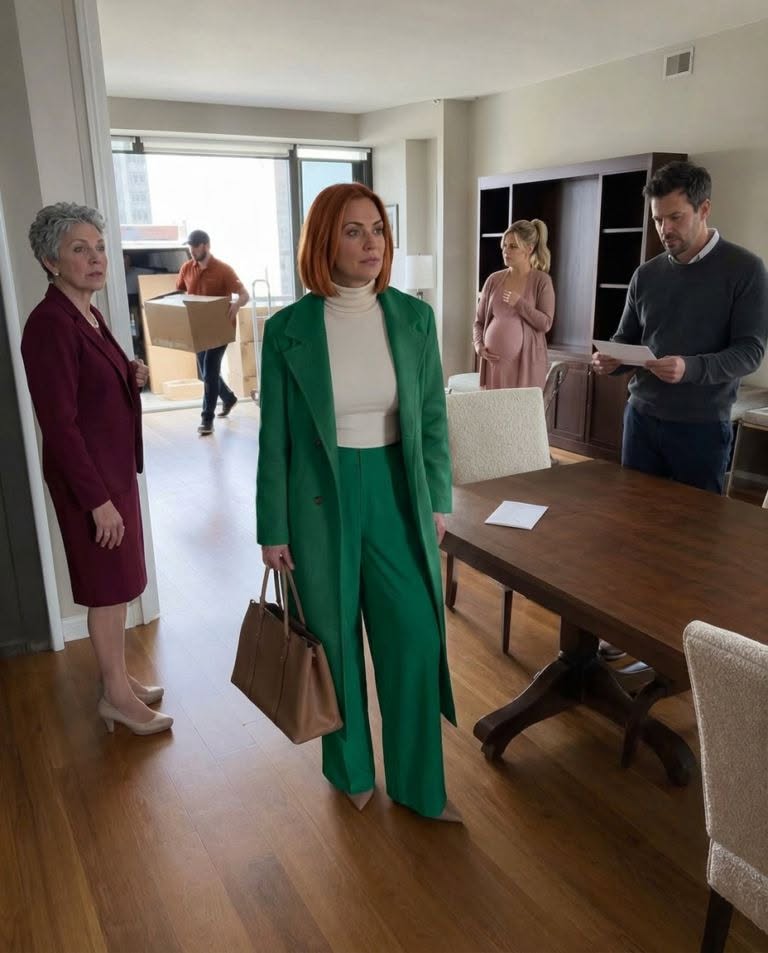

Part 1: THE LEASE
My mother-in-law ordered me to leave the apartment before her great-grandson arrived.
I did not argue, beg, or try to defend myself. I simply obeyed.
But when the movers had emptied nearly every room of the furniture and comforts my husband’s family had enjoyed for years, I faced them calmly and said, “From this moment forward, you can pay the $9,800 monthly rent yourselves.”
I used the same cold tone Eleanor had used when she decided I no longer belonged there.
“Leave this home by tomorrow,” she had announced. “My grandson’s baby will be born soon, and nobody needs you here anymore.”
Eleanor sat at the head of the dining table with both hands resting neatly beside her glass. She spoke as casually as if she were choosing dessert.
For a second, I thought I had misunderstood.
Outside the windows, evening light covered Manhattan in gold. Traffic moved far below our Upper East Side apartment while my entire life was dismissed in one sentence.
“You want me to move out?” I asked.
My voice sounded strangely distant.
“Yes, Sarah.” She barely looked at me. “You have been an obstacle long enough. Leo and Valerie need this space for their child. It is time for this apartment to become a home for a real family.”
A real family.
Those words hurt more than the order to leave.
I had been married to Eleanor’s son, Arthur, for twelve years. For eight of those years, I had shared a roof with his mother and endured her polished insults, quiet criticism, and cruelty disguised as concern.
She constantly praised women who had children, as though motherhood were the only proof that a woman had value.
At twenty-seven, I survived a serious illness that left me unable to become pregnant. From the moment Eleanor learned that, she treated me as though I were incomplete.
“You never gave Arthur a child,” she continued. “We at least allowed you to pretend you were a mother to Leo for a while. You should appreciate that.”
I pressed my lips together and forced myself to breathe.
Leo was Arthur’s son from his first marriage. He had been eleven when I met him—quiet, suspicious, and still wounded by his parents’ divorce.
During our first year, he barely spoke to me.
Still, I tried.
I helped with homework whenever he permitted it. I attended school meetings Arthur missed, remembered every birthday, and always kept Leo’s favorite cereal in the kitchen.
For nine years, I had stood outside that boy’s emotional walls, searching for a way to show him that I cared.
But Eleanor always reached him first.
“His family is his father and me,” she used to tell me with a sweet smile. “Do not confuse the poor child.”
It took me years to realize she had done more than discourage me.
She had lied to Leo.
She told him I resented him, wanted him out of the apartment, and believed Arthur and I would have been happier if he had never existed.
Slowly and patiently, Eleanor built a false version of me in his mind. While I continued trying to earn his trust, she convinced him I was the enemy.
However, there was one important fact she did not know.
The apartment she loved boasting about—the spacious rooms, polished floors, private balcony, and twenty-four-hour doorman—was not being paid for by Arthur.
He had not covered the rent in four years.
I had.
Every month, $9,800 left my bank account because Arthur’s company was quietly collapsing and his income could no longer support the lifestyle his mother believed he provided.
Arthur paid the utilities and groceries. Those visible expenses helped him maintain the illusion that he was supporting us.
But the rent, the furniture, and most of the life surrounding them came from me.
I was a pharmaceutical chemist. I worked part-time for a private hospital and accepted highly paid emergency shifts whenever they became available. Some shifts lasted fourteen exhausting hours, but they allowed me to keep our finances stable.
I earned considerably more than Arthur.
Four years earlier, he had taken my hand and begged me not to tell his mother.
He said the truth would embarrass him.
He said it would damage his dignity as a husband.
He said a loving wife protected her husband’s pride.
I agreed because I loved him—or because I had confused silence with devotion.
Even now, I am not certain which explanation is true.
“Does Arthur know you are asking me to leave?” I asked Eleanor.
A faint smile appeared on her face.
“My son is exhausted from supporting you,” she replied. “Perhaps he has finally found someone who makes him feel like a man again.”
Something inside me went cold.
Suddenly, all the details I had refused to examine returned at once.
Arthur’s unexpected business trips.
His phone always facing downward during dinner.
Messages disappearing too quickly.
The unfamiliar perfume on his clothing.
The way he avoided my eyes whenever I asked simple questions.
And Eleanor’s unusual warmth whenever she mentioned Valerie.
I did not scream.
I refused to fall apart at a table where Eleanor had spent eight years quietly cutting away pieces of my confidence.
I picked up my purse.
“Fine,” I said. “I will be gone tomorrow.”
Eleanor lifted her chin in victory.
She had no idea that the woman she had just discarded was the only reason she could remain inside that apartment for another night.
I did not check into a hotel.
I went to my sister Naomi’s apartment in Queens.
At eleven that night, I sat on her couch and told her everything. Naomi, who had never been frightened of confrontation, immediately made two calls.
The first was to a moving company willing to work overnight for an additional fee.
The second was to her friend Priya, a residential leasing attorney.
Priya asked only one question.
“Whose name is on the lease?”
“Mine,” I said. “Only mine. Arthur’s credit had been destroyed by his business problems, so the building rejected him. I signed the agreement alone four years ago.”
There was a brief silence.
Then Priya said, “Sarah, do you understand what that gives you the right to do?”
I did.
I had understood the moment Eleanor called them a real family.
I had simply needed someone else to confirm it.
The movers arrived at seven the following morning.
Later, Eleanor told everyone that I had emptied the apartment out of revenge. But I took nothing that did not belong to me.
It simply happened that I had purchased almost everything.
The sofa.
Part 2:
The dining table Eleanor had ruled over for eight years.
The rugs, lamps, televisions, bookshelves, wine refrigerator, and expensive chair Arthur had never used.
I removed the bed frame, the credenza, and most of the books.
When Arthur’s company began failing, I had quietly furnished the life we continued pretending he provided. I still had every receipt—not because I had expected this day, but because I was naturally careful with documents.
At 7:40, Eleanor emerged from her bedroom wearing a silk robe and found two movers carrying the dining table toward the elevator.
“What are you doing?” she demanded.
“Moving,” I answered.
“That is my table!”
“No. I bought it in 2019. The invoice is in my name.”
Arthur appeared behind her, unshaven and holding his phone.
He looked like a man who had heard about his mother’s plan but had deliberately avoided examining what it meant.
He did not ask me to stay.
That was the detail that hurt most.
After twelve years of marriage, he stood in the hallway and never once asked me not to leave.
“Sarah, come on,” he said. “Do not behave this way.”
“Behave like what?”
“Petty.”
A sharp laugh escaped me.
Both Arthur and Eleanor flinched.
Then Leo stepped out of his bedroom. He was twenty years old now, taller than his father, with sleep still visible on his face.
Behind him stood Valerie, thirty-two weeks pregnant, both hands resting protectively on her stomach.
She appeared frightened.
I remember realizing that none of this was her fault. Whatever Arthur had promised her, whatever lies Eleanor had told, Valerie was not responsible for the years I had surrendered.
By 9:40, the apartment was almost empty.
Only Arthur’s clothes, Eleanor’s bedroom furniture, Leo’s possessions, and vast stretches of bare floor remained.
Eleanor stood in the center of the living room with her arms crossed.
“You are acting like a spoiled child,” she said. “Fortunately, this is still our home, and you are the one leaving.”
That was when I finally said it.
“From now on, you can pay the $9,800 rent yourselves.”
The silence afterward felt almost physical.
“What are you talking about?” Arthur asked.
He did not truly sound confused.
He already knew.
“You have paid the electricity, internet, and grocery bills for four years,” I said. “I have paid the rent. Every month, on the first day, since your business began failing.”
Then I looked directly at Eleanor.
“Every dinner party you hosted here, every guest you impressed, and every time you bragged about this building was made possible by me.”
For one brief moment, her expression collapsed.
Then she gathered herself.
“That is a lie.”
“Priya Raman will send Arthur the records this afternoon. Forty-eight months of bank transfers.”
I lifted my bag.
“There is one more thing you should understand before I leave.”
I told them about the lease.
My name was the only name on it.
I had signed alone because Arthur had failed the building’s credit requirements. The lease had been renewed twice, and Eleanor had never once asked whose signature appeared on the agreement.
She simply assumed a woman she considered useless could not possibly be supporting them.
“I submitted my notice this morning,” I said. “I will not renew the lease. The current term ends in sixty-one days. The management company will send formal notification. After that, all of you will need another place to live.”
I paused.
“Sixty-one days is considerably more notice than you gave me.”
Because the dining table was already inside the moving truck, I placed an envelope on the floor and wrote Arthur’s name across the front.
He opened it while I was still there.
Inside were three items.
The first was a copy of the lease bearing only my signature.
The second was the dated notice confirming that I would not renew it.
The third was a photograph of Leo at fourteen, standing at a school science fair with a second-place ribbon.
He was not smiling, but he was looking directly into the camera.
I had taken that photograph.
Arthur had been in Chicago that day, and Eleanor claimed she had another commitment. I attended alone and remained in the gymnasium for three hours.
Afterward, I bought Leo a hamburger.
For forty-five minutes, he spoke to me about ion exchange. It was the longest conversation we had ever shared.
That evening, I cried privately because it felt as though a locked door had finally opened between us.
On the back of the photograph, I had written one sentence:
“I attended every one. Ask her why she told you I didn’t.”
Then I left.
Priya managed everything afterward, although there was little anyone could contest.
A lease was a legal agreement. The management company did not care about family arguments or marital betrayal.
Eleanor called the building twice and insisted there had been a mistake. On the second call, management politely asked her to stop contacting them.
They moved out after fifty-eight days.
Arthur, Valerie, and the baby rented a two-bedroom apartment in Yonkers. Eleanor initially joined them and took the second bedroom.
Six weeks later, when the baby arrived, the room became a nursery. Eleanor had to move into a small studio in Riverdale that she could afford with her widow’s pension and her late husband’s annuity.
The life she had performed for years finally became too expensive to maintain.
Part 3:
I learned most of this later from Leo.
Arthur called me eleven times during the first month.
I answered the ninth call.
He wanted to explain his relationship with Valerie.
I told him I did not need details. She was pregnant, and whatever promises he had made to her were between them.
Then I asked him one question.
“When your mother ordered me out, did you already know she was going to do it?”
Arthur remained silent for a long time.
Finally, he said, “She told me she would handle it.”
Those six words explained our entire marriage.
He had allowed his mother to handle me.
I filed for divorce the following week. Arthur did not contest it. The process took nine months, and when it ended, I felt almost nothing.
That emptiness frightened me more than grief might have.
The part I never expected happened the following April.
Leo called me.
I did not recognize the number.
“It’s Leo,” he said.
Neither of us spoke for several seconds.
Then he said, “I found the photograph.”
Arthur had left the envelope on a shelf in the Yonkers apartment, and Leo discovered it while searching for a phone charger.
“I remember that day,” he said. “I remember the science fair and the hamburger. I have remembered it for six years. So why do I also remember being told that you never came?”
We met three days later at a diner on Northern Boulevard.
Leo arrived carrying a list of questions written on the back of a receipt.
The first was whether I had ever said I wanted him removed from the apartment.
“No,” I replied. “Not once. Not to anyone.”
He stared at the receipt.
“She told me you did. I was thirteen. She claimed she heard you saying it to Dad.”
He rubbed his face.
“She told me so many things. I believed her because she was always there.”
“She was,” I said.
“You were there too,” he replied. “That is what I cannot understand. You were there the entire time, but she convinced me you weren’t. I went along with it because she became angry whenever I was kind to you.”
He looked down.
“I was a child, but I have not been a child for several years. I should have questioned it.”
I told him he had grown up inside a reality constructed by adults and did not owe me an apology.
“I think I do,” he said.
So I allowed him to apologize.
When someone genuinely wants to accept responsibility, sometimes the kindest response is to let them.
We began meeting for coffee once a month.
For nearly a year, every conversation felt awkward. We discussed his classes and my work while avoiding the painful history between us.
Eventually, it became easier.
Then it became good.
Leo graduated the following spring with a degree in chemical engineering.
He told me, while struggling to maintain eye contact, that his choice of career was not a coincidence.
I sat in the fourth row during his graduation ceremony.
Arthur sat in the second row beside Valerie and their four-year-old daughter, Wren.
Eleanor was not there.
Leo no longer spoke to her.
He made that decision at twenty-two after confronting her about the lies. He told me only that she did not apologize.
Instead, she tried to justify everything.
According to Leo, her explanation was worse than the deception itself.
I never encouraged him to cut contact with her.
He said his decision was no longer about me.
I believed him.
I now live in Astoria in a one-bedroom apartment that I own completely. I purchased it with the money I stopped spending on a home where I was merely tolerated.
The rooms are smaller, but they belong to me.
The enormous dining table from the Upper East Side apartment sits in the middle of the room. It is much too large for the space, and I do not care.
I have spent years thinking about why I remained silent for so long.
Arthur asked me to hide the truth about the rent because he wanted to preserve his pride. I told myself I was protecting him because I loved him.
But my silence was not really a gift.
It was a payment.
Every month, I spent $9,800 and surrendered another piece of my identity for permission to remain seated at a table where people treated me as though I were an inconvenience.
Eleanor did not simply take my place away from me.
I handed it to her slowly, one silent sacrifice at a time, and then felt shocked when she behaved as though it had never belonged to me.
The lease is what I remember most clearly.
I signed it alone because my husband’s credit had been rejected. I remember feeling embarrassed for him as I wrote my name on every required page while he waited downstairs, unwilling to enter the leasing office.
For four years, that document sat inside a drawer and seemed insignificant.
Then one evening, a woman told me I was no longer needed, and the lease became the most important object in the apartment.
I would never tell someone enduring cruelty that they should simply find financial leverage. Most people do not have that option, and I recognize how fortunate I was.
But I would tell them this:
A false story survives only while everyone continues agreeing to it.
For years, everyone in that apartment—including me—accepted the story that Arthur was the provider, Eleanor was the authority, and I was merely fortunate to be included.
At seven o’clock one morning, with a moving truck parked outside, I stopped agreeing.
Leo now comes to dinner on the first Sunday of every month.
He sits at the oversized table in my little apartment, often in the same chair his grandmother once occupied, and still eats too quickly, just as he did when he was fourteen.
Last month, he brought Wren with him.
It was Valerie’s suggestion.
Wren looked around the room and asked who I was.
Leo answered without hesitation.
“This is Sarah. She came to every one of my science fairs.”
That was all.
Nine years of standing outside his bedroom door, trying to prove that I cared, were reduced to one simple sentence spoken to a four-year-old over dinner.
I stood, walked into the kitchen, and ran the water for a moment—the same way I had after that science fair years earlier.
Then I returned to the table and asked Wren whether she wanted another piece of bread.