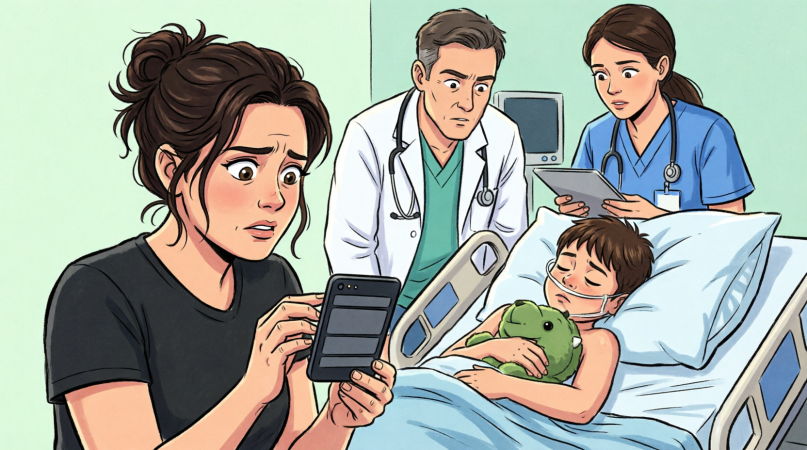
The audio started with pool music, glasses clinking, and a loud laugh from Chloe.
Then her voice came through, clear and calm, as if she were talking about the weather. —Leo needed to learn. That boy thinks that just because he gets sick, everyone is going to come running. I left him water. Don’t overreact. Besides, if Paula goes in and doesn’t find him, that’s no longer my problem. I did tell her to go to the house.
The doctor said nothing. The social worker, who had just walked in with a blue folder, stopped writing. I felt the hospital floor open up beneath my feet.
The voice of my friend Elena, the one who worked at the resort’s front desk, followed immediately in another audio clip. —Pau, she’s here. She’s at a table by the pool with Sophia and the dog. She just said that in front of another woman. I recorded her because you told me it was an emergency. And listen: she’s also saying that Richard doesn’t know Leo didn’t come.
Sophia. My eight-year-old niece.
Until that moment, I had only thought about Leo, because seeing him hooked up to an IV had driven every other thought from my mind. But Sophia was with Chloe too. Sophia, who always smiled without showing her teeth and stayed perfectly still whenever her mother spoke.
—Can you forward that audio? —the social worker asked. —I already have it —I said, my voice cracking.
The doctor stepped closer to Leo. He gently touched his forehead and checked the IV. My nephew barely opened his eyes, as if returning to the world took too much effort. —Auntie —he whispered. I leaned over. —I’m right here. —Was I bad?
I couldn’t take it. I covered my mouth, but the crying came anyway, hot and heavy. —No, my love. You didn’t do anything wrong.
The social worker introduced herself as Maricela. She had a firm voice, the kind that doesn’t ask for permission to protect. She explained that she was going to notify the Department of Child Safety and that the District Attorney’s office would have to step in. I nodded without fully understanding. I just kept looking at Leo.
His thin fingers tightly gripped Rex, the green dinosaur. There was a purple mark on his wrist, as if someone had grabbed him forcefully. When a nurse offered him a small cup of electrolytes, he asked for permission before drinking. That was what completely broke me. A child shouldn’t have to ask for permission to be thirsty.
My phone buzzed again. Chloe. “Where are you?” Then another text. “Paula, answer me.” And one more. “I know you went into the room.”
Maricela looked at me. —Don’t delete anything. —I don’t plan on deleting anything.
Then the call came in. I let it ring once. Twice. Thrice. Maricela signaled to the police officer who had just arrived in the hallway. He turned on his phone’s recorder and nodded.
I answered. —What do you want, Chloe? Her voice no longer sounded cheerful. It sounded sharp. —What did you do? —I took him to the hospital.
There was a silence. In the background, I heard a bark. Buddy. Then Sophia’s voice saying something softly. —You’re crazy —Chloe said—. I asked you to go feed the dog, not to kidnap my son. —Buddy is with you. —You don’t know what you’re talking about. —Elena saw you.
Another silence. This time longer. —You are a piece of garbage, Paula. Always nosy. I gripped the phone until my fingers ached. —You locked Leo up since Friday. —Leo lies. He always lies. Just like you. And if you think Richard is going to believe you over me, you’re stupider than I thought. —Richard is going to see his son. Chloe let out a dry laugh. —Richard sees whatever I tell him to see.
That sentence hung in the hallway like black smoke. The officer looked up. Maricela closed her folder. —Chloe —I said—, the doctors, social services, and the police are already involved.
Her breathing hitched. —Listen to me very carefully. If you ruin my life, I’ll ruin yours. You broke into my house. You had the key. You were the last adult with access to Leo.
Right then, I understood everything. She hadn’t called me for Buddy. She had called me to put my name in the story. If Leo died, she would say that I went over, I went in, I saw him, and I left. That the house was under my care. That she was far away, at a resort, surrounded by witnesses, photos, and wristbands on her arm. I felt nauseous.
—It didn’t work out for you —I said. —You still don’t know what I’m capable of pulling off. She hung up.
For a few seconds, no one spoke. Then Maricela said: —Mrs. Paula, we need to locate the other child. The officer was already radioing it in.
I called Richard again. Voicemail. I sent him the photos. The audio clips. A voice note where I could barely speak. “Richard, your son is at the Phoenix Children’s Hospital. Chloe locked him up. Sophia is with her. Answer me, for God’s sake.”
Then I called his office. An assistant told me that Richard was indeed in Dallas, at an industrial plant, and that he had been in a meeting all morning without his cell phone because Chloe had insisted that he “disconnect because of stress.” —Tell him it’s a matter of life and death —I told her—. I’m not just saying that. It’s literal.
Leo fell asleep. The hospital smelled of bleach, machine coffee, and parental fear. Outside, Scottsdale was still Scottsdale, with its bright white sun bouncing off the windows, cars driving toward Old Town, and people who were surely eating brunch or buying pastries, entirely unaware that on a gurney, a child was learning all over again that the world could give him water.
An hour later, Richard came running in. His shirt was wrinkled, he had his suitcase in one hand, and he looked like a man who had aged ten years on a single flight. —Where is he? —he asked.
I didn’t answer him right away. I looked at him with a rage that physically hurt me. —How did you not see? He swallowed hard. —Paula… —How did you not see that your son was fading away?
His eyes filled with tears. —Chloe said Leo was difficult. That he didn’t want to eat. That he threw tantrums when I wasn’t around. I… I thought we needed therapy, not this. —A five-year-old child doesn’t get dehydrated from a tantrum, Richard.
He covered his face with his hands. —Let me see him.
We walked in together. Leo opened his eyes upon hearing his voice. Richard approached as if the bed were made of glass. —Son. Leo looked at him for a moment. Then he said something that tore all of us apart. —I’m sorry for throwing up in the truck, Dad.
Richard fell to his knees beside the bed. —No, my boy. No. You forgive me. Leo touched his hair with weak fingers. —Mom said if I told you, you wouldn’t want to come back anymore. Richard sobbed silently.
I went out into the hallway because I needed to breathe. That was when I heard barking. It wasn’t coming from inside. It was coming from the parking lot. Buddy was barking like crazy. I looked through the large hallway window and saw a white SUV stopped near the emergency room entrance. It had tinted windows. The engine was off.
Standing next to the automatic sliding door was Chloe. Perfect. Dark sunglasses, a linen dress, expensive sandals, a beige purse slung over her arm. She looked like a worried mom who had just stepped out of a magazine. She was walking toward the entrance with a rehearsed expression of anguish.
But the barking continued. One after another. Desperate. My body reacted before my head did. I ran. —Sophia! —I screamed.
Chloe spun around. For the first time, I saw her lose her composure. —Paula, no!
That confirmed everything. I burst through the emergency doors, and a wave of heat hit me in the face. The afternoon was heavy and dry, with that Arizona air that scrapes your throat. I reached the SUV and slammed my hands against the glass.
Inside was Sophia. She was sitting in the backseat, sweating, pale, with Buddy moving desperately beside her. The girl’s eyes were open, but she wasn’t responding. In her lap, she held a pink backpack.
—She’s locked inside! —I screamed—. Help!
A security guard ran toward me. Chloe arrived right behind him. —Don’t touch her! She’s my daughter! —You left her in the car! —It was for two minutes. —The engine is off!
Chloe tried to shove me, but the officer who had followed me from the hallway held her back. —Ma’am, calm down. —This woman is sick! —she screamed—. She wants to take my children away from me. She broke into my house without permission. She took Leo. Now she wants to do the same with Sophia.
Her voice was so steady and confident that for a second, I understood how she had fooled everyone. Chloe didn’t lie with nerves. She lied with authority.
The guard struck the window with a tool. Once. Twice. On the third strike, the glass shattered into a brilliant rain. Buddy scrambled out first, panting and crying. Then I pulled Sophia out. She was heavier than Leo, but she was limp, burning hot, and drenched in sweat. A nurse caught her in her arms and ran back toward the ER.
Chloe started screaming. She was no longer the perfect woman from Instagram. She was something else entirely. —Let me go! I am her mother! You can’t do this to me!
Richard walked out at that exact moment. He saw Chloe detained by the officer. He saw the shattered glass. He saw Buddy trembling beside me. He saw Sophia in the arms of a nurse. His face went entirely blank. —What did you do? —he asked.
Chloe switched her mask in a split second. —Sweetheart, listen to me. Your sister is crazy. She always hated me. She wants to destroy us.
Richard looked at her as if he were finally seeing a complete stranger. —Leo apologized to me for throwing up. Chloe pressed her lips together. —He’s manipulative. Richard took a step back. —He is five years old. —Which is exactly why he learns fast.
No one moved. Even the police officer seemed frozen in place. Chloe realized she had said too much. But it was already too late.|
Sophia, from the gurney they had just positioned near the entrance, opened her eyes and said in a broken voice: —Mom said if I talked, she was going to leave me just like Leo.
The silence that followed was worse than any scream. Maricela walked over to the girl, knelt down, and took her hand. —Not anymore, sweetheart. Not anymore.
Chloe tried to break free. —She doesn’t know what she’s saying!
The officer ordered her to put her hands forward. Chloe looked around, searching for allies. She looked at me, at Richard, at the doctors, at the guards, at the hospital cameras. She found no one.
The perfect wife disappeared right there, under the parking lot sun, amid broken glass and the barks of a dog that had protected a little girl better than her own mother ever did. They put her in a police cruiser. Before getting inside, she looked at me. —This doesn’t end here.
I had Buddy pressed against my legs and my hands were bloody from the glass. I wasn’t afraid anymore. —For you, it does —I told her.
Things didn’t move quickly after that. Real life never closes out like the movies. There were depositions, medical examinations, photographs of injuries, interviews with psychologists, calls to the District Attorney’s office, and legal documents filled with harsh words: child neglect, domestic violence, abandonment, endangerment. Child Protective Services took emergency measures that very night. Leo and Sophia never went back to that house in the gated community. Neither did Richard.
When the police went to the home, they found the guest room exactly as Chloe had left it: the empty bottle, the napkin with crumbs, the stale smell, the key left on the outside of the door. In the kitchen, the bag of dog food I had dropped while running out was still lying on the floor. On the table, the family photo smiled with an absurd cruelty.
Chloe’s phone contained scheduled text messages. One meant for me: “Thanks for stopping by, Pau. Buddy is happy.” Another for Richard: “Leo is with your sister, he got a bit overwhelmed and she wanted to take him for a while.” Another for a friend: “You have no idea how much you can relax when you get a break from difficult kids.” The mask didn’t just slip; it was ripped away from her piece by piece.
Richard gave statements for hours. He didn’t try to defend her. He didn’t try to defend himself too much either. He told the truth, even when it painted him as a blind, absent, comfortable man. He said Chloe controlled the schedules, the meals, the visits. He said he had believed that keeping the peace was protecting his children.
The doctor told him something I haven’t forgotten. —Sometimes peace in a house just means that the fear has learned how to not make any noise.
Leo spent two days in the hospital. Sophia recovered faster from the heat stroke, but she spoke less. She slept with the light on and woke up every time a door closed loudly. Buddy never left their side; if anyone raised their voice, he would position himself right in the middle like a clumsy, golden guard.
The first time Leo asked for food without asking if he was allowed to, we all cried. It was just cherry Jell-O. Nothing extraordinary. But he held it with both hands as if it were proof that he was still alive.
Weeks later, when the protective orders were firmly in place and Chloe was facing her legal trial far away from them, I took Leo and Sophia to Old Town Scottsdale. Richard came with us, quiet, holding Buddy’s leash. He still didn’t know how to be a father again, but at least he was no longer pretending that he knew.
We walked past the main plazas, where the patios were filled with families and servers with trays of coffee. On one corner, it smelled of roasted corn and fresh bread. Later, we bought Mexican food at a local market, because Sophia said she was hungry and then looked utterly surprised to have said it out loud.
Leo ate slowly. Carefully. But he ate everything.
Afterward, we sat where we could see the old historic buildings silhouetted against the wide desert sky. I told Leo stories about the old town, how people used to come from miles away just to find a safe place to rest. He stared at the horizon for a long time. —A safe place for everyone? —he asked. My throat tightened. —Yes, my love. So that no one would ever be left out.
Leo hugged Rex. —Then they are good.
Richard lowered his head. Sophia took her brother’s hand.
I looked at the city lights and thought about how a place can hold so many things: legends, beautiful streets, tourist photos, golden afternoons. But it also hides closed doors, quiet children, and neighbors who hear something but prefer not to get involved. I was almost one of those people. I almost just left the dog food and walked away. That thought still wakes me up some nights.
But then I remember Leo’s voice behind that door. “Mom said you weren’t going to come.”
And I remember what I told him later, when he was finally able to understand it, when he no longer had a fever, when he no longer apologized just for breathing. I told him: —She lied to you, Leo. I did come.
He hugged me with his tiny, thin arms. And for the first time, he didn’t tremble.
PART 1 — “Can You Feed Buddy?”
My sister-in-law called me at eleven in the morning while I was reorganizing expired yogurt at the grocery store where I worked weekends for extra money.
Her voice sounded cheerful.
Too cheerful.
“Pau, sweetie,” Chloe said brightly, “can you do me a huge favor?”
I tucked the phone between my shoulder and ear while scanning discount stickers.
“What happened?”
“We’re at Golden Lake Resort with the kids and Buddy, and everything ran late. Can you stop by the house later and feed him?”
That made me pause.
“With you?”
“What?”
“Buddy.”
I frowned.
“I thought you just said Buddy was at the resort.”
Tiny silence.
Then immediate recovery.
“Oh my God, no. Sorry. Brain fog.”
A little laugh.
“He’s home. We left in a rush.”
I stared at a yogurt expiration date while something uncomfortable brushed the back of my thoughts.
Chloe always recovered too quickly.
Nothing ever rattled her properly.
Not spilled wine.
Not screaming children.
Not dead car batteries.
Not funerals.
Especially not funerals.
I still remembered her perfect makeup at my mother’s burial three years earlier. Waterproof mascara. White blouse. Soft voice. She hugged people at exactly the right moments like someone performing kindness instead of feeling it.
“You still there?” she asked lightly.
“Yeah.”
“You’re an angel.”
Her voice turned sugary again.
“The key’s under the fern pot. Like always.”
I agreed before I could overthink it.
Because despite everything strange about Chloe—
the polished smiles,
the rehearsed warmth,
the tiny sharpness underneath every interaction—
she was still family.
At least technically.
After we hung up, I tried focusing on work again.
But Leo’s face kept appearing in my mind.
Five years old.
Huge brown eyes.
Tiny shoulders always curled inward like he expected the world to hit him eventually.
The last time I saw him was at Sophia’s birthday dinner two weeks earlier.
Everyone else ate tacos around the backyard table while Leo sat quietly beside the pool clutching his green dinosaur.
Rex.
That kid carried the dinosaur everywhere.
At one point I brought him lemonade.
“Thanks,” he whispered automatically.
Not unusual.
The weird part came after.
He took exactly two sips before setting the cup down carefully.
“You don’t want more?” I asked.
His eyes flicked nervously toward the patio where Chloe laughed loudly beside my brother.
Then quietly:
“If I drink too much, Mom gets annoyed because I need the bathroom.”
I stared at him.
“What?”
Before he could answer, Chloe appeared behind us instantly.
“There you are.”
Her smile arrived too fast.
“Leo exaggerates everything.”
Leo immediately looked down.
Smaller somehow.
Chloe laughed softly and rubbed his shoulder in a way that looked affectionate from far away.
“He’s dramatic.”
She smiled toward me.
“You know how boys are.”
Actually,
I didn’t.
Because five-year-olds usually didn’t speak like tiny employees trying not to upset management.
That should have stayed with me longer than it did.
But people are good at explaining away discomfort when the person causing it looks polished enough.
And Chloe looked polished constantly.
Perfect house.
Perfect photos.
Perfect children in matching outfits on Instagram.
Meanwhile I lived alone in a small apartment over a nail salon and forgot to water plants regularly.
So who was I to judge someone else’s parenting?
Around four-thirty that afternoon, I finally left work.
The Arizona heat pressed against everything outside like a giant hand.
I stopped at a pet store on the way to Chloe’s neighborhood and bought:
dry dog food
wet food
milk bones
Buddy loved milk bones.
By the time I reached the gated community in Scottsdale, the sun hung low and golden over rows of identical luxury homes.
Everything looked:
trimmed,
quiet,
controlled.
The kind of neighborhood where nobody yelled loud enough for neighbors to hear.
I parked outside Chloe’s house and grabbed the dog food bag from the passenger seat.
The driveway was empty.
No SUV.
No children’s bikes.
No sound.
Still normal.
I walked up the front path slowly.
The fern pot sat exactly where Chloe said it would.
Key underneath.
Like always.
When I unlocked the front door, warm stale air drifted outward immediately.
And something felt wrong.
Not dramatic wrong.
Quiet wrong.
I stepped inside carefully.
“Buddy?”
Nothing.
The house was silent.
Too silent.
No barking.
No nails clicking against hardwood floors.
No frantic golden retriever excitement.
Just stillness.
I frowned slightly and shut the door behind me.
“Buddy?”
PART 2 — “The House Was Too Quiet”
The silence bothered me immediately.
Not normal silence.
Not “everyone left for vacation” silence.
Wrong silence.
I stood in Chloe’s kitchen holding a bag of dog food while late afternoon sunlight stretched across the marble counters in long golden lines.
“Buddy?” I called again.
Nothing.
Buddy was a Golden Retriever.
Nothing about that dog had ever been quiet in his entire life.
Normally he:
barked at delivery drivers
barked at sprinklers
barked because he loved existing
And the second someone opened the front door, he came flying across the house like happiness itself had grown fur.
But now?
Nothing.
I walked slowly farther into the kitchen.
The dog bowls sat near the pantry.
Empty.
Both of them.
I frowned.
Buddy’s water bowl was bone dry.
That made no sense.
Chloe obsessed over appearances.
And appearances included the dog.
Especially online.
Half her Instagram stories looked like luxury dog food commercials.
I set the grocery bags on the counter carefully.
The air inside the house felt stale.
Heavy.
As if the windows hadn’t been opened in days.
Something uncomfortable crawled slowly up my spine.
“Buddy?”
Still nothing.
I moved into the living room.
Everything looked perfect.
Too perfect.
The throw blankets folded sharply.
The coffee table spotless.
The family photos arranged carefully beside decorative candles nobody actually lit.
Chloe smiled from every frame.
Beach vacations.
Matching Christmas pajamas.
Poolside cocktails.
Children posed perfectly beside her like accessories.
And every time,
Leo looked slightly terrified.
I stopped in front of one photo from Easter.
Sophia smiled brightly beside a basket of candy.
Leo stood beside her clutching Rex, the green dinosaur.
His smile looked practiced.
Like he learned it somewhere instead of feeling it naturally.
I suddenly remembered another moment from last winter.
I had stopped by unexpectedly to drop off Christmas gifts.
Chloe answered the door wearing silk pajamas and expensive lipstick despite it being almost noon.
Behind her,
I heard something crash.
Then Leo crying softly.
Chloe didn’t even turn around.
“See?” she sighed dramatically.
“He destroys everything.”
I stepped inside and found Leo kneeling beside broken glass near the kitchen island.
He looked terrified.
Not guilty.
Terrified.
“It was an accident,” I told him gently.
He immediately shook his head.
“No.”
His voice trembled.
“I’m bad at holding things.”
That sentence hit me strangely even then.
Five-year-olds weren’t supposed to describe themselves like failed employees.
Back in the present,
I rubbed my arms uneasily.
The house felt too warm.
Too still.
I checked the backyard next.
Empty.
No Buddy.
No children’s toys.
No evidence anyone had been there recently at all.
Then the laundry room.
Nothing.
The downstairs office.
Nothing.
By now,
my heartbeat had started doing strange things.
Not panic.
Not yet.
But something underneath it.
Instinct maybe.
I returned to the hallway slowly.
The entire house seemed to hum with silence.
And that was when I heard it.
A sound.
Soft.
Almost nothing.
Like fabric dragging lightly across the floor.
I froze.
The noise came again.
Tiny.
Weak.
From the very end of the hallway.
The guest room.
My stomach tightened instantly.
That door stayed closed most of the time.
I walked toward it slowly.
Step by step.
The hallway suddenly felt much longer than before.
The sound stopped completely.
I stood outside the guest room door.
Closed.
Locked.
A key sat in the lock.
On the outside.
Cold prickles spread across my skin.
“Hello?”
No answer.
I swallowed hard.
“Is someone in there?”
Silence.
Then—
a tiny voice.
So weak I almost thought I imagined it.
“Mom said you weren’t going to come.”
ARC 1 — THE DOG THAT WASN’T THERE
PART 3 — “The Locked Door”
For one horrible second, I couldn’t move.
The voice was too small.
Too weak.
Not the voice of a child playing hide-and-seek.
The voice of someone who had already started believing nobody was coming.
My throat tightened painfully.
“Leo?”
A tiny sound came from behind the door.
Not quite a cry.
More like someone trying very hard not to make noise.
I reached for the handle instantly.
Locked.
My stomach dropped.
The key sat in the lock.
On the outside.
Cold panic shot through me so fast my hands started shaking immediately.
“Leo, sweetheart, it’s Aunt Paula.”
I pressed closer to the door.
“Are you okay?”
Silence.
Then softly:
“I tried to be good.”
Something inside me snapped.
I grabbed the key and turned it so hard it scraped against the metal.
The lock clicked open.
For one terrible second,
I hesitated.
Because some instinct already knew:
whatever waited inside that room was going to change something permanently.
Then I shoved the door open.
The smell hit first.
Hot air.
Sweat.
Urine.
Stale fabric.
Confinement.
The curtains were closed, turning the room dim and yellow-gray despite the Arizona sunlight outside.
And there—
on the floor beside the bed—
sat Leo.
My knees nearly gave out.
He looked impossibly small curled against the wall with Rex clutched tightly against his chest.
His hair stuck damply to his forehead.
His lips were cracked.
His oversized T-shirt hung off his shoulders like it belonged to another child entirely.
Beside him sat:
one empty water bottle
a napkin with crumbs
nothing else
No toys.
No food.
No blanket.
Just a five-year-old boy locked inside a hot room.
“Jesus Christ…”
The words escaped before I could stop them.
Leo blinked slowly when he saw me.
Not relieved.
Cautious.
Like he still wasn’t sure whether being found was good or dangerous.
I knelt immediately beside him.
“Oh my God, baby…”
I wanted to hug him.
But he looked fragile enough to bruise from touch alone.
“How long have you been in here?”
His eyes drifted toward the window.
Then back to Rex.
“Since Friday.”
The room tilted violently around me.
Friday.
It was Sunday afternoon.
Two full days.
I physically stopped breathing for a second.
“No…”
Leo nodded weakly.
“I was supposed to think about what I did.”
Cold fury flooded through my body so suddenly I almost felt dizzy.
“What did you do?”
His chin trembled.
“I got sick before the trip.”
I stared at him.
“You got sick.”
He nodded carefully.
“Mom said I ruined everything.”
My hands curled into fists automatically.
No child should know how to say sentences like that.
No child should look this afraid of existing.
I looked around the room desperately.
“Where’s Buddy?”
Leo swallowed hard.
“Mom took him.”
The air disappeared from my lungs.
Suddenly everything made sense at once:
the phone call
the fake errand
the empty bowls
the silent house
Chloe never needed someone to feed the dog.
She needed someone connected to the house.
A witness.
A backup story.
Maybe even a scapegoat.
Nausea rolled through me.
Leo tried pushing himself upright suddenly.
His arms shook violently under his own weight.
“I can walk,” he whispered automatically.
Then his knees buckled instantly.
I caught him before he hit the floor.
And the second I lifted him—
I realized how terrifyingly little he weighed.
Children should not feel this light.
He curled instinctively against my chest clutching Rex tighter.
“You’re burning up,” I whispered.
His forehead felt frighteningly hot.
“We’re going to the hospital.”
Immediately he panicked.
“No.”
His fingers grabbed my shirt weakly.
“Mom said not to leave the room.”
“Leo—”
“She’ll get mad.”
That broke something inside me completely.
Because even now—
even dehydrated,
locked away,
feverish—
his biggest fear was still upsetting her.
I stood up carefully holding him tighter.
“Let her be mad.”
He buried his face against my shoulder silently.
And as I carried him out of that room—
past the family photos,
the polished kitchen,
the perfect Instagram life—
I understood something horrifying:
some houses look beautiful specifically because nobody inside feels safe enough to make noise.
ARC 1 — THE DOG THAT WASN’T THERE
PART 4 — “I Only Brought Dog Food”
The Arizona heat hit me like a wall the second I ran outside.
Leo barely moved in my arms.
That terrified me more than anything.
Children were supposed to squirm.
Cry.
Fight naps.
Ask questions.
Not lie silently against your shoulder feeling lighter than a backpack.
I hurried across the driveway toward my car while my heartbeat slammed painfully against my ribs.
“It’s okay,” I whispered.
“I’ve got you.”
Leo clutched Rex tighter.
Behind us, the front door of Chloe’s perfect house swung slowly shut on its own.
Click.
The sound made my skin crawl.
I strapped Leo carefully into the backseat.
His hands trembled while he held the dinosaur against his chest.
The seatbelt looked too big across his tiny body.
I slammed the driver’s door and started the engine so fast my keys scraped painfully against my fingers.
“Stay awake for me, okay?”
He nodded weakly.
The drive to the hospital felt endless.
Every red light looked personal.
Every slow driver felt evil.
I kept checking the rearview mirror constantly.
Leo’s eyes drifted shut again.
“Nope.”
My voice shook.
“No sleeping yet, buddy.”
I forced a smile he probably couldn’t even see.
“Tell me about Rex.”
His fingers tightened slightly around the dinosaur.
“He likes chicken nuggets.”
I almost cried immediately.
“Does he?”
Tiny nod.
“He hates peas.”
“Honestly?”
I swallowed hard.
“Same.”
For the first time, the corner of Leo’s mouth moved slightly.
Then he whispered something so softly I almost missed it.
“Mom said if you came… not to tell anybody.”
Ice flooded my stomach instantly.
I gripped the steering wheel harder.
“What else did she say?”
Silence.
Then finally:
“She said you’re nosy.”
The word sounded strange in his tiny exhausted voice.
“She said that’s why Dad shouldn’t talk to you anymore.”
My jaw tightened painfully.
Richard.
My brother.
Currently on a business trip in Dallas.
Or at least that’s what Chloe claimed.
The thought suddenly made me nauseous.
How much did he know?
How much had he ignored?
Leo shifted weakly in the backseat.
“Aunt Paula?”
“Yeah?”
“If Mom gets really mad…”
His voice trembled.
“…can Rex stay with you?”
That nearly destroyed me.
Because five-year-olds weren’t supposed to make emergency plans for emotional survival.
“Yes,” I said instantly.
“Rex can stay with me forever if he wants.”
Leo nodded faintly like that solved something enormous.
By the time I pulled into the emergency room entrance, my hands were shaking so badly I barely parked correctly.
I jumped out and yanked open the back door.
Leo tried apologizing immediately.
“I’m sorry.”
The words hit me like physical pain.
“For what?”
“For being heavy.”
I stared at him.
Then looked down at the child who weighed almost nothing in my arms.
And suddenly rage moved through me so hard it felt clean.
Someone had taught this little boy:
taking up space was wrong
needing help was wrong
being sick was wrong
existing inconveniently was wrong
No.
Absolutely not.
I carried him through the emergency room doors fast enough that people turned immediately.
“Help!”
My voice cracked loudly.
“It’s a child!”
Two nurses rushed toward us instantly.
One look at Leo and their expressions changed.
Professional calm.
Fast movement.
Real concern.
A doctor appeared beside us while they transferred Leo onto a gurney carefully.
“Is he your son?”
“My nephew.”
“What happened?”
The question shattered against me.
Because where do you even begin?
My sister-in-law locked him in a room for two days.
She lied about a dog.
She left him there alone while she drank cocktails at a resort.
The truth sounded insane even inside my own head.
“It’s complicated,” I whispered.
The doctor pulled back Leo’s sleeve gently.
Then his face hardened immediately.
“Get fluids started now.”
Everything moved quickly after that.
Machines.
IV lines.
Questions.
Nurses checking his temperature.
Leo barely reacted anymore.
That frightened me most of all.
One nurse handed me a clipboard while another adjusted blankets around his tiny body.
I stood there holding a bag of dog food like an idiot.
Dry food.
Milk bones.
Wet food.
That was all I brought.
Because I thought I was feeding a dog.
Instead,
I found a child locked away so quietly the world almost kept moving without noticing him at all.
The doctor returned several minutes later.
His expression looked grim now.
“This didn’t just happen today.”
My stomach dropped instantly.
“What do you mean?”
He glanced toward Leo sleeping beneath hospital blankets.
Then back at me.
“There are signs of prolonged neglect.”
A pause.
“Malnutrition too.”
The room went cold around me.
“No…”
The doctor’s voice softened slightly.
“We’re required to report this.”
Before I could answer,
my phone buzzed in my hand.
One new text message.
From Chloe.
Thanks for feeding Buddy.
PART 5 — “The Threatening Text”
For a second, I just stared at the screen.
Thanks for feeding Buddy.
My hands started shaking immediately.
Because now I understood:
Chloe knew.
She knew I had gone into the house.
She knew I found Leo.
And somehow the casualness of the message made everything worse.
Another text appeared before I could even breathe.
And Paula… don’t go snooping where you shouldn’t.
Cold spread slowly through my chest.
The emergency room suddenly felt too bright.
Too loud.
Machines beeped softly around me while nurses moved quickly between curtained rooms.
And somewhere behind me,
Leo slept beneath hospital blankets with an IV in his tiny arm.
Another message arrived.
Some things are better left as they are. For everyone’s sake.
That was the moment fear disappeared.
Not because the situation became less terrifying.
Because fury finally became stronger.
I looked toward Leo.
His cheeks looked pale against the white pillow.
Rex rested beneath one weak arm like a guard standing watch.
Five years old.
Five.
And someone left him locked inside a hot room like forgotten laundry.
The doctor returned carrying paperwork.
His eyes dropped immediately to my phone.
“You know who did this.”
Not a question.
I swallowed hard.
“Yes.”
“Then I need the truth now.”
My mouth felt dry suddenly.
Because saying it aloud would make everything real.
Not suspicion.
Not discomfort.
Not “maybe something is wrong.”
Real.
“My sister-in-law locked him in a room.”
The doctor went very still.
I continued before fear could stop me.
“She called me pretending she needed someone to feed her dog.”
I looked down at the messages again.
“But the dog was with her.”
The doctor’s jaw tightened visibly.
“How long was the child alone?”
“Since Friday.”
A long silence followed.
Then quietly:
“I’m contacting social services.”
I nodded immediately.
No hesitation now.
No protecting family reputation.
No waiting for explanations.
No.
The doctor stepped away toward the nurses’ station while I sat slowly beside Leo’s bed.
The hospital room smelled faintly like disinfectant and overheated air conditioning.
Outside the window, late evening sunlight burned orange across Scottsdale.
Everything out there still looked normal.
Traffic.
Restaurants.
People heading home from work.
Meanwhile inside this room,
a little boy slept like someone exhausted from surviving.
Leo stirred weakly beneath the blanket.
“Auntie?”
I leaned forward instantly.
“I’m here.”
His eyelids fluttered halfway open.
“Is Mom mad?”
The question hit me harder than any threat Chloe could ever send.
Because even now—
after everything—
his first instinct was still fear.
I brushed damp hair carefully away from his forehead.
“No.”
My throat tightened painfully.
“You don’t need to worry about that anymore.”
He looked unconvinced.
Children who grow up afraid always do.
A soft knock sounded against the doorframe.
A woman entered holding a blue folder against her chest.
Mid-forties.
Serious eyes.
No wasted movement.
“Paula Mendoza?”
I stood immediately.
“Yes.”
She introduced herself as Maricela from Child Protective Services.
The words alone made my stomach twist.
Not because she frightened me.
Because this situation had become real enough for government agencies now.
Maricela glanced toward Leo sleeping quietly in the bed.
Then lowered her voice.
“The doctor briefed me.”
A pause.
“I need to ask some questions.”
I nodded.
She sat across from me while opening the folder carefully.
“Has anyone expressed concern about the child before?”
Instantly,
memories started flashing through my head:
Leo apologizing constantly
asking permission to drink lemonade
flinching when glasses broke
how thin he always looked
how carefully he watched Chloe’s face before speaking
Oh God.
How many signs had we all ignored because Chloe looked polished enough?
“I thought…”
My voice cracked slightly.
“I thought she was strict.”
Maricela’s expression softened sadly.
“A lot of abused children get described that way.”
The sentence hollowed something inside me.
My phone buzzed again.
Another message from Chloe.
Where are you?
Then immediately:
Paula answer me.
Then:
I know you went into the room.
Maricela looked up sharply.
“Do not delete anything.”
“I won’t.”
My phone started ringing before I could say anything else.
Chloe.
Her name glowed brightly across the screen.
For one second,
I almost ignored it.
Then Maricela glanced toward the hallway where a police officer had just arrived.
He lifted his phone slightly.
Recording.
My pulse jumped.
I answered.
“What do you want, Chloe?”
Gone was the sugary cheerful voice from earlier.
Now she sounded sharp.
Cold.
“What did you do?”
I stared at Leo sleeping beside me.
“I took him to the hospital.”
Silence.
Then somewhere through the phone—
a bark.
Buddy.
My blood went cold instantly.
And in the background,
I heard another voice.
Sophia.
PART 6 — “The Audio Recording”
The bark came through the phone again.
Loud.
Close.
Buddy.
My entire body went cold.
Because Buddy was supposed to be at the house.
Not beside Chloe.
Not wherever she currently was.
And then—
faintly in the background—
I heard Sophia’s voice.
Tiny.
Soft.
“Mom?”
Every hair on my arms stood up instantly.
“You said Buddy was home,” I whispered.
Chloe’s breathing shifted slightly.
Not panic.
Calculation.
“You’re overreacting.”
The police officer in the hallway looked up sharply from his recording app.
Maricela stopped writing.
I tightened my grip on the phone.
“Where is Sophia?”
A tiny pause.
“At the resort with me.”
Her voice turned smooth again.
“Obviously.”
I looked toward Leo sleeping weakly in the hospital bed.
One child hidden away.
Another still alone with her.
Suddenly the room felt much too small.
“You left Leo locked in that room.”
Chloe sighed like I was exhausting her.
“Leo needed consequences.”
The words hit me like acid.
“He’s dehydrated.”
“He exaggerates.”
“He’s five years old!”
That finally sharpened her tone.
“And you’ve always been dramatic, Paula.”
A pause.
“You walk into one situation and suddenly think you’re a hero.”
My hands shook harder.
Behind me,
a heart monitor beeped steadily beside Leo’s bed.
Alive.
Thank God he was alive.
“You abandoned him.”
“No.”
Her voice stayed terrifyingly calm.
“I left water.”
The room went completely still.
Even the officer stopped moving.
I closed my eyes briefly because rage nearly made me dizzy.
“You locked a sick child in a room for two days.”
“I told him to think about what he did.”
“He got sick!”
“That trip cost thousands of dollars.”
Silence exploded through the hospital room.
Because somehow—
unbelievably—
she sounded genuinely offended.
Like Leo ruining her vacation mattered more than what she’d done to him.
Maricela slowly closed the blue folder in her lap.
The officer’s expression darkened visibly.
And Chloe just kept talking.
“That boy thinks every little stomachache means the world should stop for him.”
I stared through the hospital window toward the burning Arizona sunset outside.
Then quietly:
“You were testing me.”
Silence.
Tiny.
But real.
“You wanted to know if I’d go inside the house.”
“No idea what you’re talking about.”
“Yes, you do.”
My voice shook now.
“If I hadn’t found him, you were going to blame me somehow.”
Nothing.
Not denial.
Nothing.
That terrified me more than screaming would have.
Then finally Chloe laughed softly.
Cold laugh.
Tiny laugh.
“You always think you’re smarter than you are.”
My stomach twisted violently.
Because people only say things like that when they already built backup plans.
I suddenly remembered:
the hidden key
the texts
her making sure I entered the house
Richard unreachable in Dallas
witnesses surrounding her at a luxury resort
Oh my God.
She really had planned this.
I looked toward Leo again.
His tiny hand still clutched Rex even while sleeping.
And suddenly I realized something horrifying:
if I had simply dropped off the dog food and left—
nobody might have checked that room until it was too late.
“Aunt Paula?”
I spun instantly.
Leo’s eyes were barely open.
Fever-bright.
Confused.
“I’m here.”
He swallowed weakly.
“Did I make Mom really mad?”
The question shattered the room.
Maricela looked away immediately.
The officer’s jaw tightened.
And something inside me hardened permanently.
“No.”
I moved beside the bed and took his tiny hand carefully.
“You didn’t do anything wrong.”
His fingers curled weakly around mine.
Then my phone buzzed again.
A new message.
From Elena.
My friend at Golden Lake Resort.
One audio file attached.
Caption:
Pau… you need to hear this right now.
My pulse jumped instantly.
I pressed play.
Pool music crackled softly through the speaker.
Glasses clinking.
People laughing.
Then Chloe’s voice drifted through clearly.
Calm.
Relaxed.
Amused.
“Leo needed to learn.”
“That boy thinks just because he gets sick everyone’s supposed to come running.”
The room froze.
Every single person listening stopped breathing.
Chloe laughed lightly in the recording.
“I left him water. People are too sensitive.”
“And honestly? If Paula goes into the house and doesn’t find him, that’s not really my problem anymore.”
The blood drained from my face.
Beside me,
Maricela slowly stood up.
The police officer took out a second phone immediately.
And suddenly I understood something with terrifying clarity:
there was no saving Chloe anymore.
PART 7 — “Was I Bad?”
Nobody spoke after the audio ended.
Not immediately.
The hospital room seemed to shrink inward around us while pool music crackled faintly from my phone speaker.
Leo slept beneath thin blankets.
An IV fed fluids slowly into his tiny arm.
And his mother’s voice still echoed in the air like poison.
“Leo needed to learn.”
Maricela stood perfectly still beside the window.
The police officer muted his phone recording carefully.
And I—
I couldn’t stop staring at my nephew.
Because suddenly all the strange little moments from the past two years rearranged themselves into something horrifyingly clear.
The apologizing.
The flinching.
The silence.
The fear.
None of it had been personality.
It had been survival.
Leo stirred weakly against the pillow.
Immediately I leaned closer.
“Hey.”
I touched his hand gently.
“I’m here.”
His eyes opened slowly.
Fever still glazed them slightly.
For a second he looked confused by the bright hospital lights.
Then his gaze landed on me.
“Aunt Paula?”
“Yeah, baby.”
His tiny fingers tightened around Rex.
“Am I in trouble?”
The question nearly stopped my heart.
Not:
Where am I?
Not:
What happened?
Am I in trouble.
A child who thinks suffering automatically means punishment.
I swallowed hard.
“No.”
My voice cracked slightly.
“You’re safe.”
Leo looked uncertain.
Like “safe” was a word adults used without meaning.
A nurse entered carrying a small paper cup filled with electrolyte ice chips.
“Let’s try a little more, sweetheart.”
Leo immediately sat up straighter.
Not relaxed.
Careful.
The nurse held out the cup gently.
And then—
in a tiny whisper—
he asked:
“Am I allowed?”
The room shattered silently.
The nurse froze.
I covered my mouth instantly because tears hit too fast to stop.
Even Maricela looked devastated now.
The nurse crouched carefully beside the bed.
“Oh honey…”
Her voice softened painfully.
“You never have to ask permission to be thirsty.”
Leo stared at her uncertainly.
Like he genuinely didn’t understand.
The nurse handed him the cup slowly.
He took one tiny sip.
Then immediately looked around the room waiting for someone to get angry.
No one did.
His shoulders loosened slightly.
Just slightly.
And somehow that made me cry harder.
Because children should not look surprised when basic kindness arrives.
Maricela quietly stepped outside with the officer.
I could hear low voices in the hallway:
- documentation
- emergency custody
- police reports
Real things now.
Legal things.
Meanwhile inside this hospital room,
Leo concentrated carefully on eating ice chips like someone completing an important test.
I brushed damp hair away from his forehead gently.
“You doing okay?”
Tiny nod.
Then after a long silence:
“Mom gets mad when I spill.”
My chest tightened painfully.
“You’re not going to spill.”
“I know.”
A pause.
“But I get scared anyway.”
God.
Five years old and already trained to anticipate anger before accidents even happen.
The nurse adjusted his blanket softly.
“You know what?”
She smiled gently.
“I spill coffee on myself at work like twice a week.”
Leo blinked.
“You do?”
“All the time.”
That finally earned the tiniest smile.
Small.
Weak.
But real.
The nurse left quietly afterward.
Outside the room,
hospital sounds continued normally:
phones ringing,
cart wheels squeaking,
voices overhead.
The world kept moving.
And that felt strange somehow.
Because sitting beside Leo,
it felt impossible that ordinary life still existed while children like him quietly learned to apologize for existing inconveniently.
My phone buzzed again.
Another text from Chloe.
You’re making a huge mistake.
Then immediately:
Richard will never forgive you for this.
I stared at the screen coldly now.
Because suddenly I understood something important:
abusive people always speak like exposure is the real crime.
Not the harm.
Not the suffering.
The exposure.
Leo’s eyelids started drooping again.
Exhaustion pulling him under slowly.
Before falling asleep,
he whispered one more thing.
“So you really came?”
That broke me completely.
I leaned down carefully and kissed his forehead.
“Yes.”
My throat burned painfully.
“I came.”
PART 8 — “You Kidnapped My Son”
The call came twenty minutes later.
This time,
Chloe didn’t bother pretending to sound sweet.
My phone lit up across the hospital chair beside me while Leo slept curled against the pillow clutching Rex tightly beneath his chin.
Outside the room, evening darkness slowly settled over Phoenix.
Machines beeped softly.
Nurses walked past in rubber-soled shoes.
And somewhere down the hallway, a baby cried briefly before being comforted.
Ordinary hospital sounds.
Meanwhile my entire family was collapsing.
The police officer standing near the doorway glanced at the screen.
CHLOE CALLING.
He lifted his phone again silently.
Recording.
Maricela nodded once.
I answered.
“What do you want?”
No greeting.
No fake warmth.
Immediately Chloe snapped:
“What the hell did you tell people?”
Her voice sounded sharp now.
Cornered.
I looked toward Leo sleeping in the bed.
“What I found.”
“You had no right to take him.”
The sentence stunned me so badly I almost laughed.
“No right?”
“You broke into my house.”
“The key was under the fern pot.”
“You were supposed to feed the dog and leave.”
There it was.
The truth hiding underneath everything.
My stomach turned.
“You knew he was in there.”
Silence.
Then coldly:
“You always were dramatic.”
I stood slowly and moved toward the hallway window because suddenly sitting still felt impossible.
“Leo could barely stand.”
“He throws tantrums.”
“He’s dehydrated.”
“He lies.”
Every answer came instantly.
Too instantly.
Like she’d rehearsed these sentences privately for years.
Gaslighting polished into reflex.
I pressed one hand against the cool glass window.
“You locked your child in a room for two days.”
“He needed consequences.”
“He had a fever!”
“So?”
Her voice sharpened suddenly.
“Do you know how much money that trip cost?”
The officer actually blinked.
Even Maricela looked momentarily stunned.
Not because Chloe screamed.
Because she sounded genuinely offended by inconvenience.
That was the terrifying part.
I lowered my voice carefully.
“Richard doesn’t know, does he?”
Tiny silence.
Then:
“Richard sees what I tell him to see.”
The words landed like black smoke inside the hallway.
Cold.
Toxic.
Certain.
And suddenly I understood something horrifying:
this wasn’t chaos.
This was control.
Long-term control.
Carefully maintained control.
I thought about:
- Richard constantly exhausted from work
- Chloe handling every schedule
- Chloe speaking for the children constantly
- Leo barely talking when she entered rooms
- Sophia smiling too carefully
Oh God.
How long had this been happening?
“You manipulated everyone,” I whispered.
“No.”
She laughed softly.
“I managed my family.”
The sentence made my skin crawl.
Behind me,
Leo shifted weakly in the hospital bed.
The IV machine beeped quietly beside him.
Alive.
Still alive.
Thank God.
Then Chloe’s voice changed suddenly.
Softer now.
More dangerous.
“Listen carefully, Paula.”
A pause.
“If you ruin my life…”
Another pause.
“…I will ruin yours.”
I closed my eyes briefly.
“There are doctors involved now.”
“I know exactly how to handle doctors.”
“Police too.”
Another tiny silence.
Then:
“You were the last adult inside that house.”
Ice flooded my bloodstream.
Oh my God.
There it was.
The real plan.
Not just abandonment.
A setup.
My mouth went dry instantly.
“She called me for Buddy,” I whispered aloud before I even realized I’d spoken.
The officer looked sharply toward me.
Maricela’s expression changed instantly too.
Because now they understood it completely:
- Chloe made sure I entered the house
- made sure my fingerprints were there
- made sure I became connected to the timeline
- made sure she had witnesses at a resort
If Leo had died—
I nearly got sick thinking about it.
Chloe spoke again calmly.
“You really should’ve minded your own business.”
I stared through the glass toward the dark parking lot outside.
Then quietly:
“It didn’t work.”
Her breathing hitched slightly for the first time.
“What?”
“You didn’t leave him enough time to die.”
Silence detonated across the phone line.
Pure silence.
Then Chloe whispered something that made every person in that hallway go cold.
“You still don’t know what I’m capable of pulling off.”
And she hung up.
PART 9 — “Richard Didn’t Answer”
After Chloe hung up, the hallway felt colder somehow.
The police officer slowly lowered his phone.
Maricela looked exhausted already,
like she’d heard too many versions of this story before.
Meanwhile I stood frozen beside the hospital window trying not to throw up.
Because I couldn’t stop thinking about what almost happened.
If I had:
- dropped off the dog food
- called for Buddy once or twice
- assumed nobody was home
- and simply left—
Leo might have stayed inside that locked room another night.
Maybe longer.
My stomach twisted violently.
“Aunt Paula?”
I spun immediately.
Leo blinked sleepily from the hospital bed.
“I’m here.”
“Did I do something wrong again?”
That question hurt worse every single time.
I crossed the room quickly and sat beside him.
“No.”
I took his tiny hand carefully.
“You didn’t do anything wrong.”
He studied my face for several long seconds like he was checking whether adults actually meant things when they said them.
Then quietly:
“Mom gets mad when people make problems.”
God.
I brushed my thumb gently across his knuckles.
“You are not a problem.”
His eyes lowered immediately.
Children believe the things they hear repeatedly.
Even when those things are cruel.
My phone sat heavy in my lap.
Richard still hadn’t answered.
Five missed calls.
Three voicemails.
Multiple texts.
Photos.
Audio recordings.
Nothing.
I hated him a little for that.
Not rationally.
Not completely fairly.
But sitting beside his starving child while he stayed unreachable somewhere in Dallas made rage feel easier than empathy.
Maricela stepped back into the room holding more paperwork.
“We’re moving forward with emergency protective procedures tonight.”
I nodded automatically.
Then:
“Can Chloe take them?”
“No.”
The firmness in her answer nearly made me collapse from relief.
“She cannot remove either child from medical supervision now.”
Either child.
My pulse jumped instantly.
Sophia.
Still with Chloe.
Still out there somewhere.
I sat up straighter immediately.
“What about Sophia?”
Maricela’s face tightened.
“We’re trying to locate her now.”
Fear crawled sharply through my chest.
Because suddenly every memory involving Sophia started replaying differently too:
- how quiet she became around Chloe
- how carefully she watched her mother’s moods
- the tiny fake smile
- how she always asked Leo if he was okay when nobody noticed
Oh God.
How much had that little girl seen?
The hospital room door opened again.
A nurse stepped inside carrying apple juice and crackers.
“For later,” she said softly.
Leo stared at the crackers like they might disappear.
Then whispered:
“Can I really eat those?”
The nurse blinked.
“Yes, sweetheart.”
He looked toward me for confirmation too.
That nearly broke me again.
I nodded quickly.
“All yours.”
Leo opened the cracker packet slowly.
Carefully.
Like someone handling something expensive.
Not because he was greedy.
Because he was afraid it might be taken away.
I looked down immediately because tears burned too fast behind my eyes.
Across the room,
Maricela quietly stopped writing for a second too.
Then my phone buzzed again.
Finally.
RICHARD CALLING.
Rage slammed into me instantly.
I answered before the first ring finished.
“WHERE WERE YOU?”
Silence exploded through the speaker.
Then my brother’s voice—
confused,
breathless,
panicked.
“Paula?”
A pause.
“What happened?”
I almost screamed.
“What happened?”
I stood so fast the chair scraped loudly backward.
“Your son is in the hospital!”
Dead silence.
Then:
“…what?”
I started crying before I realized I was crying.
“Richard, she locked him in a room.”
Nothing.
No sound at all.
Then finally:
“No.”
“Yes.”
“No, Chloe would never—”
“HE WAS DEHYDRATED.”
The words echoed harshly through the room.
Leo flinched slightly in the bed.
Immediately I lowered my voice again.
But the damage was done.
Because now the truth existed between us whether Richard wanted it or not.
I could hear airport noise in the background suddenly.
Voices.
Announcements.
Rolling luggage.
He was moving.
Good.
“Paula…”
His voice sounded smaller now.
“…tell me exactly what’s happening.”
I looked toward Leo.
Tiny body beneath hospital blankets.
Rex clutched against his chest.
Cracker packet held carefully in both hands.
And suddenly I realized something devastating:
children can be dying in plain sight while adults convince themselves everything is normal because the alternative feels too horrifying to face.
PART 10 — “The Child Who Apologized For Throwing Up”
Richard arrived an hour later looking like a man barely holding himself together.
His shirt was wrinkled.
His tie hung loose.
And he still carried his suitcase because apparently he had run straight from the airport without stopping anywhere first.
The second he entered the pediatric floor, he spotted me outside Leo’s room.
And froze.
Not because of me.
Because of my face.
He already knew before speaking:
this was real.
“Where is he?”
My anger hit so hard I physically shook.
I stood up immediately.
“How did you not see?”
Richard blinked like I slapped him.
“Paula—”
“How did you not notice your son was disappearing?”
His mouth opened.
Closed.
No defense came out.
Good.
“He’s five years old.”
My voice cracked.
“He weighs almost nothing.”
Richard covered his face with one hand briefly.
“I didn’t know it was this bad.”
“You didn’t know because you didn’t look.”
That landed hard.
I saw it hit him physically.
Because deep down,
he already knew it was true.
The hallway smelled like disinfectant and burnt coffee while nurses moved quietly around us pretending not to hear.
Richard looked suddenly older than his forty-one years.
“Chloe said he was difficult.”
A pause.
“She said he refused food.”
Another pause.
“She said he had behavioral problems.”
I stared at him in disbelief.
“He’s terrified of asking for water.”
That shattered something in my brother’s face instantly.
Not denial anymore.
Horror.
Real horror.
His eyes filled immediately.
“Oh God.”
“Yeah.”
He leaned heavily against the wall for one second like his knees might give out.
Then quietly:
“Can I see him?”
I looked through the glass window into the hospital room.
Leo slept curled toward the wall with Rex tucked beneath his chin.
So small.
So fragile.
I swallowed hard and nodded once.
Richard stepped into the room slowly.
Like approaching something sacred.
Or broken.
Maybe both.
The heart monitor beeped softly beside the bed.
Machines glowed pale blue in the dimmed evening light.
Richard stopped beside the mattress and just stared.
At first,
he didn’t touch him.
I think the shock was too big.
Because suddenly this wasn’t:
- Chloe’s explanations
- parenting disagreements
- “difficult behavior”
This was a starving child connected to IV fluids.
His child.
“Leo?”
The little boy stirred weakly.
Then slowly opened his eyes.
For one confused second, he simply stared at Richard.
Then immediately panic flickered across his face.
“I’m sorry.”
The words hit the room like a bomb.
Richard visibly flinched.
“What?”
Leo’s voice trembled.
“I’m sorry for throwing up in the truck.”
Oh God.
I covered my mouth instantly.
Richard looked completely destroyed.
“No.”
He dropped to his knees beside the bed so fast the chair beside him rattled.
“No, buddy.”
His voice cracked violently.
“No.”
Leo looked frightened now.
Like maybe apologizing was somehow wrong too.
Richard grabbed his tiny hand carefully between both of his.
“You did nothing wrong.”
Leo stared at him uncertainly.
Children always know when adults are lying.
And this child had survived on lies.
Richard started crying openly.
No control.
No pride.
No polished adult composure.
Just grief.
“I should’ve seen it.”
He pressed trembling fingers against his forehead.
“Oh God, I should’ve seen it.”
Leo reached toward him weakly.
Tiny fingers touching Richard’s hair carefully.
And then quietly—
so quietly—
he whispered the sentence that destroyed all of us:
“Mom said if I told you…”
A shaky breath.
“…you wouldn’t want to come home anymore.”
Richard broke completely.
Actual sobbing now.
Because suddenly he understood:
his son had been protecting him emotionally while being abused.
Five years old.
Protecting adults already.
I turned away toward the window because I physically couldn’t watch anymore without falling apart too.
Outside,
the Scottsdale skyline glowed orange beneath the setting sun.
People drove home from work.
Families went to dinner.
Life kept moving.
Meanwhile behind me,
a father finally realized the silence inside his house had never meant peace at all.
It meant fear had learned how to whisper quietly enough not to disturb him.
PART 11 — “Buddy Wouldn’t Stop Barking”
I stepped out into the hallway because I couldn’t breathe inside that room anymore.
Behind me,
Richard still knelt beside Leo’s hospital bed crying quietly while his son held his hand like he was the one responsible for comforting adults.
The unfairness of it made my chest ache.
I leaned against the hallway wall and closed my eyes briefly.
Hospital sounds blurred around me:
- rolling carts
- distant conversations
- overhead announcements
- monitors beeping steadily
Everything felt unreal.
Like I’d walked into somebody else’s nightmare by mistake.
Then I heard it.
Barking.
Sharp.
Loud.
Frantic.
My eyes opened immediately.
Again.
Buddy.
The sound echoed faintly through the hallway windows overlooking the emergency entrance.
Not playful barking.
Panic barking.
Every instinct in my body fired at once.
I moved toward the large glass window automatically.
Down below near the emergency drop-off area sat a white SUV with dark tinted windows.
Engine off.
Hazard lights blinking silently.
Buddy barked again.
Wildly.
I felt my stomach drop.
Because dogs know.
Dogs always know when something is wrong.
Then I saw Chloe.
Standing beside the automatic ER doors like a woman posing for a sympathy commercial.
Linen dress.
Designer sunglasses.
Perfect hair despite the Arizona heat.
Even from this distance she looked controlled.
Polished.
Her face wore carefully rehearsed concern.
But Buddy kept barking.
Over and over.
Not at strangers.
At the SUV.
Cold dread flooded my bloodstream instantly.
My body reacted before my brain fully understood why.
I ran.
“Aunt Paula?”
Richard’s voice echoed behind me somewhere.
Too late.
I was already sprinting down the hallway toward the emergency entrance.
The automatic doors burst open and brutal desert heat slammed into me immediately.
The parking lot shimmered beneath late-evening sunlight.
Buddy barked louder the second he saw me.
Desperate.
I turned toward the SUV fully.
And that was when I saw it.
A tiny shape in the backseat.
My entire body went numb.
“Sophia!”
Chloe spun around instantly.
For the first time since this nightmare began—
I saw genuine panic on her face.
“Paula, WAIT—”
That confirmed everything.
I ran harder.
The asphalt burned heat through the soles of my shoes while Buddy practically threw himself against the back passenger door barking hysterically.
I reached the SUV and slammed my hands against the tinted window.
Inside—
Sophia sat slumped sideways against the seatbelt.
Pale.
Sweating.
Barely moving.
A pink backpack rested in her lap.
“Oh my God.”
My voice broke violently.
“SHE’S LOCKED IN HERE!”
People turned immediately.
A security guard started running toward us from the hospital entrance.
Chloe grabbed my arm suddenly.
“Stop making a scene!”
I yanked free so hard she stumbled backward.
“The engine’s off!”
“It was only for a minute!”
The metal door handle burned against my hand from the heat.
Inside the SUV,
Sophia’s eyes fluttered weakly.
Buddy barked louder and scratched desperately at the door.
“She’s overheating!”
The security guard arrived beside me breathing hard.
“What’s happening?”
“Break the window!”
Chloe snapped instantly.
“Don’t you dare touch my car!”
The guard looked between us uncertainly.
Then through the glass toward Sophia.
His expression changed immediately.
Hospital staff began rushing outside now too.
Nurses.
Orderlies.
The police officer from upstairs.
Chloe’s composure cracked visibly.
“This woman is unstable!”
She pointed at me wildly.
“She kidnapped my son and now she’s trying to take my daughter too!”
For one terrifying second,
I understood exactly how she fooled people.
She sounded believable.
Not hysterical.
Not sloppy.
Confident.
Controlled.
Like a woman unfairly accused.
That was the horrifying part.
She lied with authority.
Buddy threw himself against the SUV door again barking like his life depended on it.
The police officer reached us at a run.
One glance through the window—
then instantly:
“Break it.”
The security guard grabbed a rescue tool from emergency staff nearby and swung hard against the glass.
Once.
Crack.
Twice.
Spiderweb fractures exploded across the window.
Chloe screamed.
Third strike.
The glass shattered in a glittering rain across the pavement.
Hot air burst outward from inside the SUV.
Buddy lunged through the opening immediately panting frantically.
I climbed halfway inside without thinking and reached for Sophia.
Her skin felt terrifyingly hot.
“Sophia?”
I touched her face carefully.
“Baby, wake up.”
Her eyes opened weakly.
Confused.
Then immediately frightened.
“Mom said not to talk.”
Rage flooded me so hard my vision blurred.
A nurse reached in beside me.
“We need to move her now.”
Together we carefully lifted Sophia from the seat.
Her body felt limp against us.
Behind me,
Chloe started screaming at the officer holding her back.
“She’s my daughter!”
“You can’t do this!”
“You’re all insane!”
But nobody looked convinced anymore.
Because standing in the middle of that burning parking lot—
with shattered glass,
a heat-sick child,
and a frantic dog trying desperately to protect her—
the perfect Instagram mother had finally run out of places to hide.
PART 12 — “The Shattered Window”
Everything happened at once after the glass broke.
Heat rolled out of the SUV like an oven door opening.
Sophia whimpered weakly as the nurse lifted her carefully into waiting arms.
Buddy circled frantically beside us barking nonstop, his golden fur glittering with tiny pieces of broken glass beneath the parking lot lights.
And Chloe—
Chloe completely lost control.
“DON’T TOUCH HER!”
The scream ripped out of her so violently that people near the emergency entrance physically froze.
Not polished anymore.
Not elegant.
Just rage.
The police officer tightened his grip on her arm immediately.
“Ma’am, calm down.”
“She’s MY daughter!”
Meanwhile Sophia clung weakly to the nurse’s uniform whispering something too soft for me to hear.
I climbed out of the SUV breathing hard.
My palms stung from glass cuts I hadn’t even noticed happening.
The Arizona heat still radiated off the asphalt in waves despite the lowering sun.
A second nurse rushed Sophia toward the emergency entrance.
Buddy tried following instantly.
“It’s okay, boy.”
A paramedic caught his collar gently.
“She’s safe.”
The dog kept whining anxiously anyway.
Because dogs understand fear long before humans admit it exists.
Chloe twisted toward me again.
“This is YOUR fault!”
I stared at her.
Really stared at her.
And suddenly the illusion vanished completely.
Not just for me.
For everyone watching.
The perfect wife from social media—
the polished mother,
the carefully curated woman smiling beside luxury vacations and matching family pajamas—
was gone.
In her place stood someone furious that her control had broken publicly.
“That child could’ve died in there,” I said quietly.
“It was TWO MINUTES!”
The officer looked toward the SUV.
Engine off.
Windows sealed.
Desert heat trapped inside like a furnace.
Nobody believed her anymore.
Not even close.
Then suddenly the emergency room doors opened again.
Richard stepped outside.
And stopped dead.
His eyes moved across the entire scene slowly:
- shattered glass glittering on the pavement
- Buddy trembling beside paramedics
- police restraining Chloe
- Sophia disappearing into the ER
- me bleeding lightly from my hands
His face emptied completely.
Not anger.
Shock so severe it erased expression entirely.
“What did you do?”
Chloe’s entire body changed instantly.
Like watching an actress hit her cue perfectly.
Tears appeared.
Her voice softened.
Her shoulders collapsed slightly.
“Sweetheart—”
She reached toward him desperately.
“Thank God you’re here.”
The transformation made my skin crawl.
“She’s lying to everyone,” Chloe cried.
“Paula’s obsessed with destroying me.”
Richard didn’t move.
Didn’t blink.
“She took Sophia out of my car!”
“She was overheating!”
“I left the air on!”
“The engine was OFF!”
People nearby stared openly now.
Nurses.
Security guards.
Families entering the hospital.
Chloe’s perfect image cracked wider with every second.
Then Richard said quietly:
“Leo apologized to me.”
Silence.
Complete silence.
Even Chloe froze slightly.
Richard’s voice shook now.
“He apologized for throwing up.”
The parking lot suddenly felt unbearably still beneath the burning evening sky.
Chloe recovered fast.
Too fast.
“He manipulates people.”
She wiped at fake tears carefully.
“You know how sensitive he is.”
Richard stared at her like he’d never seen her before.
“He is five years old.”
That landed harder than shouting would have.
Because truth spoken quietly always does.
For one second,
Chloe’s mask slipped again.
Just one second.
But enough.
“Which is exactly why he learns fast.”
Nobody moved.
Not the officer.
Not the nurses.
Not me.
Because suddenly we all heard it:
the cruelty underneath everything.
Not accidental cruelty.
Intentional.
Calculated.
Teach them fear young enough and they stop resisting later.
Chloe realized too late what she’d admitted aloud.
Her face shifted instantly.
But the damage was done.
Then from behind us—
a tiny exhausted voice.
“Mom said if I talked…”
We all turned.
Sophia lay on a hospital gurney just inside the ER entrance now.
Pale.
Sweating.
Tiny oxygen tube beneath her nose.
Her eyes found Richard shakily.
And then she whispered:
“…she would leave me like Leo.”
The world stopped.
Actually stopped.
Richard physically staggered backward like the words hit him in the chest.
The police officer slowly reached for handcuffs.
And for the first time all day—
Chloe finally looked afraid.
PART 13 — “He Is Five Years Old”
The parking lot went completely silent after Sophia spoke.
Not normal silence.
The kind that happens when reality finally tears through denial so violently nobody knows what to say next.
Sophia looked impossibly small on the hospital gurney.
Tiny oxygen tube beneath her nose.
Sweat dampening her hair.
Pink backpack still clutched weakly against her chest like something protective.
And beside me,
Richard looked like his entire world had just collapsed inward.
“…leave me like Leo.”
The sentence echoed through the hot evening air.
The police officer stepped closer to Chloe slowly now.
Professional.
Certain.
“Ma’am, place your hands behind your back.”
Chloe stared around wildly.
At the nurses.
At the officer.
At Richard.
Searching desperately for someone still willing to believe her.
“You can’t seriously think—”
“Hands behind your back.”
Her composure shattered fully then.
Not sadness.
Fury.
Pure fury.
“This is INSANE!”
She pointed toward me violently.
“She manipulated all of you!”
Nobody moved.
Because there were now:
- medical reports
- recordings
- text messages
- two injured children
- a locked room
- a boiling SUV
Reality had piled too high.
Richard still hadn’t spoken.
He simply stared at Chloe like he was trying to understand how long he’d been married to a stranger.
Then finally:
“How many times?”
Chloe blinked.
“What?”
“How many times did you lock him in there?”
Silence.
A dangerous silence.
Because suddenly even Chloe understood:
there was no correct answer.
Richard stepped closer slowly.
Not aggressive.
Worse.
Devastated.
“He asks permission to drink water.”
His voice cracked on the word water.
And somehow that hurt more than shouting ever could.
“He apologizes when he’s sick.”
Another step closer.
“He thought I’d stop loving him if he told me the truth.”
Chloe crossed her arms defensively.
“You always make him weak by babying him.”
The officer moved immediately.
“Hands. Now.”
Metal handcuffs clicked sharply in the desert air.
The sound made Sophia flinch visibly from the gurney.
Instantly Buddy moved beside her protectively whining softly.
Even now,
that dog understood comfort better than some adults ever learned.
Chloe’s eyes locked onto Richard again.
“You’re choosing THEM over me?”
Them.
Not:
your children.
Them.
Richard looked physically ill.
Then quietly,
with tears standing openly in his eyes,
he said:
“They are my children.”
The sentence destroyed whatever remained of her performance.
Because suddenly Chloe realized:
the control was gone.
No more polished explanations.
No more family image.
No more managing the story.
Just consequences.
She looked toward me next.
Hatred burned there now openly.
“This is your fault.”
For the first time all day,
I didn’t feel afraid of her at all.
I looked at the blood drying across my palms from the shattered glass.
Then toward Sophia being wheeled safely inside.
Then toward Leo waiting upstairs.
And quietly I answered:
“No.”
A pause.
“This is what you did.”
The officer guided Chloe toward the patrol car.
People stared openly now as she passed:
- visitors
- nurses
- security guards
- strangers arriving at the ER
And suddenly the woman who spent years obsessing over appearances finally faced the one thing she could not control:
being seen clearly.
Before entering the cruiser,
she twisted toward Richard one last time.
“You think they’ll love you after this?”
Her voice turned vicious suddenly.
“They’ll blame you too.”
That hit him hard.
I saw it.
Because deep down,
Richard already blamed himself more than anyone else ever could.
But before he could answer,
Sophia spoke softly from the gurney.
“Dad?”
Richard spun immediately.
Sophia’s small hand reached weakly toward him.
“Can you come with us?”
That was it.
That was the moment everything finally broke inside him completely.
Because children still wanted him despite everything.
Richard walked beside the moving gurney instantly gripping Sophia’s hand like he was terrified she might disappear if he let go.
And as the hospital doors closed behind them—
leaving shattered glass glittering across the parking lot beneath the Arizona sunset—
I realized something devastating:
sometimes the worst monsters are not the loudest people in the room.
Sometimes they are simply the ones who teach children that love can vanish the second they become inconvenient.
PART 14 — “For You, It Does”
They put Chloe into the back of the police cruiser just as the sun disappeared behind the hospital buildings.
The flashing lights painted everything red and blue:
- shattered glass
- hospital walls
- Buddy’s golden fur
- my blood-streaked hands
It looked unreal.
Like a crime show.
Except crime shows never captured the exhaustion afterward.
The silence.
The shaking.
The horrible realization that children had survived things adults missed completely.
Chloe sat rigidly inside the cruiser.
Still elegant somehow.
Even handcuffed,
she held herself like someone expecting the world to eventually apologize to her.
That frightened me most.
Not rage.
Certainty.
People like Chloe survive a long time because they truly believe their cruelty is justified.
The officer closed the cruiser door firmly.
And suddenly the parking lot became quiet again except for distant ambulance sirens and Buddy whining softly near my leg.
I looked down at him.
“You tried to tell us, huh?”
Buddy pressed against me immediately.
Still trembling.
Poor thing had probably spent hours trapped beside Sophia in that boiling SUV trying desperately to protect her.
A paramedic approached carefully.
“Your hands need stitches.”
I blinked down at my palms.
Tiny cuts everywhere from climbing through shattered glass.
I honestly hadn’t even noticed the pain yet.
Adrenaline was strange like that.
“It’s fine.”
“It’s not.”
Before I could answer,
Richard stepped back outside.
Alone this time.
No suitcase anymore.
No business-trip version of him.
Just a father who looked completely broken open.
“How are they?” I asked immediately.
“Sophia’s okay.”
His voice sounded wrecked.
“Dehydrated. Mild heat exhaustion.”
A pause.
“She keeps asking where Buddy is.”
The dog’s ears perked instantly at her name.
Richard looked down at him.
Then suddenly covered his face with one shaking hand.
“I didn’t see it.”
That sentence hurt more than excuses would have.
Because it was true.
He didn’t see:
- the fear
- the silence
- the apologizing
- the shrinking
Or maybe he did.
And convinced himself it wasn’t serious enough to destroy his marriage over.
That was worse.
I leaned tiredly against the ambulance railing nearby.
“She controlled everything.”
Richard nodded slowly.
“The schedules.”
A pause.
“The meals.”
Another pause.
“She always said I worked too much to understand what parenting actually looked like.”
Classic isolation.
Classic control.
Slowly convince one parent they’re uninformed enough to stop questioning the other.
Richard stared toward the police cruiser silently.
“I thought keeping peace mattered most.”
The sentence hollowed something inside me.
Because families like this always looked peaceful from outside.
Beautiful houses.
Vacation photos.
Quiet children.
Nobody asks questions when a home appears calm enough.
Then the emergency doors opened again.
Maricela stepped outside holding paperwork.
Her expression softened slightly when she saw Richard.
“The children will remain under emergency protective supervision while the investigation continues.”
Richard nodded immediately.
“Okay.”
No arguments.
No hesitation.
Just:
okay.
Maricela looked toward me next.
“You likely saved Leo’s life.”
The words landed strangely.
Heavy.
Because honestly?
I almost didn’t go inside.
That truth still sat like poison in my chest.
I looked down at the forgotten dog food bags still sitting near the curb where I dropped them hours earlier.
Milk bones spilled partly from one torn package.
Ordinary groceries.
Ordinary errands.
Ordinary moments that accidentally become life-or-death turning points forever.
Then suddenly Chloe’s voice exploded from inside the cruiser.
“This isn’t over!”
Everyone turned.
Her face pressed toward the partially opened divider window now.
Mascara smeared slightly for the first time all day.
“You think you won?”
She stared directly at me.
“You have no idea what you’ve started.”
Old fear flickered briefly through my stomach.
Then disappeared.
Because upstairs:
- Leo had water
- Sophia was safe
- doctors believed them
- police believed them
- and for the first time,
their mother no longer controlled the story
I stepped closer to the cruiser slowly.
Chloe’s eyes burned into mine.
“This doesn’t end here,” she hissed.
I thought about:
- the locked room
- the empty bottle
- Leo apologizing for being sick
- Sophia trapped in heat
- Buddy barking desperately for help
Then quietly,
without anger anymore,
I answered:
“For you, it does.”
PART 15 — “Peace Can Sound Quiet”
The police searched Chloe’s house the next morning.
Not dramatically.
No screaming officers.
No television cameras.
No neighbors standing outside in bathrobes watching chaos unfold.
Just quiet professionals walking through a beautiful home that suddenly looked horrifyingly different once people knew where to look.
I went with Richard because the detectives needed us present during the inventory process.
The gated neighborhood still looked perfect in daylight:
trimmed hedges,
silent fountains,
luxury SUVs parked neatly beside spotless driveways.
The kind of place people described as safe automatically.
That word made me sick now.
Inside the house,
everything remained exactly as we left it.
Too clean.
That was what haunted me most.
Not mess.
Not violence.
Control.
The guest room door stood open now.
Sunlight spilled across the carpet where Leo had curled beside the bed clutching Rex less than twenty-four hours earlier.
A detective photographed:
- the empty water bottle
- the crumbs on the napkin
- the lock
- the key left outside
Click.
Click.
Click.
Each camera flash felt like proof that something invisible had finally become visible.
Richard stood silently in the hallway staring into the room.
He looked physically ill.
“I walked past this door.”
The confession barely sounded audible.
“I came home from work and walked past this door.”
Nobody answered him.
Because honestly?
What could anyone say?
The detective moved into the kitchen next.
One of the dog food bags still lay tipped sideways near the island where I dropped it running out with Leo.
Milk bones scattered across the tile floor.
The detective paused.
“Who bought these?”
“I did.”
The words came out smaller than expected.
Because suddenly that image wouldn’t leave my head:
I arrived thinking a dog needed food.
Instead I found a starving child.
The detective crouched beside the bags slowly.
Then quietly:
“Sometimes people survive because somebody follows a feeling they almost ignored.”
My throat tightened instantly.
Because he didn’t know how close I came to leaving.
Richard moved toward the kitchen counter silently.
Family photos still lined the marble surfaces:
vacations,
Christmas mornings,
matching swimsuits beside resort pools.
Perfect happiness frozen inside expensive frames.
One detective carefully collected Chloe’s phone from evidence storage and opened the message logs.
The atmosphere changed immediately.
Scheduled texts.
Dozens of them.
Automated messages prepared in advance:
- for me
- for Richard
- for neighbors
- for friends
Every version of reality already written before anyone even asked questions.
One detective read quietly from the screen.
“Leo is staying with Paula for a few days.”
“He needed space after behavioral issues.”
“Kids can be exhausting sometimes lol.”
Richard closed his eyes briefly.
“She planned everything.”
Nobody disagreed.
Another officer emerged from the laundry room holding a notebook.
“There’s a food chart.”
My stomach dropped instantly.
He placed it carefully on the kitchen counter.
Columns.
Rules.
Punishments.
Red marks beside Leo’s name repeatedly.
Restrictions.
My chest hurt reading it.
Sophia’s column looked different:
clean,
organized,
approved.
Good child.
Difficult child.
The labels practically screamed from the paper.
Richard stared down at the notebook like he wanted to burn it.
“She separated them.”
The detective nodded slowly.
“Common control tactic.”
A long silence settled over the kitchen afterward.
Outside,
sprinklers clicked softly across perfect green lawns while birds moved through the Arizona heat.
Ordinary suburban sounds.
That was the terrifying part.
Abuse rarely announces itself loudly enough for neighbors to notice.
Sometimes it hides inside:
- beautiful homes
- quiet children
- organized schedules
- smiling photographs
A detective gently closed the notebook.
Then said something I don’t think I’ll ever forget:
“Sometimes peace in a house just means fear learned not to make noise.”
Nobody spoke after that.
Because standing inside Chloe’s spotless kitchen—
surrounded by family photos smiling from every surface—
we finally understood the truth:
the silence inside this house had never meant safety at all.
PART 16 — “Leo Asked Before Drinking Water”
The first night after the hospital felt strangely quiet.
Not peaceful quiet.
Fragile quiet.
The kind where everyone moves softly because something inside the house still feels bruised.
Richard rented a temporary furnished townhouse near the hospital because Child Protective Services wouldn’t allow the children back into Chloe’s home during the investigation.
Honestly?
None of us wanted to go back there anyway.
The townhouse smelled like new furniture and laundry detergent.
Too clean.
Too temporary.
But at least there were no locked doors.
That mattered more than comfort now.
Sophia fell asleep almost immediately after getting discharged.
Exhaustion finally pulling her under after hours of medical tests and interviews with child psychologists.
Buddy refused to leave her side.
The dog lay stretched across the bedroom doorway like a furry security system,
lifting his head every time someone walked past.
Meanwhile Leo sat curled on the living room couch beside me wearing one of Richard’s oversized T-shirts and holding Rex against his chest.
Cartoons played quietly on television.
He wasn’t watching them.
He watched adults instead.
Tracking moods.
Listening to footsteps.
Waiting for emotional weather changes.
Children raised around fear become experts at prediction.
Richard emerged slowly from the kitchen carrying two glasses of water.
He hesitated before handing one carefully toward Leo.
Not because he didn’t want to.
Because suddenly even ordinary parenting felt terrifyingly important.
Leo stared at the glass.
Then looked up nervously.
“Right now?”
Richard blinked.
“What?”
“Am I allowed right now?”
The room hollowed instantly.
Richard’s face broke open with fresh grief.
“Yes.”
His voice cracked immediately.
“Yes, buddy.”
He knelt beside the couch carefully.
“You never have to ask permission for water.”
Leo looked uncertain.
Like maybe adults changed rules suddenly when angry.
Slowly,
carefully,
he accepted the glass with both hands.
Then he took exactly one sip.
And stopped.
“You can drink more,” I whispered gently.
His eyes flicked automatically toward Richard.
Checking.
Always checking.
Richard swallowed hard.
“As much as you want.”
Leo drank again.
Longer this time.
Then immediately whispered:
“Sorry.”
Richard physically flinched.
“For what?”
“For taking too much.”
Oh God.
I looked away toward the dark window because suddenly tears burned too hard behind my eyes again.
How long does it take to teach a child that basic needs are inconveniences?
How many small punishments create this much fear?
Richard sat slowly beside Leo on the couch.
Not too close.
Not forcing touch.
Like he finally understood trust couldn’t be demanded back immediately just because danger was gone.
“I should’ve protected you.”
The confession came quietly.
Leo looked down at the water glass.
“Mom said you were busy.”
Richard closed his eyes briefly.
Because yes.
That was how it happened sometimes.
Not through obvious monsters.
Through exhaustion.
Work.
Avoidance.
One parent slowly becoming invisible inside their own home.
“I was busy,” Richard admitted softly.
“But that wasn’t your fault.”
Leo absorbed the sentence silently.
Maybe believing it.
Maybe not.
The television kept playing cheerful cartoon music no one actually listened to.
Outside,
cars moved quietly through Scottsdale streets beneath warm desert night air.
Normal life continuing.
That still felt strange.
Then Leo asked something so softly I almost missed it.
“Are doors gonna stay unlocked now?”
Richard looked at him immediately.
“Yes.”
“Always?”
A long silence followed.
Then Richard answered with absolute certainty:
“Yes.
Always.”
For the first time all evening,
Leo’s shoulders loosened slightly against the couch cushions.
Just slightly.
But enough to notice.
And somehow that tiny movement felt bigger than anything else that happened all day.
Because healing doesn’t begin with huge dramatic moments.
Sometimes it begins when a child realizes:
the door is unlocked,
the water is allowed,
and nobody is angry that he exists.
PART 17 — “Richard Finally Saw His Son”
The next morning, Richard burned breakfast.
Not slightly burned.
Destroyed.
Smoke rolled out of the frying pan while the townhouse fire alarm screamed overhead and Buddy barked like the apocalypse had arrived.
For one startled second,
Sophia actually laughed.
Tiny laugh.
Quick laugh.
But real.
Everyone froze.
Because it was the first normal child sound either of them had made in days.
Richard stood in the kitchen holding a spatula and looking genuinely horrified.
“I was making pancakes.”
I stared into the blackened pan.
“That was attempted murder.”
Sophia laughed again.
Small,
but stronger this time.
Even Leo’s mouth twitched slightly around the edge.
The sound of children laughing inside the townhouse felt strange.
Fragile.
Like something returning carefully after being gone too long.
Richard hurried to shut off the alarm while apologizing to literally everyone including Buddy.
The dog seemed personally offended by the smoke.
Eventually we settled for cereal around the kitchen table.
Simple.
Quiet.
Sophia sat beside the window twisting the sleeve of her sweatshirt repeatedly while Buddy rested beneath her chair.
Leo ate slowly beside me,
carefully breaking cereal pieces apart before putting them in his mouth.
Still cautious around food.
Still watching adults before taking more.
Richard noticed too.
I saw the moment it hit him.
Not abstractly.
Specifically.
His son genuinely did not know how to eat without fear.
Richard lowered his spoon slowly.
“When did he start doing that?”
I looked up.
“What?”
“The food thing.”
His voice sounded hollow.
“Taking tiny bites. Watching people.”
Nobody answered immediately.
Because the truth was awful:
we didn’t know.
That was the problem.
So many warning signs had blended quietly into ordinary life because no one wanted to imagine what they actually meant.
Sophia stared down at her cereal bowl.
“Mom said eating too fast was greedy.”
The room went silent.
Richard looked physically sick again.
“And Leo got in trouble more because he spilled things,” Sophia added quietly.
Leo shrank instantly beside me.
Even now,
he looked embarrassed hearing his mistakes discussed aloud.
Richard noticed.
Oh God,
he finally noticed.
Not just the bruised emotions.
Not just the hospital.
The constant fear underneath every movement.
Children adapting themselves into smaller versions just to survive someone else’s moods.
Richard pushed his untouched cereal away slowly.
“I thought she was strict.”
Sophia looked confused by the sentence.
“She was scary.”
Simple.
Direct.
Child truth.
No complicated adult language hiding it.
Just:
scary.
Richard covered his mouth with one hand.
And suddenly I understood something painful:
my brother wasn’t evil.
He was absent in the most dangerous possible way.
Not physically absent.
Emotionally absent.
Working constantly.
Traveling constantly.
Trusting the wrong person constantly.
He loved his children.
But he stopped looking closely enough to notice they were disappearing right in front of him.
The townhouse kitchen stayed quiet except for spoons lightly touching ceramic bowls.
Then Leo spilled milk.
Just a little.
Tiny splash across the table.
The reaction was immediate.
Leo jerked backward so fast his chair scraped loudly against the floor.
“Oh no.”
His breathing quickened instantly.
“I’m sorry.”
He grabbed napkins frantically.
“I’m sorry, I’m sorry—”
Richard stood up too fast.
Not angry.
Panicked.
“Leo—”
“I’ll clean it!”
Tears filled Leo’s eyes immediately.
“I know, I know—”
The little boy shook so hard milk splashed worse across the table.
And that—
that finally destroyed Richard completely.
Because suddenly he wasn’t seeing a difficult child.
He was seeing conditioning.
Pure conditioning.
Richard dropped to his knees beside the chair carefully.
“Buddy.”
His voice broke.
“Look at me.”
Leo kept crying anyway.
“I didn’t mean to.”
“I know.”
Richard gently took the napkins from his trembling hands.
“I know.”
Leo stared at him like he expected shouting next.
Punishment next.
Instead Richard wiped the milk slowly himself.
“That’s all.”
A shaky breath.
“It’s just milk.”
The room felt unbearably fragile.
Sophia watched silently from across the table clutching her spoon too tightly.
Buddy rested his giant head against Leo’s leg.
And Richard—
kneeling on the kitchen floor cleaning spilled milk—
finally saw the full shape of what fear had done to his children when nobody was paying enough attention.
PART 18 — “Sophia Slept With The Lights On”
That night, Sophia refused to sleep in her room.
She stood silently in the hallway clutching Buddy’s collar while the townhouse lamps cast soft yellow light across the walls.
“I don’t want the door closed.”
Richard immediately shook his head.
“It doesn’t have to close.”
But Sophia still looked uneasy.
Like she expected adults to change rules once nighttime arrived.
Children who grow up around fear always trust daylight more than dark.
“I can sleep on the couch,” she whispered quickly.
“I won’t take up much space.”
The sentence hurt almost as much as Leo apologizing constantly.
Because there it was again:
children shrinking themselves before anyone asks them to.
Richard crouched slowly in front of her.
“You don’t have to earn space here.”
Sophia looked confused by the idea.
Not emotional.
Not dramatic.
Just genuinely unfamiliar with it.
Buddy leaned heavily against her leg while his tail thumped softly against the hallway wall.
The dog hadn’t fully relaxed since the hospital.
Every loud sound still made his ears perk instantly.
Honestly?
Same.
Eventually we made a little nest in the living room instead:
blankets,
pillows,
cartoons playing quietly on low volume.
Leo fell asleep first curled beside Buddy with Rex trapped safely beneath one arm.
But Sophia stayed awake.
Watching.
Always watching.
I sat beside her beneath the soft glow of the standing lamp while Richard cleaned dishes quietly in the kitchen pretending not to cry every few minutes.
The townhouse felt warm now.
Lived in.
Still temporary.
But softer somehow.
Sophia twisted a blanket corner tightly between her fingers.
Then after a long silence:
“Mom hated noise after nine.”
My chest tightened immediately.
“What happened if you made noise?”
She shrugged automatically.
Too automatically.
Like the answer lived inside muscle memory now.
“She got angry.”
“What kind of angry?”
Sophia’s eyes stayed fixed on the television.
“Depends.”
That single word held far too much experience for an eight-year-old child.
I waited quietly.
Children speak more when silence feels safe enough.
Finally she whispered:
“Sometimes she ignored us.”
A pause.
“Sometimes she locked Leo away.”
Another pause.
“Sometimes she cried and said we ruined everything.”
I closed my eyes briefly.
God.
Emotional punishment.
Isolation.
Guilt.
All wrapped inside motherhood.
Sophia pulled the blanket tighter around herself.
“She said good kids don’t need things all the time.”
There it was again.
Need becoming shame.
I looked toward the kitchen where Richard stood motionless beside the sink hearing every word.
His shoulders looked permanently heavier now.
And honestly?
Maybe they should.
Not because he caused the abuse.
Because he ignored the silence surrounding it.
Sophia glanced nervously toward the dark hallway leading to the bedrooms.
“Can the lamp stay on?”
“Of course.”
“All night?”
“Yes.”
Her entire body relaxed slightly.
Just slightly.
Then she admitted something that nearly broke me:
“I don’t like dark rooms anymore.”
Not anymore.
Meaning:
something happened in the dark often enough to change the way safety felt permanently.
Buddy lifted his head suddenly when a cabinet closed loudly in the kitchen.
Immediately Sophia flinched hard.
The dog climbed onto the couch beside her at once pressing his body against hers protectively.
Instinct.
Pure instinct.
Sophia buried both hands into his fur.
“He always stayed with Leo outside the guest room.”
I stared at her.
“What?”
“When Mom locked Leo in there…”
Her voice grew smaller.
“…Buddy used to sleep by the door.”
Oh God.
Even the dog knew.
Tears burned instantly behind my eyes.
Because animals notice suffering long before humans stop explaining it away.
Richard quietly sat down across the room finally.
He looked wrecked.
Not dramatic crying anymore.
Worse.
The hollow exhausted grief of someone replaying years of missed signs over and over inside their head.
“I should’ve listened better,” he whispered.
Sophia looked toward him carefully.
Then after a long silence:
“You were always working.”
No anger in the sentence.
That made it sadder somehow.
Just truth.
Richard nodded once slowly.
“I know.”
The townhouse fell quiet afterward except for soft television sounds and Buddy’s steady breathing between the children.
And sometime after midnight,
Sophia finally fell asleep beneath warm lamplight—
with the lights still on,
the doors unlocked,
and a dog guarding the space between her and the dark.
PART 19 — “Buddy Slept Between Them”
Three nights after the hospital, Buddy finally stopped barking in his sleep.
I noticed because I couldn’t sleep either.
The townhouse stayed dim and quiet beneath soft kitchen lights while desert wind brushed gently against the windows outside.
Everything felt temporary still:
- borrowed blankets
- unpacked suitcases
- paper cups beside the sink
- children sleeping in the living room because bedrooms still felt unsafe
Trauma changes the meaning of rooms.
Leo slept curled on one side of the couch clutching Rex beneath his chin.
Sophia slept on the other wrapped tightly in blankets with one hand resting against Buddy’s fur like she needed proof something protective was still there.
And Buddy—
Buddy slept stretched directly between them.
Not randomly.
Protectively.
Head facing the hallway.
Ears twitching at every sound.
Guarding.
The sight nearly broke me quietly.
Because somehow the dog understood the assignment better than half the adults in this story ever had.
I sat at the kitchen counter nursing cold coffee when Richard walked in wearing sweatpants and exhaustion.
Neither of us spoke immediately.
The townhouse hummed softly with nighttime silence.
Then quietly he asked:
“Do they always sleep this lightly?”
I looked toward the couch.
Even now,
Sophia shifted slightly every time pipes creaked inside the walls.
Leo’s fingers tightened around Rex whenever someone walked too heavily nearby.
“Yes,” I whispered.
Richard stared at them for a long moment.
Then slowly sat beside me at the counter.
“I used to think Chloe was just better at parenting than me.”
The confession sounded poisonous coming out.
“I traveled constantly.”
A pause.
“She handled schedules, school, meals… everything.”
Another pause.
“So every time something felt wrong…”
He swallowed hard.
“…I assumed she understood the kids better than I did.”
Classic.
That was the terrifying thing.
Abuse often survives inside authority nobody questions enough.
I rubbed tiredly at my eyes.
“She isolated you from the truth.”
Richard laughed once quietly.
Not humor.
Self-disgust.
“I helped her do it.”
That sentence sat heavily between us.
Because yes.
Even passive blindness leaves damage behind.
From the couch,
Leo whimpered softly in his sleep.
Immediately Buddy lifted his head.
Alert.
Watching.
The dog gently nudged Leo’s arm with his nose until the little boy settled again.
Richard stared openly.
“He always does that?”
“All the time.”
Another long silence.
Then Richard whispered something that made my chest ache:
“The dog knew before I did.”
Nobody answered because honestly?
It was true.
Buddy:
- guarded doors
- barked at locked rooms
- stayed beside crying children
- panicked around Chloe’s anger
Animals don’t care about social appearances.
They react to fear directly.
Richard leaned forward slowly resting both elbows against the counter.
“I keep replaying things now.”
A pause.
“All the little moments.”
Another pause.
“Leo flinching.”
His voice weakened.
“Sophia going silent whenever Chloe walked in.”
The guilt in his face looked unbearable.
And maybe it should.
But guilt alone doesn’t help children heal.
Consistency does.
Patience does.
Showing up repeatedly does.
I looked toward him carefully.
“You can’t undo what happened.”
“I know.”
“But you can stop pretending you didn’t see it anymore.”
That landed hard.
Richard nodded once slowly.
Across the room,
Sophia stirred awake suddenly.
Instant fear flashed across her face before she fully recognized where she was.
Then Buddy lifted his head immediately and rested it against her leg.
The fear eased.
Just like that.
Sophia spotted us watching and looked embarrassed.
“Sorry.”
There it was again.
Sorry for waking up.
Sorry for existing loudly.
Sorry for needing comfort.
Richard stood slowly and crossed the room carefully.
Not rushing.
Learning.
He crouched beside the couch.
“You never have to apologize for being scared.”
Sophia stared at him uncertainly.
Like maybe fathers weren’t supposed to say things like that.
Then quietly:
“Even at night?”
Richard’s eyes filled instantly.
“Especially at night.”
Something shifted softly across her face then.
Not trust fully.
Not yet.
But maybe the beginning of believing safety could exist after dark too.
Buddy sighed heavily between the children and settled back down across the couch cushions like a living wall between them and the world.
And sometime near sunrise,
for the very first time since this nightmare began—
the townhouse finally sounded less like survival…
and a little more like home.
PART 20 — “The House In Scottsdale”
Two weeks later, I went back to Chloe’s house alone.
Not because I wanted to.
Because Child Protective Services asked whether there were any personal items the children might want retrieved before the property was processed further.
Clothes.
School things.
Comfort items.
Normal words.
Nothing about this situation felt normal anymore.
The gated neighborhood looked exactly the same as before:
perfect sidewalks,
trimmed trees,
sprinklers hissing softly beneath the Arizona sun.
That was the horrifying part.
Places where terrible things happen rarely announce themselves visually.
Sometimes abuse lives in houses with:
- luxury kitchens
- matching patio furniture
- seasonal wreaths on the front door
I parked slowly outside the house and sat motionless for a moment gripping the steering wheel.
The front windows reflected bright afternoon light.
Beautiful.
Quiet.
Like none of it had happened.
Eventually I forced myself out of the car.
The detective had left me a temporary access code.
The alarm beeped softly when I entered.
And instantly—
the silence hit me again.
Heavy silence.
Not peaceful.
Careful.
The kind of silence children learn to survive inside.
I stood in the entryway breathing slowly.
Everything still looked staged:
- decorative pillows perfectly arranged
- expensive candles untouched
- family portraits smiling from polished walls
A museum of fake happiness.
I walked toward the living room first.
Leo’s green crayons still sat beneath the coffee table.
One broken in half.
My chest tightened painfully.
How long had he sat quietly coloring in this spotless house trying not to upset anyone?
The kitchen looked even worse somehow.
Because now I noticed things differently.
Not obvious abuse.
Patterns.
Labels inside the pantry:
- GOOD snacks
- SPECIAL snacks
- ADULT snacks
Everything categorized.
Controlled.
The refrigerator held meal-prep containers lined in perfect rows like a magazine advertisement.
And suddenly I remembered Sophia whispering:
“Mom said eating too fast was greedy.”
I closed the refrigerator quickly because nausea rolled through me again.
Then I forced myself down the hallway.
The guest room door stood open now.
Sunlight poured across the carpet brightly.
Warmly.
Which somehow made it worse.
I stepped inside slowly.
The room smelled cleaner now after investigators processed it.
But I still remembered:
- the heat
- the stale air
- Leo curled beside the bed
- Rex clutched against his chest
My eyes landed on the wall near the closet.
Tiny scratch marks.
Low enough for a child.
Oh God.
I pressed one hand against my mouth immediately.
Not dramatic scratches.
Little ones.
Repeated ones.
Like someone small dragged nervous fingers there over and over while waiting.
Waiting for water.
Waiting for footsteps.
Waiting for somebody to come.
Tears blurred my vision instantly.
I turned away quickly and crossed into Sophia’s room instead.
Pink blankets.
Bookshelves.
Horse stickers on the walls.
Perfect little girl bedroom.
Except every drawer inside the dresser had labels too.
SOCKS.
PAJAMAS.
SCHOOL.
Even the stuffed animals sat arranged too carefully.
Like messiness itself had become dangerous here.
Then I noticed something beside Sophia’s bed.
A nightlight.
Still plugged in.
My throat tightened.
Of course.
She was afraid of dark rooms long before the SUV.
I carefully packed:
- Rex’s extra dinosaur pajamas
- Sophia’s favorite sweatshirt
- school notebooks
- family photos without Chloe in them
That last part felt important somehow.
The children deserved memories untouched by fear too.
As I zipped the bag closed,
something caught my eye on the kitchen counter.
A handwritten note.
Chloe’s handwriting.
Neat.
Beautiful.
Controlled.
It simply read:
Peace depends on discipline.
I stared at the sentence for a very long time.
Because suddenly the entire house made emotional sense.
Not love.
Management.
Not care.
Control.
And people outside the family probably admired her for it constantly.
The organized house.
The quiet children.
The perfect routines.
Nobody asks questions when suffering behaves politely enough.
I grabbed the bag quickly and left.
The second I stepped back into the blazing Scottsdale sunlight,
I finally breathed fully again.
And driving away from that beautiful silent house—
I realized something terrifying:
sometimes children don’t grow up inside homes.
Sometimes they grow up inside systems designed to make adults comfortable while slowly teaching fear how to behave perfectly.
PART 21 — “I Almost Left The Dog Food”
The guilt arrived quietly afterward.
Not all at once.
Not dramatic.
Just small moments that slipped into ordinary hours unexpectedly.
Three weeks after the hospital,
I stood in my apartment kitchen staring at a bag of dog treats I forgot to throw away.
Milk bones.
The same brand I bought that day.
My stomach twisted instantly.
Because suddenly I could see the entire timeline again with horrifying clarity:
- parking outside Chloe’s house
- hearing no barking
- feeling something was wrong
- almost convincing myself I was overthinking
Almost leaving.
That was the part haunting me now.
Not what I found.
How close I came to not finding him at all.
I sat heavily at my tiny kitchen table and pressed both hands against my face.
Outside,
the nail salon downstairs buzzed faintly with voices and hairdryers.
Ordinary life continuing.
Meanwhile my brain replayed one terrifying question endlessly:
What if I had ignored the feeling?
People do it every day.
We tell ourselves:
- not my business
- I’m probably exaggerating
- there’s surely an explanation
- I don’t want to cause drama
And children stay trapped behind closed doors while adults protect social comfort over instinct.
My phone buzzed softly beside me.
A photo from Richard.
Leo and Sophia sitting on the townhouse floor building a dinosaur puzzle together while Buddy sprawled across half the pieces like an unhelpful golden rug.
For the first time in weeks,
both children looked relaxed enough to make a mess.
The sight nearly made me cry again.
Then another message appeared:
Leo asked for seconds tonight.
I stared at the screen for a long moment.
Seconds.
Such a tiny thing.
But not tiny for children taught to survive by becoming smaller.
I leaned back slowly against the chair.
The apartment smelled faintly like coffee and laundry detergent.
Safe smells.
Ordinary smells.
And suddenly I remembered something else from months earlier.
One afternoon,
I stopped by Chloe’s house unexpectedly to return Sophia’s forgotten backpack.
Leo answered the door alone.
He looked startled seeing me.
Not happy.
Startled.
Like unexpected adults usually meant trouble.
“Where’s your mom?” I asked.
“Napping.”
He hesitated.
Then whispered:
“Can you be loud when you leave?”
I blinked.
“What?”
“So she knows you were really here.”
Cold moved through me even now remembering it.
Back then I laughed awkwardly and said sure.
I didn’t understand what he actually meant:
proof.
Witnesses.
Protection.
Children living inside fear think about survival differently than adults do.
My chest hurt.
How many moments had I dismissed because the alternative felt too ugly to consider?
I grabbed the dog treats and shoved them deep into the trash finally.
Then immediately felt guilty for that too.
Because now even ordinary objects carried memory:
- dog food
- locked doors
- water bottles
- nightlights
- crackers
- spilled milk
Trauma attaches itself to random things forever.
My phone buzzed again.
Another message from Richard this time without a photo.
Sophia slept with the lamp off for thirty minutes tonight.
I stared at that sentence with tears burning instantly behind my eyes.
Thirty minutes.
Another tiny thing.
But healing is made of tiny things repeated safely enough times.
I typed back slowly:
Tell her I’m proud of her.
Three dots appeared immediately.
Then disappeared.
Then finally:
I don’t think I’ll ever forgive myself.
I looked down at the message for a long time.
And honestly?
I didn’t know whether he should completely forgive himself.
Because yes,
Chloe caused the abuse.
But love also requires attention.
Presence.
Courage to notice when silence feels wrong.
Eventually I replied:
Then don’t waste the guilt.
Become the father they needed sooner.
Long pause.
Then:
I’m trying.
I believed him.
That was the complicated part.
People imagine abusive homes as places without love.
But sometimes love exists there.
It’s just too passive.
Too distracted.
Too afraid of conflict to stop cruelty growing quietly in the next room.
I looked around my tiny apartment afterward:
unwatered plants,
laundry basket,
cheap furniture,
messy countertops.
Nothing polished.
Nothing perfect.
And suddenly I realized something important:
safe homes are rarely the most impressive-looking ones.
They’re the places where children aren’t afraid to make noise.
PART 22 — “The Children Learned To Eat Slowly”
By the fourth week, the townhouse kitchen finally started sounding like people actually lived there.
Not survival.
Living.
Cabinet doors opening.
Buddy’s nails clicking across tile floors.
Sophia humming softly while drawing at the table.
Leo asking questions about dinosaurs with absolute scientific seriousness.
Small sounds.
Normal sounds.
The kind fear used to erase from their lives.
I came over after work carrying takeout from a Mexican restaurant near Old Town Scottsdale.
The second I walked in,
Buddy nearly tackled me.
“Okay, okay!”
I laughed breathlessly while he shoved a tennis ball into my hand.
“I missed you too.”
That alone felt important somehow.
Dogs only relax after humans do.
The townhouse smelled like:
- warm tortillas
- rice
- laundry detergent
- crayons
Home smells.
Richard emerged from the kitchen looking exhausted but different now.
Present.
Actually present.
Not holding a phone.
Not distracted by emails.
Not halfway out the door mentally.
Just there.
“Hey,” he said quietly.
“Hey yourself.”
Then Sophia appeared carrying napkins carefully stacked against her chest.
Not stiff anymore.
Not silent.
Still cautious.
But softer.
“We got horchata,” she announced seriously.
Like this was critical information.
I gasped dramatically.
“Well now this is a celebration.”
That earned a tiny grin.
Leo sat cross-legged on the living room rug building a dinosaur park out of cereal boxes and tape.
Rex supervised from nearby.
Obviously.
“Look!”
He pointed excitedly.
“This one bites tourists.”
Honestly?
Fair.
Dinner happened around the coffee table because nobody wanted formal seating tonight.
The children sat close to Buddy while movie music played quietly in the background.
And for the first time since the hospital,
I noticed something different:
they reached for food automatically.
No asking first.
No watching adult reactions constantly.
Just:
hunger.
That nearly made me emotional immediately.
Richard noticed too.
I saw his throat tighten when Sophia grabbed another tortilla without hesitation.
Then Leo reached carefully toward the rice container.
Paused.
Old instincts flickered across his face briefly.
Fear still lived there sometimes.
But then he quietly took another spoonful anyway.
No apology.
No panic.
Just food.
I looked away quickly because tears threatened again.
Healing is exhausting like that.
It sneaks up on you inside tiny ordinary moments.
Halfway through dinner,
Leo spilled horchata on himself.
Everyone froze instinctively.
Including him.
The little boy went completely still.
Eyes wide.
Breathing shallow.
Waiting.
The old fear returned so fast it physically hurt to watch.
Then Buddy sneezed directly into the spilled drink.
Sophia burst out laughing.
Real laughter this time.
Loud.
Messy.
Leo blinked.
Then unexpectedly giggled too.
And suddenly the entire moment broke apart into chaos:
- napkins everywhere
- Buddy licking spilled horchata
- Richard laughing helplessly
- Sophia almost falling sideways against the couch cushions
No yelling.
No punishment.
Just a mess.
Just family.
Leo stared around the room like he couldn’t fully believe this version of reality existed.
Then quietly:
“Nobody’s mad?”
Richard looked at him immediately.
“Buddy, it’s just a spill.”
Leo absorbed that silently.
Then something incredible happened.
He relaxed.
Actually relaxed.
Not fully.
Not permanently.
But enough that his shoulders dropped naturally instead of defensively.
And somehow that tiny movement felt bigger than court cases,
police reports,
or medical documents.
Because trauma teaches children mistakes are dangerous.
Healing teaches them mistakes can simply be mistakes.
Later that night,
after the food was gone and the movie credits rolled softly across the television screen,
Leo climbed sleepily into my lap holding Rex.
His voice sounded drowsy.
“Aunt Paula?”
“Yeah?”
“Can we have tacos again someday?”
I kissed the top of his head gently.
“As many times as you want.”
He nodded once against my shoulder.
Satisfied.
Safe enough to assume there would be a someday.
And honestly?
That might have been the most important healing milestone of all…