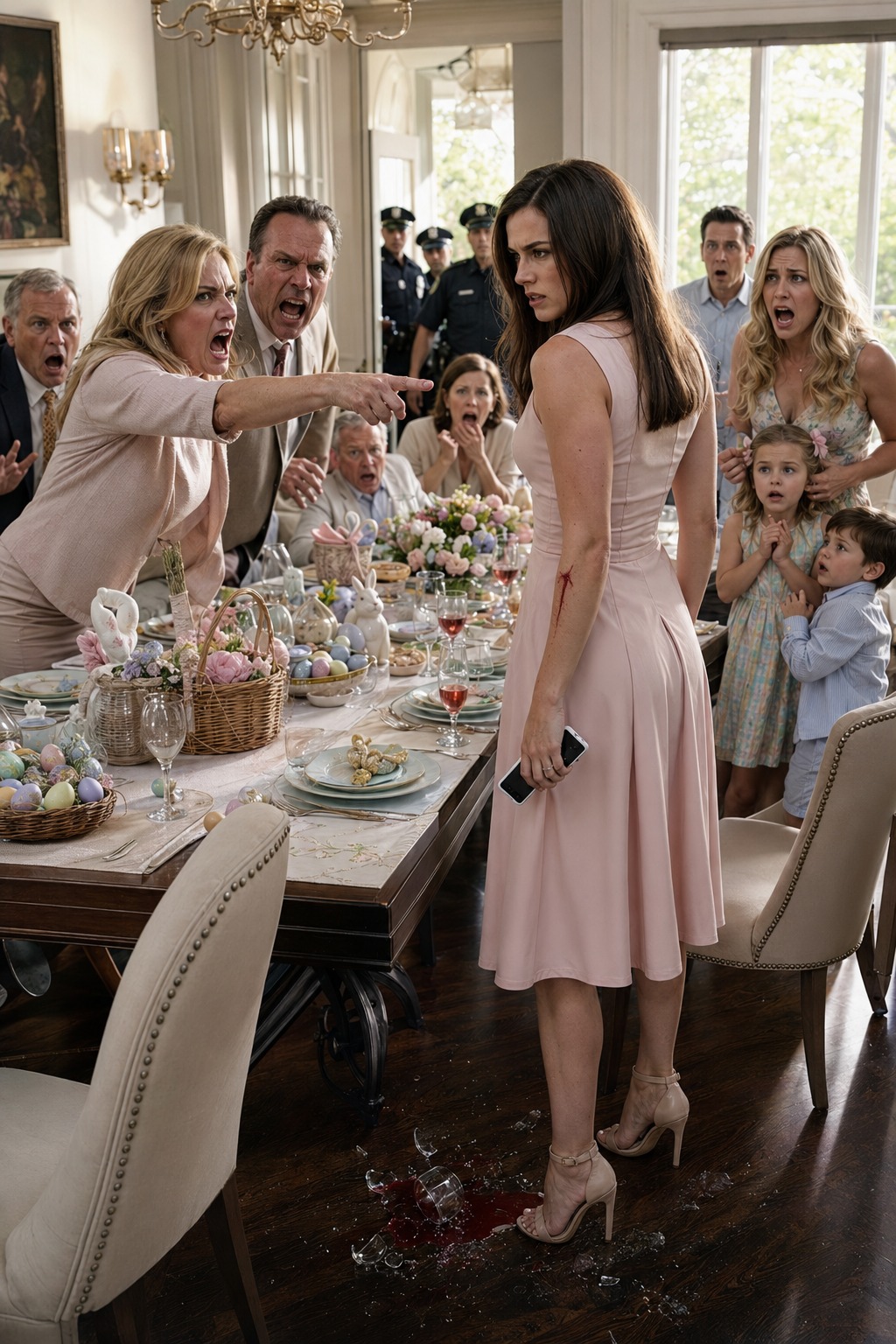
During Easter Dinner, My Parents Threw A Wine Glass At Me When I Refused To Let My Sister And Her Kids Move Into My House. “You’re Being Selfish!” My Mother Said, And They Added, “You Have Empty Bedrooms!” So I Smiled, Got Up, And Drove To The ER. While Bleeding, I Texted My Lawyer, “Phase One Is Complete.” The Police Came!
### Part 1
The wine glass hit me before I saw my father throw it.
One second, I was sitting at my parents’ Easter table, staring at the ham glaze hardening under the yellow dining room light. The next, something cracked against the side of my forehead with a sharp, wet sound that silenced everyone.
For half a second, I thought the warmth running down my face was wine.
Then it reached my lip, and I tasted metal.
My mother, Virginia, was still standing at the end of the table with both hands planted on the lace tablecloth, breathing like she had just run up a hill. My father, Harold, stood beside her, his right hand still hanging in the air like the throw had not fully left his body.
Red wine slid down the wall behind me.
Blood slid down my temple.
My niece Madison stood frozen near the doorway with a paper plate of carrot cake in her hands. Her little brother Tyler was upstairs crying because my sister Bethany had sent both kids away when “adult conversations” started. But Madison had come back down for dessert. She had seen everything.
“You’re being selfish,” my mother said.
Not shocked. Not sorry. Not even scared.
Just angry.
“You have empty bedrooms,” she added, as if that explained the glass, the blood, the nine-year-old shaking in the doorway.
I lifted my hand to my forehead. My fingers came away bright red, sticky, and dotted with tiny pieces of glass. My father’s eyes flickered to my hand, then back to my face.
For the first time all afternoon, I smiled.
It was small. Not happy. Not kind.
Just enough to make my mother blink.
“Perfect,” I said.
Bethany made a strangled sound from behind me. Her husband Kenneth looked like someone had slapped the air out of him. He had spent most of dinner staring into his mashed potatoes while my family explained why I needed to let his wife, their children, and all their unpaid bills move into my house.
My house.
The one I had spent ten years paying for.
The one with the blue front door, the crooked lilac bush by the porch, the home office I had painted soft green because nobody else had to approve it. The one Bethany had recently started calling “the family house” when she thought I was too tired to correct her.
“Where do you think you’re going?” my father demanded when I pushed back my chair.
The chair legs scraped across the hardwood. That sound snapped Madison out of her frozen state. The paper plate slid from her hands and landed frosting-side down on the rug.
“I’m going to get this looked at,” I said.
My voice sounded strange. Calm. Almost polite.
I picked up my purse from the back of the chair. My mother’s eyes narrowed.
“Don’t you dare make this dramatic, Sally.”
That was my name. Sally Donovan. Thirty-two years old. Mortgage holder. Taxpayer. Project manager. Ungrateful daughter, depending on who in my family was telling the story.
I took my phone out of my purse. My thumb left a red smear across the screen.
My father took one step toward me.
I raised the phone slightly, not enough to threaten, only enough to remind him that it existed.
“Thank you both,” I said. “This was exactly what I needed.”
Their anger shifted into confusion.
That was the first moment they looked afraid.
Not because they had hurt me. They had done that in smaller ways for years and slept fine afterward.
They looked afraid because I was not reacting the way I was supposed to react.
I did not cry.
I did not apologize.
I did not promise to think about Bethany’s situation.
I walked past my sister, past Kenneth, past Madison, who whispered, “Aunt Sally?” in a voice that nearly broke me.
I wanted to stop. I wanted to kneel in front of her and tell her none of this was her fault.
But blood was dripping onto my collar, my head was starting to pulse, and if I stopped, my mother would find a way to turn even that moment into proof that I was cruel.
So I kept walking.
Outside, the evening air smelled like cut grass, wet pavement, and someone else’s charcoal grill. The neighborhood was quiet in that Easter Sunday way, all pastel dresses and parked minivans and families pretending they did not scream behind closed doors.
I got into my car.
My hands shook only after I locked the doors.
At the first red light, I took a picture of my face. At the second, another. At the third, I zoomed in on the swelling above my eyebrow and the little glass sliver shining in the skin.
Then I sent a text to my lawyer, Richard Stevens.
Phase one is complete.
His reply came before the light turned green.
Go to the ER. Save everything. Say nothing to them.
I looked in the rearview mirror at the blood running down my cheek.
For the first time in my life, my family had finally crossed a line they could not drag me back from.
And I already knew they had no idea what I had been building behind that line.
### Part 2
The emergency room smelled like disinfectant, burnt coffee, and the faint sourness of fear.
I sat under fluorescent lights with a folded towel pressed to my head while a little boy in dinosaur pajamas coughed into his mother’s sweater across from me. A man with a swollen hand paced near the vending machines. Every few minutes, the automatic doors opened and let in a gust of cool night air.
My phone buzzed until I turned it face down.
Bethany called first.
Then my mother.
Then my father.
Then Bethany again.
Seventeen times in forty minutes.
No voicemails from my father. He never liked leaving evidence if he could help it. My mother left three.
The first one was angry.
The second was sweet.
The third was both.
“Sally, sweetheart, this has gotten out of hand. Your father didn’t mean it. Come back here and let’s talk like a family.”
I saved all three.
When the triage nurse asked what happened, I told her the truth.
“My father threw a wine glass at my head.”
She paused with her pen over the form. Her face did not change much, but her voice got softer.
“Do you feel safe going home tonight?”
“Yes,” I said. “They don’t have access to my house.”
That had not always been true.
Six months earlier, my parents still had a spare key. My mother said it was “for emergencies,” but somehow emergencies included letting herself in to rearrange my pantry, check my mail, and leave passive-aggressive notes on my kitchen counter.
Too many takeout containers. Are you eating properly?
This sweater still has tags on it. Must be nice.
Why do you need three bedrooms when Bethany’s children are sharing?
I changed the locks in January.
My mother did not speak to me for eight days, which at the time felt like punishment.
Now it felt like a vacation I had not appreciated enough.
After two hours, a doctor examined me and confirmed what my throbbing skull had already announced: concussion, seven stitches, multiple shallow cuts from glass, and bruising that would look worse by morning.
A nurse named Carla cleaned my face with careful hands.
“This is going to sting,” she warned.
It did.
I stared at a poster about stroke symptoms while she picked glass from my skin with tweezers. Each tiny click into the metal tray made my stomach tighten.
“You’re very calm,” she said after a while.
“I’ve had practice.”
She looked at me then. Not nosy. Just human.
I almost told her everything. About the January afternoon when Bethany arrived at my house with a real estate agent. About the emails titled Family Solution and Responsible Transition Plan. About my father’s voicemail saying he would “teach me respect” if I kept embarrassing him.
Instead, I said, “They’ve been escalating.”
Carla nodded like she understood more than I had said.
The police arrived after midnight because the hospital had to report the assault. Officer Martinez was younger than I expected, with dark hair pulled into a tight bun and tired eyes that missed nothing.
She photographed my injuries, my torn blouse, the dried wine on my sleeve, the little cuts on my cheek.
Then she asked me to start from the beginning.
“Tonight’s beginning,” I said, “or the real beginning?”
Her pen stopped.
“The real beginning.”
So I opened the folder on my phone.
Not a literal folder. Richard had told me not to keep everything in one place where my family could trick me into deleting it. I had cloud backups, email backups, screenshots, audio files, copies with Richard, copies with my friend Jennifer from work.
But on my phone, it appeared as a neat little folder labeled Receipts.
Officer Martinez scrolled through text messages from my mother.
You don’t need all that space.
Bethany has children. That means her needs come first.
You are thirty-two and still acting like a spoiled child.
She listened to one of my father’s voicemails.
“You better remember who raised you, girl. Family isn’t optional. You keep pushing us, you’ll find out what happens.”
Then she read Bethany’s email where my sister explained, in three numbered sections, why her family moving into my house would be “the most fair outcome for everyone.”
Everyone meant Bethany.
Fair meant I disappeared.
Officer Martinez’s expression hardened.
“How long has this been happening?”
“Since Bethany and Kenneth fell behind on their mortgage,” I said. “But the house thing started in January.”
“And you didn’t report it before?”
I looked down at my hands. There was dried blood under my fingernails.
“Because they were careful. Cruel, but careful. If I reported guilt trips and family pressure, everyone would tell me to compromise. So I documented. I waited.”
“For them to cross a line?”
“For them to stop hiding who they were.”
She studied me for a long moment.
“You planned for this possibility.”
“I protected myself.”
That was something Dr. Whitman had made me repeat in therapy.
Preparation was not revenge.
Evidence was not cruelty.
Boundaries were not attacks.
Officer Martinez closed her notebook.
“With injuries like these and the evidence you’ve shown me, we’ll be making arrests tonight.”
The words landed strangely.
Not like victory.
Like a door locking behind me.
My phone lit up again.
This time it was Kenneth.
Please don’t do this. Think of the kids.
I turned the screen toward Officer Martinez.
“Should I answer?”
She shook her head.
“No. Let them talk to us now.”
And suddenly, after years of being told I was the problem, someone else was finally going to knock on their door.
### Part 3
I slept for three hours that night, sitting upright on my couch with an ice pack on my face and every light in the house turned on.
My house was usually my favorite place in the world after dark. Warm lamps. Pine candle. The low hum of the refrigerator. The old floorboards clicking when the heat came on.
That night, every noise sounded like footsteps.
At 4:12 a.m., Richard emailed me copies of the police report request, a protective order draft, and a message that said: Do not respond to anyone. Not one word.
At 5:30 a.m., Nathan called.
Nathan was my cousin on my mother’s side, Aunt Lorraine’s son. We had never been best friends, exactly, but we had always been the two people who slipped outside during family gatherings when the house got too loud.
I almost ignored it.
Then I remembered Nathan had once seen my father punch a hole in the garage wall because the Thanksgiving turkey was “taking too long.”
I answered.
“I heard,” he said quietly.
My throat tightened at the sound of genuine concern.
“What did you hear?”
“That Uncle Harold and Aunt Virginia got arrested. That you went to the ER. That Bethany is telling everyone you staged some kind of scene.”
I laughed once, and it hurt my head.
“Of course she is.”
“Are you okay?”
No one else had asked that.
Not Bethany. Not Kenneth. Not Aunt Lorraine, whose first text arrived ten minutes after my parents were taken away.
How could you do this to your own mother?
Not even my mother, whose last voicemail before the arrest said, You’re going to regret humiliating us.
“I have seven stitches and a concussion,” I told Nathan. “But I’m okay.”
There was a pause.
“I’m sorry,” he said. “I know that doesn’t fix anything, but I’m sorry.”
I stared across the living room at the picture frames on my mantel. Most of them were landscapes or friends from work. No family photos. I had removed the last one in January after my mother told me my house looked “cold” without enough family in it.
“I think I’ve been waiting my whole life for someone in this family to say that,” I said.
Nathan exhaled.
“They’re all going to side with them. You know that, right?”
“I know.”
“They’re already saying you overreacted. Aunt Lorraine said your dad just tossed the glass and you moved into it.”
I closed my eyes.
Moved into it.
That was new, even for them.
“Madison saw it,” I said.
“I know. Lorraine says kids get confused.”
“They always have an answer.”
“They always do.”
After we hung up, I stood in the middle of my living room and let myself look at everything they had wanted.
The hallway with the framed botanical prints.
The kitchen I had renovated one cabinet at a time.
The guest room with white curtains.
The office with the desk facing the backyard.
Bethany had walked through those rooms in January with Tiffany Morgan, a real estate agent she knew from high school. I had opened the door expecting my sister with maybe a casserole or an apology. Instead, she came in with Tiffany, a tape measure, and a smile too bright to be real.
“We’re just planning ahead,” Bethany had said.
“For what?”
“For when we transition.”
That was the first time she used that word.
Transition.
As if my life were a storage unit she could clear out.
Tiffany measured the guest room while Bethany explained that Madison could have my office because “all you do is type in there anyway,” and Tyler could have the guest room once I got my “single-woman furniture” out.
I remembered the exact smell of that afternoon: lemon cleaner, cold rain on Bethany’s coat, and the lavender candle burning on my desk.
I also remembered Tiffany’s face.
Embarrassed. Nervous. Not surprised enough.
When I told them to leave, Bethany cried on my porch. Loudly. For neighbors.
“You’re choosing walls over children,” she said.
Tiffany slipped a business card under my hand before she left.
On the back, in rushed handwriting, she had written: She told me you agreed. I’m sorry. Call if needed.
I called Richard that same day.
Now, three months later, my parents were in jail, my sister was spreading the family-approved version of events, and Tiffany’s card sat in an evidence envelope.
At 9:00 a.m., Aunt Lorraine called.
I let it go to voicemail.
Her voice came through sharp and trembling.
“Your parents spent the night in a cell because of you. I hope that house keeps you warm when you have no family left.”
I listened twice.
Then I forwarded it to Richard.
Five minutes later, my doorbell rang.
I froze.
The camera app showed Bethany on my porch, hair unbrushed, eyes swollen, fist raised to knock again.
Behind her stood Kenneth.
And in his hand was a folder I had never seen before.
### Part 4
I did not open the door.
Bethany pressed the doorbell again and again, each chime making my headache flare behind my stitched eyebrow.
“Sally,” she called, leaning close to the camera. “I know you’re in there. We need to talk.”
Kenneth stood two steps behind her, holding the folder against his chest like it might explode if he lowered it.
I used the speaker on the doorbell camera.
“You need to leave.”
Bethany looked straight into the lens.
“Mom and Dad are in jail.”
“I know.”
“Because of you.”
“Because Dad threw a glass at my head.”
Her mouth tightened.
“That’s not fair.”
I almost smiled. My sister could watch me bleed and still call my description unfair.
Kenneth shifted behind her.
“Sally,” he said, “can we just talk for five minutes? Please. The kids are scared.”
“Then go be with your kids.”
Bethany slapped the door with her palm.
“You don’t get to act superior. You planned this. Mom said you texted a lawyer from the hospital.”
“She’s right.”
That made both of them go still.
I stepped closer to the door, though they could not see me.
“I texted my attorney because I was assaulted. That is what adults do when crimes happen.”
Kenneth looked down at the folder.
Bethany noticed and snatched it from him.
“We came to show you something,” she said. “Something Mom and Dad were going to discuss before you made everything ugly.”
Before I made everything ugly.
There it was again. The family language. The person who objected to being harmed was always the one causing trouble.
“What is it?”
Bethany lifted a paper toward the camera, too close for me to read.
“A family occupancy agreement.”
My stomach dropped, not because I understood it fully, but because I recognized Richard’s warning in my head.
They may try to get you to sign something under emotional pressure. Do not sign anything. Do not accept anything. Photograph everything.
Bethany continued, voice growing stronger now that she had a script.
“It just says Kenneth and I can live here with the kids for a temporary period while we stabilize. Mom and Dad said you’d be more comfortable if things were official.”
“How temporary?”
She hesitated.
Kenneth answered softly, “Three years.”
I laughed.
I could not help it. It came out cracked and painful.
“Three years in my house?”
“Our kids need stability,” Bethany snapped.
“So do I.”
“You don’t have kids.”
“I am still a person.”
She rolled her eyes like I had made a technical argument no one cared about.
Then she said the sentence that chilled me more than the glass had.
“Mom said if you refused, we could prove they had a financial interest in the house.”
I went very still.
“What financial interest?”
Bethany’s confidence wavered.
“The down payment.”
“I paid that loan back.”
“Mom says you didn’t.”
I felt the old panic rise. The familiar childhood panic of knowing the truth but being surrounded by people willing to lie louder.
“I have bank records.”
“Mom has records too.”
Kenneth looked miserable.
I focused on him.
“Kenneth, what is in that folder?”
His eyes lifted to the camera.
For one second, I saw shame.
Then Bethany stepped in front of him.
“You don’t get to interrogate my husband.”
“No,” I said. “But the police can.”
That worked.
Bethany’s face changed.
She looked over her shoulder at the street, suddenly aware that my neighbors had windows, that my porch had a camera, that my father’s arrest had happened less than twelve hours earlier.
Kenneth touched her arm.
“Beth, let’s go.”
“No. She needs to know this isn’t over.”
I took a slow breath.
“It is over. You are not moving into my house. You are not getting ownership of my house. You are not using your children as crowbars to pry open my front door.”
Bethany’s eyes filled with tears, but they were angry tears. Performance tears. The kind my mother used whenever facts stopped working.
“You were always selfish,” she whispered. “Mom was right about you.”
Then she shoved the folder through my mail slot.
It landed on the entry rug with a soft slap.
Bethany and Kenneth left after that. I watched them through the camera until their car turned the corner.
Only then did I pick up the folder.
Inside were printed forms, typed notes, and a copy of my mortgage statement with yellow highlights over my name and loan number.
On the final page, in my mother’s handwriting, was a sentence underlined twice.
If Sally will not cooperate willingly, we need to establish prior family investment and force negotiation.
My hands went cold.
This was no longer just about a desperate sister.
This was organized.
And my parents had planned for me to lose long before Easter dinner.
### Part 5
Richard’s office was on the third floor of a brick building downtown, above a bakery that made the whole stairwell smell like butter and cinnamon.
Usually, that smell comforted me.
That morning, with my forehead bandaged and the folder in my lap, it made me nauseous.
Richard Stevens was in his late fifties, with silver hair, rimless glasses, and the calmest voice I had ever heard in a crisis. He did not waste words. He did not gasp. He did not perform outrage.
He read.
Page after page.
The “family occupancy agreement.”
The notes about my parents’ supposed investment.
The highlighted mortgage statement.
The handwritten line from my mother.
When he finished, he placed the pages neatly back into the folder.
“This is useful,” he said.
“Useful?”
“Very.”
I rubbed my hands over my jeans.
“Richard, were they actually able to do anything with this?”
“With this? No. This document is nonsense. But nonsense can still hurt you if enough people repeat it confidently.”
That sounded like my family motto.
He tapped the folder.
“They were building a story. They wanted to pressure you into signing something that would give Bethany and Kenneth legal residency in your home. Once inside, removing them could become expensive and emotionally brutal.”
I looked toward his window. Below, people walked past carrying coffee, living in a world where Easter dinner did not turn into evidence.
“They were going to squat?”
“Possibly. Or force you into a civil dispute so exhausting you’d agree to sell or transfer partial ownership to make it stop.”
I closed my eyes.
I could see it.
Bethany’s boxes in my hallway.
My mother crying to relatives that I was trying to evict children.
My father standing in my kitchen, daring me to call the police.
My house slowly turning into a battlefield where every room I loved became proof that I owed someone something.
Richard’s voice softened.
“Sally, I need you to understand something. The assault may feel like the central event because it was violent. But legally, this folder helps show motive and pattern.”
Pattern.
That word had followed me for months.
Dr. Whitman used it too.
“When you grow up inside dysfunction,” she had told me once, “you’re taught to treat every incident as isolated. He had a bad day. She was stressed. Your sister was desperate. Healing starts when you see the pattern.”
The pattern started before Bethany’s foreclosure.
Before my house.
Before I knew how to sign my name on a mortgage.
When I was sixteen, I worked at a used bookstore called The Dust Jacket. I loved that place. It smelled like paper, coffee, and old carpet. I earned $7.25 an hour shelving mysteries and ringing up customers who wanted Nora Roberts paperbacks in bulk.
My father helped me open a bank account.
“Good lesson in responsibility,” he said.
Every paycheck went there.
By graduation, I should have had almost five thousand dollars.
I had two hundred and eighty-seven.
When I asked where the rest went, my father said, “Family emergencies.”
“What emergencies?”
His face darkened.
“Don’t start keeping score, Sally.”
That phrase became a wall.
Don’t keep score.
Don’t be selfish.
Don’t embarrass us.
Years later, when I asked my mother about the college fund my grandparents had supposedly started, she told me there had never been much in it.
“Your grandmother liked to talk big,” she said.
I believed her until I was twenty-three and an estate attorney accidentally mentioned an education account that had contained eighteen thousand dollars when I turned seventeen.
By then, I had student loans, two jobs, and a stomach ulcer from living on vending-machine crackers during finals.
Richard knew some of this, but not all. I had told him only what seemed relevant to the house.
Now he asked me to tell him everything.
So I did.
The missing paychecks.
The vanished college fund.
The down payment loan I had repaid with interest.
The way my mother demanded copies of my financial statements before “helping” me buy the house.
The way my father got angry when I paid him back early because, apparently, debt was only noble when it kept me obedient.
Richard took notes.
Not dramatically. Not emotionally.
But with the steady precision of a man building a bridge over a pit I had lived in for years.
When I finished, he leaned back.
“There’s a chance some of this may not be admissible in the criminal case. But it matters. It tells us what they were doing.”
“What were they doing?”
“Training you to doubt ownership of your own life.”
The sentence hit harder than I expected.
I looked down at my hands.
For years, I had thought I was bad at being loved.
Maybe I had only been good at being used.
Richard slid a clean legal pad toward me.
“Write down every incident you remember. Dates if possible. Details if not. Smells, rooms, exact phrases. Especially phrases they repeated.”
“Why?”
“Because families like yours survive by making you forget the pattern.”
He paused.
“And because I suspect the folder Bethany brought you is not the only one.”
That night, I went home and opened the old storage bin in my closet.
At the bottom, under tax returns and Christmas cards, I found the envelope my mother had insisted I keep from the house closing.
Inside was a copy of the down payment loan agreement.
And stapled behind it was a page I had never seen before.
### Part 6
The page was not signed.
That was the first thing I noticed.
My name appeared at the top in block letters: SALLY MARIE DONOVAN.
Below it, someone had typed a paragraph stating that Harold and Virginia Donovan had provided “substantial family funds” toward the purchase of my home with the expectation of “future shared family benefit.”
Future shared family benefit.
I sat on the floor of my closet, surrounded by shoe boxes and old tax folders, reading that phrase until it stopped looking like English.
The paper was dated two days before my closing.
I remembered those days vividly because I had barely slept. I had checked every document three times, terrified of missing something. My mother had come with me to the bank “for moral support,” wearing perfume so strong the loan officer sneezed.
At one point, she asked to hold the folder of documents while I signed a final form.
Had this page been in there then?
Had she tried to slide it into the closing packet?
Or had she simply kept it, waiting for the day she needed a lie with a date on it?
I photographed the page and sent it to Richard.
His reply came fifteen minutes later.
Do not touch original more than necessary. Bag it. Bring it tomorrow.
I stared at the message.
Then my phone rang.
Unknown number.
I let it go to voicemail.
A minute later, the transcript appeared.
This is Aunt Lorraine. Your mother is sobbing herself sick. Your father’s blood pressure is through the roof. You need to drop this nonsense before it kills them.
Nonsense.
Seven stitches was nonsense.
A forged-looking document was nonsense.
A child watching her grandfather throw glass was nonsense.
I put the phone down and went into the bathroom.
My reflection startled me.
One side of my face was swollen yellow and purple. The stitches curved above my eyebrow like an ugly little ladder. Dried cuts dotted my cheek. Under the bright vanity bulbs, I looked both fragile and furious.
I remembered being eleven years old and standing in this same kind of light in my parents’ bathroom while my mother dabbed concealer over a bruise on my upper arm.
“You bruise too easily,” she said.
My father had grabbed me there the night before because I dropped a glass pitcher.
“Don’t tell people you’re clumsy,” my mother added. “They’ll think we don’t watch you.”
Even then, the priority had not been pain.
It had been appearance.
The next morning, Richard placed the unsigned page in an evidence sleeve.
“This may not be forgery if they never used it,” he said. “But paired with the folder Bethany brought and the Easter demands, it helps show intent.”
“Intent to do what?”
“To create leverage.”
The preliminary hearing happened three days later.
My parents arrived in court wearing the kind of clothes they wore to church funerals. My mother had chosen a navy dress and pearls. My father wore a gray suit with a tie I gave him for Father’s Day five years earlier.
I hated that I noticed.
I hated more that some part of me still cared whether he remembered.
They did not look at me when they entered.
Bethany did.
Her eyes were red, but her mouth was hard.
The prosecutor presented the basics first: injury photos, medical records, the police report, the glass recovered from my parents’ dining room, witness statements from Kenneth and Madison.
Madison’s statement was read without bringing her into court.
I was grateful for that.
She had said, in a child’s plain words, “Grandpa got mad and threw the cup at Aunt Sally’s face. Grandma was yelling.”
My mother covered her mouth like she was hurt by the statement.
Not by the memory.
By the statement.
Then came the messages.
Sweet ones first.
Honey, let’s discuss Bethany using the extra rooms.
You have always been so practical. This is the practical thing.
Then sharper.
You are embarrassing this family.
Do you enjoy watching children suffer?
Then my father’s.
You think you’re untouchable because you own a house?
The judge’s expression barely changed, but I saw his jaw tighten.
My parents’ public defender tried to argue that the injury came from “a chaotic family disagreement” and that my father had not intended to hit me.
Richard, who was there for me but not acting as prosecutor, passed a note to the assistant district attorney.
She stood.
“Your Honor, we also have evidence of escalating property-related coercion.”
My mother’s head snapped toward me.
There it was.
Fear again.
The same flash I had seen after I smiled through the blood.
The court did not see everything that day, but it saw enough.
Bail was set.
Restraining conditions were ordered.
And as officers led my parents back through the side door, my father finally looked at me.
His lips moved without sound.
But I knew the words.
You’ll regret this.
For the first time, I wondered if he had any idea that I already regretted something.
Not calling the police sooner.
### Part 7
The family campaign began before my parents made bail.
Aunt Lorraine posted first.
Some people forget who loved them first. Pray for my sister and brother-in-law during this cruel time.
No names. No details. Just enough for relatives to gather in the comments with sad-face emojis and vague outrage.
Then Bethany posted a picture of Madison and Tyler on Easter morning holding plastic baskets.
Family should protect children, not punish them.
By noon, I had twelve missed calls, nine texts, and one message from a second cousin in Ohio I had not seen since I was fourteen.
You only get one mother.
I stared at that sentence while sitting in my car outside Dr. Whitman’s office.
The sky was low and gray. Rain streaked the windshield in crooked lines. My stitches itched under the bandage.
You only get one mother.
As if that settled anything.
Dr. Sarah Whitman’s office was warm, always a little too warm, with woven blankets folded over the couch and a white noise machine outside the door. She specialized in family trauma, though when I first found her, I told myself I was only going because I needed help with “stress.”
Stress sounded normal.
Family trauma sounded like something that happened to other people.
She noticed the bandage immediately.
I told her everything.
The dinner. The glass. The police. The folder. The unsigned page.
She listened without interrupting, one leg crossed over the other, pen resting in her hand.
When I finished, she said, “How are you feeling?”
I laughed.
“I hate that question.”
“I know.”
“I feel relieved. Then guilty for feeling relieved. Then scared that relief makes me a terrible person. Then angry that I’m still measuring my morality by whether my parents approve of my feelings.”
“That’s a very clear answer.”
“I’ve had a long week.”
She smiled gently.
“What did you need on Easter when you arrived?”
The question surprised me.
“I wanted to say no and leave.”
“What stopped you?”
I looked at the bookshelf behind her. Trauma, Boundaries, Adult Children, Nervous System. The spines blurred slightly.
“Hope,” I said. “Stupid hope. That maybe if I said it calmly enough, they’d hear me.”
“That wasn’t stupid. That was human.”
My throat tightened.
“My mother called me selfish while I was bleeding.”
Dr. Whitman nodded.
“What does that tell you?”
“That she’s a monster?”
“It tells me her need to control the story was stronger than her instinct to care for your injury.”
That was worse, somehow.
Monsters were born different.
My mother had made choices.
Over the next hour, we mapped the family pattern on a whiteboard.
Demand.
Guilt.
Revision.
Punishment.
When I complied, the cycle paused.
When I resisted, it escalated.
“You were not waiting for them to cross a line because you wanted harm,” Dr. Whitman said. “You were waiting because every smaller violation had been normalized by the people around you.”
I thought of family dinners where my father slammed cabinets and everyone kept eating.
I thought of my mother reading my bank statements at the kitchen table and calling it guidance.
I thought of Bethany borrowing money and never repaying it because “you know how tight things are for us.”
After therapy, I found Nathan waiting outside by the coffee shop next door. He had texted earlier asking if I wanted company, and I had said maybe, which he correctly interpreted as yes.
We sat near the window. He ordered black coffee. I ordered chamomile tea I did not want.
“They’re out,” he said.
My hand tightened around the paper cup.
“Already?”
“Lorraine posted bail.”
Of course she had.
“She’s furious,” he continued. “At you, mostly. A little at them, but only privately.”
“Did they say anything?”
Nathan hesitated.
“What?”
“Uncle Harold says you’re going to learn what happens when you humiliate him.”
My body went cold, then hot.
Nathan leaned forward.
“I’m not telling you to scare you. I’m telling you because you need to know.”
I looked out the window at people crossing the wet street under umbrellas.
For thirty-two years, the threat of my father’s anger had been the weather system of my life. Everyone checked it, worked around it, planned for it, excused it.
Now Nathan was naming it.
Warning me.
Standing outside it with me.
“I’m changing the security code tonight,” I said.
“Good.”
“And sending that threat to Richard.”
“Better.”
He looked tired.
“You know what’s strange?” he said. “When I told Mom what Uncle Harold did was wrong, she said I’d understand when I had children. Like having children makes assault reasonable.”
“That’s the family religion,” I said. “Parents are always owed. Children are always owing.”
Nathan looked at my bandage.
“Do you still feel like you owe them?”
I wanted to say no.
Instead, I looked down at my tea.
That was answer enough.
And that night, when I got home, a manila envelope was waiting on my porch with no stamp, no name, and three words written across the front.
Final chance, Sally.
### Part 8
I called the police before I touched the envelope.
That was new for me.
Old Sally would have brought it inside, opened it alone, panicked alone, and then convinced herself it was not serious enough to bother anyone.
New Sally stood on her porch in the cold porch light with her arms crossed, watching the envelope sit on the welcome mat like something alive.
Officer Martinez arrived with another officer twenty minutes later.
“You did the right thing,” she said.
Those six words did something strange inside me.
They steadied me.
She photographed the envelope, put on gloves, and opened it while I stood back.
Inside were three things.
A printed copy of the unsigned “family interest” document.
A photocopy of a check from my parents for fifteen thousand dollars, the old down payment loan.
And a handwritten note.
You can still fix this. Withdraw your statement. Sign the occupancy agreement. Let Bethany’s family move in by May 1. No one else has to know what you did.
Officer Martinez read it twice.
“What I did,” I said quietly.
She looked up.
“That’s how coercion works. They reverse victim and offender.”
I almost laughed.
Everyone in my life had become a therapist or lawyer lately, and somehow all of them made more sense than my family ever had.
The photocopied check was familiar. I had seen it before.
When I bought my house, my parents offered the down payment loan like a gift wrapped in pride.
“We want to help you get started,” my mother said.
I cried when they gave it to me.
Actual tears.
I thought it meant they believed in me.
The agreement we signed said I would repay them over five years at three percent interest. I paid it back in three by working overtime, skipping vacations, and eating so many peanut butter sandwiches that I still avoided them in the grocery store.
I had records of every transfer.
But in my family, proof never mattered unless my parents were holding it.
Officer Martinez bagged everything.
“Do you know who left it?”
“No.”
“Camera?”
I opened the app.
At 10:43 p.m., a figure in a hooded sweatshirt approached my porch, placed the envelope down, and walked away. The face was mostly hidden, but the walk was not.
Bethany.
I knew the short, impatient stride. The way her left foot turned slightly inward. The way she checked over her shoulder not from fear, but annoyance.
Officer Martinez watched the video.
“Can you send me this?”
“Yes.”
After the police left, I sat at my kitchen table with my laptop and opened the folder of bank records.
I had avoided looking at them too closely before because they made me feel sick. Not from fear. From humiliation.
Every transfer back to my parents had a note.
Loan repayment, month 1.
Loan repayment, month 2.
Extra principal.
Final payment. Thank you.
Thank you.
I had thanked them for the privilege of escaping a debt they later tried to turn into a chain.
At midnight, Richard called.
“I’m filing for an emergency extension of the protective order terms,” he said. “And we’re adding this to the harassment evidence.”
“Can they still contact me through other people?”
“They can try. We’ll document that too.”
I looked at the dark window over the sink. My reflection floated there, pale and bruised, with the kitchen behind me looking warm and almost normal.
“Richard?”
“Yes?”
“Do people like this ever stop?”
He did not answer immediately.
“Not because you explain better,” he said. “Not because you find the perfect words. They stop when access costs them more than control rewards them.”
That sentence stayed with me.
The next week was a blur of statements, calls, and forwarded messages.
Bethany denied leaving the envelope until Officer Martinez mentioned the camera. Then she claimed she was “returning family documents.” Kenneth sent me an email apologizing for the porch incident and asking me, again, to think about the kids.
I did think about them.
I thought about Madison holding that fallen plate.
I thought about Tyler crying upstairs.
I thought about what they would learn if everyone pretended violence was a misunderstanding and theft was family planning.
Then I forwarded Kenneth’s email to Richard.
The trial date was set for June.
My parents rejected the plea deal.
Anger management, probation, no contact, admission of guilt.
My mother would have taken it, Richard suspected.
My father refused.
“He thinks a jury will understand him,” Richard said.
“What does that mean?”
“It means he believes ordinary people will agree that you deserved to be controlled.”
In June, I walked into court wearing a navy suit, low heels, and makeup carefully blended around a fading scar.
Across the aisle, my father smiled at me.
Not warmly.
Like he knew something I did not.
And for one terrible moment, I wondered what he had saved for trial.
### Part 9
Jury selection took two days.
I had never watched people get questioned about their beliefs so directly.
Do you believe family conflicts should stay private?
Do you believe adult children have a duty to care for siblings?
Have you ever been involved in a domestic violence case?
Some people answered carefully. Some answered too quickly. One man said, “I just think daughters should respect their fathers,” and Richard wrote something on his legal pad with a calm little nod that meant absolutely not.
The prosecutor, Ms. Alvarez, was sharp and compact, with a voice that could cut through fog. She told me before opening statements that my job was simple.
“Tell the truth. Don’t argue with their lawyer. Don’t soften things to protect them.”
That last instruction was harder than it sounded.
Softening was my oldest habit.
My mother did not scream. She got emotional.
My father did not threaten. He had a temper.
Bethany did not demand my house. She was desperate.
Language had been the first place I learned to betray myself.
Ms. Alvarez did not let the defense soften anything.
In opening statements, she stood in front of the jury and said, “This case is about what happens when entitlement becomes coercion, and coercion becomes violence.”
My father’s attorney, Walter Green, looked exhausted before he even began. He described Easter dinner as “a tragic misunderstanding during a stressful family conversation.”
Misunderstanding.
I touched the scar above my eyebrow.
The first witnesses were clinical and procedural.
The ER doctor described the concussion, the stitches, the glass fragments.
Officer Martinez described my injuries, my statement, the evidence folder, the envelope left on my porch.
Photos appeared on a screen.
My face, bloodied under hospital lights.
The dining room wall with wine splatter.
The shattered stem of the glass on the hardwood.
I stared at the table, not the screen.
I had seen enough of my own blood.
Then Kenneth testified.
He walked to the stand in a suit that did not fit right, shoulders rounded inward, eyes avoiding Bethany’s side of the gallery. My sister sat stiffly behind the defense table, lips pressed so tight they looked white.
Ms. Alvarez began gently.
“Mr. Harper, were you present at Easter dinner?”
“Yes.”
“Did you see Harold Donovan throw a wine glass?”
He swallowed.
“Yes.”
Bethany made a tiny sound behind him.
The prosecutor continued.
“Was it an accident?”
Kenneth closed his eyes for half a second.
“No.”
The courtroom shifted.
It was not loud. No dramatic gasp. Just a collective adjustment, like everyone had leaned forward at once.
“What happened before the glass was thrown?”
Kenneth described the conversation. Bethany asking about the house. My mother saying I had more space than I needed. My father telling me family came first. Me saying no.
“Had there been previous discussions about your family moving into Ms. Donovan’s home?”
“Yes.”
“Were you and your wife financially able to assume her mortgage?”
“No.”
“Had you been approved by her lender?”
“No.”
“So what was the plan?”
Kenneth looked miserable.
“Bethany thought if we moved in, Sally wouldn’t make us leave. Not with the kids there.”
There it was.
Simple. Ugly. True.
Ms. Alvarez let the silence sit.
“Who encouraged that plan?”
Kenneth looked toward Bethany.
“Her parents.”
My mother’s face crumpled, but no tears came.
The defense tried to make Kenneth look bitter. They asked about his failing business, his arguments with Bethany, whether he blamed my parents for his financial problems.
He answered quietly.
“I blame myself for my part. But I know what I saw.”
Bethany testified next.
She came in ready for battle.
Her hair was smooth, makeup perfect, voice trembling just enough to sound wounded.
She said I had always been distant. Always “career-focused.” Always treated the family like an inconvenience.
Ms. Alvarez asked, “Do you believe your sister owed you her house?”
Bethany lifted her chin.
“I believe family should help family.”
“That wasn’t my question.”
Bethany’s jaw tightened.
“She had empty rooms.”
“Did you believe you were entitled to live in them?”
“My children were about to lose their home.”
“Because your sister caused that?”
“No, but she could have helped.”
“By giving you her home?”
“By sharing.”
“Sharing for three years?”
Bethany flushed.
“Until we got stable.”
“Despite not being approved to assume the mortgage?”
“That’s paperwork.”
“Despite Ms. Donovan saying no?”
“She says no to everything.”
Ms. Alvarez paused.
“Mrs. Harper, did you leave an envelope on your sister’s porch after your parents were arrested?”
Bethany’s eyes flicked to the jury.
“I returned documents.”
“Documents that said she had a final chance?”
Bethany did not answer.
The prosecutor read the note aloud.
By the time she finished, my sister’s wounded act had cracked around the edges.
Then Ms. Alvarez asked one final question.
“When your father threw the glass at your sister, did you check on her injury?”
Bethany looked at me for the first time.
“No.”
“Why not?”
For once, she had no polished answer.
“Because I was upset,” she whispered.
I believed her.
She had been upset.
Just not for me.
### Part 10
My mother wore pearls on the day she lied under oath.
I noticed them because they were my grandmother’s.
Tiny cream-colored pearls with a gold clasp, the ones Grandma Elaine used to let me touch when I sat beside her in church. She had promised them to me once, laughing softly as she said, “When you’re grown, Sally. Pearls are for women who know themselves.”
After she died, my mother said Grandma must have changed her mind.
Now those pearls rested against Virginia Donovan’s throat while she told twelve strangers that she loved me.
“I love both my daughters,” she said, dabbing at the corner of one eye with a tissue. “I only wanted them to support each other.”
Ms. Alvarez let her speak for a while.
That was the clever thing.
My mother was always most dangerous when interrupted. When allowed to explain, she could not resist decorating the lie until it bent under its own weight.
She talked about sacrifice.
About motherhood.
About how painful it was to see one child “hoarding comfort” while another suffered.
Then Ms. Alvarez stepped closer.
“Mrs. Donovan, did your husband throw a wine glass at Sally?”
“It slipped.”
“From his hand to her forehead?”
My mother’s lips tightened.
“He was gesturing.”
“With a full wine glass?”
“It was a stressful conversation.”
“Were you yelling?”
“I was emotional.”
“Were you standing when you called your daughter selfish?”
“I may have stood.”
“Did you check whether she was injured?”
My mother looked down.
“I was in shock.”
That was almost funny.
I remembered her voice clearly.
Don’t you dare make this dramatic.
Not shock.
Strategy.
Ms. Alvarez then introduced my mother’s notebook.
I had forgotten about it until Richard found it in discovery photos from the dining room. My mother kept lists for everything: groceries, church donations, grudges disguised as prayer requests.
The police had photographed the dining room after the arrest. On a sideboard near the Easter centerpiece sat the notebook, open to a page dated March 15.
Richard noticed the line in one of the photos and asked the prosecutor to subpoena it.
Ms. Alvarez held it up.
“Is this your handwriting?”
My mother’s fingers tightened around the tissue.
“Yes.”
“Can you read the sentence marked here?”
“I don’t have my glasses.”
The prosecutor read it for her.
“If Sally will not listen to reason, we will have to make her understand. There have to be consequences.”
The courtroom went very still.
“What consequences did you mean?”
“I was frustrated.”
“What consequences?”
“I don’t remember.”
“You wrote it three weeks before your husband threw a wine glass at her head.”
The defense objected.
Sustained.
But the jury had heard it.
My father testified after lunch.
He did not wear guilt well.
Some people shrink under judgment. Harold Donovan grew harder. He sat in the witness chair with his shoulders squared, answering questions like each one insulted him.
“Did you throw the wine glass?” Ms. Alvarez asked.
“No.”
“What happened?”
“It slipped.”
“While you were angry?”
“I was disappointed.”
“In your daughter?”
“In her behavior.”
“What behavior?”
“Refusing to help family.”
“By giving up her house?”
He glared.
“No one asked her to give it up.”
The prosecutor picked up the occupancy agreement.
“This document requests residency for Bethany Harper’s family for three years.”
“That’s temporary.”
“Three years is temporary?”
“In a family, yes.”
I felt the old pressure in my chest. The pressure of being in a room where my father sounded insane to me but confident to himself.
Ms. Alvarez asked about his past.
The defense fought hard, but some of it came in: the plate he threw three weeks before Easter, the former supervisor who said Harold was fired after threatening a coworker, the neighbor who heard monthly screaming and crashes from my parents’ house.
My father denied almost everything.
Everyone exaggerated.
Everyone misunderstood.
Everyone disrespected him.
Then Richard passed Ms. Alvarez one final note.
She glanced at it and said, “Mr. Donovan, do you remember telling your daughter she was ‘untouchable’ because she owned a house?”
“No.”
“Do you remember leaving her a voicemail saying she would ‘find out what happens’ if she forgot family?”
“I don’t recall.”
The audio played.
His voice filled the courtroom.
“You better remember who raised you, girl. Family isn’t optional. You keep pushing us, you’ll find out what happens.”
My father’s face turned red.
Not with shame.
With rage.
For one second, I was back at the Easter table. Back under the chandelier. Back with glass flying toward me.
Only this time, he could not reach me.
When it was my turn to testify, my legs felt unsteady, but my voice did not.
I described Easter dinner. The smell of ham and wine. Madison’s plate. My mother’s words. The glass. The blood. The strange quiet after impact.
The prosecutor asked, “Why didn’t you give your sister your house?”
“Because it’s mine,” I said.
Simple.
Almost shocking in its simplicity.
“I earned it. I paid for it. I live there. Having more than someone else does not make my life public property.”
The defense attorney tried to paint me as cold.
“You texted your lawyer instead of your family?”
“My family was the reason I needed a lawyer.”
“You had prepared evidence before Easter?”
“Yes.”
“So you were waiting for this?”
“No,” I said. “I was afraid of this. There’s a difference.”
He frowned.
“You smiled after being injured, didn’t you?”
“I did.”
“Why?”
I looked at the jury.
“Because for years, they hurt me in ways that left no marks. That night, they finally did it in a way nobody could call imagination.”
No one spoke.
Then Mr. Green looked away first.
And I knew, before the verdict, that something had shifted.
### Part 11
The jury deliberated for six hours.
Six hours is long enough to live several lives in your head.
In one version, my parents were acquitted and walked out smiling, immediately surrounded by relatives who would call it justice.
In another, the jury convicted my father but not my mother because she had not thrown the glass.
In the worst version, everyone agreed something bad happened but decided family made it complicated.
Family always made things complicated for people who did not want to call harm by its name.
I sat in a courthouse hallway with Richard on one side and Nathan on the other. Nathan had taken a day off work to be there. He brought me coffee I barely drank and a blueberry muffin I picked apart into crumbs.
“You’re doing that thing,” he said.
“What thing?”
“Trying to predict disaster so it feels less painful if it happens.”
I looked at him.
“When did you get so insightful?”
“I’ve been reading.”
“Dangerous.”
He smiled, then looked down the hallway where Aunt Lorraine stood with Bethany. Neither of them approached. The restraining order conditions made that unwise, but I suspected the cameras near the ceiling helped too.
Bethany looked smaller than she had on the witness stand.
For a second, I almost felt sorry for her.
Then I remembered Madison’s shaking hands.
Pity was not the same as permission.
When the bailiff called us back, my stomach dropped so hard I thought I might be sick.
The courtroom filled with the rustle of coats, whispers, and wooden benches creaking under shifting bodies.
My parents stood.
I stood too.
The jury foreperson was a woman around my mother’s age with silver-streaked hair and kind eyes. She did not look at me when she handed the forms to the clerk.
On the charge of assault: guilty.
On the charge of harassment: guilty.
On the charge of coercive intimidation related to property demands: guilty.
My mother made a sound like air leaving a tire.
My father stared forward.
Bethany began sobbing behind them, but even her crying sounded angry, like grief had offended her by arriving.
I did not cry.
Not then.
I felt the verdict like heat on frozen hands.
Painful because feeling was returning.
The judge set sentencing for two weeks later and continued the protective order. My parents were taken into custody pending review. As they passed the aisle, my mother turned her head.
Her eyes found mine.
For once, there was no sweetness in them.
No motherly mask.
Just blame.
Outside, reporters waited near the courthouse steps. The local news had picked up the story after the second day of trial. “Parents Assault Daughter Over House Dispute” was too strange, too ugly, too clickable to ignore.
Ms. Alvarez told me I did not have to speak.
Richard said the same.
But I wanted my words somewhere public before my family replaced them.
So I stood in front of the microphones with my scar visible and my hands folded.
“My parents were convicted today because they chose violence and intimidation when I refused to give them control over my home. I hope this reminds people that family is not a legal right to someone else’s property, labor, money, or forgiveness. Boundaries are not cruelty. Abuse does not become love because it happens at a holiday table.”
I stepped back.
Bethany found me in the parking lot.
Kenneth tried to stop her, but she pulled away.
“You destroyed us,” she shouted.
A few reporters turned.
Richard stepped slightly in front of me, but I touched his arm.
“No,” I said to Bethany. “I didn’t.”
“Our parents are going to jail.”
“They committed crimes.”
“You could have stopped this.”
“I could have stayed quiet.”
Her face twisted.
“Madison and Tyler lost their grandparents because of you.”
That one hit.
She knew it would.
I took a breath.
“Madison and Tyler watched their grandfather throw glass at my face while their grandmother screamed. Maybe losing that version of grandparents is not the tragedy you think it is.”
Bethany flinched like I had slapped her.
Good, I thought.
Not because I wanted to hurt her.
Because the truth should land somewhere.
Kenneth finally pulled her away. She screamed my name once from the car, but I did not turn around.
Nathan drove me home because my hands were shaking too badly to hold the wheel.
When we reached my house, he walked me to the porch.
The lilacs were starting to bloom, purple buds opening against the gray siding. I had planted them the first spring after I moved in, back when I thought owning a home would finally make my parents proud.
“You okay?” Nathan asked.
“No.”
He nodded.
“Do you want me to stay?”
I looked at my blue front door.
For years, I had been terrified of being alone because my family taught me alone meant abandoned.
But that night, alone sounded peaceful.
“I think I need to sit in my own house,” I said, “and realize it’s still mine.”
He hugged me carefully.
Inside, the rooms were quiet.
No one measuring walls.
No one calling empty bedrooms selfish.
No one telling me love had a price.
I locked the door, leaned my forehead against it, and finally cried.
Not because I missed them.
Because I was beginning to understand how much of myself I had survived losing.
### Part 12
Sentencing happened on a Thursday morning.
The courthouse smelled like wet wool and floor polish because it had rained all night. My shoes squeaked faintly as I walked through security.
Richard had warned me that sentencing could reopen wounds.
“Conviction answers what happened,” he said. “Sentencing invites people to argue what it should mean.”
My parents’ attorney argued remorse.
I almost laughed.
My mother had written a statement. She read it in a trembling voice, one hand pressed to those stolen pearls.
“I never wanted any of this,” she said. “I love my daughter. I am heartbroken that our private family pain became a criminal matter.”
Private family pain.
Not assault.
Not harassment.
Not coercion.
Pain, as if it had floated into the room by itself.
She said Bethany’s children were suffering. She said my father’s health was fragile. She said she hoped “one day healing could happen.”
Healing meant I came back obedient.
Then my father stood.
He had no statement prepared.
Of course he didn’t.
“I’m not a criminal,” he said. “I worked my whole life. Raised two daughters. Tried to keep my family together. Sally always had a stubborn streak. This got out of hand.”
The judge watched him without expression.
“This,” the judge repeated.
My father’s jaw moved.
“The situation.”
The judge nodded once, as if confirming something.
Then Ms. Alvarez read my victim impact statement.
I had written it six times.
The first draft was too angry. The second too polite. The third sounded like I was still applying for the job of good daughter.
The final version was short.
“My parents did not lose control on Easter. They used the tools they had always used: guilt, fear, money, reputation, and finally violence. The difference is that this time there was evidence. I am not asking the court to make them understand me. I have stopped believing understanding is required for accountability. I am asking the court to protect my right to live without being threatened, coerced, or harmed by the people who raised me.”
The courtroom was silent when Ms. Alvarez finished.
The judge sentenced my father to one year in county jail, eligible for release after six months with good behavior, three years of probation, mandatory anger management, and no contact.
My mother received one year with possible release after six months, probation, mandatory counseling, and no contact.
The restraining order became permanent.
Five hundred feet.
No calls.
No messages.
No third-party contact.
The judge looked at them both.
“Familial relationship is not a shield against accountability. Your adult daughter had the right to refuse your demands. She had the right to own property without being treated as a family resource. She had the right to leave Easter dinner without injury. You chose otherwise.”
My mother cried.
My father stared at the floor.
I felt nothing at first.
Then, slowly, I felt air.
Outside, Aunt Lorraine waited near the courthouse steps.
She did not shout this time.
She looked tired. Older. Smaller.
“You got what you wanted,” she said.
I looked at her carefully.
“No.”
Her eyes narrowed.
“I wanted parents who loved me more than they loved control. I didn’t get that.”
For once, she had no answer.
Two months after sentencing, my parents sold their house and moved to Florida after their early release. Aunt Lorraine said it was because they needed a fresh start.
Nathan said it was because nobody in town could look at my father without remembering the headline.
My mother sent one final email before the no-contact order fully locked into place through their probation terms.
I hope you are happy. Your father and I are ruined. Your sister is struggling. You are alone in that big house. Was it worth it?
I printed it for Richard, then deleted it from my inbox.
But the question stayed.
Was it worth it?
I asked Dr. Whitman during therapy.
She leaned back in her chair.
“What do you think worth means?”
“I don’t know.”
“Did you lose something?”
“Yes.”
“What?”
I opened my mouth, then closed it.
What had I lost?
Holiday dinners where my stomach hurt before I arrived.
Parents who tracked my bank account.
A sister who saw my house as her emergency plan.
A family that required silence as membership dues.
“I lost the fantasy,” I said finally.
Dr. Whitman nodded.
“That is a real grief.”
It was.
I grieved the mother I had imagined when Virginia packed my lunch in elementary school with little notes on napkins. I grieved the father I remembered teaching me to ride a bike, running beside me down the sidewalk, one hand on the seat.
Those moments had existed.
That was the cruel part.
Abusive people were not abusive every minute.
If they were, leaving would be easier.
The good memories were hooks. Shiny, sharp, and buried deep.
That summer, I started reclaiming my house room by room.
The office Bethany wanted for Madison became a reading room. I bought a deep blue chair, brass lamp, and shelves tall enough to require a step stool. I filled them with books I chose for no practical reason.
The guest room she wanted for Tyler became an art studio. I painted badly at first. Then less badly. Then with enough joy that quality stopped mattering.
In the kitchen, I replaced the dining set my mother hated because it was “too modern” with a round oak table that fit four.
Not eight.
Not twelve.
Four.
My life no longer needed seating for people who came hungry for pieces of me.
In September, Madison saw me at the grocery store.
She ran before Kenneth could stop her.
“Aunt Sally!”
Her arms wrapped around my waist. She smelled like strawberry shampoo and bubblegum.
I froze, then hugged her back.
“I miss you,” she said.
“I miss you too, sweetie.”
She pulled away and touched the air near my scar without touching it.
“I’m sorry Grandpa hurt you.”
My throat tightened.
“That wasn’t your fault.”
“Mom says we can’t talk to you because you sent Grandma and Grandpa away.”
Kenneth stood a few feet off, pale and ashamed.
I crouched so Madison and I were eye level.
“Grandma and Grandpa got in trouble because they hurt me and scared people. Adults are responsible for what they do. You and Tyler did nothing wrong.”
She nodded solemnly.
Then she said, “Dad got a job.”
I looked at Kenneth.
He gave a small, embarrassed nod.
“Good,” I said.
And I meant it.
Not because I forgave him.
Because children deserved adults who stopped digging.
When they left, I stood in the cereal aisle for several minutes with a box of oatmeal squares in my hand, breathing through the ache.
Forgiveness had once been described to me as the only way to be free.
But I was learning something different.
Sometimes freedom was not opening the door again just because someone knocked softer.
### Part 13
A year after Easter, Bethany sent a letter.
Not an email.
A real letter in a pale gray envelope, my name written in her rounded handwriting. Seeing it in the mailbox made my pulse jump like the old days.
There was no return address, but I knew.
I set it on the kitchen table and made tea before opening it.
That was another new habit.
I no longer let my family decide the speed of my nervous system.
The letter was three pages long.
Bethany said she was in therapy. She said Kenneth was working full time and taking night classes. They had moved into a small rental across town, two bedrooms, no dining room, old carpet, but clean and theirs.
She said Madison had nightmares after Easter.
She said Tyler asked why Grandpa was allowed to yell but he was not.
She said she had started seeing things differently.
Mom told me you were the favorite. She told me they sacrificed everything for your college. She told me you owed us because you had been given more. I believed her because it was easier than facing my own choices.
I stopped reading for a minute.
Rain tapped against the kitchen window. The lilacs outside were in bloom again, full and purple and bending slightly under the water.
I continued.
I am sorry I tried to take your house. I am sorry I used my children to make you feel guilty. I am sorry I stood there after Dad hurt you and cared more about what would happen to me than whether you were okay.
That line hurt.
Not because it was cruel.
Because it was finally honest.
At the end, she wrote:
I do not expect forgiveness. I don’t deserve it. I only wanted to tell the truth once without asking you for anything.
I folded the letter and placed it back in the envelope.
For a long time, I sat with it.
Then I put it in a drawer.
Not the trash.
Not a frame.
A drawer.
That was where complicated things could live without ruling the house.
I did not reply.
Maybe that sounds cold to some people.
A few years earlier, it would have sounded cold to me too.
But the old version of me confused response with kindness, access with love, and forgiveness with proof that I was good.
I had no interest in proving goodness by reopening wounds for someone else’s comfort.
Bethany might change. I hoped she did, for Madison and Tyler. Kenneth might become the kind of father who told the truth even when it cost him. My parents might someday sit in their Florida condo and understand that they had not lost a daughter because of court.
They had lost me every time they treated me like a bank account with a heartbeat.
Every time they called control concern.
Every time they chose reputation over repair.
I did not need to witness their realizations, if they ever came.
My life got quieter after that.
Good quiet.
The kind where Saturday mornings smelled like coffee and toast, not dread. The kind where my phone could buzz without making my shoulders climb to my ears. The kind where I learned to invite people over because I wanted them there, not because blood demanded a seat.
Nathan came for dinner once a month. Sometimes more.
Jennifer from work came over with wine and gossip and never once commented on my empty bedrooms.
Dr. Whitman eventually suggested spacing our sessions farther apart, and I cried in my car afterward because progress still felt like loss sometimes.
On the anniversary of Easter, I did not go to church with Aunt Lorraine. I did not check my mother’s Facebook. I did not reread court documents.
I painted the guest room window trim.
Pale yellow.
The color looked ridiculous at first, cheerful in a way I did not fully trust. But by afternoon, sunlight hit it and warmed the whole room.
I stood there barefoot on the drop cloth, paint on my wrist, scar faint above my eyebrow, and realized I was not waiting for the next demand.
I was not rehearsing arguments.
I was not imagining how to make them understand.
I was deciding whether the second coat needed another hour to dry.
That was peace.
Not dramatic. Not cinematic.
Just mine.
Two weeks later, my mother tried to contact me through Aunt Lorraine.
The message was short.
Your mother is ill. She wants to hear your voice.
No diagnosis. No apology. No accountability.
Just another door disguised as an emergency.
I sent it to Richard.
Then I blocked Aunt Lorraine.
That night, I sat in my reading room with a book open on my lap and did not read a word for twenty minutes.
My hands shook.
My chest hurt.
But I did not call.
Late love, I had learned, was often just hunger wearing a softer dress.
And I was no longer food.
The scar faded until strangers did not notice it. I noticed it sometimes in harsh bathroom light or the black mirror of the kitchen window at night. A thin pale line, easy to miss unless you knew where to look.
I knew.
I remembered the sound of glass.
The taste of blood.
The way my mother said selfish while I bled.
The text to Richard.
Phase one is complete.
Back then, I thought phase one meant police, court, consequences.
I was wrong.
Phase one was the moment I stopped begging people to become safe before I protected myself.
Everything after that was rebuilding.
My parents never got my house.
They never got my apology.
They never got another holiday where I carved myself into portions and passed the plate.
I kept the blue front door. I kept the lilacs. I kept the rooms they called empty and filled them with books, paint, music, sleep, silence, laughter, and people who knocked without entitlement.
In the end, I did not forgive them.
I did not need to.
I survived them.
Then I built a life they could not enter.
And every morning I woke up inside it, that was enough.
THE END!
Disclaimer: Our stories are inspired by real-life events but are carefully rewritten for entertainment. Any resemblance to actual people or situations is purely coincidental.